
Price differences between packaging factories and trading companies are not always caused by margin alone. A quote for bubble wrap, EPE foam, plastic bags, air cushions, or corrugated boxes may look similar on the surface, but the real cost can change with thickness, density, roll length, board grade, tolerances, packing quantity, printing, carton space, and export handling, so factory audit questions for packaging manufacturers in China help buyers understand whether two prices are truly comparable or whether one supplier is quoting a different packaging standard.
The main decision is not simply factory versus trading company. It is whether your product needs direct production control, custom protection, sample confirmation, and repeat-order consistency, or whether broad sourcing and consolidation are more useful. For fragile, heavy, scratch-sensitive, or export goods, buyers should compare specifications, packing method, quality checks, and total usage cost before accepting the lower unit price.
A price comparison is easier to trust when every recommendation can be traced back to the buyer’s product information and confirmed order details. Product size, weight, photos, drawings, packing method, order quantity, and shipping destination give the supplier a clearer basis for choosing material, thickness, density, carton structure, labels, and export packing. Without those inputs, two suppliers may appear to quote the same item while actually making different assumptions about protection level, production tolerance, or delivery preparation.
Buyers should also separate normal packaging performance from claims that need extra confirmation. A supplier can recommend materials that may help reduce damage risk, improve packing efficiency, or support a specific handling plan, but those recommendations should still be matched to the product, carton, route, carrier, storage condition, and destination-market requirements. If a quotation includes food-contact use, environmental claims, regulated transport, moisture barrier language, anti-static performance, or heavy stacking requirements, those points should be checked before production rather than assumed from the product name.
Quick Packaging Decision Guide
| Buyer Question | Practical Reading | What to Check |
|---|---|---|
| Are two quotes based on the same packaging? | Similar product names can hide different thickness, density, roll length, or paper grade. | Written specifications, dimensions, tolerances, material grade, and packing quantity. |
| Is the lower price actually cheaper? | A low unit price may increase damage, waste, labor time, storage space, or freight volume. | Total usage cost, product protection, carton fit, and repeat-order consistency. |
| When is a factory quote more suitable? | Factories are often stronger when custom size, protection design, and stable repeat production matter. | Sample control, measurable specs, production tolerance, and quality inspection method. |
| When can a trading company make sense? | Trading companies can help with low-risk sourcing, multiple small items, or shipment consolidation. | Supplier transparency, inspection scope, material consistency, and included services. |
| What changes for export packaging? | Longer routes and handling steps make carton strength, pallet needs, labels, and protection layout more important. | Shipping route, destination, carton limits, pallet plan, and bulk packing method. |
Before comparing prices, buyers should also compare how many usable packed products each quotation supports. A lower roll price may not be cheaper if the roll is shorter, the width creates cutting waste, or the material needs double wrapping to reach the same protection level. A lower carton price may not be cheaper if fewer units fit per pallet or if extra void fill is needed because the internal size is not matched to the product and inner cushioning.
Quick Questions Before You Read
Q: Why can the same packaging item have very different prices?
Because the quote may use different material thickness, density, dimensions, roll length, carton packing, tolerances, or service scope.
Q: Should I always buy directly from a packaging factory?
Not always. Direct factory sourcing is useful for custom, protective, or repeat packaging, while trading companies may help with simple items and consolidation.
Q: What should I send before requesting a packaging quote?
Send product size, weight, photos, fragile points, surface sensitivity, current packing method, order quantity, carton limits, route, and destination.
Q: How should I compare a China packaging materials supplier?
Compare written specifications, sample accuracy, quality checks, communication detail, export packing support, and repeat-order control.
Why Factory and Trading Company Prices Can Look Different
The question of packaging factory price vs trading company price is rarely as simple as “factory is cheaper” and “trader adds margin.” In real packaging procurement, buyers often receive different prices for what appears to be the same product: bubble wrap rolls, EPE foam inserts, poly mailer bags, corrugated boxes, stretch film, air cushion packaging, or printed cartons. The problem is that the product name may be the same while the specification, service scope, order condition, and quality responsibility are not.
A packaging quotation can change because of direct production cost, raw material grade, material thickness, density, paper grade, roll length, bag sealing method, packing quantity, freight term, or sample requirement. It can also change because one supplier is quoting only the material, while another includes design discussion, sourcing coordination, export carton packing, labels, inspection support, or repeat-order tracking. Before judging why quotes are different, the buyer needs to confirm whether the two suppliers are actually quoting the same thing.
This matters especially when sourcing from a China packaging materials supplier or a protective packaging manufacturer. A buyer may ask for “50-micron film,” but one supplier may quote actual measured thickness close to 50 microns while another quotes a nominal value with wider tolerance. One carton supplier may quote a stronger paper grade for export stacking, while another quotes a lighter board that looks similar in photos. One bubble wrap quote may be based on a full roll length, while another uses a shorter roll or looser winding. These details can make the same packaging different price in a way that is not visible from the item name alone.
The same product name may not mean the same product
Packaging product names are broad labels, not full specifications. “Bubble wrap” may refer to different bubble diameters, film thicknesses, roll widths, roll lengths, weights, and winding tightness. “EPE foam” may mean foam rolls, sheets, bags, pads, laminated foam, or die-cut inserts, each with different density and cutting requirements. “Poly bag” can involve different materials, thicknesses, opening styles, sealing types, printing requirements, and packing quantities. “Carton box” can vary by flute type, paper grade, bursting strength, surface finish, printing, and carton structure.
For protective packaging, small specification differences can change both price and performance. A lower EPE foam density may reduce material cost, but it may also reduce cushioning for heavier or sharper products. A thinner poly mailer may look acceptable in a quotation photo, but it may puncture more easily during courier handling. A corrugated box with a weaker board may be fine for lightweight domestic storage but unsuitable for export pallets or long-distance stacking. The buyer’s first task is not to ask which supplier is cheaper; it is to make sure each supplier is quoting the same size, material, structure, tolerance, packing method, and order condition.
Unit price is only one part of the buying decision
Unit price is easy to compare, but it does not show the full buying result. A slightly cheaper foam insert may cost more if warehouse staff need extra time to fit it around the product. A lower-cost void fill option may increase carton size and freight volume. A cheap carton may collapse under pallet stacking and create replacement, repacking, or customer complaint costs. A poorly wound stretch film roll may slow down wrapping work or create waste at the packing table.
Reordering consistency is another cost that buyers often notice too late. If the first order uses one foam density, one bag thickness, or one carton board grade, but the repeat order changes because the specification was not locked, the buyer may face packing delays or product damage even if the unit price looks similar. A reliable supplier price comparison should include material accuracy, protection performance, packing labor, carton fit, storage space, freight impact, and repeat-order control. Until those conditions are aligned, comparing only the number on the quotation can lead to the wrong sourcing decision.
Where a Direct Packaging Factory Usually Has Cost Advantages
A direct packaging factory usually has its strongest cost advantage when the buyer needs clear specifications, repeat orders, custom sizes, or production coordination. The advantage does not come only from removing one communication layer. It also comes from direct control over raw material selection, machine setup, cutting, sealing, lamination, die-cutting, bag making, printing coordination, carton packing, and finished product review.
For standard items, the difference may be modest if the order is small or the product is easily available in stock. But for bulk order price discussions, custom EPE foam inserts, special-size bubble rolls, air cushion film, poly mailers, garment bags, corrugated boxes, and stretch film, factory-side control becomes more important. Production decisions affect waste rate, setup cost, machine changeover time, tooling or mold requirements, packing configuration, and the final number of usable pieces per carton or pallet.
As a China packaging materials supplier and protective packaging manufacturer, Daipak often starts the discussion with the product details rather than only the material name. A buyer asking for foam, bubble, film, or corrugated packaging may need different cost options depending on product weight, surface finish, carton space, packing speed, shipping distance, and whether the order will repeat. The more stable and measurable the requirement is, the easier it is for a factory to quote with practical cost control.
Stable repeat orders make factory pricing easier to control
Repeat orders help a packaging materials manufacturer reduce uncertainty. Once the approved size, thickness, density, sealing method, cutting pattern, printing layout, and packing quantity are confirmed, the factory can plan production with fewer adjustments. That can reduce sampling confusion, avoid repeated quotation revisions, and make it easier to control material purchasing and production preparation.
For example, a buyer who reorders the same EPE foam insert every month gives the factory a clearer basis for material preparation and die-cutting setup. A buyer who repeatedly orders the same poly mailer size and thickness allows bag-making parameters to stay consistent. A repeat corrugated box order with fixed dimensions, paper grade, and printing can be managed more predictably than a new carton request with incomplete stacking requirements. Factory pricing becomes more controllable when the supplier does not need to guess what changed between orders.
Custom packaging often benefits from direct production communication
Custom packaging usually involves more than quoting a size. Foam inserts need to fit the product shape, support fragile areas, avoid pressure on weak points, and still fit the outer carton. Special bag sizes need correct opening direction, sealing width, material thickness, printing position, and packing quantity. Corrugated boxes need inner dimensions that match the product and inner protection, not only an outside carton size. Roll products such as bubble wrap, EPE foam, stretch film, and air cushion film need width, length, thickness, winding, core size, and packing method confirmed.
Direct production communication helps because the factory can respond to technical details early. If a foam insert shape creates too much waste, the production team may suggest adjusting the layout. If a bag seal is too close to a heavy product edge, the sealing method may need review. If a carton size creates poor pallet loading, the buyer may need to adjust carton dimensions or inner packing. These details affect both cost and usability, and they are easier to clarify when the supplier responsible for production is involved in the discussion.
Specification Confirmation Note: For custom foam, bubble, film, bag, or carton orders, buyers should confirm size, thickness, density, structure, quantity, printing, labels, tolerance, and packing method in writing before production, so the quotation, sample, and repeat order are based on the same measurable standard.
For scratch-sensitive products, direct communication is also useful because the visible surface may need different protection from the structural part of the product. A polished metal panel, painted accessory, acrylic display, or glossy retail box may not need heavy cushioning on every side, but it may need clean separation, dust protection, soft contact material, and a packing sequence that prevents rubbing during handling. In these cases, the buyer should show product photos and mark the surface areas that cannot be scratched, so the supplier can choose between EPE sheet, foam bag, bubble wrapping, protective film, paper interleaving, or a combined method.
For custom work, it is useful to keep a simple chain from inquiry to production: buyer product details, supplier recommendation, confirmed sample or drawing, agreed specification, production requirement, finished product review, and packing review. This does not need to be a formal system, but it can help both sides see why a certain foam density, bag thickness, seal width, carton grade, or label format was chosen. When a repeat order is placed months later, the buyer and supplier can check the new request against the same confirmed basis instead of relying on memory or a previous email subject line.
Factories can identify specification-cost trade-offs earlier
A factory can often see where a small specification change may reduce cost without weakening the packaging function. This is not the same as simply making the material thinner or cheaper. Good cost control means understanding which specification protects the product and which specification only adds waste, oversized cartons, slow packing, or unnecessary material use.
For instance, a foam pad may not need the same thickness on every side if the product has one fragile surface and one strong base. A bubble wrap roll may work better at a different width if the current width creates cutting waste at the packing station. A poly mailer may need stronger sealing rather than a much thicker film. A corrugated box may need a better paper grade instead of an oversized structure. These trade-offs are easier to identify when the supplier understands production yield, material behavior, and the buyer’s packing workflow.
Why Trading Companies May Quote Higher—or Sometimes Lower
A trading company packaging quote may be higher because it includes more than the factory’s production cost. A trading company may handle supplier sourcing, product comparison, communication, order consolidation, inspection coordination, export document support, and shipment follow-up. That service margin can be reasonable when the buyer needs many unrelated packaging items, has fragmented order quantities, or does not have the time to manage several factories directly.
At the same time, a trading company may sometimes quote lower than a factory. This can happen if the trader sources from a lower-cost factory, uses an alternative material, quotes from available stock, accepts a lower margin to win the order, or changes the specification in a way the buyer does not immediately notice. A lower quote should not be rejected automatically, but it should trigger careful specification verification.
The right question is not whether a trader is good or bad. The better question is whether the supplier can control the packaging requirement that matters to the product. For simple wholesale packaging materials, a trading company may provide useful purchasing flexibility. For technical protective packaging, the buyer should confirm who controls material consistency, sample approval, production monitoring, packing method, and repeat-order specifications.
A trading company price may include sourcing and coordination work
Trading companies can add value when the buyer needs mixed packaging categories from different sources. One order may include poly mailers, garment bags, labels, cartons, tape, stretch film, and small accessories. Managing each item with a separate factory can take time, especially when the quantities are not large enough to attract strong factory attention. In that situation, the trading company’s margin may represent sourcing work, order coordination, communication, and consolidation.
This can be useful for early-stage projects or buyers who are still testing product lines. A packaging sourcing company may help compare several suppliers, collect samples, combine shipments, and simplify communication. The trade-off is that the buyer may be one step further away from the actual production details. That is not always a problem, but it becomes important when the packaging has strict thickness, density, paper grade, fit, print, or performance requirements.
A lower quote may come from a changed specification
A lower trader quote often deserves a second look at the details. A poly bag may be thinner than requested, or the quoted thickness may be nominal rather than actual. An EPE foam insert may use lower density material. A bubble wrap roll may have a shorter roll length, smaller width, or looser winding. A corrugated box may use weaker board, a different flute, or lower paper grade. A stretch film quote may use lower net weight per roll or a different core weight, making the apparent unit price misleading.
Loose tolerance can also create price differences. If one supplier holds tighter cutting accuracy on foam sheets, bag dimensions, or carton size, the cost may be higher but the packing process may be more stable. If another supplier allows wider variation, the quote may look attractive but create problems in carton fit, sealing, product separation, or automated packing. Buyers should ask for written specifications before deciding whether the lower quote is genuinely better.
Trading companies can help when orders are mixed or uncertain
Trading companies can be a practical choice when the buyer is sourcing many low-risk items, testing a new product category, or placing small mixed orders that do not justify direct factory management for every item. They may also help when the buyer needs one contact point for several packaging and accessory products. In these cases, convenience and coordination can be part of the value, not just an added cost.
Still, uncertainty should not replace specification control. Even when using a trading company, buyers should confirm the material grade, thickness or density, dimensions, tolerance, printing, packing quantity, carton packing method, and sample reference. For repeat orders, the buyer should ask how the trader will ensure that the next batch matches the approved sample. A trading company can support sourcing, but the buyer still needs a clear standard for what is being purchased.
Packaging Specifications That Must Match Before Comparing Prices
A useful price comparison starts with controlled packaging specifications for quotation. If one supplier quotes a 50-micron poly mailer and another quotes a “50-micron” nominal film with a wider tolerance, the prices may look comparable but the products may not perform the same. The same problem appears with EPE foam density, bubble wrap thickness, corrugated box material, roll length, printing coverage, and packing quantity. Before judging a quote, buyers should confirm that each supplier is pricing the same size, same thickness, same structure, same tolerance, and same packing requirement.
The safest approach is to prepare a simple specification sheet before asking for prices. It does not need to be complicated, but it should remove guesswork. For custom protective packaging, buyers should send product dimensions, product weight, photos or drawings, fragile areas, surface finish, packing method, carton size if available, shipping route, destination, and expected order quantity. These details help the supplier understand whether the packaging is mainly for dust protection, surface protection, cushioning, void filling, stacking strength, export handling, or a combination of functions.
That specification sheet should also show which details are confirmed and which details still need supplier advice. For example, the buyer may already know the product size and carton limit but still need help choosing foam density, bubble wrap width, bag thickness, or board grade. Separating confirmed information from open questions helps the supplier explain the recommendation and makes it easier to check later whether the sample, quotation, and production order followed the same requirement.
Material parameters that change both price and protection
Material parameters are often the biggest reason two quotes are different. For EPE foam packaging, density and thickness affect both cushioning performance and material consumption. A lower-density foam may reduce material cost, but it may also compress too easily around a heavy product or lose recovery after stacking. A higher-density foam may improve support, but it may also be unnecessary for a lightweight product that mainly needs scratch separation. The right comparison is not simply “foam price”; it is foam type, density, thickness, structure, and the way the part contacts the product.
For bubble wrap, buyers should confirm bubble diameter, film thickness, roll width, roll length, layer structure, and whether the quoted length is actual usable length. A roll that appears cheaper may contain less material if the roll length is shorter or the film is thinner. For poly bags, courier bags, garment bags, liners, and stretch film, film thickness, resin structure, sealing quality, puncture resistance, transparency, color, and printing coverage can all affect cost. A thin mailer may work for soft apparel, but it may not be suitable for sharp-edged retail boxes or heavier parts.
Corrugated boxes require a different set of checks. Paper grade, GSM, flute type, board structure, box style, printing, slotting accuracy, and glue or staple requirements all influence price and stacking performance. A carton made with weaker board may look similar before use, but it can collapse during pallet stacking or export transit. Buyers comparing corrugated box material should ask whether the quote is based on the same paper combination, same flute, same dimensions, same printing area, and same packing form.
Food-contact and regulated-use packaging need separate confirmation
If the packaging will directly touch food, cosmetics, medical-related products, or other regulated goods, the buyer should not treat a normal packaging quote as automatic evidence of suitability. Food-contact packaging in the United States and European Union is subject to specific material and safety frameworks, so polymer, paper, coating, ink, adhesive, and migration-related questions should be confirmed before purchase when direct contact is involved.[1]
For practical sourcing, this means the buyer should state the intended contact condition, product type, temperature exposure, storage time, destination market, and whether the package touches the product directly or only serves as secondary shipping protection. A supplier can then clarify whether the requested material is being quoted as general protective packaging or as a food-contact material requiring separate documentation. This avoids a common price-comparison error: one supplier quotes standard film or paper while another includes material checks, documentation, or controlled components for the contact application.
Medical, pharmaceutical, cosmetic, child-related, battery, and electronics packaging can also bring requirements that are outside an ordinary protective packaging quote, especially when custom packaging development involves product claims, safety functions, shelf-life roles, anti-static requirements, moisture-barrier requirements, or destination-market statements. Buyers should identify whether the packaging is only for transport protection or whether it will carry a product claim, safety function, shelf-life role, anti-static requirement, moisture-barrier requirement, or destination-market statement. If any of those points apply, the supplier should review the intended use before production, and the quotation should state what is included and what still needs separate confirmation.
Size and tolerance details that affect material usage
Small size changes can create meaningful cost differences in packaging production. A foam insert that is a few millimeters larger may reduce sheet yield and increase cutting waste. A poly bag with a slightly wider opening may require a different film width. A corrugated box with increased height may change board usage, carton fit, pallet count, and shipping volume. For roll products such as bubble wrap, EPE foam rolls, air pillow film, or stretch film, width and length directly affect how much material the buyer is actually receiving.
Tolerance also matters because packaging is produced in batches, not as one perfect single piece. Buyers should confirm acceptable tolerance for thickness, length, width, sealing position, printing position, foam cutting, bag opening, and carton dimensions. A tight tolerance may require more careful production control and inspection, while a loose tolerance may create problems during packing. For example, foam pads that vary too much may not fit into a fixed carton layout, and bags with inconsistent opening size may slow down warehouse staff during daily packing.
For buyer-side comparison, the practical question is: will this specification fit the product, the carton, and the packing workflow every time? A lower quote loses value if the material saves a small amount on purchase price but causes poor carton fit, more void filling, slower assembly, or inconsistent repeat orders.
Packing method and quantity per carton also affect quotation
Packing method can change both the supplier’s cost and the buyer’s landed cost. Bubble wrap rolls, foam rolls, stretch film, and air cushion film may be packed by roll diameter, roll weight, core size, or carton quantity. Bags may be flat packed, bundled, compressed, or packed in master cartons. Corrugated boxes may ship flat, bundled, strapped, palletized, or packed in outer cartons depending on the order and export requirement. These choices affect labor, carton volume, warehouse handling, and freight calculation.
Quantity per carton should also match across quotes. A supplier quoting 1,000 bags per carton and another quoting 500 bags per carton may have different packing material cost, carton size, handling efficiency, and pallet loading result. For export orders, master carton strength, carton marks, pallet requirements, compression limits, and container loading method can all influence the final quote. If the packaging will travel long distances or pass through multiple handling points, the outer packing of the packaging material itself should not be treated as an afterthought.
A practical quote comparison checklist should include the material specification, dimensions, tolerance, printing, packing quantity, master carton details, and pallet or export packing needs. Once those items match, the buyer can compare prices with much more confidence. Without that alignment, a lower number may simply mean the supplier priced a different product.
For export purchasing, carton marks and labels should be agreed before bulk packing, not after the goods are finished. Buyers may need item numbers, purchase order numbers, destination marks, carton sequence, batch labels, or handling marks. These details do not always add much material cost, but unclear marking can create warehouse confusion, shipment delays, mixed cartons, or extra relabeling work after arrival.
How Product Risk Should Influence Supplier Choice
Supplier choice matters more when packaging failure creates high cost. For simple, low-risk items, a stock packaging supplier or trading company may be enough if the size, material, and delivery terms are clear. For fragile product packaging, heavy parts, high-value retail goods, scratch-sensitive surfaces, or export shipments, buyers usually need stronger technical communication with a protective packaging supplier. The issue is not only who offers the lower unit price; it is who can understand the product risk and translate that risk into a reliable packaging structure.
Better protection does not always mean thicker material or a more expensive design. A lightweight glass item may need separation and cushioning around impact points. A polished metal part may need surface protection more than thick void fill. A heavy industrial component may need compression support and carton strength rather than soft wrapping alone. The right cushioning choice depends on product weight, shape, fragile zones, surface finish, carton space, handling frequency, and shipping distance.
Low-risk products may not need complex supplier support
Low-risk products often have more flexibility in supplier type. Garment bags, simple inner poly bags, dust covers, light liners, standard carton filling, or basic stretch wrapping may not require a custom protective packaging factory if the buyer already knows the required size, film thickness, sealing type, and packing quantity. In these cases, a trader or stock supplier may help if the buyer needs small mixed quantities or several unrelated packaging items at the same time.
Even for low-risk products, the buyer should still confirm the basic specification before ordering. A garment bag that is too short may expose the product. A thin liner may tear during warehouse handling. A carton filler that takes too much space may increase shipping volume. The decision can be simple, but it should not be vague. Low-risk does not mean no specification control; it only means the packaging design may not require intensive technical development.
Fragile or high-value products need stronger specification control
Fragile glass, ceramics, electronics, lighting products, furniture parts, coated components, precision parts, and premium retail goods need more careful packaging decisions. In these cases, the price difference between suppliers may reflect differences in cushioning structure, material consistency, cutting accuracy, sample development, and production control. A cheaper foam insert may not support the product correctly if the cavity shape is loose or the density is too low. A cheaper carton may not provide enough stacking strength if the paper grade or flute structure is reduced.
Many fragile or high-value products need combined packaging. EPE foam inserts may hold the product in position, bubble wrap may protect exposed surfaces, air cushion packaging may fill carton voids, protective film may reduce scratch risk, and corrugated boxes may provide outer strength. One material alone may not solve every risk. The supplier should understand whether the main risk is drop impact, vibration, compression, surface abrasion, moisture exposure, or movement inside the carton.
Sample testing is especially important in these orders. Buyers should check whether the product fits the foam, whether the carton closes without pressure points, whether parts touch each other during movement, whether the surface finish is protected, and whether warehouse staff can pack the product consistently. Visual approval is not enough if the packaging must perform during handling and transit.
Export shipping increases the cost of packaging mistakes
Export shipping makes packaging mistakes more expensive because the product may face long transit time, container loading pressure, port handling, warehouse transfers, stacking, vibration, and repeated manual handling. A packaging design that works for short domestic delivery may not be enough for overseas shipment. The buyer also has less control once the goods leave the factory, and claims or replacements can be difficult, slow, and costly.
For export orders, the inner protection and outer carton need to work together. Foam or bubble wrap can reduce impact and surface damage, but the corrugated box must also support stacking and protect the shape of the packed goods. Void fill should prevent movement without overfilling the carton. Pallet preparation, carton marks, packing quantity, and loading method should be discussed before production if they affect the final packing plan.
For overseas buyers, direct technical communication can reduce misunderstanding when the product is fragile, heavy, irregularly shaped, or difficult to repack. The supplier should be able to review product details, recommend practical material options, and explain the trade-off between protection, packing speed, carton size, and cost. No supplier can remove every shipping risk, but a risk-based packaging discussion usually produces a better decision than a unit-price-only comparison.
Use recognized transit-test language when the risk is high
When the product is expensive, fragile, or sold through a strict retail or e-commerce channel, buyers may need more than a supplier’s general assurance that the packaging is “strong enough.” Transit packaging can be evaluated through structured performance tests that simulate distribution hazards such as handling, vibration, compression, and transport conditions; ASTM D4169 and ISTA Procedure 3A are examples of recognized packaged-product testing references for these discussions.[2]
This does not mean every packaging order needs laboratory testing. For low-risk packaging, sample fitting and warehouse trials may be enough. But if damage claims are costly, the buyer should ask whether the supplier can support a practical test plan, sample quantities for testing, and clear acceptance criteria. The quotation should then show whether the price includes only packaging production or also the extra sample preparation, revision work, test support, and documentation needed for a higher-risk shipment.
Hidden Costs That Make the Lowest Quote More Expensive
The lowest unit price does not always create the lowest total packaging cost. Packaging affects damage, packing labor, warehouse space, freight volume, material waste, production delays, and repeat-order stability. A small saving on each bag, sheet, roll, or carton can disappear quickly if the material fails, slows the packing line, increases dimensional weight, or causes rework before shipment.
For bulk packaging orders, buyers should compare more than the purchase price. A better comparison includes unit cost, protection performance, packing speed, carton fit, storage efficiency, quality consistency, and export packing cost where relevant. A higher unit price may be justified when the material reduces operational friction or protects a product that is costly to replace. A lower price may be acceptable when the product risk is low and the specification is clearly controlled.
Damage and returns can outweigh small unit-price savings
Damage is one of the clearest hidden costs in packaging procurement. A thin mailer that tears during delivery can lead to replacement shipments, customer complaints, extra handling, and repacking. A weak carton that collapses during stacking can damage multiple units at once. A foam insert that does not hold the product properly may allow movement inside the carton, especially during export transit or parcel delivery.
The cost is not limited to the damaged product. Teams may need to inspect returned goods, reissue orders, answer customer claims, update packing instructions, or source emergency replacement materials. For brand owners and distributors, visible packaging failure can also affect customer confidence, especially when the product is sold through retail or e-commerce channels. A small unit-price saving is not worth much if it increases the chance of avoidable claims or repeated packing problems.
Packing labor matters when daily order volume is high
Packing labor becomes a major cost factor when warehouse volume is high. A roll that unwinds poorly, tears unevenly, or has inconsistent perforation can slow workers down. Foam inserts that require extra trimming or adjustment can create bottlenecks. Bags with weak seals or inconsistent openings can delay packing and increase rejects. Corrugated boxes that do not fold cleanly can reduce packing speed and frustrate warehouse staff.
Pre-cut materials, correctly sized bags, accurate foam shapes, reliable sealing, and cartons that fit the product can improve packing consistency. This does not mean every buyer needs the most customized option. It means the packaging format should match the daily packing method. If workers pack hundreds or thousands of units per day, ease of use becomes part of packaging cost control, not just an operational detail.
Buyers should ask how the packaging will be used on the packing table. Will the operator wrap each item by hand? Will foam inserts be assembled before use? Will bags be heat sealed, self-sealed, or taped? Will cartons be filled manually or through a more standardized packing process? These questions help reveal whether a low quote may create higher labor cost later.
Freight and storage can change the real landed cost
Packaging materials take space before they are used, and finished packages take space during shipping. Oversized bubble wrap rolls, loosely packed foam, bulky void fill, or inefficient carton dimensions can increase storage space and freight volume. For parcel shipping, dimensional weight may become more important than actual weight. For export shipments, pallet loading and container space can affect the real landed cost.
Compression and packing density should be discussed carefully. Some foam, bags, and film products can be packed compactly, but too much compression may deform the material or make it harder to use. Corrugated boxes should be packed in a way that protects board edges and prevents moisture or handling damage before use. Roll products should be wound and packed consistently so they do not create problems during warehouse handling or production-side packing.
Storage conditions also matter. Materials that sit in a warehouse for weeks or months should be packed in a way that prevents dust, moisture exposure where relevant, deformation, and carton damage. A quote that ignores carton size, master carton strength, pallet loading, and storage efficiency may look attractive at the purchasing stage but become more expensive after freight, warehousing, and handling are included.
Over-specification can also waste money
Not every packaging cost problem comes from buying material that is too weak. Buyers can also lose money by over-specifying packaging that does not match the real risk. A lightweight apparel item may not need a very thick courier bag. A product already protected by a strong retail box may need dust protection and carton support more than heavy foam on every side. A short domestic warehouse transfer may not need the same protection layout as an export shipment with pallet stacking and multiple handling points.
The practical target is enough protection, not maximum material. Buyers should separate the product’s risks into surface protection, cushioning, separation, compression support, moisture or dust protection, and outer carton strength. Once the risk is clear, the supplier can suggest where material should be added and where it can be reduced. This approach usually gives a more useful cost discussion than asking each supplier to quote the thickest or cheapest version of the same item.
Sustainability claims should be priced and worded carefully
Environmental language can change supplier selection, but buyers should separate measurable packaging choices from broad claims. Recyclable, recycled-content, compostable, biodegradable, and reduced-material claims may require different forms of verification depending on the material and destination market. The FTC Green Guides caution marketers to qualify environmental claims so they are not misleading, which makes claim wording part of packaging risk as well as marketing review.[3]
For paper-based or corrugated packaging, buyers can ask whether the material is designed for recycling in the intended market and whether inks, coatings, laminations, or mixed materials affect the recovery path. Corrugated packaging is widely discussed as recyclable in industry recovery systems, but the buyer should still confirm the local recycling route and any coating, label, tape, or contamination issue that could change the practical result.[4]
For plastic bags, films, and mailers, recyclability depends on resin type, additives, labels, color, attachments, and collection access. Design-for-recycling guidance from organizations such as the Association of Plastic Recyclers is useful for understanding why a lower-cost film construction may not support the same end-of-life claim as a cleaner mono-material design.[5] If a supplier’s price includes recycled content, compostable certification, special labeling, or a designed-for-recycling structure, those details should be written into the quotation instead of treated as a general promise.
Compostable or biodegradable wording needs particular care because it is not the same as ordinary disposal convenience. Compostability claims for plastics and coated packaging are commonly linked to defined specifications such as ASTM D6400 for compostable plastics and ASTM D6868 for biodegradable plastic coatings on compostable substrates, while certification programs may have their own review process.[9] If a buyer wants to use a compostable claim on packaging, the quotation should identify the exact material, coating, ink, label, intended composting environment, and documentation available for the destination market before that claim is printed or promoted.
What to Ask Each Supplier Before Accepting a Quote
A packaging price only becomes useful after the buyer knows what the quote actually includes. Before accepting a number from a factory or a trading company, the buyer should turn the discussion into a set of packaging supplier quotation questions that confirm material, dimensions, tolerance, packing method, sample control, and repeat-order expectations.
This step is especially important when two suppliers describe the item with the same product name. A “50-micron poly mailer,” a “30 kg EPE foam insert,” or a “five-layer corrugated box” may still vary in actual thickness, density, paper grade, sealing quality, printing coverage, packing quantity, or carton strength. If those details are not written into the quote, the lower price may simply reflect a different product.
Questions about material and specification
The first group of questions should confirm what is being priced. Ask whether the quote is based on actual measured thickness or nominal thickness. For plastic bags, courier bags, stretch film, and protective film, this can change both puncture resistance and material cost. For EPE foam packaging, confirm density, foam thickness, sheet size, cut shape, bonding method, and whether the quoted design is for pads, bags, rolls, or custom inserts. For corrugated boxes, ask about paper grade, flute type, board structure, outer and inner dimensions, printing, and any surface treatment.
Useful questions include: What tolerance applies to thickness, length, width, sealing position, color, printing registration, or roll length? Is the material virgin, recycled, blended, or another agreed grade? Is the color standard or custom? Is printing included in the price, and if so, how many colors and how much coverage? How is quantity counted: by piece, roll, square meter, kilogram, carton, or set?
Buyers should also ask whether the quoted dimensions are internal or external. This matters for corrugated boxes, foam inserts, and air column packaging because small measurement differences can affect product fit. A foam insert that is slightly tight can slow warehouse packing or damage a surface finish. A carton that is slightly loose may require more void fill or allow movement during shipping.
Questions about samples and bulk production
Sample confirmation should not be treated as a casual approval. Ask whether the approved sample will be kept as a reference for bulk production. If the order is custom, ask whether a pre-production sample can be reviewed before the full run starts, especially when the packaging involves die-cut foam, printed bags, custom cartons, laminated film, or sealed pouch structures.
For a direct factory, the buyer can ask which production steps affect the final result: extrusion, foaming, printing, cutting, sealing, lamination, bonding, folding, or carton forming. The goal is not to audit every machine. The goal is to know where variation may appear and how the supplier checks it during production. For example, bag sealing temperature affects seal strength, foam cutting accuracy affects product fit, and carton creasing affects assembly and stacking.
For a trading company, ask how the approved specification is transferred to the producing factory. Which factory controls the material? Who checks the first batch? How will the trader make sure a repeat order matches the approved sample? If the trader changes factory later, the buyer should be notified before production, because the same written item may perform differently from another production source.
It is also worth asking what changes if the order quantity changes. A small order may be produced using stock material, while a larger bulk order may require fresh material preparation, different packing configuration, or a more efficient production run. The unit price, tolerance, delivery preparation, and sample process may all shift when quantity changes.
For clearer order control, buyers can ask the supplier to identify the reference point for each important check: sample, drawing, written specification, purchase order, artwork file, label file, carton mark, or packing instruction. This makes it easier to understand what production should follow and what quality review should compare against. It is especially useful for printed bags, foam inserts, laminated structures, and export cartons where a small mismatch in artwork, cutout position, label text, or packing quantity can create delays even if the base material is correct.
Questions about packing, export, and repeat orders
The quote should also explain how the packaging materials themselves will be packed. Bubble wrap rolls, foam sheets, poly mailers, air pillow film, and corrugated boxes can take up very different warehouse and container space depending on compression, roll diameter, bundle quantity, master carton size, and pallet method. If this is not clear, a buyer may compare unit prices but miss freight and storage differences.
Ask how many pieces, bags, sheets, rolls, or boxes are packed per master carton. Confirm master carton strength if the goods will be stacked, stored, or exported. For printed packaging, ask whether carton marks, item labels, batch labels, or customer part numbers are included. For export orders, confirm whether pallets are required, whether cartons need specific marks, and whether the supplier understands destination handling needs.
Repeat-order control deserves a direct question: how will the next order be matched to this one? A useful answer should refer to the written specification, approved sample, material grade, production record, and packing method. If the only answer is “same as last time,” the buyer should ask for more detail before placing a repeat order.
Questions about wood pallets and regulated transport routes
If the export packing plan uses wood pallets, wood crates, or wood dunnage, the buyer should confirm the destination-market treatment and marking requirement before shipment. ISPM 15 sets an international phytosanitary framework for wood packaging material used in international trade, and country authorities may enforce import requirements for untreated or unmarked wood packaging.[6]
For hazardous, restricted, or safety-sensitive products, the packaging discussion should be separated from ordinary protective packaging. Dangerous goods shipments may require packaging and transport preparation under applicable regulations, so a standard carton, bag, foam insert, or pallet quote should not be treated as proof that the shipment is compliant; related China packaging manufacturer checks should also distinguish ordinary packaging solutions from regulated transport requirements.[7] Buyers should identify the product classification, route, and carrier requirements before asking any supplier to quote packaging for regulated transport.
How to Verify Whether the Quote Matches the Sample
Packaging sample verification should be simple enough for a buyer, warehouse team, or inspection partner to repeat, but specific enough to catch meaningful differences. A sample is not fully approved just because it looks acceptable on a desk. It should be tied to measurements, material details, packing method, and the actual product it needs to protect.
This matters because price differences often appear after sampling. A supplier may quote one thickness, send a sample that feels stronger, and later produce bulk goods closer to the lower end of tolerance. Or a sample may be hand-cut neatly, while bulk production shows looser cutting, weaker seals, shorter roll length, or different carton board. Verification helps turn sample approval into a controllable buying decision.
Make the approved sample measurable
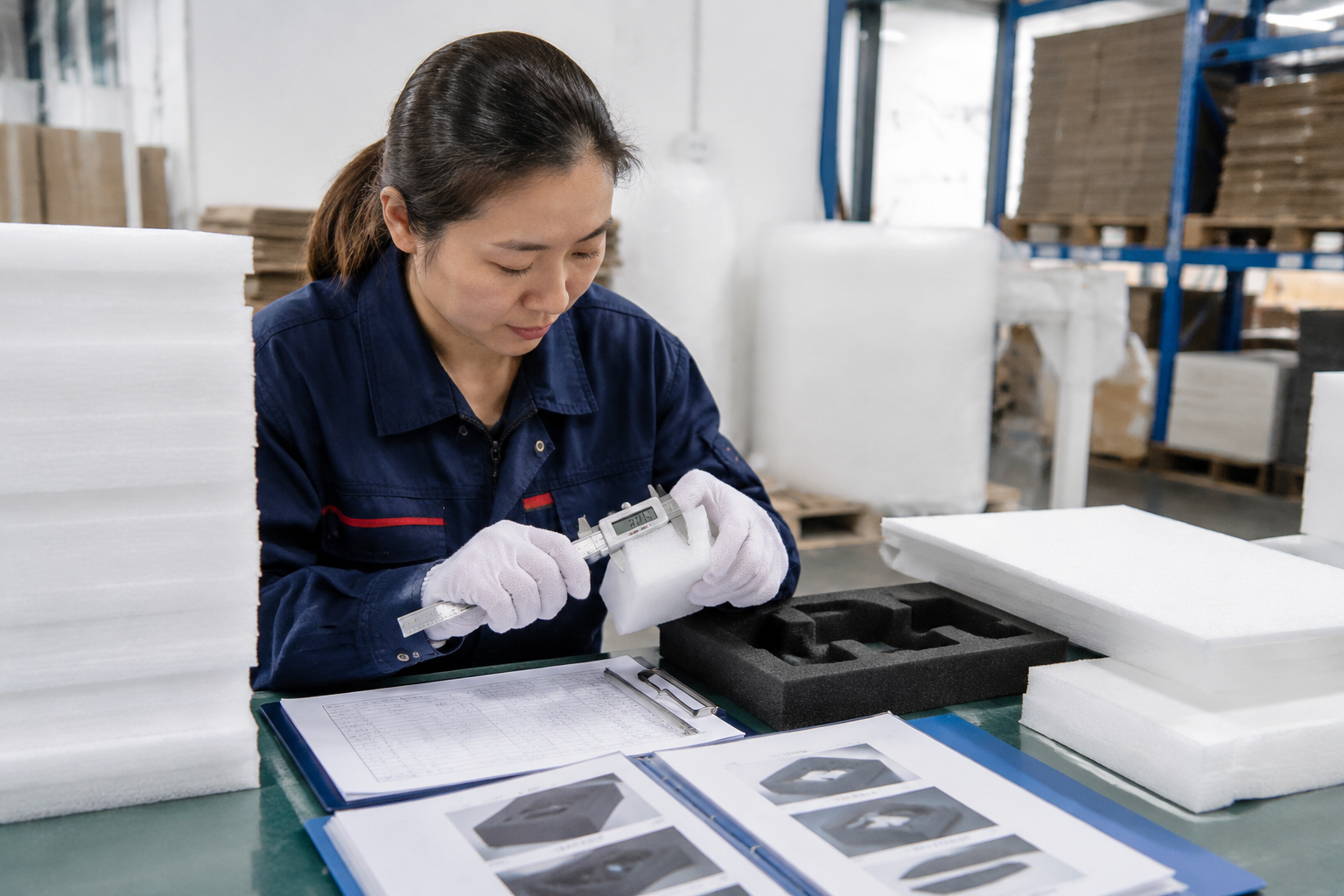
The approved sample should be labeled and recorded with the main specification details. For a poly bag or mailer, record width, length, flap size, film thickness, sealing style, adhesive strip position, color, and printing. For EPE foam, record density, thickness, shape, cutout position, bonding points, and fit with the product. For bubble wrap, record roll width, roll length, bubble diameter, bubble height if relevant, film structure, and roll packing. For corrugated boxes, record internal size, board structure, flute type, paper grade if confirmed, printing, slotting, creasing, and packing quantity.
A measurable sample does not need to become a complicated technical report. A clear specification sheet, photos with dimensions, sample labels, and agreed tolerance are often enough for practical packaging quality control. The key is to avoid relying only on memory, color, or material feel.
At Daipak, sample discussion usually starts with the product details and the packing method, not only the sample appearance. A foam insert may look correct, but the real question is whether the product can be inserted easily, stay separated from fragile edges, and remain stable inside the carton during handling.
Check bulk goods against the approved sample
When bulk packaging production is ready, buyers should compare finished goods against the approved sample using the same checks. Measure the size, thickness, density where applicable, roll length, bag count, carton count, weight per roll or bundle, sealing strength, print position, print color, and structure. For corrugated boxes, assemble a sample carton and check whether the panels fold cleanly, the flaps meet correctly, and the box fits the intended product and inner protection.
Weight comparison can be useful, especially for rolls, bags, and foam sheets. If the dimensions are the same but the weight changes significantly, it may indicate a change in thickness, density, roll length, or material structure. Weight alone does not prove quality, but it can highlight where further checking is needed.
Quality Review Note: Before shipment, buyers should review dimensions, appearance, sealing, cutting, bonding, printing, labels, packing quantity, and carton marks against the approved sample and written specification, especially when the order will be exported or repeated.
For overseas buyers, photo and video confirmation can help before shipment. Ask the supplier to show measurement points, packing quantity, carton labels, roll labels, and finished product appearance. If a third-party or internal inspection is used, the acceptance criteria should match the approved specification rather than a vague visual standard.
Finished product review should connect directly to the confirmed requirement, not to a general idea of acceptable packaging. If the order confirmation specifies 500 bags per inner bundle, 2,000 bags per carton, a printed label on each master carton, or a certain roll width and carton mark, those details should be checked before shipment preparation. This kind of practical review can help prevent correct products from being delayed by wrong labels, missing marks, mixed quantities, or cartons that do not match the buyer’s receiving process.
Test the packaging in the real packing workflow
The final check is whether the packaging works in the buyer’s actual packing process. A foam insert should allow staff to place the product without forcing it. A bubble bag should close properly around the item. A poly mailer should seal securely without slowing the packing line. An air column bag should inflate and hold the product in the intended position. A corrugated box should leave enough room for inner protection without becoming oversized.
Warehouse staff often notice problems that are not obvious in a sample room. If foam pieces are difficult to separate, if bags stick together, if rolls unwind unevenly, or if cartons take too long to assemble, the real cost rises even when the unit price looks attractive. For high-volume operations, a small packing delay repeated hundreds or thousands of times can become a meaningful cost.
Protective performance should also be checked with the actual product. Look for surface rubbing, movement inside the carton, weak corners, compression marks, and loose void fill. Better packaging does not always mean thicker material. It means the material, structure, carton space, and packing method work together for the product’s weight, shape, fragility, and shipping route.
Match inspection depth to the claim being made
Inspection should be stronger when the supplier quote makes a performance claim, not only a dimensional claim. If a carton is being sold for stacking strength, compression resistance should be considered against the actual box, load, and handling condition rather than assumed from board name alone; ASTM D642 is a recognized reference for determining compressive resistance of shipping containers.[8]
If a supplier claims that a package can handle parcel distribution, vibration, or export handling, the buyer should ask what practical evidence supports that claim: past shipment results, internal drop checks, a documented packing trial, or an agreed test method. A supplier may still provide useful packaging without formal laboratory data, but the buyer should avoid treating a general statement such as “export quality” as a measurable specification.
When to Choose a Factory, a Trading Company, or a Hybrid Approach
The decision to choose packaging factory or trading company should come from the order situation, not from a fixed assumption about which supplier type is better. A factory may be the stronger choice for technical, custom, repeated, or protection-sensitive packaging. A trading company may be useful when the buyer needs broad sourcing support across many unrelated items. Some purchasing programs work best with both.
The practical question is: where does the risk sit? If the main risk is material performance, product protection, production consistency, or repeat-order accuracy, direct factory communication usually has more value. If the main challenge is coordinating many small, low-risk items, a trading company may reduce the buyer’s sourcing workload.
Choose a factory when specifications and repeatability matter
A factory is usually the better fit when the packaging needs custom size, stable material parameters, repeat production, or direct technical adjustment. This includes custom EPE foam inserts, shaped foam pads, bubble wrap rolls or bags with fixed size requirements, printed poly mailers, garment bags, stretch film with defined thickness, air cushion packaging, and corrugated boxes that must match a product and inner protection system.
Direct production feedback matters when small changes affect cost or performance. A factory can often explain whether a foam insert design creates unnecessary waste, whether a bag size can be adjusted to improve material yield, whether a carton dimension is inefficient for board layout, or whether a sealing structure may be difficult to keep consistent in bulk production. That does not automatically mean the factory will always quote the lowest price, but it can make the quote easier to understand and control.
For repeat orders, a factory-side record of material, dimensions, cutting, sealing, packing, and carton labels can help reduce drift between orders. This is especially important for protective packaging, where a small change in foam density, board grade, or film thickness may not be obvious at first glance but can affect packing performance.
Choose a trading company when sourcing scope is broad
A trading company can make sense when the buyer needs many mixed products and the packaging items are not highly technical. For example, a buyer may need standard poly bags, labels, simple cartons, tape, hang tags, small accessories, and several unrelated warehouse supplies in one purchasing program. In that case, the value may come from coordination, consolidation, communication, and reduced supplier management.
This approach can also help early-stage buyers who are still testing product lines and do not yet have stable packaging specifications. If order quantities are small, product categories are fragmented, or the buyer needs one contact to collect options from several sources, a trading company may be practical.
The buyer should still require written specifications and sample confirmation. A trading company can coordinate sourcing, but the packaging still has to perform. For any item that affects damage risk, customer presentation, warehouse speed, or export handling, the buyer should ask how production is controlled and how future orders will match the approved sample.
Use a hybrid model for complex purchasing programs
A hybrid model often works well when a buyer has both critical packaging and low-risk accessories. The buyer may source custom protective packaging directly from a manufacturer, while using a trading company to consolidate simple or secondary items. This keeps direct communication where it matters most and reduces sourcing workload where the risk is lower.
For example, a brand owner shipping fragile products may work directly with a custom protective packaging factory for EPE foam inserts, bubble wrap, air column protection, and corrugated export cartons. At the same time, it may purchase simple labels, standard bags, or general warehouse consumables through a consolidating supplier. This separation helps the buyer protect the most important part of the packaging system without making every small item a separate factory project.
As a China packaging materials supplier and protective packaging manufacturer, Daipak is usually a fit for buyers who need direct discussion across foam, bubble, film, plastic bags, corrugated boxes, and custom protective packaging. The best supplier structure still depends on the buyer’s order size, product risk, specification clarity, shipping route, and internal sourcing capacity.
How Daipak Helps Buyers Compare Price, Specification, and Protection
Daipak Packaging, Zhejiang Daipak Packaging Materials Co., Ltd., works as a China packaging materials supplier and protective packaging manufacturer for overseas B2B buyers that need practical, specification-based packaging support. In a price comparison, the useful question is not only whether one quote is lower than another. The better question is whether the quoted material, size, thickness, structure, packing method, and protection level match the buyer’s actual product and shipping conditions.
Daipak’s role is to help buyers connect quotation details with packaging performance. That may mean comparing bubble wrap with EPE foam for a fragile product, checking whether an air column bag fits the carton space, reviewing poly mailer thickness for puncture risk, or confirming whether a corrugated box structure is suitable for storage and export handling. For custom packaging, the discussion often starts with the product itself before any material is recommended.
For export and foreign trade communication, Ethan Lee often asks buyers to clarify not only the material they want, but also how the finished goods will be packed, stored, loaded, and handled after arrival. This helps prevent a common problem in international sourcing: the quotation is based on a material name, while the real requirement is a complete packing method that includes inner protection, carton strength, labels, pallet plan, and repeat-order control.
What buyers should send for a more accurate quote
A packaging quote becomes more reliable when the supplier receives enough product and logistics information. A product name alone is rarely enough, especially for protective packaging. A glass component, coated metal part, electronic device, garment, and e-commerce accessory may all need packaging, but their risks and cost drivers are different.
For a more accurate quote, buyers should prepare product dimensions, product weight, photos or drawings, fragile points, surface finish, current packing method, carton size if already fixed, target order quantity, shipping route, and destination market. If the product is scratch-sensitive, compression-sensitive, moisture-sensitive, or shipped through multiple handling points, that should be stated early. These details help the supplier decide whether the product needs wrapping, separation, cushioning, void filling, surface film, a stronger outer carton, or a combined packaging structure.
Material preference is useful, but it should not replace the product requirements. If a buyer asks only for “foam packaging” or “bubble bags,” the quote may miss key details such as foam density, bag opening direction, sealing style, sheet size, roll length, tolerance, or packing quantity per carton. A clearer request allows Daipak to compare packaging options on the same basis instead of guessing which specification the buyer intended.
When the buyer shares a current packing photo or a failed packaging example, the recommendation becomes easier to connect to a real problem. For example, a crushed carton may point to outer board strength, pallet stacking, or overfilled cartons, while surface scratches may point to contact material, product movement, or missing separation between parts. Daipak can then discuss material choice, thickness, density, forming, sealing, labeling, and carton packing as linked decisions rather than isolated price items.
How direct factory communication reduces quotation gaps
Direct factory communication helps reduce gaps between the requested packaging, the sample, the quotation, and the bulk order. Many price differences happen because one supplier quotes actual thickness while another quotes nominal thickness, or one quote includes printing, master carton packing, and export carton marks while another does not. These differences may look small in email communication, but they can change the real cost and the performance of the final packaging.
From a factory-side discussion, Daipak can review whether a requested size is efficient to cut, whether an EPE foam insert can be repeated consistently, whether a bag seal is suitable for the product weight, or whether a corrugated carton needs adjustment for stacking. If a design needs sampling, the approved sample should be connected to measurable details such as dimensions, thickness, density, material grade, printing, color, packing quantity, and tolerance. This makes future repeat orders easier to control.
Direct communication also helps when a buyer wants to lower cost without weakening protection. Sometimes the best adjustment is not simply using thinner material. It may be reducing unnecessary carton space, changing the foam shape to improve cutting yield, switching from full wrapping to corner protection, using bubble wrap only where impact risk is higher, or combining a lighter inner material with a stronger outer carton. The goal is to control cost while keeping the packaging matched to the product risk.
Where Daipak can support custom and bulk packaging orders
Daipak supports standard and custom packaging across several practical product families, including bubble wrap and air cushion packaging, EPE foam packaging, plastic bags and film packaging, corrugated boxes, and custom protective packaging. These materials serve different jobs. EPE foam can cushion, separate, and protect surfaces. Bubble wrap can wrap irregular products and fill carton space. Air cushion packaging can help with lightweight void filling and selected protective applications. Plastic bags, liners, garment bags, courier bags, stretch film, and protective film support dust protection, grouping, wrapping, and shipping preparation. Corrugated boxes provide the outer structure for storage, e-commerce delivery, bulk packing, and export handling.
For bulk orders, Daipak can help buyers confirm specifications before production, discuss samples, prepare quotations, coordinate production details, review packing requirements, and support export packing preparation where relevant. This may include checking carton packing quantity, carton marks, pallet requirements, roll packing, bundle packing, label needs, or whether the packaging can be handled efficiently by the buyer’s warehouse team.
For repeat orders, the buyer’s feedback after receiving and using the packaging is also useful. If warehouse staff report that bags are difficult to open, foam inserts need trimming, labels are hard to scan, cartons are too heavy, or pallet loading is inefficient, those observations can be reviewed before the next production run. Feedback tied to the original specification helps improve consistency without changing the packaging by guesswork.
The strongest sourcing result usually comes from precise communication. Buyers do not need to have every answer before contacting a supplier, but they should share the product details, the protection concerns, and the operating scenario as clearly as possible. With that information, Daipak can help compare price, specification, and protection in the same discussion, so the buyer is not choosing only by the lowest number on a quotation sheet.
References
[1] European Commission, “EU Food Contact Materials,” regulatory overview of food contact material safety requirements in the European Union, available at EU Food Contact Materials.
[2] ASTM International and International Safe Transit Association, “ASTM D4169 Shipping Container Performance Testing” and “ISTA Procedure 3A Overview,” packaged-product performance testing references for distribution and parcel delivery discussions, available at ASTM D4169 Shipping Container Performance Testing and ISTA Procedure 3A Overview.
[3] Federal Trade Commission, “FTC Green Guides,” U.S. environmental marketing guidance for recyclable, degradable, compostable, and other environmental claims, available at FTC Green Guides.
[4] Fibre Box Association, “Corrugated is Recyclable,” industry resource on corrugated packaging recyclability and recovery context, available at Fibre Box Association Corrugated is Recyclable.
[5] Association of Plastic Recyclers, “APR Design Guide Overview,” design guidance reference for plastic packaging recyclability considerations, available at APR Design Guide Overview.
[6] International Plant Protection Convention, “IPPC ISPM 15 Wood Packaging,” international phytosanitary standard for wood packaging material used in international trade, available at IPPC ISPM 15 Wood Packaging.
[7] Pipeline and Hazardous Materials Safety Administration, “PHMSA Hazardous Materials Regulations,” U.S. hazardous materials transport regulation reference relevant to regulated shipping preparation and packaging requirements, available at PHMSA Hazardous Materials Regulations.
[8] ASTM International, “ASTM D642 Standard Test Method for Determining Compressive Resistance of Shipping Containers,” packaging test method reference for compression resistance discussions, available at ASTM D642 Compression Resistance.
[9] ASTM International, “ASTM D6400 Compostable Plastics” and “ASTM D6868 Compostable Coated Packaging,” compostability references for plastics and coated packaging claim discussions, available at ASTM D6400 Compostable Plastics and ASTM D6868 Compostable Coated Packaging.
Packaging Supplier Guides cornerstone library
Cornerstone guides for this topic
Keep these Packaging Supplier Guides guides close while you read. They are the standing references for the decisions covered on this page.
Wholesale Packaging Materials in China: Samples, MOQ, Quotation, and Bulk Order Process
Wholesale packaging materials from China can look simple at the inquiry stage, but the real decision depends on much more than naming a material...
Read cornerstone guide
Packaging Manufacturer vs Trading Company in China: What Overseas Buyers Should Check
When you are sourcing packaging from China, the main decision is not just who gives the quote. It is whether the supplier can handle...
Read cornerstone guide
China Packaging Materials Supplier Guide: How to Choose the Right Factory for Custom Packaging
Choosing a China packaging materials supplier is not only about finding a factory that can quote foam, bubble wrap, cartons, film, or plastic bags....
Read cornerstone guide