
This article looks at a March 2026 electronics accessory kit project where the first request seemed simple: cut an EPE foam insert for one compact device. After reviewing the full kit, Daipak found that the real packaging decision was broader, especially when carton marks and pallet packing requirements had to be considered alongside the charger, cable, adapter, manual, foam, carton, and empty carton space, which all created different risks, including surface scratches, shifting, pressure points, cable movement, and document creasing.
The useful lesson is that electronics kit packaging should not rely on one material to solve every problem. Foam can stabilize the main device, poly bags can separate accessories, corrugated boxes can provide structure, and air pillows can control remaining voids. For buyers, the key is to share complete kit dimensions, weights, surface concerns, carton size, packing direction, quantity, and shipping route before asking for a final quotation.
For a buyer comparing suppliers, this kind of review also makes the quotation easier to judge. A low foam unit price may look attractive at first, but it may not include accessory separation, carton void control, packing labor, or later revisions after the first sample. A more useful comparison is to check whether the supplier has understood the full kit, the carton space, the packing sequence, and the export handling condition before confirming the material specification.
For buyers who need a more formal validation step, the packaging discussion can be tied to a test plan instead of judged only by visual fit. Distribution-performance standards such as ASTM D4169 are used to evaluate complete shipping containers and systems under defined distribution cycles, which is a reminder that foam, bags, carton, and void fill should be reviewed as a packed system rather than as isolated materials.[1]
Quick Packaging Decision Guide
| Buyer Question | Practical Reading | What to Check |
|---|---|---|
| Is an EPE foam insert enough for the full kit? | Usually only if the main device is the only risk point. | Accessory movement, carton voids, manual placement, and surface contact. |
| Why did the proposal change from foam-only? | Each item needed a different control method inside the carton. | Device fit, charger thickness, cable folding size, and adapter position. |
| When are poly bags useful? | They help separate small accessories without adding bulky protection. | Scratch risk, accessory grouping, packing speed, and visual organization. |
| Why use air pillows in the export carton? | They fill remaining space so the assembled kit moves less during handling. | Carton empty space, shipping distance, stacking pressure, and packing consistency. |
| What details improve quotation accuracy? | A complete kit review prevents under-designed packaging and later revisions. | Full item list, dimensions, weights, carton size, packing method, and route. |
Quick Questions Before You Read
Q: Should the main device and accessories use the same packaging material?
Not always. The device may need foam positioning, while accessories may only need separation, grouping, or void control.
Q: What should buyers send before requesting a kit packaging quote?
Send the full item list, product dimensions, accessory sizes, weights, carton size, surface risks, packing direction, and shipping method.
Q: Does adding more foam always make the package safer?
No. Extra foam can waste carton space or create pressure points if the accessory layout is not reviewed.
Q: Why does export packing change the decision?
Export cartons face longer handling, stacking, and movement, so the full kit layout and remaining void space must be controlled.
When the Buyer Asked Whether One Foam Insert Was Enough
On March 11, 2026, a Southeast Asia electronics accessory supplier contacted Daipak for an EPE foam insert quote for a compact device kit. At first, the request sounded straightforward: the main device needed a shaped position inside the package, and custom foam packaging seemed like the obvious starting point.
For a single compact device, one foam insert can often provide useful positioning and cushioning. It can reduce direct movement, keep the product centered, and create a cleaner presentation inside the box. But electronics accessory kit packaging is rarely only about the main device. Once a charger, cable, small adapter, printed manual, and shipping carton are included, the packaging question becomes wider than the foam cavity.
Daipak treated the request as a carton-level review rather than only a foam-cutting job. The main concern was simple: if the buyer used one foam insert for the device but left the smaller items loose or poorly placed, the kit could still face rubbing, shifting, pressure points, or messy packing during handling.
The March 11 Inquiry From a Southeast Asia Electronics Accessory Supplier
The buyer was sourcing packaging for a compact device kit, the kind of product often shipped with several small parts in one retail or export carton. Their first message focused on the main device and asked whether Daipak, as a protective packaging manufacturer, could quote a foam insert to hold it in place.
This is a common starting point for B2B buyers. The main device usually has the highest value, the most visible surface, and the clearest dimensions. It is natural for a buyer to think first about protecting that item. A shaped EPE foam insert can be a good choice when the product needs stable positioning, soft support, and separation from the carton wall.
Still, the first request did not yet answer the full packing question. The buyer had not initially described the charger, cable, adapter, manual, or final carton arrangement. Without those details, a foam insert quote could be technically possible, but it might not reflect how the whole kit would actually be packed.
The Real Question Behind the Quote Request
The practical question was not only, “Can one foam insert hold the device?” It was, “Can the complete device kit move through the planned shipping route with fewer avoidable packing risks?” Those two questions lead to different packaging decisions.
If the charger is hard and thick, it may press against the device or create an uneven stack. If the cable is folded loosely, it may spring open and move around inside the box. If the adapter has corners or metal contact points, it may scratch a coated surface when packed without separation. If the manual has no flat position, it may bend, crease, or shift under accessories.
That is why Daipak first looked beyond the foam insert itself. A useful quote needed to consider how the device, accessories, manual, and shipping carton would work together. In this project, the buyer was not simply buying foam; they needed a practical packing method for a multi-item electronics kit.
Why Daipak Asked for the Full Item List Before Quoting
Before preparing a packaging material recommendation, Daipak asked the buyer to confirm the full item list. The confirmed kit included the compact device, charger, cable, small adapter, printed manual, and export shipping carton. Each item created a different packaging requirement, so quoting only from the main device dimensions would have left too many open questions.
As a China packaging materials supplier working with foam, plastic bags, air cushion packaging, and corrugated boxes, Daipak needed to understand which material should solve which problem. The main device needed positioning. The charger and adapter needed controlled placement and separation. The cable needed a clear folding size. The manual needed a flat area. The carton needed enough structure and controlled empty space.
This step was not about making the quotation process difficult. Many buyers start with the main product because it is the easiest item to define and the most important item to protect. But for kit packaging, the missing small parts often decide whether the final structure is simple, stable, and repeatable on the packing table.
A practical recommendation is easier to trace when each material choice is linked to a confirmed input. In this project, the device dimensions supported the foam cavity, the charger and adapter photos supported the accessory separation plan, the cable folding size supported the bag size, and the carton inner dimensions supported the use of air pillow film. If any of those inputs changed later, the affected part of the packaging plan would need to be checked again before production.
Compliance-Sensitive Details That Should Be Confirmed Early
Electronics accessory kits can include parts that create additional packaging questions beyond ordinary cushioning. If the product includes lithium batteries, power banks, hazardous components, liquids, adhesives, regulated samples, or destination-specific labels, the buyer should confirm the applicable shipping and documentation requirements before production. Daipak can support packaging material selection and packing layout discussion, but the buyer, carrier, and relevant compliance parties should confirm regulated shipment requirements where they apply.
For this project, the discussed kit involved a compact device, charger, cable, adapter, manual, carton, and void fill. The packaging proposal therefore focused on separation, positioning, carton fit, and export handling. It should not be read as a general approval for all electronics, battery, food-contact, medical, hazardous, or child-safety packaging uses. If a later order changes the product category or destination market, the material specification and packing marks should be reviewed again.
Environmental and performance descriptions should also stay specific. A supplier may explain that a material can help reduce movement, organize accessories, or support a cleaner packing sequence, but claims such as recyclable, waterproof, anti-static, heavy-duty, or suitable for regulated goods should be used only when the exact material, test basis, destination rules, and supporting documents have been checked. This keeps the packaging discussion useful without turning a material suggestion into an unsupported compliance claim.
Main Device Details Were Not Enough
The main device dimensions were useful, but they could not determine the full packaging plan by themselves. Length, width, and thickness help define the foam cavity, but they do not show how much room remains for the accessories, whether the carton has excess space, or whether the top surface will stay level when the manual is added.
Daipak also needed to know the device weight, surface finish, and any fragile edges or exposed parts. A glossy, coated, or easily scratched surface may need more careful separation from accessories than a rugged plastic housing. A heavier device may need firmer support than a lightweight item of the same size. These details affect the insert structure and the surrounding packing method.
If the quote had been based only on the device, the foam insert might have looked correct on paper but still failed to answer how the rest of the kit would be placed. For a multi-item carton, the foam design needs to fit the packing sequence, not just the product shape.
Accessory Dimensions Changed the Packaging Direction
Once the charger, cable, and adapter were added to the review, the packaging direction changed. Charger size was not only about length and width; thickness mattered because a thick accessory can create pressure if stacked above or beside the device without enough clearance. Plug shape and protruding parts also needed attention because they can create hard contact points.
The cable required a different kind of review. Cable length alone did not tell Daipak how much carton space it would occupy. The more useful detail was the cable folding size: how tightly it would be bundled, whether it would be tied or bagged, and whether the folded shape would stay controlled during packing. A cable that opens inside the box can interfere with the device, manual, or carton closure.
The small adapter also affected accessory packaging. If the adapter had corners, metal ends, or an irregular shape, it could not be treated the same as a soft cable. Daipak needed these dimensions and photos or drawings to decide whether the accessory should sit in a separate bag, beside the foam, above the foam, or in its own defined area.
Carton Information Helped Confirm the Final Protection Layer
The export carton size was another important part of the protective packaging review. Even if the foam insert held the device well, empty space around the kit could still allow movement. Carton inner dimensions, board structure, packing direction, and the number of kits per shipping carton all influence the final protection layer.
For this project, carton information helped Daipak judge whether additional void filling would be needed after the device and accessories were placed. If the carton had too much remaining space, the kit could shift during warehouse handling or export transportation. If the carton was too tight, the charger or adapter could press against the manual or device.
Shipping method and distribution route also mattered. Regional warehouse handling, export carton stacking, and repeated loading or unloading can expose the package to movement and compression. The goal was not to add unnecessary material, but to confirm whether the outer carton and inner packing had enough control as one system.
Carton planning should also include the packing quantity and pallet condition where they are known. A carton that works for one kit may not work the same way when many cartons are stacked, strapped, or loaded in a mixed shipment with heavier goods nearby. Buyers should confirm carton marks, orientation marks, pallet height limits, and whether cartons may be hand-loaded or palletized, because these details can influence board selection, void fill amount, and the allowed carton weight.
Where stacking strength is important, the buyer should not assume performance from carton appearance alone. Compression-resistance methods such as ASTM D642 focus on the ability of shipping containers to resist compressive loads, so stacking questions should be checked against the actual carton, contents, loading direction, and expected storage or transport condition.[2]
What Risks Appeared After the Accessories Were Added to the Review
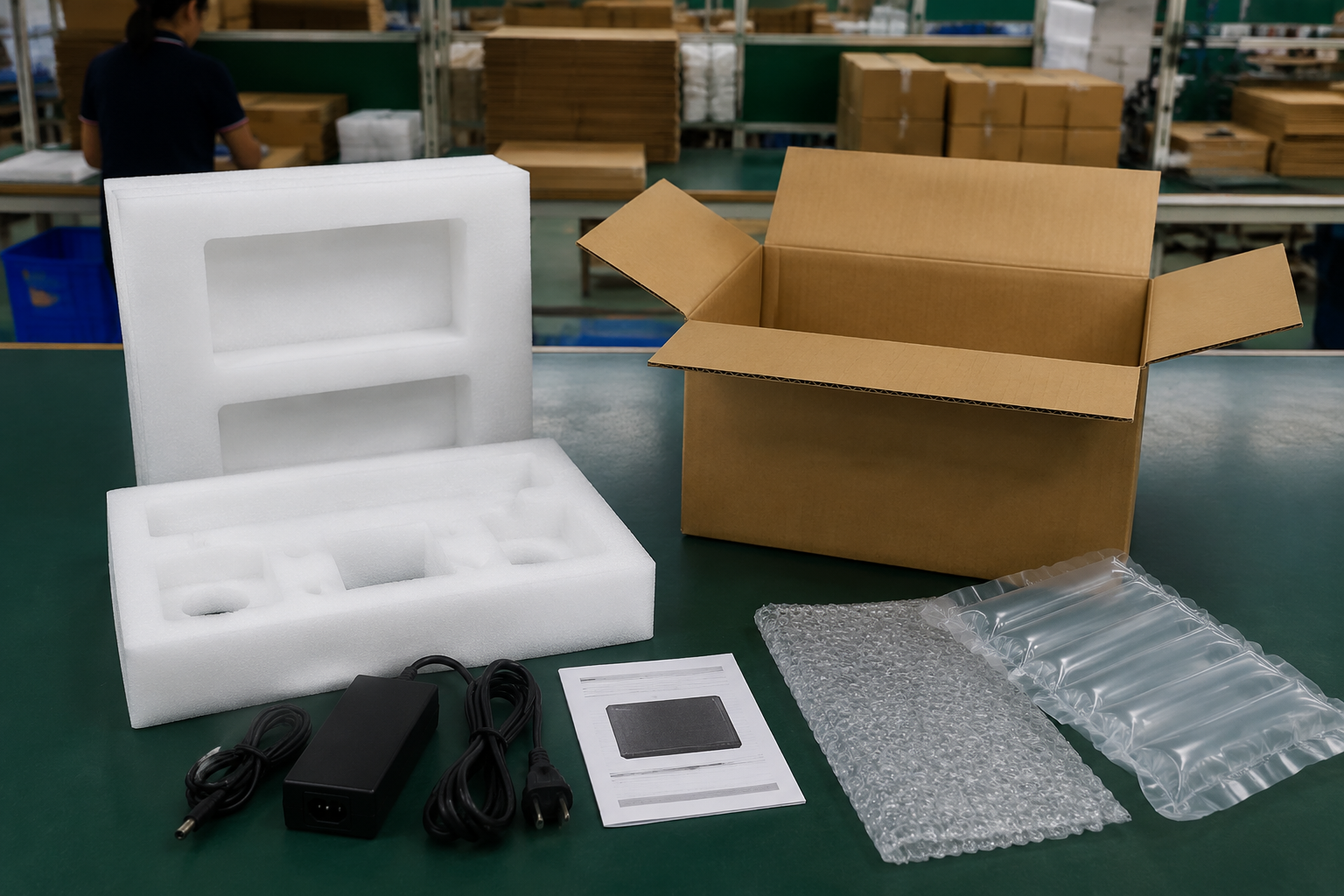
After the full kit list was confirmed, the project became more specific. A foam insert could still protect the compact device, but it would not automatically control every part in the carton. The charger, cable, adapter, manual, and remaining carton space each introduced a separate risk.
This is where electronics kit protective packaging becomes more complicated than packaging one product alone. The risk is not only breakage. It can also be parts rubbing together, loose accessories moving to the wrong area, the charger pressing the device, the cable shifting in the box, or the manual bending because it has no planned position.
From a factory packing point of view, these risks often appear before shipment, right on the packing table. If workers need to decide accessory placement differently each time, the finished carton may vary from one unit to another. A stable packaging plan should reduce that uncertainty by giving each part a clear role and location.
For this type of project, the finished product review should compare the packed sample against the confirmed item list, drawing, material specification, and packing sequence rather than only checking whether the carton can close. The reviewer usually needs to check that the device sits in the correct foam position, each accessory is bagged as agreed, the manual remains flat, and the void fill is placed in the same area shown in the approved sample photos.
Scratch Risk Between the Device and Loose Accessories
The first visible risk was scratch protection. A charger, adapter, or cable end can contact the device surface if the accessories are not separated. Even when the main device sits inside foam, loose small parts may slide above it, beside it, or into open spaces during packing and handling.
The charger was a particular concern because it is harder and thicker than a cable. If placed without control, it could rub against the device housing or create pressure on one area of the foam. The adapter could also create scratch risk if it had corners, pins, or a harder molded edge. These are small details, but they matter for electronics products where the surface condition affects customer perception.
The cable created a different kind of contact risk. A cable may look soft, but its connectors are often harder than the cable body. If the connector moves against a coated or glossy device surface, it can leave marks. For this reason, accessory separation was not just about neatness; it was part of the protection plan.
Movement Risk Inside the Carton
The second risk was product movement inside the carton. A shaped foam insert can reduce movement of the main device, but it does not automatically fill all remaining carton space. If the carton has open areas around the kit, the packed items can shift during warehouse transfer, carton stacking, truck movement, or export handling.
Loose accessories make this problem more noticeable. A cable can move into empty space if it is not folded and contained, which is why a sample approval checklist can help confirm accessory placement before final carton closure. A small adapter can slide into corners. A charger may move from its intended position and press against the device or manual. Once the carton is closed, these movements are hard to see until the package is opened again.
Carton void fill had to be considered after the actual kit layout was reviewed. Too much empty space can make the package feel unstable. Too much inner material can make packing slow or create pressure when the carton closes. The right approach depends on the confirmed carton size, the accessory layout, and how the shipment will be handled.
Manual Placement Risk
The printed manual also needed attention. It may not be fragile in the same way as the device, but it still affects the presentation and packing quality of the kit. If the manual is placed under uneven accessories, it can crease. If it is placed above a charger or adapter without a flat support area, it can bend or shift.
A manual also needs a predictable location for the packing team. If workers place it differently each time, the carton may close differently from unit to unit. One carton may have the manual flat on top, while another may have it pushed to the side or caught between accessories. That kind of variation can create both presentation issues and packing inconsistency.
For this project, manual placement became part of the overall packaging review rather than an afterthought. The device needed foam positioning, the accessories needed separation, and the manual needed a flat and repeatable location. Only after those parts were reviewed could the final carton space be managed properly.
How Daipak Changed the Proposal From Foam Only to a Combined Packaging Solution
The recommendation changed from a foam-only quote to a combined packaging solution because the kit was not only one compact device. Once the charger, cable, adapter, printed manual, and export carton were included in the review, each item created a different protection need. The foam insert was still useful, but it could not be expected to solve every issue inside the carton.
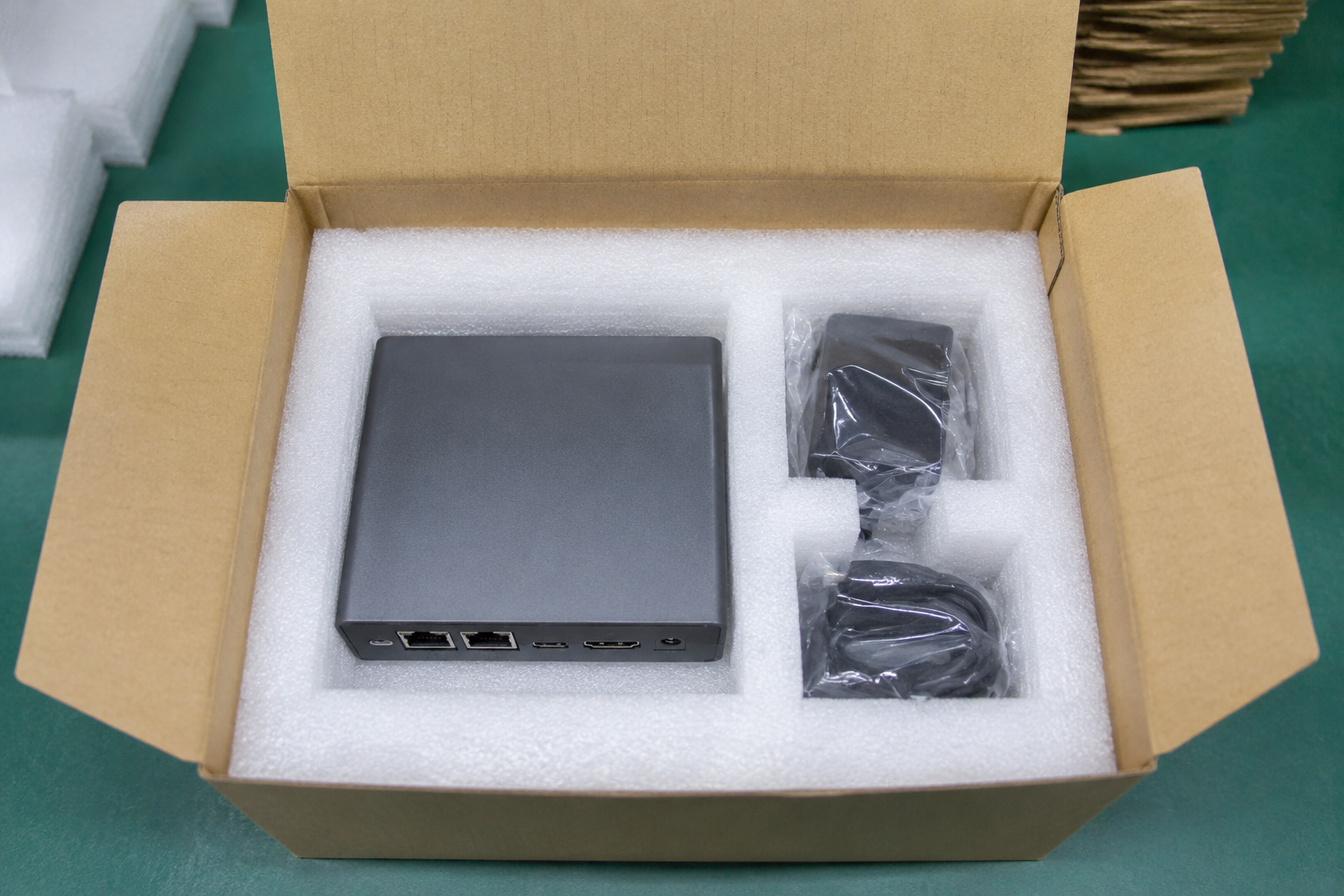
Daipak treated the package as a small system rather than a single material order. EPE foam packaging was used where shaped support mattered most. Clear poly bags handled accessory separation. The corrugated shipping box provided the outer structure. Air pillow film helped control the remaining empty space after all parts were loaded. This approach kept each material tied to a specific job instead of adding more foam everywhere.
Material Selection Note: For a multi-item electronics kit, the material choice should follow the actual risk of each part: foam for controlled device positioning, bags for accessory separation, corrugated board for structure, and air pillow film for remaining carton space.
EPE Foam Held the Main Device in a Stable Position
The compact device needed the most controlled support because it was the main product in the kit and had to stay in a predictable position during handling. A custom-cut EPE foam area helped hold the device in place, reduce direct movement, and provide a cushioning layer between the product and the carton environment.
This did not mean the foam had to surround every accessory. If the foam insert tried to carry the charger, cable, adapter, and manual without a clear layout, the insert could become larger, more complicated to pack, and less efficient inside the carton. For this project, the foam’s main role was main device protection: shaped positioning, basic cushioning, and separation from harder loose items.
Clear Poly Bags Separated the Smaller Accessories
The smaller accessories needed organization as much as cushioning. The charger, cable, and adapter were different shapes, and each could create contact points if placed loose in the carton. Clear poly bags gave each accessory a defined packing unit and reduced direct rubbing between cable ends, adapter edges, charger surfaces, and the main device.
Clear bags also made the packing process easier to check. A worker could quickly see whether the charger, cable, and adapter were included without opening each bag. For many electronics accessory kits, this kind of simple separation is practical because the risk is not always heavy impact; it is often surface contact, mixed parts, and inconsistent placement.
Using bags also kept the accessories flexible in the layout. They could be placed beside the foam, above a controlled area, or in another defined space depending on carton size. That flexibility mattered because the final carton had to fit the device, accessories, manual, and void fill without creating pressure on one side.
The bag specification should still be confirmed rather than treated as a minor detail. A bag that is too small can force the cable into an inconsistent fold, while an oversized bag can wrinkle, trap air, or make the accessory harder to place neatly. Thickness, opening direction, sealing method, warning text, barcode label space, and whether the bag needs a vent hole can all affect packing speed and carton fit.
Corrugated Box and Air Pillow Film Completed the Carton System
The corrugated shipping box supplied the outer structure for the kit. It helped keep the package shape stable during warehouse handling, carton stacking, and export movement. The box also gave the inner materials a defined boundary, which is important because foam and bags can only work properly when the carton size supports the overall layout.
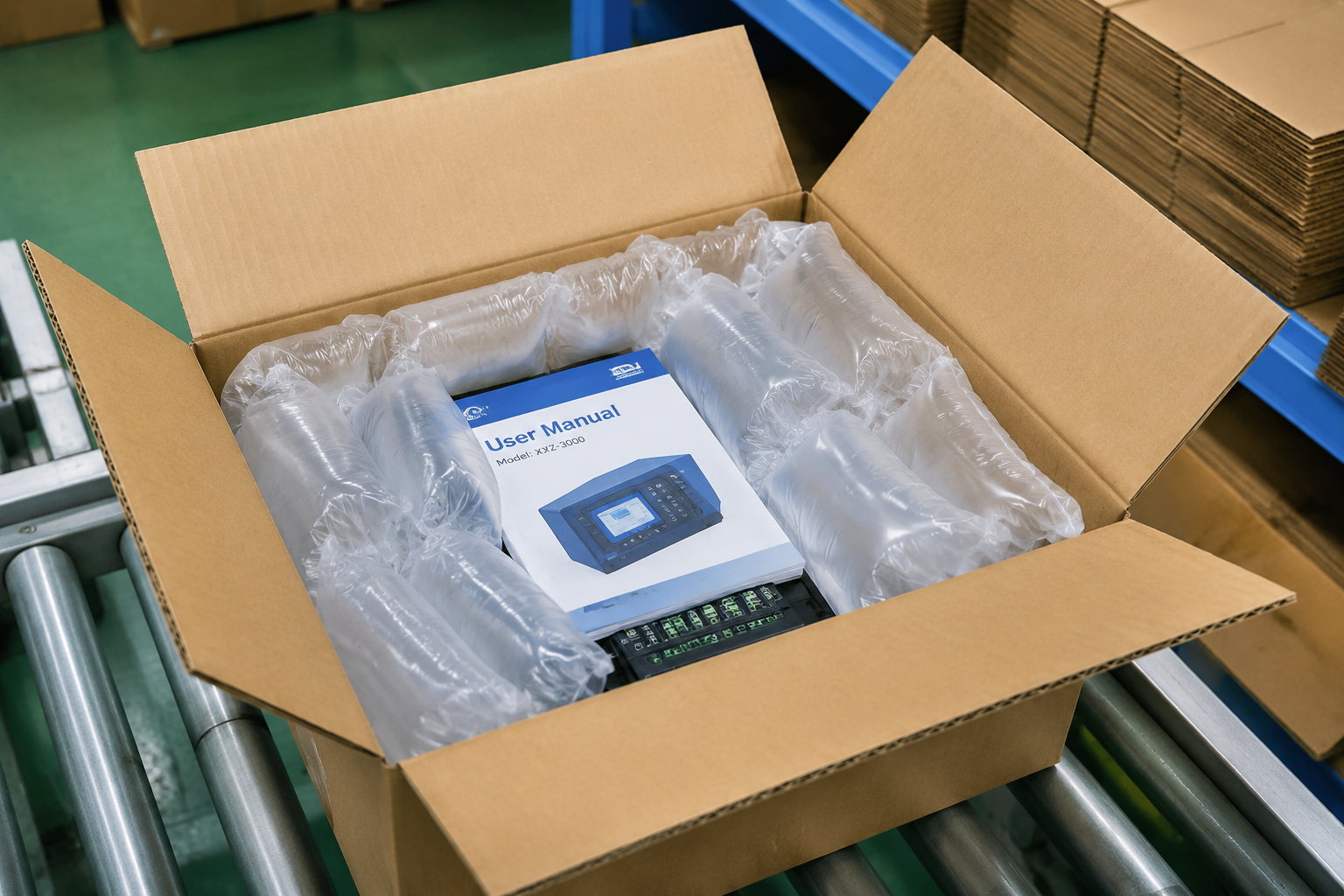
Air pillow film was added for empty space filling after the device, accessories, and manual were placed inside the carton. This was a carton-level problem, not a device-shape problem. If the remaining space stayed open, the packed kit could shift inside the box even though the main device was sitting in foam. The air pillows helped reduce that movement without redesigning the foam insert to fill every corner.
The final structure was not about using more materials for appearance. It was about assigning the right protection task to the right layer: foam for positioning, bags for separation, corrugated board for structure, and air pillow film for void control. For similar electronics kits, the exact mix may change, but the same logic applies: each material should solve a real packing risk.
Evidence-Based Checks Before Sample Approval
Before approving a sample, buyers can separate visual approval from performance review. A good-looking foam insert may confirm that the device fits, but it does not confirm how the finished carton behaves during drops, vibration, compression, or repeated handling. For parcel-style movement, ASTM D5276 provides a free-fall drop test method for loaded shipping containers, bags, and transport packages, which is useful when buyers want a defined way to discuss drop exposure instead of relying only on a hand shake test.[3]
For small packaged products moving through parcel delivery systems, ISTA Procedure 3A is another practical reference point because it is written around packaged products shipped through parcel delivery systems. It does not guarantee that a specific electronics kit will survive every route, but it gives buyers and suppliers a clearer vocabulary for discussing package validation, especially when the final carton will face courier handling rather than controlled pallet movement only.[4]
These references also show why the sample should be reviewed as a packed unit. The device cavity, accessory bags, printed manual, corrugated box, carton tape, and void fill all influence the result. If a buyer changes the charger model, cable fold, carton size, or packing quantity after sample approval, the earlier sample check may no longer represent the final shipment.
Why the Foam Layout Was Adjusted After Cable and Charger Details Were Confirmed
Between the first request and the later review period in March 2026, the foam layout changed because the accessory information became more complete. The buyer’s original request focused on the main device, but the confirmed cable folding size and charger thickness affected how the whole kit would fit. A custom EPE foam insert cannot be planned only from the device length and width when the surrounding accessories also share the same carton.
This is a common point in custom packaging work. A quote can be directionally useful at the start, but the design often needs adjustment after the supplier sees how the parts actually fit. Cable shape, charger thickness, adapter corners, manual size, and packing direction can all influence whether the foam cavity should stay simple or whether the surrounding layout needs more control.
Cable Length Was Less Important Than Folded Cable Size
Cable length alone did not tell Daipak how much space the cable would occupy in the package. A long cable folded tightly with a band creates one footprint. The same cable loosely looped by hand may take more space, spring open, or press against other parts. For packaging layout, the folded cable size is usually more useful than the total cable length.
This detail affected the accessory area. If the folded cable was compact and consistent, it could be bagged and placed in a defined carton space. If the folded shape varied too much, the package needed more tolerance so the cable would not push against the foam insert, manual, or carton wall. Buyers can reduce later revisions by confirming how the cable will be folded before the foam layout is finalized.
Charger Thickness Affected Space Planning
The charger created a different issue because it was thicker and harder than the cable. Its thickness, plug shape, and any protruding parts affected stacking height and pressure points inside the carton. If a charger sits above or beside the device without enough clearance, it can create uneven pressure when the carton is closed or stacked.
For that reason, the charger could not be treated as just another small accessory. Its placement had to be checked against the foam cavity, the manual position, and the inside height of the corrugated box. A layout that looks acceptable from the top may still create fit problems in side height if the charger is too thick or if the manual bridges over uneven parts.
From a factory perspective, this is where specification confirmation matters. The review team would usually look at whether the planned layout can be repeated consistently during packing, not only whether one sample arrangement can be made to fit on the table.
The Foam Insert Needed to Match the Whole Kit, Not Only the Device
The foam insert’s shape had to support the main device while leaving a practical route for the accessories and manual. If the insert was too large, it could crowd out the accessory bags and force workers to place parts wherever space remained. If it was too small or too loose, the device might shift even before the carton void fill was added.
The better approach was to match the foam to the full packing sequence. The device needed a stable foam cavity. The charger, cable, and adapter needed separated positions. The manual needed a reasonably flat area. The carton needed enough remaining space for air pillow film without bulging or forcing the lid. These details explain why the foam layout changed after real accessory dimensions were confirmed.
The Final Packing Workflow Made the Solution Easier to Use
The final electronics kit packing workflow was designed to make the materials practical for daily use, not only protective in theory. A good structure can still create problems if workers must guess where each item goes. For this kit, the packing order helped keep parts separated, reduce confusion, and make the carton easier to close in a consistent way.
The general workflow followed a simple sequence: control the small accessories first, place the main device in the foam cavity, position the manual, load the set into the corrugated box, and add air pillow film to the remaining carton space. This order helped the packaging work as a system instead of leaving each worker to decide the arrangement differently.
- Bag the charger, cable, and adapter so the small parts are separated before carton loading.
- Place the compact device into the EPE foam cavity so its position is controlled first.
- Set the printed manual in the planned flat location rather than forcing it around uneven accessories.
- Load the packed components into the corrugated shipping box in the agreed direction.
- Add air pillow film to the remaining empty space before closing the carton.
For production use, this workflow should be converted into a simple packing instruction with photos, material names, sizes, and quantities. That gives the packing team a clearer basis for checking each carton: one device in the foam, one charger bag, one cable bag, one adapter bag, one manual in the agreed position, and the correct amount of void fill before sealing.
Accessories Were Controlled Before the Main Device Was Packed
Bagging the accessories first reduced the chance of loose-part confusion. The charger, cable, and adapter could be prepared as separate units before they came near the main device. This made it easier to confirm that the kit was complete and reduced direct contact between harder accessories and the device surface.
This step also supported repeatable packing. If workers receive loose cables and chargers at the final carton stage, placement can vary from box to box. Some parts may sit beside the foam, some may land on top of the manual, and some may press against the device area. Accessory bagging gave the packing line a cleaner starting point.
The Manual Needed a Predictable Flat Position
The printed manual was not a fragile electronic part, but it still needed a planned location. If placed under uneven accessories, it could bend, crease, or make the top surface irregular. If placed loose at the side of the carton, it could shift during handling and interfere with the void fill.
A predictable flat position helped keep the kit presentation orderly and made the carton easier to close. It also helped prevent the manual from becoming a spacer that accidentally carries pressure from the charger or adapter. For small device kits, manual placement should be part of the packaging plan, not something decided after the protective materials are already chosen.
Air Pillow Film Was Added After Carton Loading
Air pillow film was used last because the remaining void space could only be judged after the device, foam, bagged accessories, and manual were inside the box. Adding void fill too early can create the wrong fit. Adding it after carton loading lets the packer see where movement is still possible and fill that space more accurately.
This final step connected protection with packing practicality. The air pillows helped limit shifting inside the corrugated box without forcing the foam insert to become oversized. For the buyer, the main takeaway was simple: the package should be easy to pack in the same order every time, with each layer doing a clear job inside the carton.
Why the Combined Plan Avoided Overusing One Material
Good packaging material selection is not about forcing one material to solve every problem. In this electronics accessory kit, a full foam structure for the device, charger, cable, adapter, and manual might have looked protective at first, but it could also have added unnecessary material, taken more carton space, and made the packing sequence harder to repeat. The more practical answer was to choose the right layer for each protection task.
EPE foam still had an important role. It gave the compact device shaped support and helped keep the most valuable part from moving directly inside the carton. But not every part needed the same level of shaped cushioning. Some accessories mainly needed separation, organization, and reduced surface contact. The remaining empty space inside the carton needed a different answer again, because carton-level movement is not the same problem as product-level positioning.
This is where packaging cost control becomes more practical than simply reducing material. A lower material count is not always better, and more foam is not always safer. The useful question is whether each layer is doing a clear job: holding the main product, separating smaller parts, supporting the carton, or filling remaining space after loading.
Foam Was Reserved for Positioning the Main Product
The compact device received the highest level of shaped support because it needed stable positioning. A custom EPE foam insert can match the device shape, reduce direct movement, and create a more predictable location inside the carton. This matters for electronics accessories because the main device often has the most sensitive surface finish, the highest unit value, or the most visible customer-facing appearance.
Using foam in this position made sense because the device needed more than loose wrapping. It needed a defined cavity and controlled contact points. If the device could slide, tilt, or press against harder accessories during handling, the carton might still arrive intact while the product surface or presentation suffered. Foam was used where its cushioning and positioning value were strongest.
At the same time, extending shaped foam to every small item would not automatically improve the whole pack. Extra cavities for a cable, charger, and adapter can increase layout complexity and reduce flexibility if accessory dimensions change later. For this project, the better matched approach was to use EPE foam for the main product and simpler separation for parts that did not require full shaped support.
Simple Separation Was Enough for Some Accessories
The charger, cable, and small adapter had different risks from the main device. They needed to be kept organized and separated so they would not rub directly against the device surface or become mixed in the carton. Clear poly bags were a practical layer for this job because they controlled small parts without overbuilding the insert.
Poly bags do not replace cushioning where impact protection is required. Their role is different. They help keep loose accessories together, reduce direct contact, make the kit easier to check during packing, and prevent the cable end or adapter corner from sitting directly against the device surface. For warehouse workers, bagged accessories are also easier to count and place in the same order every time.
This kind of simple separation is often enough when the accessory itself is not fragile and does not need a shaped cavity, a practical point often reflected in packaging news updates for accessory kit layouts. The buyer still needs to confirm accessory size, plug shape, cable folding method, and surface sensitivity, but the goal is to avoid unnecessary material while keeping the kit controlled.
Void Fill Solved a Carton-Level Problem
Air pillow packaging was used for a different reason: it helped manage the remaining space inside the corrugated box after the device, foam, manual, and bagged accessories were loaded. This was not about matching the shape of the charger or cable. It was about reducing open carton space so the packed kit would not shift too much during storage, warehouse handling, and export transportation.
A corrugated box provides the outer structure, but empty space inside the box can still allow the inner contents to move. If that space is ignored, the foam insert may protect the main device but the whole kit can still slide inside the carton. Air pillow film helps fill that carton-level gap without redesigning the entire foam insert every time the final loading position changes slightly.
The main point is that void fill should be judged after the actual packing layout is confirmed. If the carton is too large, air pillow film may help control movement, but buyers should also review whether the box size itself is appropriate. A practical combined plan considers both: the material inside the carton and the space the carton creates.
Total Packaging Cost Was Judged by the Finished Pack
For this project, the cost discussion was not only about the unit price of EPE foam, poly bags, corrugated boxes, or air pillow film. The finished pack also had to consider packing speed, material waste, carton cube, storage volume, sample revision time, and the risk of reworking the structure after accessories were added. A slightly cheaper material choice can become more expensive if it slows packing or creates carton instability.
Buyers should compare packaging proposals by the total packed result: how many parts are used, how easy the pack is to repeat, whether the carton closes without force, whether the accessories stay separated, and whether the shipment uses space efficiently. This is especially important for export orders because carton volume, pallet arrangement, and loading condition can affect landed cost as much as the inner material price.
Environmental Claims Should Stay Specific
If the buyer later wants to describe the pack as recyclable, reduced-material, or more sustainable, those claims should be checked against the exact materials, labels, and destination market rather than added as broad marketing language. The FTC Green Guides caution that environmental marketing claims should be qualified where needed to avoid misleading buyers or consumers, so packaging teams should confirm the basis for any green claim before printing it on cartons, bags, labels, or product pages.[5]
For flexible plastic components such as clear poly bags or air pillow film, recyclability depends on design, collection, sorting, and recycling conditions, not only on the resin name. CEFLEX guidance frames flexible packaging circularity around design choices that support collection, sorting, and mechanical recycling, which makes it more accurate to discuss recyclable design requirements than to call every flexible pack automatically recyclable.[6]
What Buyers Should Send Before Asking for an Electronics Kit Packaging Quote
An electronics packaging quote becomes more realistic when the supplier can review the complete kit instead of only the main product. In the March 2026 project, the first request focused on the foam insert, but the final recommendation changed after the charger, cable, adapter, manual, and export carton were included in the discussion. That is a useful lesson for any buyer preparing a custom packaging request.
Buyers do not need to send confidential product files at the first conversation if they are not ready. Clear photos, basic drawings, measured dimensions, weight information, and packing expectations are often enough to start a practical review. The more complete the information, the fewer revisions are likely during sample confirmation and bulk order preparation.
Product and Accessory Information
The first item to send is a full item list. For an electronics kit, that usually means the main device plus every part that will share the carton: charger, cable, adapter, printed manual, warranty card, label, retail sleeve, or any small insert. Even a small accessory can affect the layout if it is hard, thick, sharp at the corner, or likely to rub against a finished surface.
For each item, buyers should prepare the basic dimensions and weight. For the main device, include length, width, height, surface finish, fragile areas, buttons, screens, ports, raised parts, or any surface that cannot be scratched. For accessories, include charger thickness, plug shape, adapter dimensions, cable folding size, and whether the cable is tied, banded, or bagged before packing.
Photos are especially useful because they show details that measurements may miss. A charger with a protruding plug, a cable with a stiff connector, or an adapter with a hard corner can change the packaging direction. A custom packaging supplier can give a better material recommendation when it understands how the parts actually touch each other inside the box.
Packing and Carton Information
Carton information is just as important as product information. Buyers should provide the inner carton size, outer carton requirements if known, expected packing direction, and whether the package is for retail display, warehouse storage, e-commerce delivery, or export carton packing. Each use case creates different pressure, handling, and presentation needs.
Manual placement should also be confirmed early. A printed manual may look simple, but it needs a flat and predictable position. If it sits under uneven accessories, it can bend. If it is placed loosely on top, it may shift before the carton is closed. If the buyer wants the manual to appear first when the carton is opened, that presentation requirement should be part of the packaging plan.
For Daipak or any packaging materials supplier in China, the carton details help connect the inner protection with the outer structure. Foam thickness, accessory bag size, air pillow film use, and carton closure can all be affected by the available space. A good quote is not only a material price; it should reflect how the parts will be packed together.
Shipping and Handling Information
The shipping method helps the supplier judge the final protection layer. Regional warehouse distribution, courier delivery, palletized export cartons, and mixed-container handling do not create the same risks. Buyers should share the destination region, expected handling route, storage condition if known, and whether cartons will be stacked for a long period before delivery.
For export packing, the supplier should also know whether the buyer has carton mark requirements, pallet requirements, or special labeling needs. These details may not change the foam cavity, but they can affect carton selection, packing quantity, and shipment preparation. Daipak’s export communication team may ask overseas buyers to confirm these points early because packaging and export communication are easier to coordinate before production details are fixed.
Export preparation should also consider how the finished cartons will be counted, labeled, and grouped before dispatch. If cartons are palletized, the buyer and supplier should align on pallet height, carton orientation, stretch film use, label visibility, and whether the receiving warehouse needs item codes or carton sequence marks. These details are not decorative; they help the packing team prepare cartons in a way that matches the buyer’s receiving process.
If the buyer expects the goods to move through a named parcel or express carrier, carrier packaging instructions should be checked before final sealing and labeling. General carrier guides commonly address cushioning, sealing, labeling, and shipment preparation, but the exact requirement may vary by product, service, destination, and shipment condition.[7]
The most useful request includes the full item list, dimensions, weights, carton size, packing direction, and shipping method. With that information, Daipak can review whether the kit needs shaped foam, poly bags, corrugated support, air pillow film, or a different material combination before sample confirmation begins.
Sample Confirmation and Specification Review
Before bulk production, buyers should check a physical sample or a clearly documented sample arrangement whenever the project involves several materials. The sample review should not stop at whether the device fits the foam cavity. It should also check cable folding size, bag opening direction, accessory count, manual position, carton closure, void fill amount, and whether the packed carton can be shaken lightly without obvious internal movement.
Written specifications help prevent misunderstandings between purchasing, the packaging supplier, and the packing team. Useful details include foam material and thickness, cavity size, tolerance expectations, bag size and thickness, carton inner dimensions, packing quantity per carton, carton marks, and photos of the approved packing sequence. When these details are confirmed together, production consistency becomes easier to manage than relying on a sample alone.
Specification Confirmation Note: Before production, the buyer and factory should confirm size, thickness, density, structure, quantity, printing, labels, carton marks, and packing method so the approved sample can be translated into repeatable bulk packing.
A practical confirmation file can be simple: one page for material specifications, one packing sequence photo set, and one carton information sheet. For a combined pack, this is often more useful than approving foam, bags, and cartons separately, because the final result depends on how those parts work together on the packing table.
If the buyer updates any detail after sample approval, the change should be connected back to the affected specification. A new charger thickness may require a bag size and height check, a changed manual size may require a new flat placement review, and a revised carton dimension may change the void fill quantity. Recording these changes in the order detail helps the production team understand which requirement is current before cutting, sealing, bonding, printing, forming, or final packing begins.
Document Review Before Using Performance or Compliance Claims
After a sample is approved, buyers sometimes want to use short claims on cartons, online product pages, or sales sheets. This should be handled carefully. A phrase such as “drop-tested,” “moisture-resistant,” “anti-static,” “recyclable,” or “suitable for export” may require a defined test method, material record, destination-market check, or carrier requirement review. If the claim is important to the buyer’s sales channel, it should be confirmed before printing or mass production, not after the finished cartons are packed.
Daipak can help connect the packaging specification to the material structure and packing method used in the order, such as foam size, bag thickness, carton dimensions, and void fill placement. It should not be treated as a regulator, testing laboratory, or certification body. Where third-party testing, regulatory documentation, or buyer-specific approval is needed, the buyer should arrange the appropriate review and share the requirement with the supplier before the packaging specification is locked.
What This March 2026 Project Shows About Daipak’s Packaging Review Process
This March 11 to March 25, 2026 project showed a simple but important point: Daipak did not treat the first material request as the whole answer. The buyer asked for a foam insert quote, but the real packaging need involved a compact device, several accessories, a printed manual, a corrugated shipping box, and remaining carton space. The review became more useful once the full kit was considered together.
As a China packaging materials supplier and protective packaging manufacturer, Daipak can coordinate foam, poly bags, corrugated boxes, and air cushion packaging for overseas B2B buyers when the project requires more than one material. The value is not in adding layers for their own sake. The value is in matching each layer to a real packing risk and confirming whether the structure can be used clearly in daily packing.
Daipak Reviewed the Kit as a Complete Packing System
The review looked beyond the main device cavity. It considered where the device would sit, how the charger and adapter would be separated, how the cable would be folded, where the manual would be placed, and how much empty space remained after the kit entered the carton. These details affect protection, presentation, and packing consistency.
From a factory perspective, this kind of review helps avoid a common problem: a packaging part looks correct by itself but does not work smoothly inside the finished carton. A foam insert can be well cut, a poly bag can be the right size, and a box can be strong enough, yet the total pack can still feel loose or difficult to repeat if the sequence is not planned.
For combined packaging orders, the review also needs coordination between material preparation and final packing. Foam cutting, bag sizing, carton production, and air pillow use may be handled as separate production tasks, but the buyer experiences them as one finished pack. When these tasks are checked against the same approved layout, it becomes easier to control packing quantity, reduce last-minute substitutions, and keep the carton arrangement consistent.
The Buyer Received a Practical Plan Instead of a Single-Material Answer
The proposal changed from “foam insert only” to a combined packaging solution because the confirmed kit required several different jobs. EPE foam positioned the main device. Clear poly bags separated and organized the smaller accessories. The corrugated box provided the outer structure. Air pillow film helped control remaining carton space after loading.
This answer was more practical than asking one material to do everything. It also gave the buyer a clearer way to review the sample: check the device fit, check accessory separation, check manual placement, check carton loading, and check whether the final empty space is controlled. That kind of review is easier for procurement, product, and warehouse teams to discuss together.
The Main Lesson for Electronics Kit Buyers
For electronics kits, a more complete quote request includes more than the main product dimensions. Buyers should send the full item list, accessory dimensions, cable folding method, charger thickness, adapter shape, manual size, carton size, packing direction, and shipping method before confirming the final packaging structure.
This does not mean every project must use the same combination of materials. Some kits may need more foam, some may need bubble wrap or air column packaging, and some may need a revised carton size more than extra inner material. The right choice depends on the product, carton space, handling route, and packing process.
For repeat orders, buyers should keep notes from the first packing run instead of only saving the final quotation. If workers find that a bag is difficult to close, a manual position slows packing, or a carton mark needs adjustment, that feedback should be added to the next order specification. Small updates like these help the supplier keep the next production run closer to the buyer’s real packing and receiving requirements.
Repeat-order consistency is easier to control when feedback is tied to a specific part of the pack. For example, a buyer can report that the cable bag needs 10 mm more length, the carton mark should move to a wider panel, the air pillow quantity should be reduced after carton resizing, or the accessory bag label should face upward for receiving checks. These practical comments give the supplier a clearer basis for updating the next production instruction instead of guessing from a general complaint.
The practical takeaway is straightforward: start with the whole kit, not only the most valuable item. When the supplier can review all parts and the final carton plan, the packaging recommendation is more likely to fit the real product, the real packing table, and the real shipping route.
References
[1] ASTM International, “ASTM D4169 Standard Practice for Performance Testing of Shipping Containers and Systems,” distribution-cycle performance testing reference for complete shipping containers and packaging systems, available at ASTM D4169 Shipping Container Performance Testing.
[2] ASTM International, “ASTM D642 Standard Test Method for Determining Compressive Resistance of Shipping Containers,” compression-resistance test method reference for shipping containers and stacking-related packaging discussions, available at ASTM D642 Compression Resistance.
[3] ASTM International, “ASTM D5276 Standard Test Method for Drop Test of Loaded Containers by Free Fall,” drop-test method reference for loaded shipping containers, bags, and transport packages, available at ASTM D5276 Free-Fall Drop Test.
[4] International Safe Transit Association, “ISTA Procedure 3A Overview,” packaged-product test overview for parcel delivery systems and small-package shipping contexts, available at ISTA Procedure 3A Overview.
[5] Federal Trade Commission, “16 CFR Part 260 Guides for the Use of Environmental Marketing Claims,” U.S. environmental marketing guidance for recyclable, compostable, degradable, and other green claims, available at 16 CFR Part 260 FTC Green Guides.
[6] CEFLEX, “Designing for a Circular Economy Guidelines,” design guidance for collection, sorting, and mechanical recycling considerations for flexible packaging, available at CEFLEX Designing for a Circular Economy Guidelines.
[7] FedEx, “FedEx General Packaging Guidelines,” carrier guidance on cushioning, sealing, labeling, and general shipment preparation, available at FedEx General Packaging Guidelines.