
This article examines a real export packaging problem: 120 ml glass aromatherapy diffuser bottles were moving sideways inside the carton shortly before a planned June 2026 sea shipment, and the buyer needed a fix aligned with a sample approval checklist without changing the outer carton size, packing quantity, or export schedule, so the packaging decision had to focus on controlled bottle position, cap clearance, label protection, and repeatable packing rather than simply adding more material.
The case shows how custom EPE foam trays can solve movement, rubbing, and bottle-to-bottle contact when they are designed around the full product and carton situation. It also explains what buyers should send before requesting a packaging solution, including bottle dimensions, cap height, label position, carton inner size, packing direction, test photos, and observed risks from pre-shipment checks.
Quick Packaging Decision Guide
| Buyer Question | Practical Reading | What to Check |
|---|---|---|
| Are the glass bottles moving inside the carton? | Loose layouts can cause breakage, label rubbing, cap stress, and bottle contact during export handling. | Check cavity fit, side support, top clearance, and movement after a simple packing test. |
| Is thicker foam enough to fix the problem? | Not always. The structure must control position without pressing caps or slowing packing too much. | Confirm bottle diameter, cap height, label area, tray depth, and removal ease. |
| Can the inner packaging change if cartons are already planned? | Yes, but the solution must stay within the existing carton size, quantity per carton, and packing direction. | Compare tray dimensions with carton inner size before printing or bulk packing starts. |
| What matters most for aromatherapy or skincare glass bottles? | Protection must cover both breakage risk and retail appearance, including labels, caps, and surface finish. | Review cap clearance, label rubbing points, bottle-to-bottle gaps, and top compression. |
| What should be confirmed before bulk production? | A physical sample should verify fit, packing speed, carton compatibility, and any tight areas. | Test insertion, shaking, lifting, removal, and whether the cap area needs adjustment. |
Quick Questions Before You Read
Q: Is custom EPE foam necessary for every glass bottle export order?
No. It is most useful when bottles are fragile, have decorated surfaces, need fixed spacing, or show movement in carton testing.
Q: What information should a buyer send before asking for a quote?
Send bottle dimensions, cap height, label position, carton inner size, quantity per carton, packing layout, photos, and any test observations.
Q: Can a tight foam cavity create new risks?
Yes. If the cavity is too tight around the cap or body, it can slow packing, make removal difficult, or create unwanted pressure points.
Q: Why does export shipping affect the packaging design?
Sea shipment and warehouse handling can add stacking, vibration, and repeated movement, so carton fit and internal support need to be checked together.
When the Buyer Contacted Daipak Before the June Sea Shipment
On May 27, 2026, a European aromatherapy brand contacted Daipak after a pre-shipment packing test showed that its 120 ml glass diffuser bottles could still move inside the carton. The buyer was preparing glass bottle packaging for export, and the issue appeared late in the order flow: the goods were planned for mid-June sea freight, while the outer cartons still needed to be printed.
This was not a normal request for a material price. The buyer needed to correct the inner protection before carton printing, bulk packing, and shipment preparation moved forward. If the inner packaging changed after the cartons were printed, the carton layout, packing quantity, or printed marks could require rework. If the inner packaging stayed unchanged, the bottles could continue shifting during handling.
As a China packaging materials supplier and protective packaging manufacturer, Daipak’s role was to review the packing risk quickly and practically. The discussion started with the bottle and carton details, not with a fixed product recommendation. The main question was simple but urgent: how could the inner structure hold each glass bottle more securely within the available carton space before the shipping schedule tightened further?
To make the recommendation traceable to the real order condition, Daipak linked each suggested change to a confirmed input from the buyer. Bottle diameter guided the cavity width, cap height guided upper clearance, label position guided the no-rub contact area, carton inner size set the maximum tray size, and quantity per carton controlled the full layout. This gave both sides a clearer basis for deciding whether the revised EPE structure solved the actual packing problem rather than only looking stronger on paper.
The May 27 Packing Problem
The buyer had already placed the bottles into the intended carton and checked how the packing behaved before shipment. During that pre-shipment packing test, the bottles were not fully controlled by the existing inner protection. They could shift sideways inside the carton, which created concern for both glass impact and surface rubbing.
For a diffuser bottle order, movement inside the carton is rarely a single-risk problem. A bottle may not break during the first check, but repeated movement can still affect the cap area, printed label, or neighboring bottles. The buyer contacted Daipak because the export schedule was close and there was little room for a slow trial-and-error process.
The request therefore focused on troubleshooting. Daipak needed to understand where the movement happened, how much carton space remained, and whether a revised inner structure could be sampled and confirmed before the buyer committed to printed outer cartons.
Why the Mid-June Shipping Window Created Pressure
The planned mid-June sea freight schedule made the inner packaging decision time-sensitive. Sea freight preparation involves more than placing products into cartons. The buyer also needed to confirm carton size, carton printing, packing quantity, carton marks, and the sequence of bulk packing. A late change to the inner protection could affect each of those steps.
Outer carton printing was especially important. Once the printed cartons are made, the buyer expects the inner packing layout to match the carton inner size and the stated quantity per carton. If the foam, tray, or top protection changes too much after printing, the carton may no longer close correctly, or the packing quantity may need to be adjusted.
For this reason, the packaging correction had to happen before the buyer moved into bulk packing. The goal was not to create the thickest possible protection. The goal was to create a controlled inner structure that fit the existing export plan and gave the buyer enough confidence to proceed with carton printing and shipment preparation.
Evidence Checks Behind a Practical Packing Rescue
Daipak did not need to turn this urgent project into a full laboratory program, but the same risk categories used in recognized transport-package testing helped frame the review. Drop testing is one accepted way to examine how a loaded package responds to free-fall handling events, while compression testing is used to evaluate how shipping containers perform under stacking-type forces.[1][2] For this bottle order, those standards supported a practical point: the foam insert should be judged inside the complete packed carton, not as a loose material sample on its own.
Carton markings also needed to stay aligned with the final packing direction. Handling symbols can communicate package orientation, storage, and handling instructions in a standardized way, but they should match the real internal structure and product position inside the carton.[3] That is why Daipak reviewed the foam layout before carton printing, rather than treating the printed carton and inner tray as separate decisions.
What Made the 120 ml Diffuser Bottles Difficult to Pack Safely
The 120 ml glass diffuser bottle packaging challenge was not only about fragile glass. The bottle diameter, cap height, label area, carton inner size, and packing quantity all affected the final protection design. A diffuser bottle with a straight body, a raised cap, and a printed label can behave differently inside a carton than another bottle with the same volume but a different shoulder, closure, or label coverage.
This is why aromatherapy packaging, fragrance bottle packaging, skincare bottle packaging, and fragile gift packaging often need more than a general cushioning layer. The inner packaging must control movement without pressing too hard on the cap or damaging the visible surface. A bottle that looks secure at first may still rotate, rub, or lean if the cavity does not match the product shape closely enough.
In this project, the carton inner size was already part of the buyer’s export plan. Daipak could not simply increase foam thickness everywhere. More material may improve cushioning in one direction while creating a new problem in another direction, such as tight carton closure, reduced packing quantity, or pressure on the cap.
Why Bottle Diameter and Cap Height Changed the Foam Design
The bottle diameter determined how closely the foam cavity needed to hold the glass body. If the cavity was too wide, the bottle could still move sideways during carton handling. If it was too narrow, the packing team might need to force the bottle into position, which can slow packing and create unnecessary stress on the glass or the foam edge.
The cap height added another design concern. The cap area needed clearance because it was not meant to carry the main pressure from the inner packaging. A foam structure that grips the cap too tightly may look stable, but it can make packing difficult and may transfer pressure to the closure area during stacking or vibration.
For this type of bottle, a practical approach is usually to stabilize the glass body first, then check the cap clearance separately. The cavity should guide the bottle into a repeatable position while leaving enough space around the top profile for practical packing and handling.
Why Printed Labels Added a Surface Protection Risk
The printed label changed the risk from breakage alone to surface protection. If bottles shift or rotate inside the carton, the label area can rub against foam edges, neighboring bottles, dividers, or the carton wall. For aromatherapy and home fragrance products, the label is part of the retail presentation, so a rubbed label can create a quality concern even when the glass remains intact.
This mattered because the original packing test showed side movement. Side movement can leave small marks that may not appear during a short check but can become more visible after longer handling, carton compression, and sea freight movement. The inner packaging therefore needed to separate the bottles and reduce contact around the label area.
Buyers of candles, essential oil sets, skincare bottles, and gift bottle packaging face a similar issue. The product may be structurally strong enough to survive normal handling, but the visible finish still needs protection. A good inner structure should consider both impact control and surface contact.
Why the Fixed Carton Inner Size Limited the Options
The fixed carton inner size limited how much protection could be added. A larger foam insert might reduce movement, but it could also make the carton too tight or change the number of bottles that fit in each carton. That trade-off matters when outer carton printing, packing quantity, and shipping preparation are already tied to the buyer’s order plan.
Daipak had to redesign the inner structure within the available carton space. That meant checking the space around the bottle body, the height above the cap, the side clearance near the carton wall, and the arrangement of bottles inside the carton. The answer was not simply “add more foam.” The answer had to fit the carton and still allow the packing team to load bottles consistently.
For export packaging, carton fit and inner protection need to work together. If the inner protection is too loose, the product moves. If it is too tight, packing becomes difficult and pressure can build in the wrong area. The right design sits between those two problems.
What Daipak Checked Before Changing the Inner Packaging
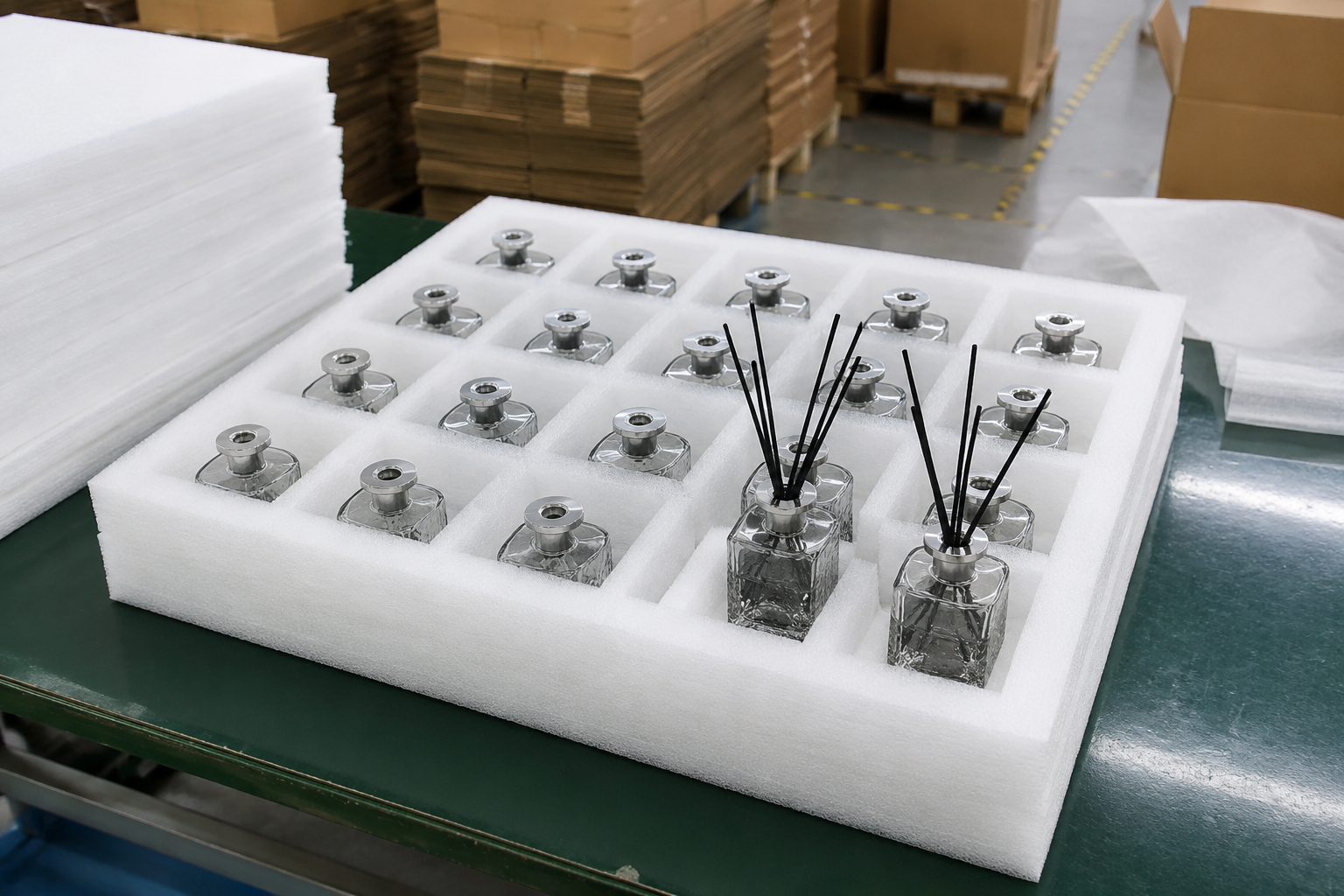
Before changing the inner packaging, Daipak reviewed the product and carton details as a complete custom protective packaging problem. The team did not start by choosing foam thickness only. The first step was to understand why the current packing allowed movement and where added support could fit without disrupting the carton plan.
The buyer provided information about the bottle size, cap height, label position, carton inner size, and quantity per carton. These details helped Daipak judge whether EPE foam packaging could be adjusted into a bottom tray, separated cavities, side support, and upper protection within the available space. The review also helped identify which areas needed tighter control and which areas needed clearance.
This kind of export packaging support depends on accurate inputs from the buyer. Photos, dimensions, and packing direction reduce guesswork. They also make sample review more useful, because both sides can compare the new structure against the real bottle and carton rather than discussing protection in general terms.
For a rush export correction, Daipak usually needs the information in a sequence that follows the order flow: product details first, then carton space, then packing method, then shipment preparation. When these details are connected, the confirmed specification becomes a working production requirement: the foam cutting size, cavity spacing, top pad height, carton quantity, and carton marks can all be checked against the same approved packing layout.
Specification Confirmation Note: For custom glass bottle inserts, Daipak treats bottle size, cap height, label position, foam structure, carton inner size, quantity per carton, and packing method as connected specifications that should be confirmed before production rather than adjusted after bulk packing starts.
Reviewing Photos Before Cutting a New Sample
Photos helped Daipak understand the actual packing problem before cutting a new sample. Bottle photos showed the body shape, cap profile, shoulder area, and label coverage. Carton photos and fitting photos showed how the bottles sat inside the carton and where the movement appeared during the buyer’s pre-shipment check.
This photo review was useful because movement inside a carton is not always obvious from dimensions alone. A bottle may have enough theoretical space on paper but still lean inside the carton because of the way it is loaded. A label may be safe in one packing direction but exposed to rubbing in another. Seeing the bottle inside the carton helped Daipak connect the measurements with the actual packing layout.
From a factory perspective, reviewing photos before sampling also helps avoid unnecessary material changes, especially when a faster RFQ review method is used to clarify repeated quote revisions before production decisions. The new sample can be aimed at the real weak points: side movement, bottle-to-bottle contact, top clearance, and label exposure.
Confirming Dimensions That Affect Cavity Tolerance
The main measurements were bottle diameter, total bottle height, cap height, label area, carton inner size, and quantity per carton. Each one affected cavity tolerance. The bottle diameter guided the width of the cavity. The cap height helped decide how much upper clearance was needed. The label position showed where rubbing had to be avoided.
The carton inner size set the boundary for the whole solution. Daipak needed to check whether the revised foam structure could fit without changing the buyer’s intended carton arrangement. The quantity per carton also mattered because the protection for one bottle could not be designed separately from the full carton layout.
Small measurement differences can create large practical effects in custom glass bottle packaging. A cavity that is only slightly too tight can slow packing or press against the cap. A cavity that is slightly too loose can allow the same movement the buyer was trying to solve. For this reason, the measurement review was part of the sample design, not a separate administrative step.
Checking the Packing Direction Inside the Carton
Daipak also checked how the bottles would be placed inside the carton. Vertical placement, horizontal placement, top clearance, and side support all affect the protective structure. In this project, the inner packaging needed to position the glass bottles in a stable way while keeping the cap and label areas from receiving unnecessary contact.
Top clearance was especially important because the final structure needed a top foam layer without pressing too firmly on the caps. Side support also had to be balanced. Too little side control would allow movement; too much side pressure could make loading difficult or deform the foam during packing.
The packing direction also affects bulk packing speed. A structure that works only when a bottle is placed at a perfect angle may create problems on the packing table. The sample needed to be practical for repeated packing, not just acceptable in a single fitting photo.
Reviewing the Carton as Part of the Protection System
The carton was not treated as a separate purchasing item. For fragile export goods, the outer carton, inner tray, top foam, side support, and product quantity must work as one packing system. If the carton is too large, the foam may shift with the products. If the carton is too small, the foam may compress too much and transfer pressure to the bottle cap or shoulder.
Daipak also needed to consider how the packed carton would be closed, stacked, marked, and handled before container loading. Carton marks, orientation arrows, product codes, and packing quantity are often confirmed before shipment, so a last-minute inner packaging change should not disturb the information printed on the carton. This is why inner size, usable height, and closing condition were checked before the buyer moved ahead with printed cartons.
When Regulatory or Claim-Sensitive Details Should Be Separated
This aromatherapy bottle project focused on transit protection, not food-contact approval, medical packaging approval, or environmental marketing claims. If a buyer later uses similar bottles or inserts for products where packaging directly contacts food, cosmetics, or regulated contents, the compliance review should be handled separately from the cushioning design. EU food-contact rules place safety requirements on materials and articles intended to come into contact with food, so a protective insert that works mechanically should not be described as food-contact suitable unless the material and use case are confirmed for that purpose.[4]
The same restraint applies to environmental language. A buyer may ask whether a foam insert, film bag, corrugated divider, or mixed packaging system is “eco-friendly,” but that wording should be supported with specific claims such as recyclability, recycled content, compostability, or disposal route in the destination market. U.S. environmental marketing guidance cautions that green claims should be qualified and not overstate the environmental benefit of a product or package.[5]
How the New EPE Foam Structure Controlled Movement Inside the Carton
The redesigned inner protection used a custom EPE foam tray as the main positioning structure. The goal was not simply to add more material. The problem found in the buyer’s pre-shipment packing test was movement inside the carton, so each foam part had to answer a specific risk: bottle shifting, bottle-to-bottle contact, label rubbing, cap pressure, and carton fit.
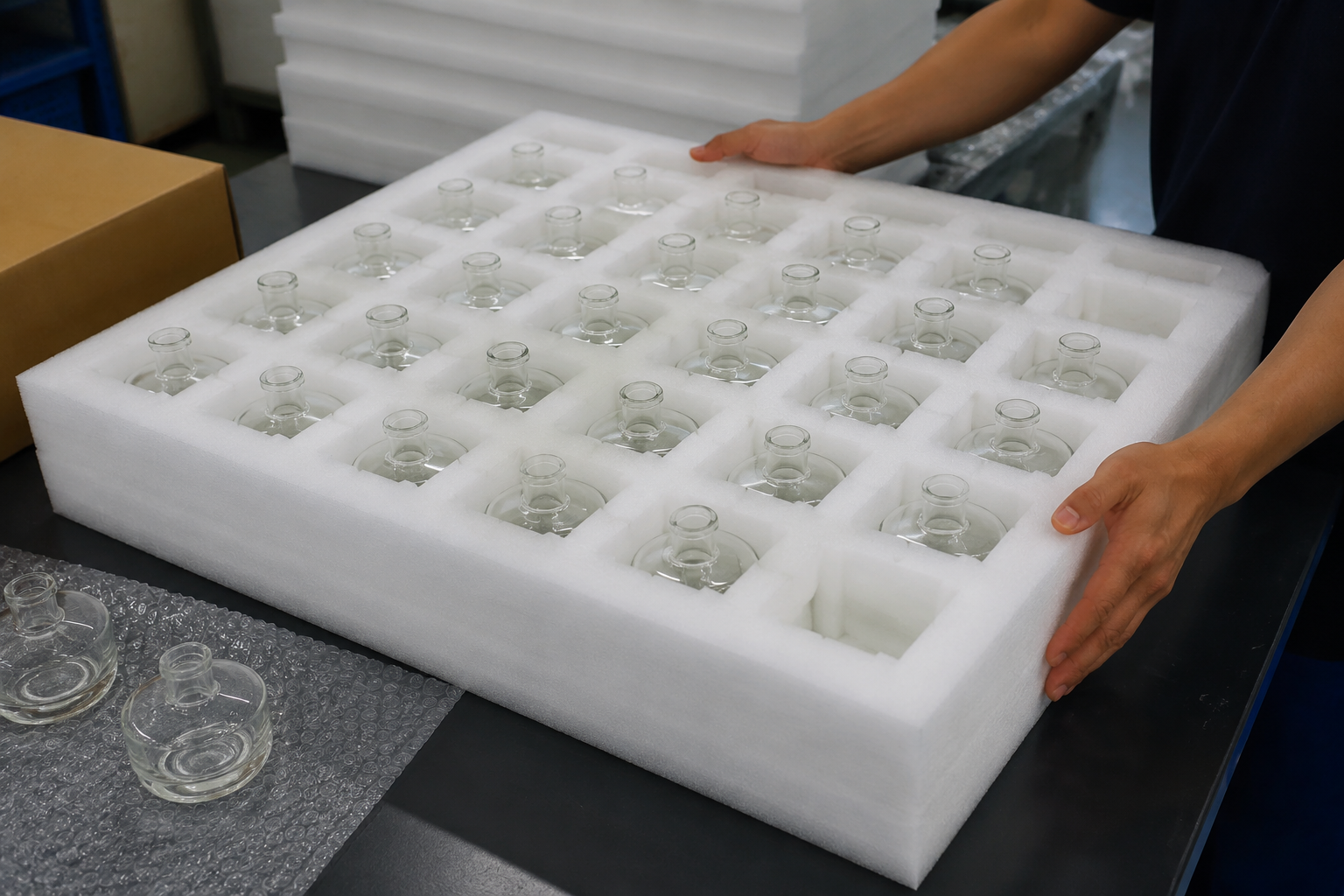
For this order, Daipak rebuilt the inner layout around the actual bottle shape and the available carton space. The lower tray created fixed bottle positions. The separated cavities kept the glass bodies apart. Side support helped control lateral movement. A top foam pad then added upper support so the bottles were less likely to lift, lean, or knock against each other during handling before sea freight loading.
The Bottom Tray Held the Bottle Positions
The bottom tray was the first control point because the original issue started with loose movement inside the carton. If the glass diffuser bottles could slide at the base, the cap and label area would also shift during carton handling. The new tray gave each bottle a defined seat, helping the packer place the bottles consistently instead of relying on manual spacing inside the carton.
This mattered for both protection and packing speed. A tray with clear positions reduces the chance that one bottle is packed too close to another or pressed against the carton wall. It also helps the buyer keep the planned quantity per carton without creating a messy layout. For fragile export products, a clean internal arrangement is often as important as the cushioning material itself.
The tray was designed to improve carton fit within the fixed inner carton size. If the foam base had been made too thick or too wide, it could have changed the usable carton space and created pressure when the top layer was added. If it had been too loose, it would not have solved the movement found in the packing test. The useful range was between those two problems.
Separated Cavities Reduced Bottle-to-Bottle Contact
The separated cavities were added to keep the glass bodies from touching each other during movement. This is especially important for fragrance bottle packaging and aromatherapy gift sets, where the product may survive without breaking but still arrive with scuffed labels, scratched surfaces, or shifted presentation details. For retail and gift products, that kind of surface damage can still create a customer complaint.
Each cavity acted as a small boundary around the bottle body. Instead of several bottles sharing one open space, the bottles had individual positions with foam between them. This helped reduce side movement and lowered the chance that the printed labels would rub against neighboring bottles or the carton interior.
The cavity shape also had to avoid over-clamping the bottle. Too much grip can slow packing and make removal difficult. Too little grip allows the bottle to move again. From a protective packaging manufacturer’s point of view, the value of separated cavities is in controlled fit, not in making the tightest possible hole.
The Top Foam Layer Added Support Above the Caps
The top foam layer was used to control upper movement after the bottles were seated in the bottom tray. During export handling, cartons may be lifted, stacked, turned, or vibrated. If only the lower section is supported, a taller bottle can still lean or rise slightly inside the carton. The top foam pad helped reduce that movement from above.
Cap clearance was the key detail. The top layer needed to limit movement without pressing directly and heavily on the cap area. A cap that sits higher than the bottle shoulder can create a pressure point if the upper foam is not matched to the actual height. For diffuser bottles, this can affect packing comfort, foam deformation, and the stability of the final carton.
Daipak treated the top pad as part of the full inner structure, not as a loose extra sheet. The bottom tray, side support, separated cavities, and top foam pad had to work together inside the same carton. That combined structure gave the buyer a more stable packing method before bulk packing moved forward.
Why a Combined Structure Was Better Than Loose Wrapping Alone
Loose bubble wrap or air cushion packaging can be useful for many fragile items, but it may not solve a fixed-position problem when several glass bottles share one carton. Wrapping can add cushioning around each bottle, yet the wrapped products may still shift if the carton has open space or if workers wrap each bottle with slightly different tightness. For this order, the main risk was not only impact; it was uncontrolled movement inside a confirmed carton layout.
The custom EPE foam structure gave the buyer more repeatable positioning. Bubble wrap, plastic bags, or film may still be used in other projects for scratch resistance, dust protection, or surface separation, but they should be selected according to the risk. When bottle spacing, label protection, cap clearance, and carton fit all matter at the same time, a shaped foam tray often gives better control than relying only on loose cushioning material.
Why the First Sample Needed a Small Cavity Adjustment
The first sample was an important step because it showed how the new structure behaved with the real bottle. It improved bottle positioning and gave the buyer a clear view of the new foam layout, but the EPE foam sample fitting also showed one detail that needed attention: the cavity was slightly tight around the cap area.
This was not treated as a major defect. It was the kind of adjustment that often appears during custom fragile packaging work, especially when a bottle has a wider cap, raised shoulder, or label area that cannot be rubbed. Sample confirmation exists to catch these details before bulk production, when small fit problems become slower packing, inconsistent insertion, or unnecessary handling pressure.
The sample review also created a practical reference for production. Once the buyer confirmed which cavity area needed release and which bottle-body area still needed support, Daipak could keep the adjustment focused instead of changing the whole insert. This helps protect the link between the original specification, the revised sample, and the final cutting or forming requirement used for bulk foam pieces.
What the First Sample Solved
The first version solved the main concern from the buyer’s earlier packing test: the bottles no longer sat loosely in a general open space. The custom foam layout created visible positions for each bottle and made the carton arrangement easier to review. It also helped confirm that the basic direction of the design was correct.
For the overseas buyer, the first sample gave more than a material sample. It gave a practical packing reference: how the bottle entered the cavity, where the label sat, how the cap aligned with the top layer, and whether the carton could still close within the planned size. Those checks are more useful than judging foam density or thickness separately.
Why the Cap Area Was Adjusted
The slightly tight cap area showed why custom packaging should be confirmed with real products whenever possible. A cap may look small in a drawing but still become the widest or most sensitive contact point in the actual packing structure. If workers need to push the cap through the foam edge, the packing process becomes slower and the closure area may receive pressure that the buyer did not intend.
The adjustment focused on improving clearance without returning to a loose structure. The bottle body still needed to stay controlled, and the label area still needed separation. The revised cavity therefore had to release the cap area while keeping the lower body stable. This kind of small tolerance change can make the difference between a sample that looks protective and a packing method that is practical for a full export order.
What Should Be Checked After the Revised Sample
After the cavity adjustment, the buyer should check the revised sample with the same carton, the same packing quantity, and the same packing direction planned for shipment. Useful checks include placing all bottles into the tray, adding the top foam layer, closing the carton, gently shaking or moving the carton, reopening it, and checking whether labels, caps, and foam edges show any unwanted contact marks.
The revised sample should also be reviewed for packing speed and removal. If the bottles are difficult to insert, workers may press harder or change the packing method during bulk packing. If the bottles are too easy to lift out, the shipment may still have movement risk. The best sample is not the tightest one; it is the one that gives controlled fit, reasonable packing speed, and stable carton closure.
Quality Checks Before Bulk Packing and Carton Printing
Because the buyer needed to print outer cartons before the mid-June shipping window, quality checking had to be practical and timely. The first checkpoint was dimensional consistency: foam length, width, tray height, cavity position, and top pad thickness should match the confirmed sample closely enough for the carton to close the same way during bulk packing.
The second checkpoint was packing consistency. A good foam insert should not depend on one careful worker adjusting every bottle by hand. The cavities should guide placement clearly, the side support should sit flat in the carton, and the top layer should be easy to position without covering labels in a way that creates rubbing. If the packing team needs special handling for every carton, the design may create hidden labor cost and delay.
The third checkpoint was carton condition after closing. Buyers should look for bulging sides, top pressure, uneven flaps, and foam movement inside the carton. These signs may suggest that the insert is too high, the cavity alignment is off, or the carton inner size is being used too aggressively. Checking these issues before bulk carton printing can reduce the risk of rework when the shipment schedule is already tight.
For this kind of order, finished product review should compare the bulk foam pieces against the approved sample and the confirmed order details. Cutting edges, cavity spacing, bonding position, foam density or thickness, top layer fit, and carton closing condition usually need to be checked together. If a later carton mark, label position, or packing quantity changes, the packing team should not assume the old sample still applies without another fit review.
Quality Review Note: Before shipment preparation, a practical review should compare bulk foam dimensions, cutting condition, cavity alignment, carton closing condition, packing quantity, carton marks, and label exposure against the approved sample so the packing team has a clear reference during production.
How to Make Sample Approval More Defensible
For buyers who need stronger internal approval, the sample review can be documented with a simple evidence file: product dimensions, carton inner dimensions, photos of the loaded tray, photos after carton closure, observations after handling, and notes on any tight or loose areas. If a formal distribution test is required by the buyer, retailer, or carrier, ASTM D4169 provides a recognized practice for performance testing shipping containers and systems under selected distribution cycles.[6] That does not mean every fragrance bottle export order needs the same test level, but it gives quality teams a clearer language for discussing transit validation when the shipment value or risk is high.
Daipak’s practical recommendation for this project was to use the revised sample as the buyer’s working approval standard. The factory team could then compare bulk foam pieces against the approved tray dimensions, cavity position, top pad height, and carton closing condition. This approach is useful when the buyer needs a fast rescue before shipment but still wants a traceable basis for accepting the final packaging.
Carrier and Destination Requirements Should Not Be Assumed
A packaging structure that looks strong in the factory should still be checked against the buyer’s actual route, carrier instructions, pallet method, and destination requirements. Parcel, sea freight, warehouse transfer, and retailer distribution can expose the same carton to different handling patterns, so buyers reviewing packaging news updates should confirm whether any carrier-specific packaging, sealing, labeling, or palletizing instructions apply before shipment. Carrier packaging guides commonly address cushioning, sealing, labeling, and shipment preparation, and those instructions should be considered alongside the supplier’s inner packaging design rather than after cartons are already packed.[7]
For this aromatherapy order, the immediate concern was bottle movement in the carton, not regulated dangerous goods shipment. If a future product contains contents that may be classified as hazardous, flammable, restricted, or otherwise regulated for transport, the buyer should confirm the shipment classification, required packaging, marks, documents, and carrier acceptance separately before production. A foam insert can help position a bottle, but it does not determine transport classification or replace the shipper’s review of applicable rules.
What Overseas Glass Bottle Buyers Can Learn From This Project
For overseas buyers, the main lesson is simple: a glass bottle packaging quote is more accurate when the supplier can see the full packing situation, not only the bottle volume. A 120 ml bottle can have many different shapes, cap heights, label areas, and carton layouts. Those details decide whether the protection should hold the bottle body tightly, leave more clearance around the cap, separate each bottle, or add support above and around the product.
This is especially important for aromatherapy bottle packaging, skincare bottle packaging, and fragile gift packaging where the product may survive impact but still arrive with rubbed labels, loose caps, scuffed surfaces, or a retail presentation problem. The packaging needs to protect both the glass and the visible selling surface.
Information Buyers Should Prepare Before Sampling
Before sampling, buyers should send enough information for the supplier to understand the actual product and carton space. Bottle diameter, total height, cap height, shoulder shape, bottom shape, and label position all affect the foam cavity. If the cap is taller or wider than expected, a cavity that fits the bottle body may still create pressure at the top. If the printed label reaches close to the bottle edge, the supplier may need to adjust the contact area so the label is not used as the main support point.
The carton details matter just as much. Buyers should provide the carton inner size, quantity per carton, packing direction, and any required carton marks or printed layout limits. A foam design that looks safe on a table may not work in the carton if it changes the packing quantity or pushes the carton height beyond the confirmed size. If the outer carton has not yet been printed, there is usually more room to correct the structure. If it has already been printed, the supplier must work within a tighter limit.
A practical sampling request should include product photos, a simple drawing if available, close-up photos of the cap and label, the planned carton layout, and the shipping method. These details help the supplier judge whether EPE foam, bubble wrap, air cushion packaging, corrugated dividers, or a combined structure is more suitable for the product.
Questions That Help Prevent Movement and Label Rubbing
Buyers should describe what happened during their own packing test instead of only saying the product is fragile. Useful comments include whether the bottle moved from side to side, whether the cap touched the top layer, whether bottles contacted each other, whether the foam was too tight during packing, and whether any label rubbing appeared after shaking or handling. These observations help identify the real weak point.
For label protection, the supplier needs to know where the label sits and what type of finish it has. A paper label, metallic label, printed coating, or transparent label may react differently to friction. Even small side movement can become visible after long handling, especially when the carton is stacked, tilted, or moved several times during export preparation.
Top clearance is another common issue. If the upper foam presses directly on the cap, packing may feel secure at first, but it can create pressure during carton stacking. If the top space is too loose, the bottles may lift and settle during handling. The better target is controlled support, where the product stays positioned without unnecessary compression on the cap or label surface.
Why Shipping Method Should Be Shared Early
The shipping method should be part of the packaging discussion from the beginning. Sea freight usually means longer transit, carton stacking, warehouse transfers, container loading, and more time under compression than a short domestic delivery. The inner protection does not work alone; it has to match the carton strength, packing quantity, pallet arrangement, and expected handling route.
For fragile product packaging, a supplier may review side support more carefully when cartons will be stacked for an extended period. If the goods will move through export warehouses before loading, the foam structure may need to control both side movement and vertical movement. If the products are packed as retail gift sets, the visible condition of labels, caps, and outer surfaces can be as important as preventing breakage.
Sharing the destination region, shipping method, and packing schedule early also helps avoid late changes. If the carton size, printed marks, or packing quantity must stay fixed, the supplier needs to know that before designing the sample. Otherwise, a technically good insert may create a new problem by changing carton fit or slowing down bulk packing.
Total Packaging Cost Is More Than Foam Unit Price
For export glass bottle orders, buyers should compare total packaging cost rather than only the unit price of the foam insert. A cheaper inner material may look attractive at the quotation stage, but it can cost more if it increases breakage risk, slows packing, causes label rubbing, changes carton quantity, or creates rework before shipment. The cost of missed carton printing timing can also be higher than the difference between two insert options.
A practical cost review should include material cost, cutting or bonding complexity, packing labor, carton size, pallet efficiency, container loading condition, and the value of the finished product. In some cases, a custom EPE tray with separated cavities may cost more than loose wrapping, but it can help reduce handling uncertainty and make carton packing more repeatable. In other cases, a simpler divider, bubble wrap sleeve, or film bag may be enough if the product is lighter, less fragile, or packed in a smaller quantity per carton.
What Buyers Should Not Assume From One Successful Sample
A successful sample fit is a strong starting point, but it should not be treated as a guarantee that every future bottle, cap, label, and carton version will behave the same way. A small change in glass mold, cap supplier, label thickness, bottle shoulder, or carton supplier can change how the product sits in the cavity. For repeat export orders, buyers should recheck the foam fit whenever the product specification changes, even if the bottle volume remains 120 ml.
Buyers should also avoid turning a transit-protection result into a broader claim. A tray that reduces bottle movement does not automatically prove waterproof protection, moisture-barrier performance, food-contact suitability, compostability, or universal recyclability. Those claims need separate material data, destination-market checks, and, where relevant, appropriate testing or regulatory confirmation.
Where Daipak Fits in Fragile Export Packaging Projects
Daipak’s role in this type of project is to connect the product details with the packing structure and the export schedule. As a China packaging materials supplier and protective packaging manufacturer, Daipak does not need to start with a single material assumption. The better starting point is the product: glass thickness, bottle shape, cap height, label area, carton space, packing quantity, and the way the goods will move before shipment.
For glass bottles, aromatherapy products, skincare containers, candles, and fragile gift sets, the final answer may be EPE foam, bubble wrap, air cushion packaging, corrugated cartons, film bags, or a combined packaging system. The right choice depends on whether the main risk is breakage, surface rubbing, bottle-to-bottle contact, carton void space, moisture or dust exposure, or slow packing on the production side.
Practical Support From Sample Review to Carton Fit
In this project, the useful work was not only cutting a foam tray. Daipak reviewed the bottle dimensions, cap position, label exposure, carton inner size, and quantity per carton before adjusting the sample. That review helped the buyer move from a loose packing structure to a more controlled layout with separated cavities, side support, and a top foam layer.

Sample adjustment is a normal part of custom protective packaging. A small cavity change can affect packing speed, cap clearance, foam recovery, and how consistently workers can place each bottle. From a factory perspective, Mr. Wang usually checks whether a sample structure can be repeated during batch production, not only whether one piece looks correct on the table.
Carton fit also needs attention before bulk packing begins. If the foam structure changes the total height or carton layout, it can affect outer carton printing, carton marks, pallet count, and shipment preparation. Direct factory communication helps reduce this risk because the foam design, carton space, and packing method can be reviewed together instead of separately.
Before shipment preparation, the same confirmed information should carry through to packing review: carton quantity, inner packing sequence, label direction, carton marks, pallet arrangement, and loading notes. When those details are checked against the approved sample and final carton plan, the buyer has a clearer basis for approving the shipment without reopening the packaging decision at the last moment.
When Buyers Should Contact a Packaging Supplier Earlier
Buyers should contact a packaging supplier as soon as the bottle design, cap style, label position, and carton plan are close to confirmed. Earlier review gives more room to compare materials, adjust cavity tolerance, confirm carton size, and avoid reprinting or repacking work later. It also makes sampling more useful because the first sample can be based on real product and shipping details.
Late-stage problems can still be reviewed, especially when a packing test shows movement, rubbing, or poor carton fit. In that situation, the supplier needs clear photos, dimensions, test observations, and the remaining production schedule. The goal is not to make the packaging heavier without reason. The goal is to control the specific weak point while keeping the carton layout, packing speed, and export preparation workable.
For repeat orders, buyers can also use the confirmed structure as a reference point. If the bottle diameter changes, the cap supplier changes, the label moves, or the carton quantity is adjusted, the protective packaging should be checked again before production. Small product changes can create new pressure points, especially in glass bottle packaging where fit and clearance matter closely.
Repeat-order feedback is also useful when the buyer can share what happened after delivery: whether cartons arrived flat, whether labels stayed clean, whether any bottles moved, and whether warehouse workers found the insert easy to remove. This feedback can help Daipak keep the same confirmed specification for stable repeat orders or make a small adjustment to cavity tolerance, top foam thickness, carton marks, or packing quantity before the next production run.
Claim Boundaries Buyers Should Keep Clear
When the revised EPE tray is described internally or in sales materials, it is more accurate to say that the structure can help reduce movement, bottle-to-bottle contact, and label rubbing when matched to the confirmed carton and product details. It should not be described as guaranteed damage-free packaging, because shipping outcomes can also depend on carton strength, palletizing, carrier handling, container loading, storage conditions, and the final packed product condition.
Moisture, waterproof, barrier, anti-static, and load-bearing statements should also be handled carefully. If a buyer needs moisture-related performance for labels, closures, paper cartons, or sensitive contents, the requirement should be reviewed separately from the foam positioning design. Water vapor transmission and conditioning methods are separate test topics for packaging materials and systems, so a foam tray selected for bottle positioning should not be assumed to provide moisture-barrier performance without supporting data.[8]
For cosmetic, skincare, aromatherapy, or household fragrance orders, buyers should distinguish between the package that protects the glass bottle during transport and the primary package or closure system that contains the product. The inner shipping insert may be important for export handling, but it should not be used to support claims about product safety, ingredient compatibility, direct contact suitability, or market approval unless the buyer has reviewed the relevant material documents and destination-market requirements.
If environmental positioning matters for a brand, the claim should be built from the actual material, structure, collection route, and destination market rather than from a general label. Mixed packaging that combines foam, film, corrugated board, labels, and adhesive may require different disposal or recycling instructions for each component. Buyers should confirm the intended claim before artwork, carton marks, or consumer-facing copy is printed, especially when using words connected to recyclability, compostability, biodegradability, recycled content, or broad environmental benefit.[5]
Final Practical Takeaway for Fragile Bottle Orders
This project shows why fragile bottle packaging should be confirmed before carton printing and shipment preparation reach the final stage. The most useful solution is not always the thickest foam or the most expensive material. It is the structure that matches the bottle shape, protects the visible finish, controls movement inside the carton, and still allows the warehouse team to pack consistently.
For overseas buyers preparing aromatherapy, skincare, candle, essential oil, or fragile gift packaging orders, a practical discussion starts with real product information and real packing observations. When the supplier can review the bottle, cap, label, carton, quantity, and shipping condition together, the packaging decision becomes more practical and the risk of late-stage correction is lower.
References
[1] ASTM International, “ASTM D5276 Standard Test Method for Drop Test of Loaded Containers by Free Fall,” standard drop-test method reference for loaded shipping containers and transport packages, available at ASTM D5276 Free-Fall Drop Test.
[2] ASTM International, “ASTM D642 Standard Test Method for Determining Compressive Resistance of Shipping Containers,” compression resistance testing reference for shipping containers and packaging strength discussions, available at ASTM D642 Compression Resistance.
[3] International Organization for Standardization, “ISO 780 Packaging — Distribution packaging — Graphical symbols for handling and storage of packages,” standard reference for package handling symbols and storage instructions, available at ISO 780 Packaging Handling Symbols.
[4] European Union, “Regulation (EC) No 1935/2004 on materials and articles intended to come into contact with food,” framework regulation supporting food-contact packaging safety boundaries in the EU market, available at EU Regulation 1935/2004 Food Contact Materials.
[5] U.S. Federal Trade Commission, “16 CFR Part 260 Guides for the Use of Environmental Marketing Claims,” U.S. environmental marketing guidance supporting qualified and non-misleading packaging sustainability claims, available at 16 CFR Part 260 FTC Green Guides.
[6] ASTM International, “ASTM D4169 Standard Practice for Performance Testing of Shipping Containers and Systems,” performance testing practice for shipping containers and systems under selected distribution cycles, available at ASTM D4169 Shipping Container Performance Testing.
[7] FedEx, “FedEx General Packaging Guidelines,” carrier packaging guidance covering package preparation, cushioning, sealing, and related shipment considerations, available at FedEx General Packaging Guidelines.
[8] ASTM International, “ASTM D4279 Standard Test Methods for Water Vapor Transmission of Shipping Containers,” test method reference for water vapor transmission considerations in shipping containers, available at ASTM D4279 Water Vapor Transmission of Shipping Containers.