
For small and medium importers, the real packaging decision is not just what material looks right on paper. It is whether the supplier can match product size, weight, fragility, surface protection, and packing method without creating avoidable stock risk or packing errors. The first order usually works best as a controlled test: confirm dimensions, check sample-to-bulk consistency, and see whether the carton, insert, bag, or cushioning actually fits the way your team ships goods.
This article explains how China packaging suppliers can support that process with standard sizes, light customization, and practical quotation support. It also shows when to keep the SKU set small, when a custom option is worth it, and what information to send before asking for pricing. If you are balancing carton space, shipping route, reorder timing, and quality control, the goal is to help you choose packaging that protects the product without tying up too much cash or inventory.
Quick Packaging Decision Guide
| Buyer Question | Practical Reading | What to Check |
|---|---|---|
| Should I start with standard or custom packaging? | Start standard unless product specs are stable and clear repeat volume exists. | Dimensions, fragility, reorder speed, and storage impact. |
| How many packaging SKUs should I carry? | Keep the set small until sales and packing patterns justify more variety. | Shared sizes, packing labor, storage space, and slow-moving stock. |
| When is light customization enough? | Use it when you need better fit, protection, or basic branding. | Sample results, carton fill, print accuracy, and packing time. |
| What should I send before requesting a quote? | Clear product data leads to a more useful supplier response. | Product size, weight, shipping route, quantity, and current problems. |
| How do I avoid paying for the wrong packaging? | Test with real products before bulk ordering. | Damage risk, surface marks, fit in carton, and warehouse handling. |
| What makes a supplier useful, not just cheap? | Support matters when specs change or reorders need adjustment. | Communication, sample accuracy, practical advice, and flexibility. |
Quick Answers Before You Read
Is standard packaging enough for a first order?
Often yes, if the product is not unusually fragile and the size is still changing.
When does custom packaging become worth it?
When the product spec is stable and better fit, protection, or efficiency will repay the extra setup.
What should I confirm in samples?
Check fit, protection, packing speed, carton use, and whether the sample matches the bulk version.
What if I only know my product size loosely?
Share the best measurements you have and ask for standard or semi-custom options first.
Start With Packaging That Proves the Supplier, Not the Whole Brand System
For small and medium importers, the first order from China packaging suppliers should not carry the weight of the entire brand system. It should prove whether the packaging supplier in China can understand the product, communicate clearly, prepare usable samples, control specifications, and coordinate packing details without creating unnecessary inventory pressure.
A starter packaging order is most useful when it answers practical questions. Does the supplier ask about the product size, weight, fragile points, surface finish, and shipping method? Can they suggest a workable stock or semi-custom option instead of pushing the most complicated design? Are the samples close to what can be produced in bulk? Do carton labels, packing quantities, and order communication stay consistent from quotation to shipment preparation?
Small importer packaging sourcing works best when the first purchase is treated as a verification step. The goal is not to make every package perfect. The goal is to protect the product, support the current packing process, and give the buyer enough structure to measure supplier performance before placing larger or more customized orders.
Why the first order should be treated as a controlled test
A controlled test order reduces the cost of being wrong. If the supplier misunderstands the product, chooses a weak material, packs the wrong quantity per carton, or sends samples that do not match bulk production, the buyer discovers the problem before too much cash is locked into packaging stock. This matters especially for new brands and importers with limited budgets, where slow-moving packaging can sit in the warehouse long after the product mix changes.
The first order should test both the packaging and the supplier’s working style. Bubble wrap rolls, EPE foam sheets, poly mailers, corrugated boxes, or air cushion packaging may all be simple products on paper, but the details still matter. A poly mailer that is slightly too small slows packing. A foam sheet that is too thin may not protect a sharp corner. A carton that leaves too much empty space may require extra void fill and increase shipping volume.
Supplier verification should include communication discipline as well as material performance. A buyer should watch whether the supplier confirms sizes in the same unit, records the approved material thickness or density, marks cartons clearly, and keeps packing quantities aligned with the quote. These details are not exciting, but they are often what separate a repeatable supply chain from a one-time purchase.
A simple risk ladder for the first packaging order
Small importers can make the first order easier to judge by separating packaging decisions into risk levels. Low-risk choices include standard carton sizes, plain bags, shared bubble wrap rolls, and simple foam sheets that can be used across several products. Medium-risk choices include light printing, adjusted thickness, basic carton marks, or pre-cut cushioning that still leaves room for product changes. Higher-risk choices include tight custom inserts, multi-color printed packaging, special structures, or packaging tied to only one product size before demand is proven.
This risk ladder helps buyers avoid treating every improvement as equally urgent. If the main uncertainty is sales volume, the safest improvement may be a standard package that is easy to reorder. If the main uncertainty is damage, a protection-related sample may deserve attention before branding. If the product is still changing dimensions, a tight custom insert may create more risk than it removes.
A practical first order should usually contain more low-risk items than high-risk items. That gives the buyer enough packaging to operate, enough information to evaluate the supplier, and enough flexibility to adjust the next order. The first purchase becomes a measured test rather than a long-term commitment made too early.

What a small importer should not try to solve immediately
Small buyers should be careful about solving too many packaging goals in the first order. Advanced branding, complex inserts, multiple printed color versions, and a wide range of packaging SKUs can make the order look more polished, but they also increase sampling time, purchasing risk, and warehouse pressure. If demand is still uncertain, the safer move is to keep the first packaging set practical and flexible.
Many branding improvements can wait until repeat sales prove which products deserve investment. A new apparel seller may start with standard poly mailers and simple labels before moving into printed mailers. A distributor with several fragile items may begin with shared bubble wrap or foam sheets before designing separate inserts for every model. A product line with seasonal uncertainty should avoid ordering too many size-specific cartons before the sales pattern is clear.
This does not mean the first order should look careless. It means the buyer should separate necessary protection from optional presentation. Product safety, packing speed, carton fit, and clear labeling usually matter earlier than premium finishes or highly specific unboxing details.
What Daipak can help clarify before the first quote
At Daipak, the discussion usually starts with the product details rather than the material name. Before quoting, a practical China packaging materials supplier needs to understand the product dimensions, weight, shape, surface sensitivity, fragile areas, current packing method, shipping route, and expected order mix. These details help narrow the choice between standard packaging, semi-custom adjustments, and fully custom protection.
For example, a light non-fragile product may only need a suitable poly mailer or carton. A glossy item may need surface protection from plastic film, foam sheet, or a soft inner bag. A fragile product shipped through parcel networks may need cushioning, separation, and an outer corrugated box that works together. If several products are being sourced at once, the supplier should also review whether one packaging size or material can cover multiple items without creating poor fit or waste.
A clear first quote request should also show the buyer’s current stage. A supplier can make more realistic recommendations when the buyer explains whether this is a first test order, a repeat item with growing sales, or a product line that may change soon. That context helps keep the packaging decision tied to protection, cost control, and inventory risk instead of treating every project as a full custom launch.
Choose Standard Sizes Before Custom Tooling or Complex Branding
Standard packaging sizes are usually the safest starting point for early-stage importers. They reduce the number of decisions, simplify sample review, and make reordering easier if sales move faster than expected. They also help the buyer avoid custom tooling or print commitments before the product has a stable sales history.
Standard does not mean low quality or unsuitable. Stock packaging can be a practical match when the product has common dimensions, moderate protection needs, or uncertain early demand. Standard mailers, clear plastic bags, garment bags, corrugated cartons, foam sheets, bubble rolls, and air cushion materials can cover many starter packaging needs without forcing the buyer into a narrow design too early.
The useful distinction is between standard, semi-custom, and fully custom packaging. Standard packaging uses existing or common sizes and specifications. Semi-custom packaging may adjust thickness, add a simple logo, use printed labels, change carton marks, or make a basic size adjustment if the order supports it. Fully custom packaging involves more specific dimensions, structures, printing, inserts, or material combinations that require tighter coordination and usually more commitment.
When standard packaging is the smarter first purchase
Standard packaging is often the smarter first purchase when the product size is common, the buyer is testing several SKUs, or the sales forecast is still uncertain. A small importer selling apparel, accessories, replacement parts, or simple household items may not need a custom package for every variation. One or two suitable mailer sizes, a few carton sizes, and a shared cushioning material may be enough to start shipping reliably.
Standard sizes also help when storage space is limited. Packaging stock takes up warehouse volume before it creates revenue. A buyer who orders many custom sizes too early may end up with slow-moving packaging tied to products that sell less than expected. By starting simple, the buyer can learn which package sizes move quickly and which ones should not be repeated.
From a packing station perspective, standard sizes can reduce hesitation. Workers can learn which mailer, carton, or cushioning material fits each product group, rather than checking a large list of similar custom options. This is especially useful for small e-commerce teams where the same people may handle receiving, packing, labeling, and shipping.
Where light customization can add value without too much risk
Light customization makes sense when it improves recognition, organization, or protection without creating too much inventory exposure. A simple printed label can add brand identity to a standard mailer or carton. Carton marks can help the warehouse identify product groups, packing quantities, or destination batches. Adjusted film thickness, foam thickness, or bag size may improve function while keeping the order less complex than a fully custom structure.
Simple logo printing may be reasonable when the buyer has enough confidence in the product and the design is unlikely to change soon. Basic color choices can also support brand recognition or warehouse sorting, but they should not multiply versions unnecessarily. For a limited-volume importer, one clean branded element is often better than several design variations that are hard to reorder and store.
A China packaging materials supplier can help compare whether a light customization step is worth it. The decision should be based on product dimensions, packing workflow, likely reorder quantity, and the cost of mistakes. If the same label, thickness, or carton mark can support several products, the customization has a stronger practical case.
When full customization should wait
Full customization should usually wait until demand is clearer and the buyer understands real packaging performance. Complex foam inserts, unique printed cartons, multi-color film, special structures, and tight-fit packaging can be valuable later, but they add sampling rounds, specification control, and reorder responsibility. If the product changes, the packaging may no longer fit.
There are exceptions. If a product is fragile, heavy, sharp-edged, or easily scratched, protection-related customization may be needed earlier. But even then, the buyer should confirm the product risk first rather than starting with a decorative design. A custom EPE foam insert may be more urgent than a printed outer carton if the main problem is breakage.
The practical sequence is to start with a standard or near-standard solution, add light customization where it clearly helps, and move toward full customization after the buyer has repeat sales, stable product dimensions, and enough usage data to justify the commitment.
Use MOQ as a Planning Tool, Not Just a Price Barrier
MOQ is often discussed as a pricing obstacle, but for packaging factories it also reflects production reality. Minimum order quantity can be affected by material roll usage, printing setup, machine adjustment, cutting time, sealing or bonding process, carton packing, and the effort required to keep specifications consistent. A low MOQ packaging supplier may have flexibility in some areas, but not every material, size, or printed design can be reduced in the same way.
Small buyers can have a better MOQ discussion when they treat it as planning, not pressure. Instead of simply asking for the lowest possible quantity, they can ask what drives the minimum. Is it the raw material, the printing setup, the bag size, the foam cutting process, or the carton structure? Once the reason is clear, the buyer and supplier can look for practical adjustments.
For small first orders, the best path may include standard sizes, shared materials, fewer SKUs, mixed packaging orders where workable, and a visible reorder plan. This helps control cash-flow risk while showing the supplier that the buyer is thinking beyond a one-time purchase.
Why MOQ changes by material and customization level
MOQ changes because different packaging materials are produced and converted in different ways. Plain bubble wrap or foam sheets may be easier to discuss in flexible quantities than a special printed bag or a highly specific foam insert. A printed poly mailer may involve film selection, plate or printing setup, color control, sealing, and packing. A custom carton may depend on board grade, structure, printing, die-cutting, and packing requirements.
Special sizes can also affect the minimum. If a bag, sheet, or carton uses an unusual dimension, the supplier may need to adjust cutting, sealing, or material layout. Thickness and density matter as well. A change in film thickness, foam density, or board strength may require different material preparation and can affect what the factory can produce efficiently.
This is why buyers should avoid treating all packaging items as equal. A simple plain stock item, a semi-custom label solution, and a fully printed custom structure may have very different minimums even if they serve the same product. Understanding that difference helps the buyer decide where customization is worth the commitment.
How to discuss small volume without weakening the specification
A small-volume buyer may be tempted to remove specifications just to make the order easier to accept, but that can create problems later. Some details should remain clear even when the order is small: usable dimensions, material type, thickness or density where relevant, packing quantity, carton marks, and the approved sample reference. Flexibility should usually be applied to size choice, branding depth, or SKU count, not to the basic performance requirements that protect the product.
For example, a buyer may accept a standard carton size instead of a new custom carton, but the board strength still needs to match the product weight and shipping method. A buyer may choose a plain bag instead of printed film, but the bag still needs to close properly and resist tearing during packing. A buyer may share one foam sheet across several items, but the surface protection and cushioning thickness still need to be checked with the real product.
This distinction makes the MOQ conversation more productive. The supplier can suggest where to simplify without guessing what performance can be reduced. For a first order, the best compromise is often a simpler structure with a clear specification, not an unclear product made cheaply.
How mixed orders can help small buyers test more packaging types
Mixed packaging orders can help small buyers test more than one packaging type without overcommitting to a single item, when production and coordination allow it. A buyer may want to combine corrugated boxes, bubble wrap, poly mailers, and foam sheets in one sourcing discussion because the real packing system uses several materials together. This can be more useful than buying one item in isolation and discovering later that it does not work with the carton or packing process.
Mixed orders are not automatically possible in every situation. The supplier still needs to consider material preparation, production scheduling, packing method, carton quantity, and shipment arrangement. Printed items, special sizes, and heavily customized structures may have less flexibility than plain or standard materials.
The buyer can make the conversation easier by grouping items logically. For example, ask whether several mailer sizes can share the same film material, whether plain stock items can be included with a smaller printed portion, or whether cushioning materials and cartons can be planned together for the same product group. The goal is not to force every item into one order, but to build a starter packaging mix that can be tested in real packing work.
How repeat-order visibility can improve the MOQ conversation
Suppliers often assess flexibility differently when the buyer can show a realistic reorder path. A small first order with no future plan is harder to evaluate than a controlled test order connected to expected monthly usage, product growth, or a planned reorder cycle. Even rough visibility can help the supplier understand whether the project may become stable enough for better coordination later.
Buyers do not need to provide confidential sales data, but they should share useful planning information. They can explain which products are already selling, which items are being tested, which packaging sizes may repeat, and whether future orders may consolidate several SKUs. This helps the supplier recommend standard materials, semi-custom adjustments, or staged customization more responsibly.
A good MOQ conversation should end with clarity about what can be flexible now, how a supplier communication guide frames packaging manufacturer red flags that require more volume, and what may improve after repeat orders. That is more useful than pushing for an unrealistic first quantity that creates production stress, weak consistency, or a supplier relationship that cannot support growth.
Control SKU Count Before Expanding Packaging Variety
Packaging variety can grow faster than product sales if small importers are not careful. One new product size leads to one new mailer, one new carton, one new foam pad, and one new label. After a few months, the packing area may have many packaging items but only a few that move quickly. This is why packaging SKU control matters in small importer packaging sourcing. It is not only an inventory topic; it affects cash flow, packing speed, reorder accuracy, and the ability to test a supplier without carrying too much stock.
A practical first goal is to build a compact packaging set that covers the real product range. That may mean one or two poly mailer bags for apparel or soft goods, a few corrugated boxes for products that need structure, one cushioning material such as bubble wrap or EPE foam packaging for shared protection, and basic labels or carton marks where needed. The point is not to force every product into the same package. The point is to avoid creating a separate packaging item before the sales volume or protection need justifies it.
At Daipak, the discussion usually starts with product dimensions and packing workflow rather than a long wish list of packaging styles. If several products share similar size, weight, and fragility, they may be able to share one packaging family. That kind of review can reduce unnecessary variation before the buyer commits to a larger reorder list.
How too many packaging SKUs increase hidden cost
The direct cost of a bag, carton, or foam sheet is only one part of the decision. A slow-moving packaging SKU takes up shelf space, ties up cash, and can become obsolete if the product changes size, color set, or sales channel. For a small importer with limited warehouse space, five cartons of unused packaging can be more painful than a slightly higher unit price on a simpler first order.
Too many packaging choices also slow down the packing station. Workers need to identify the correct mailer, carton, cushioning material, label, and packing quantity for each order. If several sizes look similar, picking errors become more likely. A product may be placed in an oversized carton with too much void fill, or a fragile item may be packed with the wrong cushioning. These mistakes do not always show up in the material invoice, but they can appear later as damaged goods, higher shipping volume, customer complaints, or extra labor.
Repeat ordering becomes harder as the list grows. The buyer must track which items are low, which are slow movers, which supplier specification was last approved, and which packaging items need to be combined in the next shipment. A smaller set of proven packaging items makes it easier to reorder accurately and compare supplier consistency over time.
How to build a starter packaging set
A good starter set begins by grouping products, not by choosing packaging from a catalog. Small importers can first separate products by size range, fragility, surface sensitivity, and shipping route. Soft goods may only need dust protection and a mailer. Light fragile items may need bubble wrap plus a carton. Products with polished or coated surfaces may need EPE foam sheets or bags to reduce scratching before they go into the outer box. Heavier goods may need a stronger corrugated box and tighter internal blocking.
Once the groups are clear, the buyer can look for shared packaging. One bubble wrap roll may work for several small home goods if the wrapping method is consistent. One carton size may cover multiple products if the difference can be managed with controlled void fill or air cushion packaging. One poly mailer size may cover several apparel SKUs without creating excessive looseness. Foam sheets can sometimes be cut for related items instead of ordering a separate shaped insert for every product at the start.
The starter set should be easy to store, easy to explain to packers, and easy to reorder. A buyer may begin with a limited range such as two mailer sizes, two or three carton sizes, one cushioning solution, and one label or carton mark system. As sales data improves, the set can be adjusted. The first version does not need to be perfect; it needs to be controlled enough to reveal what actually works.

When a separate packaging SKU is justified
A separate packaging SKU is worth adding when it clearly solves a real problem. If a product is consistently damaged at the corners, a dedicated EPE foam corner protector or a better-fitting carton may be justified. If a small item ships in a box with too much empty space, a smaller carton may reduce shipping volume and void fill. If packers spend too much time cutting material by hand, a pre-cut pad or bag may save labor and improve consistency.
The decision should be based on measurable pain, not only brand preference. A new size or material makes sense when it reduces damage, lowers freight waste, speeds up packing, protects a sensitive surface, or prevents customer complaints. It is less convincing when the only reason is that each product “should have its own package” before sales volume is proven.
For small and medium importers, packaging variety should follow product performance. Start with shared packaging where the risk is low. Add separate packaging only when the product’s size, fragility, value, or customer expectation makes the extra inventory and coordination worthwhile.
Confirm Samples Around Use, Not Just Appearance
Packaging sample confirmation is one of the most useful safeguards before a first bulk order. A sample should not be approved only because the logo looks good or the color feels close enough. It should be tested with the real product, the real packing method, and the likely shipping conditions as much as possible. The buyer needs to know whether the package fits, closes, protects, and can be packed repeatedly without creating extra work.
This is especially important when working with a custom packaging supplier for the first time. A foam insert sample may look clean on a table but hold the product too tightly for fast packing. A printed poly mailer sample may look acceptable but have a sealing area that is too narrow. A carton sample may fit the product but leave too much movement inside during parcel handling. The sample review should connect appearance with function.
Sample approval also needs to create a production reference. The approved sample should be tied to clear specifications: size, material, thickness or density where applicable, printing details, packing quantity, carton marks, and photos. Without that record, a buyer may approve one thing visually but receive a bulk order that is difficult to check against the original decision.
What to test with the real product
The first test is fit. Place the actual product into the sample package and check whether it slides, presses against weak points, or leaves too much empty space. For fragile products, pay attention to corners, edges, handles, screens, coated surfaces, and protruding parts. A protective packaging sample should control movement without creating pressure marks or making the product hard to remove.
The second test is closure and packing speed. A mailer should seal cleanly after the product is inserted. A box should close without bulging. Bubble wrap or EPE foam should cover the needed surfaces without requiring excessive cutting or taping at the packing station. If one package takes too long to prepare during a sample test, that problem usually becomes more serious during bulk packing.
The third test is carton compatibility. Inner packaging should work with the outer carton, not fight against it. Check how many units fit per carton, whether the product stack compresses the cushioning, and whether the carton can be closed and labeled properly. For export or longer-distance shipping, buyers should also consider how the packed cartons will be handled, stored, and palletized.
What to record before approving production
Before production starts, the buyer and supplier should agree on the practical details that define the package. For bags and film products, this may include material type, size, thickness, sealing method, printing position, color reference, and packing quantity. For EPE foam packaging, the record may include foam thickness, density if specified, cut size, bonding details, insert shape, and how the product should sit inside. For corrugated boxes, it may include box style, dimensions, board choice, printing or carton marks, and packing arrangement.
Photo references are useful because they reduce misunderstanding. A photo can show how the product sits inside the foam, how much bubble wrap overlaps, where a label is placed, or how many pieces are packed into a carton. Photos should not replace written specifications, but they help confirm the intended use of the sample.
At Daipak, sample details are usually aligned with production specifications before bulk manufacturing. This does not remove every shipping risk, but it reduces avoidable mistakes such as wrong size, unclear print placement, inconsistent packing quantity, or a material choice that does not match the approved sample.
How to judge acceptable sample differences
Not every sample difference carries the same risk. A slight cosmetic variation in a plain inner cushioning material may be acceptable if the size, thickness, and protection remain correct. A small change in print shade may matter less for an internal carton mark than for a customer-facing retail package. But a change in foam thickness, carton strength, seal position, or inner fit can affect packing performance and should be treated more carefully.
Buyers should ask whether a difference is visual, functional, or repeatability-related. Visual differences affect appearance. Functional differences affect protection, closure, packing speed, or carton use. Repeatability differences affect whether the same result can be produced again in bulk or in the next reorder. For small importers, functional and repeatability issues usually deserve more attention than minor appearance differences in non-retail packaging.
This approach helps avoid two common mistakes: rejecting a usable sample for a harmless cosmetic issue, or accepting a risky sample because it looks close enough. The better question is whether the difference will change how the product is packed, shipped, stored, or received by the customer.
Quality Control Note: For first-time packaging orders, buyer confidence should come from visible and repeatable quality-control details such as measured dimensions, material thickness, seal strength, carton fit, print placement, packing quantity, and sample-to-bulk consistency. These points should be checked item by item rather than assumed from a supplier name, catalog photo, or low quotation alone.
Why one sample round may not be enough for custom packaging
One sample round may be enough for simple stock packaging or light customization, but tighter-fit custom packaging often needs adjustment. Foam inserts, special cartons, printed bags, and combined packaging systems can reveal issues only after the real product is packed. A slot may need to be widened, a foam wall may need more thickness, a mailer may need a different size, or a carton may need better internal support.
This is not a failure of the sampling process. It is part of making sure the first bulk order does not lock in a weak specification. Small importers often feel pressure to move quickly, but approving a poor sample can create more cost later through repacking, damaged goods, or unusable inventory.
The buyer should treat each sample round as a decision point. If the sample protects the product, fits the packing method, and can be repeated in production, it can move forward. If the issue is visible during sample review, it is usually better to adjust before bulk production rather than hope the problem disappears in a larger order.
Match Customization Depth to Sales Confidence
Custom packaging for small business importers should grow in stages. A new brand may want a polished packaging system from the beginning, but limited order volume makes every custom decision more sensitive. The deeper the customization, the more the buyer must manage sample rounds, material commitment, printing details, storage, and repeat-order accuracy. A practical path is to protect and ship reliably first, improve packing efficiency second, add branding third, and move toward fully custom structures after repeat demand becomes clearer.
This does not mean small importers should avoid customization. Some products need it early because the damage risk is real. A fragile electronics item may justify custom foam inserts before custom printed outer cartons. Ceramics may need cushioning layout and carton fit before premium graphics. Apparel may start with standard poly mailers and branded labels, then move to printed bags after size demand and reorder rhythm become more stable.
The main question is whether the customization reduces risk or mainly improves presentation. Protection upgrades can be justified sooner when they prevent damage or reduce packing labor. Decorative upgrades can still be valuable, but they are usually safer after the buyer has more confidence in sales volume, product mix, and repeat orders.
Protection customization that may be worth doing early
Protection-related customization deserves earlier attention when the product is fragile, heavy, sharp-edged, easily scratched, or expensive to replace. EPE foam inserts, foam bags, edge protectors, cushioning pads, or a better-fitting corrugated box can help control movement and protect weak points. For products with polished, painted, or coated surfaces, surface protection may be as important as impact cushioning.
The packing method also matters. If warehouse staff need to wrap each item by hand with several layers of bubble wrap, a semi-custom foam pouch or pre-cut foam sheet may improve consistency. If a product shifts inside the carton, a custom insert or adjusted carton size may reduce movement. If air cushion packaging is used for void fill, the carton size and product weight should still be checked so the product does not settle unevenly during handling.
Protection customization should be based on the product’s real risk. A low-cost item with low breakage risk may not need a custom insert. A fragile or high-return item may justify extra packaging work much earlier because one damaged shipment can cost more than the material saved by using a generic package.
Branding customization that can often wait
Branding has value, but not every branding idea needs to be included in the first packaging order. Multi-color printed bags, premium finishes, special carton structures, multiple seasonal versions, and highly specific unboxing designs can increase coordination and inventory pressure. If demand is still uncertain, these choices may leave the buyer with attractive packaging that no longer fits the product mix or sales channel.
Light branding is usually a safer starting point. A printed label, simple logo print, basic carton mark, or one-color design may provide enough brand recognition without overcommitting. For apparel, a standard mailer with a branded label can support early sales while the buyer learns which sizes and colors move fastest. For e-commerce products, clear carton marks may help packing and receiving even before full retail graphics are needed.
The buyer should separate customer-facing value from operational risk. If a branding feature helps the product look more credible and does not create large inventory exposure, it may be reasonable. If it requires many versions, complex printing control, or a high commitment before demand is proven, it may be better to customize later.
How to move from standard to semi-custom to fully custom
A staged approach gives small importers room to learn. The first stage is standard packaging: stock mailers, cartons, bubble wrap, foam sheets, or air cushion materials that protect the product and support a manageable first order. This stage helps the buyer test product demand, supplier communication, packing workflow, and real monthly usage.
The second stage is semi-custom packaging. This may include adjusted size, selected material thickness, simple logo printing, pre-cut foam, basic carton marks, or a shared packaging family for several related products. Semi-custom choices should be guided by order history. If one carton size sells through quickly and another sits on the shelf, the next order should reflect that pattern.
The third stage is fully custom packaging. This may include custom cartons, shaped foam inserts, printed bags, special internal structures, or a complete packaging system. It is best considered when the buyer has repeat sales, stable product dimensions, clear feedback on damage or packing labor, and enough confidence to carry the inventory. By moving in stages, the buyer can improve packaging without turning the first sourcing step into a high-risk commitment.
Plan the First Order With Reorder Data in Mind
The first order should do more than move product from point A to point B. For a small importer, it should also create the data needed for the next purchase. That means watching how much packaging is actually used each month, which sizes move fastest, where waste appears, and whether the approved sample matches what arrives in the carton. A first order that is treated this way gives the buyer a clearer basis for repeat packaging orders and a better position when discussing the next quote with a China packaging materials supplier.
The goal is not to predict the entire year at the start. It is to avoid guessing. If one carton size runs out quickly while another sits on the shelf, or if one cushioning format slows packing without adding real protection, the next order should reflect that. At Daipak, this kind of follow-up usually starts with simple facts: usage by SKU, storage pressure, packing speed, and any damage feedback from the first shipment cycle.
A practical reorder plan should also consider lead time in stages. The buyer needs to allow time for confirming the next specification, producing or preparing the materials, arranging shipment, receiving stock, and placing it into the packing workflow. If packaging is ordered only when the last cartons or mailers are almost gone, the buyer may be forced into rushed decisions or temporary substitutes that weaken consistency.
What usage data small importers should track
Small importers do not need a complicated planning system to learn from the first order. They need a short list of practical signals. Monthly consumption by SKU is the starting point, because it shows what is actually being used rather than what was originally planned. If several product lines share the same poly mailer, carton, bubble wrap, or EPE foam sheet, that should be tracked separately so the buyer can see which item is driving demand.
It also helps to watch product mix changes. A new size, a seasonal shift, or a sales campaign can change packaging usage faster than expected. Packing waste matters too. If a carton is too large, too much void fill gets used. If a bag or mailer is oversized, the buyer may pay for space that does not protect the product. Damage reports and customer feedback are equally useful, because they show whether the packaging is performing well in real shipping conditions or only looked correct during sampling. Remaining stock should be checked often as well, since slow movers can quietly tie up cash long after the product line has changed.
How to avoid both stockouts and overstock
The safest reorder plan sits between two problems: running out too early and holding too much packaging that no longer fits demand. A small importer should estimate monthly usage, then leave room for shipping time, production time, and normal sales fluctuation. That buffer is the practical safety stock. It does not need to be large, but it should be enough to avoid an emergency reorder when sales suddenly pick up.
Storage space matters just as much as timing. Packaging that takes up too much room can become expensive even if the unit price looks attractive. Excess cartons, film rolls, or foam sheets can crowd a warehouse and make packing less efficient. It is usually better to reorder before the last pallet is gone than to buy too much too early. The right balance depends on sales rhythm, shelf space, and how quickly the buyer can turn inventory into shipped orders.
For repeat packaging orders, the buyer can also use the first cycle to narrow the next purchase. Slow movers may be reduced, while fast movers get a stronger reorder plan, and a custom packaging supplier guide gives the supplier a better basis for recommending quantity and mix instead of repeating the same order blindly.
How repeat orders can support better supplier cooperation
Repeat orders work best when the supplier has useful information to work from. Clearer forecasts help the factory group materials, plan production, and reduce avoidable changes. Stable specifications also matter. If the buyer keeps changing carton sizes, foam thickness, or print details without a real reason, the order becomes harder to manage and less consistent from one cycle to the next.
Consolidated orders can also improve cooperation. A buyer who places a small but organized reorder cycle has a stronger chance of discussing better packaging mix, fewer unnecessary variations, or gradual customization. The supplier can look at actual usage and suggest what should stay standard and what should be adjusted. That is especially useful when packaging is shared across several SKUs or when the business is still figuring out which product lines will remain active.
In practice, this is where a practical supplier adds value. A factory-side team can help the buyer compare what was ordered, what was consumed, and what should change next time. That keeps the relationship focused on better planning rather than just another price check.
Evaluate Supplier Flexibility Before Asking for the Lowest Price
For small and medium importers, the cheapest quote is not always the safest choice. A low unit price can look good on paper, but the real question is whether the supplier can support the buyer’s stage of growth. A useful supplier should help clarify specifications, suggest standard or semi-custom options, prepare samples that match production, coordinate different product categories, and stay responsive when the buyer is ready to reorder. That is the kind of flexibility that matters more than a single number.
When comparing China packaging suppliers, buyers should look beyond material cost and ask how the supplier handles practical work. Can they explain why one foam thickness fits better than another? Can they recommend a standard carton size instead of forcing full customization too early? Can they review packing details before production? These questions help reveal whether the supplier is acting like a packaging partner or just a quote sender.
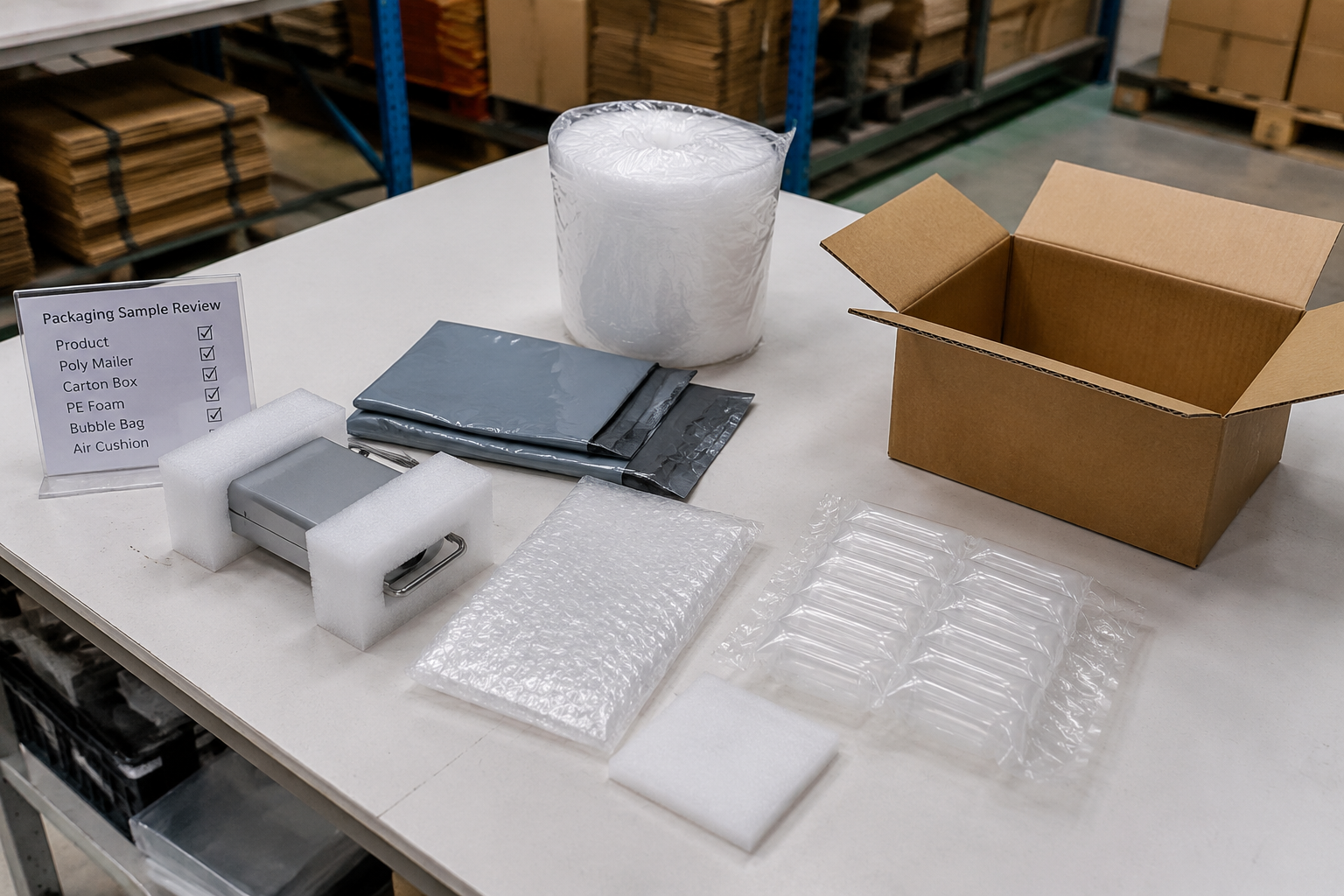
Supplier capabilities small buyers should test first
The first test is communication. A responsive supplier should ask about product size, weight, fragility, packing method, shipping route, and the buyer’s order mix before giving advice. If the reply is vague, that usually means the recommendation will be vague too. Clear specification support is the next test, because small buyers often need help converting a product description into usable packaging details.
Sample support matters just as much. A good supplier should be willing to prepare samples that reflect the real order, not just a loose example. Practical recommendations are another sign of flexibility. Sometimes the right answer is not a fully custom box or insert, but a standard carton, a better bag thickness, or a simpler cushioning layer. Production coordination also matters when the buyer needs foam, bubble, film, bags, and corrugated items to work together as one packing system rather than as separate purchases.
A practical supplier scorecard for a first order
Small importers can evaluate a supplier more clearly by using a simple first-order scorecard. The buyer can rate whether the supplier understood the product risk, recommended a suitable packaging level, provided usable samples, recorded specifications clearly, packed and labeled cartons as agreed, and communicated changes before they became problems. These checks are more useful than judging the supplier only by catalog range or unit price.
The scorecard should also include how the supplier reacts when the buyer asks for lower-risk options. A supplier that can suggest standard sizes, shared materials, or staged customization may be more suitable for a growing importer than one that immediately pushes complex custom packaging. The ability to simplify responsibly is often a sign that the supplier understands limited-volume purchasing.
After the first order, the same scorecard can guide the reorder decision. If the packaging performed well but one specification caused waste or slow packing, the buyer can adjust that point. If communication or sample consistency was weak, the buyer should be cautious about expanding customization too quickly. Supplier evaluation should become more specific after each cycle, not reset to a price comparison every time.
Where low unit price can create higher total risk
A cheap quote can create higher total risk if the packaging does not fit well, slows packing, or causes damage in transit. A weak fit may lead to product movement inside the carton, while poor packing details can increase labor time at the packing station. The wrong material choice can also produce waste, especially if the buyer ends up overusing void fill or replacing damaged goods later.
Inventory risk is another hidden cost. If the supplier pushes a low price by forcing a larger quantity than the buyer can use, the packaging may sit too long and outlast product changes. Repeat inconsistency is a final problem. If the first order and second order do not match closely, the buyer spends time checking every batch instead of building a stable sourcing rhythm. A slightly higher unit price can be easier to accept if the supplier reduces these risks and supports repeat support with better consistency.
For many buyers, the real comparison is not price versus price. It is price versus total outcome: damage, labor, space, and reorder reliability.
How Daipak fits a staged sourcing approach
Daipak, or Zhejiang Daipak Packaging Materials Co., Ltd., fits this kind of sourcing model as a practical China packaging materials supplier and protective packaging manufacturer. The useful part of that role is not a promise of a one-size solution. It is the ability to compare foam, bubble, film, bags, and corrugated options based on the product and the packing process.
For overseas B2B buyers, that factory-side view can make the early order easier to manage. A standard option may be enough for one product line, while another line may need a light adjustment or a combined packaging structure. The point is to keep the buyer moving forward with a workable setup, not to overbuild the packaging system before demand is clear.
Build a Traceable Specification File for the First Order
Small importers get better results when every packaging choice can be traced back to a measured sample, a written spec, and a clear use case. Save the product dimensions, weight, material thickness or density, carton style, print position, packing quantity, and the exact sample that was approved so the next quote can be compared against the same baseline. That makes it easier to see whether a new offer is truly different or just described differently.
Supplier names, catalog photos, and quotation headers should be treated as starting points, not proof of performance. A factory may be strong on one mailer size and less consistent on a different board grade or insert shape, so the safest judgment is version-specific: compare the exact carton, bag, foam part, or cushioning build that will be ordered, not the general product category.
Before approving a first order, buyers should review real sample photos and, where possible, use the actual product to check fit, seal, closure, carton compression, stacking behavior, and label placement. Stock images and broad packaging descriptions are useful for screening, but they do not replace a physical sample review.
For parcel-shipped goods, the buyer should also think beyond the sample table and ask how the package behaves in transit. Repeated vibration, compression, and handling checks are the right mental model for a first-order packaging decision, because a box that looks good in the warehouse can still fail when stacked, dropped, or moved through parcel networks.[7][8][9]
If the packaging touches food or carries recyclability language, the file should also record the compliance basis used for the material and wording. Buyers should confirm whether the pack is intended for food-contact use and whether any recyclable or compostable claim matches the actual structure and local guidance, rather than relying on a generic “eco” description.[1][2][3][4][6]
This traceable record shortens the next reorder conversation. Instead of restarting the discussion from scratch, the buyer can send the approved spec, the current usage rate, the sample photos, and the packing issue that the package must solve. That usually leads to a more practical second order with less back-and-forth and fewer avoidable changes.
Check Compliance Before You Scale a Packaging Format
If your package may touch food, treat compliance as a separate check from appearance. The European Commission keeps a formal food-contact materials framework, and the U.S. also regulates paper, paperboard, and polymer components that may be used in food-contact applications.[1][2][3]
For recyclable or compostable claims, keep the wording narrow. How2Recycle and the Association of Plastic Recyclers both focus on design-for-recycling guidance and consumer-facing labeling, while the FTC Green Guides caution buyers against environmental claims that the package design does not clearly support.[4][5][6]
Use Transit Checks Before You Repeat a Packaging Order
Packaging should also be checked against the route it will actually travel. ASTM D4169, ASTM D642, and ISTA 3A are useful references for thinking about shipping-cycle, compression, and parcel-delivery stress before you repeat a packaging order.[7][8][9]
A small importer does not need a laboratory program to learn from that idea. A short in-house check can still use the real product, the approved carton or mailer, and a brief handling test to see whether the package shifts, dents, or opens before the order is repeated.
Favor Fit-for-Purpose Packaging Over Overbuilt Packaging
It is also worth resisting the habit of overbuilding packaging on the first pass. ISO packaging guidance and the Sustainable Packaging Coalition both emphasize packaging that is fit for purpose rather than oversized or material-heavy by default.[10][11]
For a limited-volume buyer, this usually means choosing the smallest practical carton, the simplest insert that still protects the product, and the fewest packaging SKUs that can handle the real order mix. The goal is not minimal material at any cost; it is a package that protects the product, reorders cleanly, and does not trap cash in unnecessary stock.
Prepare a Quote Request That Gives the Supplier Room to Recommend
A strong packaging quote request does not need to be long, but it should be complete. If the buyer only sends a product name and asks for a price, the supplier has too little information to make a practical recommendation. If the buyer gives dimensions, weight, photos, fragility level, shipping method, and current packing concerns, the supplier can compare standard and semi-custom options more accurately. That usually leads to a better first order and fewer surprises later.
The best approach is to ask for practical alternatives, not just one fixed design. A supplier may see that a standard carton works well now, while a small adjustment in thickness or closure style would improve protection without creating unnecessary inventory pressure. This is especially helpful for limited-volume buyers who need a useful first order rather than a perfect but oversized packaging plan.
Details to include in the first quote request
Start with the product size, weight, and photos from a few angles. Include the packaging goal as well: protection, storage, shipping, retail presentation, or a combination of those. The supplier also needs the expected order quantity, sales stage, shipping route, and any known issues with the current packaging. If the product is fragile, scratched easily, or sensitive to compression, that should be stated clearly.
It also helps to share the preferred packaging type if one is already in mind, but keep the request open enough for the supplier to recommend alternatives. A buyer may think a printed carton is the answer, while the real need is a stronger insert or a better inner bag. For a first quote request, the more useful detail is usually the problem the packaging must solve, not the design idea the buyer started with.
Questions to ask when volume is still limited
When order volume is small, buyers should ask whether standard sizes are available before requesting a new structure. They should also ask whether mixed orders are possible, especially if several packaging items are needed for the same product line. Sample options should be discussed early so the buyer can confirm fit before bulk packaging quotation and production.
Material alternatives are worth asking about too. A supplier may be able to suggest a different thickness, a different carton style, or a simpler protective layer that still meets the product’s needs. Buyers should also ask how packing quantity is usually arranged and whether repeat-order flexibility is realistic if sales grow. Those questions help the supplier recommend a starter setup that does not lock up too much cash or storage space.
Verification Note: When possible, buyers should review real sample photos, size measurements, material specifications, carton labels, packing quantity, and fit with the actual product before approving a first order. Stock images, catalog descriptions, and supplier claims alone are not enough for a reliable judgment when packaging will affect damage risk, storage space, or repeat-order consistency.
How to keep the first order open for improvement
The first order should be treated as a baseline, not the final answer. Once the buyer sees how the packaging performs in real packing and shipping conditions, the next order can be adjusted with better judgment. That might mean changing the quantity, simplifying the mix, improving protection, or adding a small amount of branding where it actually helps.
This is why a staged quote path works well: start with standard options, add light customization only if it solves a real problem, confirm samples, then use real sales and packing data to improve the next order. For limited-volume importers, that approach keeps the first purchase practical and leaves room for better decisions later. It also gives the supplier enough room to recommend packaging that balances cost, protection, and inventory pressure instead of forcing a rushed choice.
References
[1] European Commission, “EU Food Contact Materials,” food contact materials framework for packaging that may come into contact with food, available at EU Food Contact Materials.
[2] eCFR, “21 CFR Part 177 Polymers,” U.S. regulation covering polymers used in food-contact contexts, available at 21 CFR Part 177 Polymers.
[3] eCFR, “21 CFR Part 176 Paper and Paperboard,” U.S. regulation covering paper and paperboard used in food-contact contexts, available at 21 CFR Part 176 Paper and Paperboard.
[4] How2Recycle, “How2Recycle Label Guidance,” consumer-facing guidance for recyclability labeling and instructions, available at How2Recycle Label Guidance.
[5] Association of Plastic Recyclers, “APR Design Guide Overview,” design guidance for plastic packaging recyclability, available at APR Design Guide Overview.
[6] Federal Trade Commission, “FTC Green Guides,” environmental marketing guidance for recyclable, degradable, compostable, and related claims, available at FTC Green Guides.
[7] ASTM International, “ASTM D4169 Shipping Container Performance Testing,” performance testing practice for shipping containers and systems, available at ASTM D4169 Shipping Container Performance Testing.
[8] ASTM International, “ASTM D642 Compression Resistance,” compression resistance test method for shipping containers, available at ASTM D642 Compression Resistance.
[9] ISTA, “ISTA Procedure 3A Overview,” packaged-product test overview for parcel delivery systems, available at ISTA Procedure 3A Overview.
[10] ISO, “ISO 18602 Packaging Optimization,” packaging optimization framework for source reduction and fit-for-purpose packaging, available at ISO 18602 Packaging Optimization.
[11] Sustainable Packaging Coalition, “Packaging Design,” sustainability-oriented packaging design guidance, available at Sustainable Packaging Coalition Packaging Design.
Packaging Supplier Guides cornerstone library
Cornerstone guides for this topic
Keep these Packaging Supplier Guides guides close while you read. They are the standing references for the decisions covered on this page.
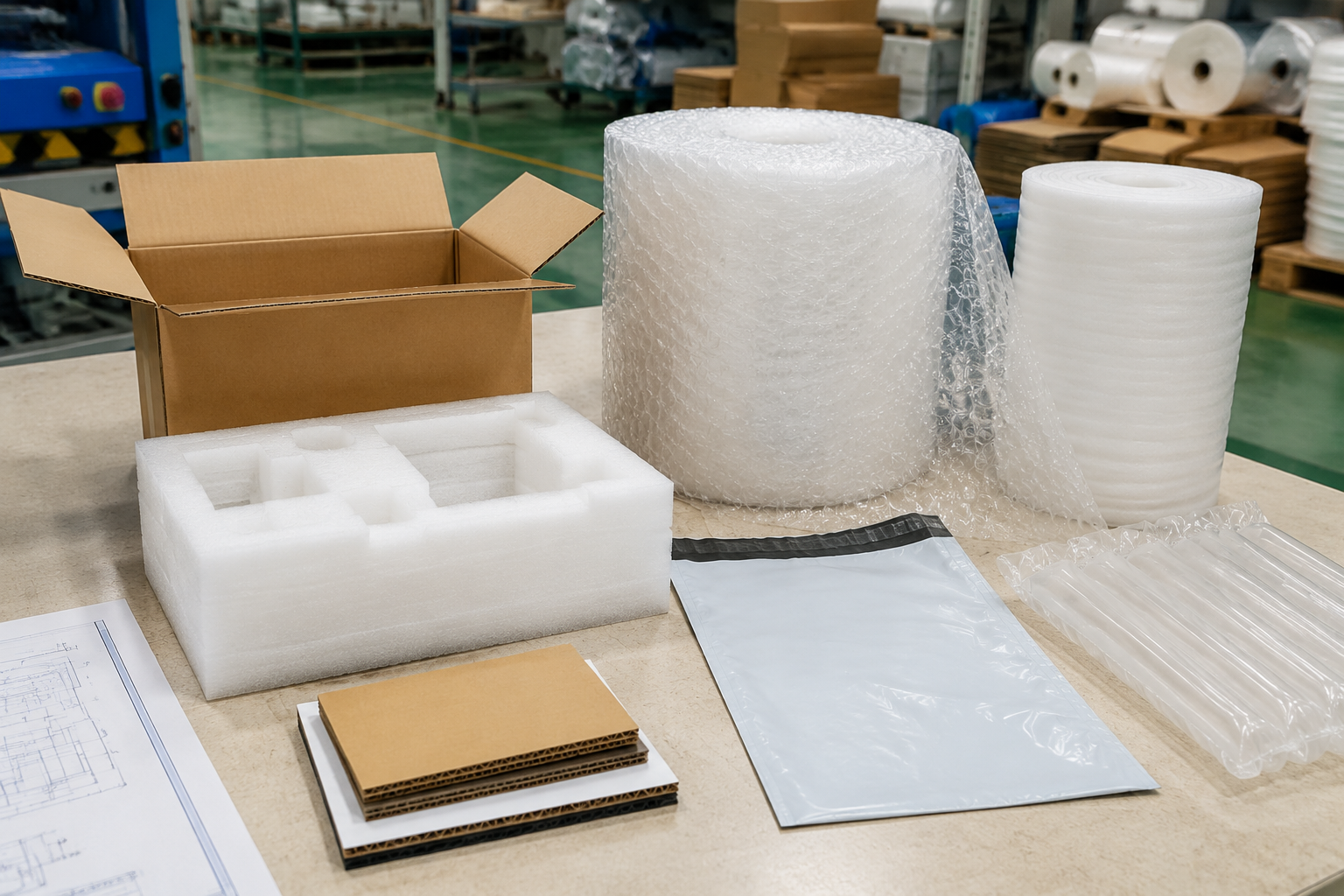
Wholesale Packaging Materials in China: Samples, MOQ, Quotation, and Bulk Order Process
Wholesale packaging materials from China can look simple at the inquiry stage, but the real decision depends on much more than naming a material...
Read cornerstone guide
Packaging Manufacturer vs Trading Company in China: What Overseas Buyers Should Check
When you are sourcing packaging from China, the main decision is not just who gives the quote. It is whether the supplier can handle...
Read cornerstone guide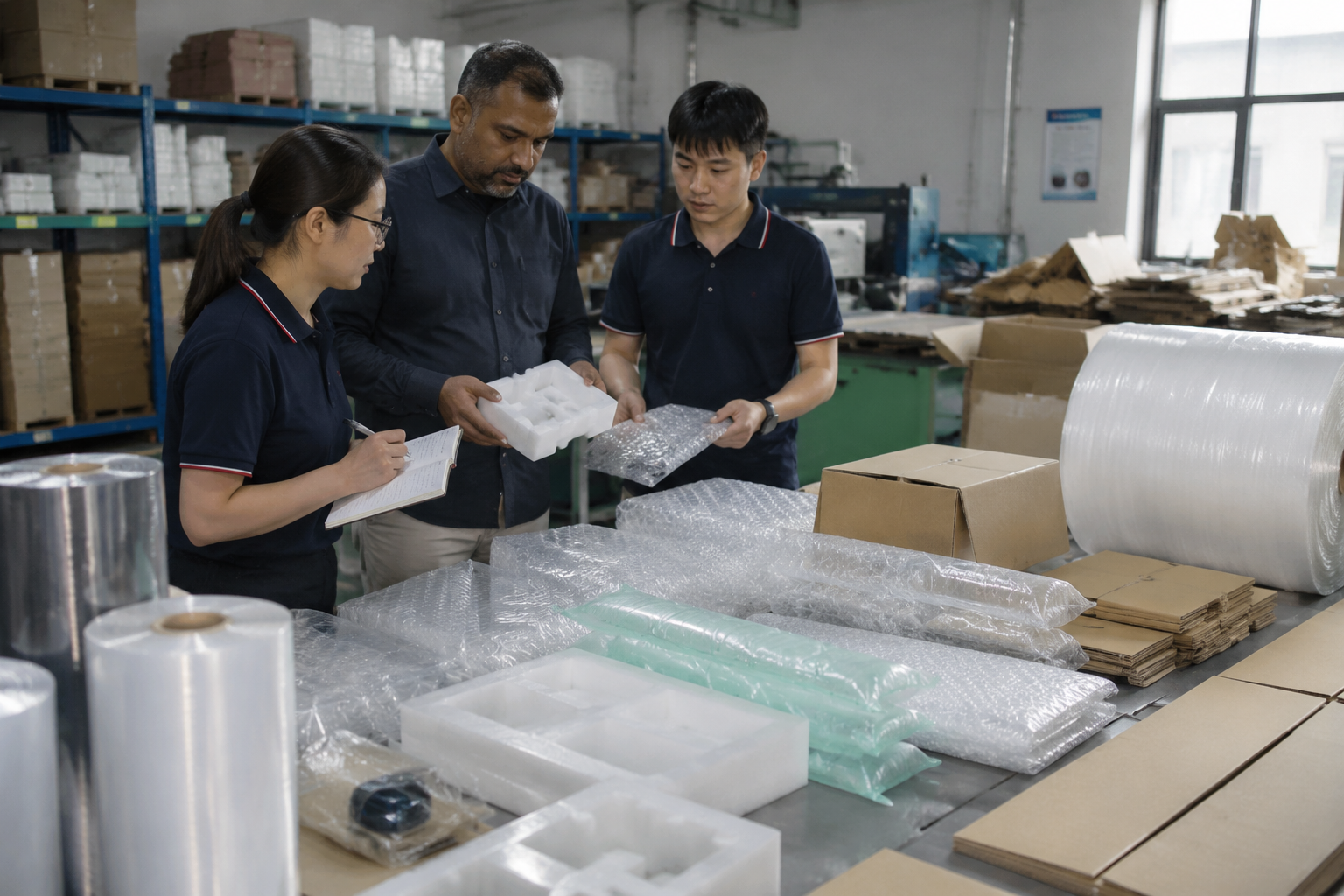
China Packaging Materials Supplier Guide: How to Choose the Right Factory for Custom Packaging
Choosing a China packaging materials supplier is not only about finding a factory that can quote foam, bubble wrap, cartons, film, or plastic bags....
Read cornerstone guide