
Carton damage during export shipping is rarely caused by one simple issue. A box may fail because the carton board is too weak, the product fit is poor, the pallet overhangs, humidity softens the material, or an export packaging documentation checklist fails to capture how the container load shifts during a long route. This article helps buyers look beyond the carton name and trace where damage is most likely to start.
The practical decision is how much protection is needed without adding unnecessary material cost or freight volume. You will see how carton size, gross weight, stack height, pallet pattern, moisture control, labels, documents, and loading records all affect export performance. The goal is to approve packaging that matches the product, route, handling method, and repeat-order quality checks.
Quick Packaging Decision Guide
| Buyer Question | Practical Reading | What to Check |
|---|---|---|
| Is the carton itself the problem? | Not always; damage can come from packing, pallets, humidity, or rehandling. | Seams, board strength, carton fit, pallet build, and handling records. |
| Will a stronger carton solve export damage? | Only if board strength is the weak point; overspecifying may raise cost and volume. | Product weight, stack height, route severity, and compression risk. |
| How important is pallet stability? | Very important, because unstable pallets create corner crush, shifting, and uneven pressure. | Footprint alignment, layer pattern, wrap tension, straps, and corner boards. |
| What changes for sea freight? | Long transit and humidity can soften cartons, damage labels, and affect metal parts. | Storage time, liners, desiccants, moisture barriers, and container condition. |
| Can smaller cartons reduce cost? | Sometimes, but only if they improve loading without slowing packing or deforming goods. | Carton dimensions, pallet height, container utilization, labor, and damage rate. |
| What should be verified before shipment? | Final checks are cheaper before departure than after damage or customs delays occur. | Labels, counts, documents, pallet photos, moisture controls, and loading evidence. |
Quick Questions Before You Read
Q: Is carton damage always a packaging supplier issue?
No. It may come from carton design, poor palletizing, warehouse handling, container loading, humidity, or shipment delays.
Q: What information should I confirm before choosing export cartons?
Confirm product size, gross weight, fragility, packing method, pallet pattern, stack height, route, and expected storage conditions.
Q: Is the lowest carton price usually cheaper overall?
Not if it increases damage, rework, freight volume, slow packing, or rejected shipments. Compare total landed packaging cost.
Q: Why do documents matter for carton protection?
Incorrect shipping marks, counts, HS codes, or packing lists can cause delays and extra handling, which increases damage risk.
Start With the Failure Mode, Not the Carton Name
Export carton damage is rarely caused by the carton name alone. A box can be labeled “strong” and still arrive crushed if the load was stacked badly, exposed to moisture, shifted in transit, or held up long enough for handling to multiply the risk. The first step to prevent carton damage during export shipping is to identify where the failure starts: on the packing floor, in the warehouse, during truck pickup, at the port, inside the container, or at destination unloading.
This matters because the cost of damaged export cartons is not limited to the box itself. Crushed cartons can lead to arrival damage, rework, rejected goods, delayed clearance, and extra labor at the destination. In export shipping packaging, the carton is only one part of a much larger system. If the pallet, wrap, route, and paperwork are weak, even a good carton can fail.
A practical review should begin with the question, where does the damage start? If the answer is unclear, buyers often fix the wrong thing. They may specify a heavier carton when the real issue is shifting on the pallet, or they may blame loading when the real issue is moisture damage from a humid lane. The goal is to separate carton weakness from logistics failure before production starts.
For a useful damage review, buyers should collect more than a short complaint such as “cartons arrived crushed.” Photos should show the outside carton, inner packing, pallet condition, container position if known, shipping marks, and whether damage is concentrated on corners, side panels, top layers, or bottom layers. Corner crush often points to stacking or pallet pressure, split seams may suggest overfilling or weak sealing, and damp staining usually needs a moisture and storage review. This evidence helps the supplier, warehouse team, and freight partner discuss the actual failure instead of guessing from the carton grade alone.
Before Daipak recommends a carton structure or pallet plan, the buyer’s product information gives the review a clearer basis. Product size, unit weight, photos, drawings, quantity per carton, packing method, shipping destination, and expected transport mode help connect the damage risk to a practical specification. Without those details, the supplier may only quote a general carton, while the real need may involve a different board structure, inner partition, sealing method, pallet height, or moisture-control plan.
Where export damage usually begins in the supply chain
Many damaged shipments are already vulnerable before the container even moves. On the packing floor, cartons can be overfilled, underfilled, or sealed poorly, which makes them easier to crush or split later. In the warehouse, repeated rehandling can cause corner wear, punctures, and edge collapse, especially when cartons sit near forklift traffic or get stacked unevenly.
Truck pickup adds another layer of risk. Sudden stops, vibration, and mixed cargo can shift the load before it ever reaches the port. At port handling, cartons may be lifted, dropped, or compressed again during sorting and staging. Once inside the container, pressure from nearby cargo, poor load distribution, and long transit time can turn a small weakness into visible arrival damage.
Moisture damage often begins even earlier than buyers expect. A carton that looks fine at the warehouse can absorb humidity while waiting for loading, then weaken further when the container experiences temperature swings at sea. That is why the damage story usually starts with exposure, not with the carton label.
Which problems are packaging problems and which are logistics problems
Not every damaged carton means the corrugated board was wrong. Some failures are packaging problems, such as a carton that is too light for the stacked weight, a weak seam, poor cut accuracy, or a spec that does not match the product size. These are design and production issues, and they should be fixed before shipment approval.
Other failures belong to logistics. A strong carton can still crush if the pallet overhangs, if the container is loaded with uneven pressure, or if the route involves repeated rehandling. A shipment can also arrive damaged because the documents were wrong, which delayed release and kept the cargo in poor conditions longer than planned. In that case, the box may not be the real problem at all.
The useful way to review risk is to ask three questions: does the carton match the product load, does the pallet and loading method protect the carton, and do the documents support a smooth release? When buyers separate those responsibilities, they can fix the correct weak point instead of overspecifying the entire pack.
Set Clear Boundaries for Special Packaging Claims
Some export packaging requests involve claims that should be confirmed before they appear on cartons, labels, sales documents, or product pages. Words such as recyclable, compostable, food-contact suitable, moisture barrier, anti-static, heavy-duty, or compliant can mean different things depending on the material, structure, destination market, and intended use. Buyers should treat these as specification questions, not as general descriptions.
If environmental claims matter for the order, the buyer should confirm the material composition, recycling stream, labeling requirements, and destination-market rules before using those claims in customer-facing materials. U.S. environmental marketing guidance expects green claims to be clear, qualified where needed, and supported rather than broad or vague.[9] For flexible packaging, design choices such as material mix, inks, adhesives, closures, and labels can also affect recyclability discussions and should be reviewed before production if recyclability is part of the selling point.[10]
If the packaging will directly contact food, cosmetics, medical products, electronics, lithium batteries, or regulated goods, the packaging specification should be checked separately before production. Daipak Packaging can discuss foam, bubble, film, corrugated, and custom packaging options, but the buyer should confirm the applicable product-use requirements, destination rules, and documentation needs with the responsible importer, brand owner, freight provider, or qualified advisor. A carton or inner pack that is suitable for ordinary export protection should not automatically be treated as suitable for every regulated end use.
Match Carton Specification to Route, Stack Height, and Cargo Weight
Export carton strength should be selected for the actual shipping condition, not for a generic box description. A corrugated carton for export must handle stack load, route severity, humidity, and the way the cargo will be handled at each stage. A carton that is strong enough for short domestic movement may be too weak for a long ocean lane, while a carton that is overly heavy can raise freight cost and reduce loading efficiency without adding meaningful protection.
Buyers should treat shipping carton specification as a balance of strength, size, and transit exposure. If the product is heavy or the stack is tall, carton compression becomes a serious issue. If the route is humid or delayed, board performance can fall faster than expected. If the cartons will be palletized, the load pattern and wrap method also affect how much strength is really needed.
At Daipak, this discussion usually starts with the product details and the route, not the box name. The same board grade can be acceptable in one lane and too weak in another, depending on weight, stacking height, and handling frequency.
For custom export cartons, a specification review should include the product drawing or dimensions, weight per piece, quantity per carton, inner protection method, carton sealing method, and whether the product has sharp edges, polished surfaces, painted finishes, or parts that can scratch each other. Fragile items may need EPE foam, bubble wrap, paper dividers, corrugated partitions, or air cushion packaging inside the carton so the outer box is not expected to absorb every shock. If the product surface is easily marked, the inner wrap should prevent abrasion and dust as well as impact; a strong master carton cannot fix scratches caused by poor separation inside the box.
Once the carton specification is confirmed, it should become a production requirement rather than a loose preference. Board grade, flute or structure, carton size, cutting accuracy, sealing tape, printing content, label position, and quantity per carton usually need to be checked against the approved sample, drawing, or written order detail. This makes it easier for production and quality teams to compare finished cartons with the same reference the buyer approved, instead of relying on memory or a general product name.
When the shipment value, damage history, or customer requirement justifies it, buyers should move from opinion-based carton selection to test-based validation. Compression resistance can be checked with a defined method for shipping containers, while free-fall drop testing can help evaluate whether a loaded package survives common handling impacts under controlled conditions.[1][2] These tests do not guarantee perfect arrival, but they give the buyer and supplier a clearer basis for comparing carton grades, inner packing, sealing methods, and pallet plans before a large export order ships.
What buyers should confirm before approving a carton spec
Before approving production, buyers should confirm the carton size, product weight, and how much stacking load the carton will carry during export transit. A carton that fits the product too tightly can buckle more easily, while one that is too large can leave room for movement and edge damage. Size and structure need to work together.
Board strength matters as much as size. Buyers should ask whether the carton will be shipped loose or on pallets, because palletized cartons may need a different balance of compression strength and cube efficiency. If cartons sit in a humid lane or wait in a port warehouse, the spec should also account for moisture exposure, not just dry-room handling.
Print and shipping marks matter too. A carton that carries heavy marks, handling icons, or destination information should still leave enough board performance for the load itself. The best time to check the spec is before approval, not after the first sample already looks right on the packing table.
Specification Confirmation Note: Before Daipak prepares mass production for export cartons or combined protective packaging, the buyer should confirm size, thickness, board structure, quantity per carton, inner packing method, printing, labels, carton marks, and pallet or loose-loading requirements so the factory can produce against one clear specification.
When a stronger carton is not the best answer
A stronger carton is not always the better carton. Overspecifying can increase material cost, add weight, and reduce the number of cartons that fit per pallet or per container. That extra volume can raise freight cost even when the unit carton price looks acceptable.
In export shipping, cube efficiency matters. If a heavier board pushes the outer dimensions up or makes the carton harder to fold and stack, the shipment may need more pallets or more container space. The result is often a higher total landed cost, not a better pack.
The better choice is the carton that is strong enough for the route, stack height, and cargo weight without wasting freight volume. Buyers should compare the real cost of damage against the real cost of extra board, extra cube, and extra handling time. That is usually the right way to judge a carton spec before shipment.
Build Stable Pallets Before the Container Moves
Palletizing for export protects cartons from handling shock, edge crush, and stack collapse. A strong carton can still fail if the pallet build shifts during truck movement or container loading. The real goal is unit load stability: cartons, pallet footprint, wrap tension, straps, and corner support all working together so the load stays square from the warehouse to destination unloading.
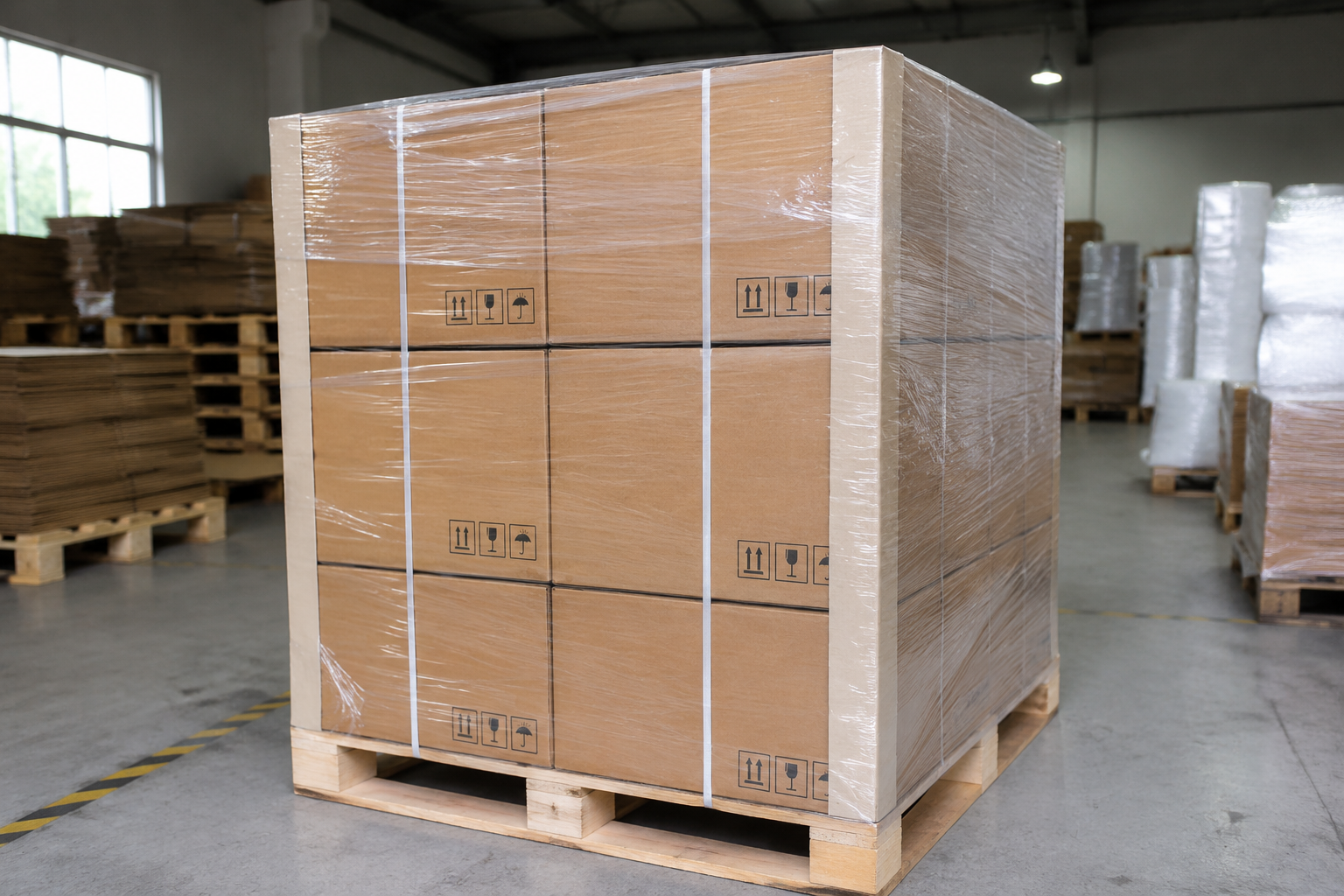
A stable pallet build also helps with labor and traceability. Workers can move it more safely, count it more accurately, and inspect it more quickly. If the pallet is unstable, the shipment often gets rehandled, tightened, or reworked, which adds time and creates more damage risk. For export packing, the pallet is not just a base; it is part of the protective system.
For large or palletized shipments, the pallet should be planned as a handling unit rather than a pile of cartons. Export packing guidance for large and palletized cargo emphasizes securing the load to the pallet, maintaining a stable footprint, and protecting the shipment from movement during transport.[3] In practice, this means buyers should approve the pallet pattern, not only the carton drawing.
A pallet plan is easier to control when the supplier records the carton quantity per layer, layers per pallet, total pallet height, gross weight, wrap method, label position, and carton marks before loading. These details connect the physical shipment to the packing list and loading photos. If the destination warehouse reports crushed corners or missing cartons, the buyer can compare the arrival condition with the approved pallet build instead of reviewing the problem from a single delivery complaint.
How pallet footprint and carton footprint should align
The pallet footprint and carton footprint should align as closely as practical. Overhang leaves the carton edges exposed to impact, and even a small overhang can become a crush point when the pallet is pushed, lifted, or stacked. Misalignment also makes the stack less stable, especially when the load is tall or the cartons are not all the same weight.
Uneven layers are another common problem. If one layer is shifted or has gaps, pressure does not distribute evenly through the stack. That can cause the lower cartons to bow, the corners to compress, and the whole pallet to lean during transit. A stable export pallet load depends on keeping the footprint square and the layer pattern consistent.
Pallet dimensions should fit the route and the warehouse equipment, not only local habit. If a pallet format works in one facility but does not match the container pattern or forklift setup at destination, the shipment may suffer from more movement and more handling than planned.
How wrap, straps, and corner protection work together
Stretch wrapping holds the load together, but wrap alone is not enough if the cartons are already unstable. The wrap should be tight enough to limit movement without crushing the carton top, following export palletizing best practices that help keep the stack square and reduce shifting during handling. Too little tension lets the load shift; too much tension can deform the carton edges and create pressure points.
Straps add another layer of restraint, especially when the pallet is tall or the route is rough. Corner boards help distribute strap pressure and protect the carton edges from cutting or bending. Used together, wrap, straps, and corner protection reduce tilt, side movement, and impact damage during loading and transit.
The right combination depends on the cargo weight, stack height, and route severity. A short domestic trip may need less reinforcement than a long ocean shipment. For export lanes with more rehandling, buyers should ask for a stable pallet build that keeps the load from shifting before the container even closes.
Mixed pallet loads need extra judgment because not all cartons carry pressure the same way. Heavy cartons, dense film rolls, and boxed hardware should not be stacked over light bubble wrap, air cushion products, foam inserts, or thin retail cartons unless the load path is designed for it. If a shipment combines different carton sizes, the pallet plan should show which SKUs sit at the bottom, how gaps are filled, and whether top caps, slip sheets, dividers, or corner boards are needed to keep pressure even. A neat-looking pallet is not enough if the weight distribution is wrong.
Factory Coordination Note: When one export order includes corrugated cartons, EPE foam, bubble wrap, plastic film, and pallet protection, coordination across materials helps keep carton size, inner protection, packing quantity, pallet height, and loading sequence consistent before the shipment is released.
Confirm wood pallet and handling mark requirements
If the export shipment uses solid wood pallets, crates, or other wood packaging material, the buyer should confirm whether the destination market requires treatment and marking under ISPM 15. The international standard covers regulation of wood packaging material in international trade, and destination requirements can affect whether a pallet is accepted, delayed, or rejected.[4] This check should happen before packing, because changing pallets after cartons are stacked and wrapped adds handling risk.
Handling symbols should also be treated as shipment instructions, not decoration. Standardized package handling symbols help communicate storage and handling needs across languages and logistics teams.[5] If cartons require “keep dry,” “this way up,” fragile handling, stack limits, or other marks, the buyer should confirm the symbol set, print position, and document consistency before mass carton production.
Control Moisture and Condensation on the Way to Port
Moisture damage is one of the quietest causes of export carton failure. A carton may look acceptable when it leaves the packing floor, but after warehouse dwell time, truck movement, port waiting, ocean transit, and destination unloading, softened board can lose stacking strength and show crushed corners, bulged panels, staining, or delamination. The risk is higher when cartons travel through humid ports, tropical climates, long ocean routes, or large temperature swings between day and night.
Export moisture control should be matched to the route and the product. A dry short-haul shipment moving quickly by truck or air may not need added controls beyond good carton storage and proper wrapping. A long sea shipment through humid conditions is different. Container humidity and temperature changes can create condensation inside the container, often called container sweat. If that moisture reaches the carton surface or is trapped under wrap, the carton can weaken before it ever reaches the buyer’s warehouse.
The carton specification and the moisture plan should be reviewed together. Stronger board helps with stacking, but even a strong corrugated carton performs worse when it absorbs moisture. Products with metal parts, paper components, electronics, textiles, coated surfaces, or retail packaging may also need extra protection because the concern is not only carton collapse. Rust, odor, mold risk, label damage, and stained inner packaging can all become receiving problems.
For moisture-sensitive shipments, buyers should avoid vague language such as “waterproof carton” unless the package design and test evidence support the claim. Water vapor transmission and conditioning practices are measurable topics in package testing, and they depend on the container, material, exposure condition, and test setup rather than on the carton name alone.[6][7] A more useful request is to define the expected route, storage time, humidity risk, and the part of the shipment that must be protected.
When moisture control matters most
Moisture control matters most when transit time is long, the route crosses different climate zones, or cargo may sit at port before loading or after arrival. A shipment from an inland factory to a coastal port may already face several handling and storage points before the container is sealed. If the cargo then moves by ocean freight through hot and humid conditions, small moisture exposure can become a larger problem over time.
Temperature swings are especially important. A container loaded in warm, humid air and then exposed to cooler night temperatures may develop condensation on interior surfaces. If the carton stacks are tight against the container wall or roof area, moisture can affect the outer cartons first. These cartons often carry more stacking pressure and are more likely to show compression damage at destination.
Some cargo is more vulnerable than others. Lightweight packaging materials, printed cartons, paper-based products, fabric goods, and items packed in retail boxes can be sensitive to moisture even if they are not breakable. Heavy goods also need attention because softened cartons under weight can deform quickly. In these cases, the buyer should not treat moisture control as an optional accessory; it is part of carton protection in humid transit.
What to ask for in humid or long-transit lanes
For a humid lane or long ocean route, buyers should ask the supplier to review the full moisture path: factory storage, carton packing, pallet wrapping, container condition, and loading timing. Moisture control works best when these steps support each other. Adding desiccant is less effective if cartons are loaded wet, stored outside, or wrapped in a way that traps surface moisture against the board.
Useful controls may include a liner bag for product groups or master cartons, desiccant inside the carton or container where appropriate, moisture barrier material for sensitive goods, and stretch wrap applied with enough coverage to stabilize the pallet without sealing in damp cartons. For some shipments, a pallet top sheet can help protect against light exposure during handling, while still allowing the load plan to avoid direct contact with wet floors or container walls.
Before shipment, the buyer should confirm what is being protected: the product, the carton, the pallet load, or all three. A liner bag protects the contents more than the outside carton. Desiccant helps reduce moisture in a closed space, but placement and quantity should match the cargo and route. Stretch wrap improves unit load stability, but it is not a complete moisture barrier unless the wrapping method and material are selected for that purpose. The practical question is not “Do we need extra protection?” but “Which part of the shipment will fail first if moisture appears?”
Review Sensitive Products Before Packing Decisions Are Locked
Some export shipments need an extra review because the product category affects packaging, documents, carrier acceptance, or destination inspection. Food-contact packaging, medical or pharmaceutical goods, cosmetics, electronics, lithium batteries, hazardous goods, and child-related products should not be handled with a one-size-fits-all carton plan. Requirements may vary by product, market, carrier, and route, so the buyer should confirm applicable rules before production and before freight booking.
If plastic, paper, adhesive, coating, foam, or film will be used in a direct food-contact application, the buyer should confirm the intended market and applicable food-contact requirements separately. U.S. rules include provisions for polymers, paper and paperboard, adhesives, and coatings used in food-contact contexts, while EU rules include framework and plastic material requirements for food-contact materials.[11][12][13][14] A protective export carton or inner wrap should not be described as food-contact suitable unless the exact material, use condition, and documentation have been reviewed for that purpose.
For regulated transport, buyers should not assume that a strong carton is enough. Hazardous materials, dangerous goods, lithium batteries, and some chemical or aerosol products may require specific packaging, marks, labels, documents, and carrier acceptance steps. International and U.S. dangerous goods references include packaging-related provisions, but the exact requirement depends on the product classification and route.[15][16] These checks should be completed before the supplier finishes cartons, labels, or pallet marks, because late changes can create delays and extra handling.
Load the Container to Prevent Shifting, Crush, and Rehandling
Good pallet packing can still fail if container loading is careless. During export shipping, cartons face vibration, braking force, lifting, tilting, and sometimes transshipment before arrival. If cargo can move inside the container, carton edges and corners take repeated impact. If weight is not distributed correctly, lower cartons can carry more pressure than the carton specification was meant to handle.
Container loading should control three things: vertical pressure, side movement, and rehandling exposure. In an FCL shipment, the supplier and freight team usually have more control over loading pattern, dunnage, and load distribution. In LCL shipment, cargo may be consolidated, unloaded, reloaded, and handled with other goods. That added rehandling can increase carton damage risk, especially for loose cartons, mixed cartons with different sizes, or pallets that are not easy to identify and separate.
Some damage blamed on weak cartons actually starts with poor stowage. A carton stack that leans, a gap that allows cargo shifting, a heavy SKU loaded over a lighter SKU, or a pallet placed against an uneven cargo surface can create concentrated pressure. Freight damage prevention depends on the carton and pallet, but it also depends on whether the load behaves as one stable cargo block during movement.
For heavier export loads, container planning should account for mechanical handling as well as static stacking. Test methods for mechanical handling of large shipping cases, crates, and unitized loads show why forklift movement, clamp pressure, lifting, and other handling events can be part of the risk picture for unitized cargo.[8] Buyers do not need to run every test for every shipment, but they should recognize that a pallet strong enough while standing still may still fail if it is poorly supported during handling.

How loading method changes carton survival
Loading method changes how pressure moves through the cargo. When cartons are stacked evenly, with aligned corners and flat contact surfaces, compression moves down through the strongest parts of the box. When cartons are offset poorly, overhanging, or pressed against uneven cargo, pressure moves into side panels and weak edges. That is where crushed corners, split seams, and dented carton faces often appear.
Side pressure also matters. A container that is only partially filled can allow cargo to shift unless void fill, blocking, bracing, or dunnage is used. Even small movement can damage cartons during a long route because the impact repeats many times. Tight loading can reduce movement, but it should not mean forcing cartons into place or pressing them against container ribs, door edges, or sharp pallet corners.
Mixed SKUs need special attention. Heavier cartons should normally sit lower, lighter or more fragile cartons should not carry unplanned top load, and cartons with different heights should not create unstable layers. If top stacking is necessary, the top load should be planned and visible in the loading record. If the shipment includes foam, bubble wrap, plastic film, corrugated boxes, or other low-weight high-volume packaging materials, the load may look full but still need restraint because the cargo can compress or shift under movement.
When transport mode is part of the packaging decision
Sea freight usually creates the strongest need for container loading discipline because transit time is longer and humidity, vibration, and port handling all combine. Cartons may spend weeks under compression, so stacking pattern and load distribution matter as much as the carton grade. For sea freight, buyers should confirm whether the cargo is palletized, floor-loaded, mixed with other cargo, or likely to be transshipped.
Air freight often has shorter transit time but different handling pressure. Cartons may move through faster sorting and more frequent manual handling, so label visibility, carton weight, and edge protection can become more important. A carton that is acceptable for palletized sea freight may not be ideal if it will be handled loose by multiple teams. The packaging decision should follow the real handling path, not only the transport name.
Truck-to-port movement also deserves attention. Damage can begin before the container reaches the vessel, especially if pallets are loaded into a truck without proper restraint or if cartons wait in a warehouse staging area. For export orders, the buyer should ask for a clear loading method, not just a finished goods photo. A useful loading record usually shows container condition, pallet placement, row pattern, dunnage or void fill, door area condition, and final seal confirmation.
Use Shipping Marks and Documents to Avoid Delays That Turn Into Damage
Carton damage is not always caused by impact or compression. It can also begin with a paperwork mismatch that delays customs clearance, inspection, or warehouse release. When shipping marks, packing list details, commercial invoice information, HS code, carton count, or weight data do not match, the shipment may be held, opened, moved, restacked, or stored longer than planned. Every extra handling step increases the chance of crushed cartons, moisture exposure, and missing or mixed goods.
Shipping marks connect the physical cartons to the export paperwork. They should help warehouse teams, freight forwarders, customs brokers, and the receiving team identify the shipment quickly. Marks that are too small, inconsistent, missing from some cartons, or different from the packing list can create confusion during inspection or delivery. For export shipments, clear marks are not decoration; they are part of shipment control.
A document check before shipment should focus on what customs and receiving teams will compare. The goal is not to make paperwork complicated. The goal is to keep the physical cargo, labels, and documents consistent enough that the shipment can move without unnecessary delay or rehandling.
The document review should be tied back to the packed goods, not handled only as an office task. Carton marks, pallet labels, carton numbers, PO numbers, destination details, gross weight, net weight, carton dimensions, and packing quantity should be checked against the actual packed shipment before release. This gives the buyer and supplier a clearer basis for resolving receiving questions, because the cartons, packing list, invoice, and loading photos all describe the same shipment.
Label durability should be considered together with the carton surface and route. Paper labels can scuff, peel, or become unreadable if cartons are wrapped too tightly, exposed to moisture, or handled many times in consolidation warehouses. For export cartons, buyers should confirm label position, adhesive suitability, barcode readability where required, and whether marks should be printed directly on the carton instead of applied as separate labels. A clear label at the factory is not enough if it cannot survive warehouse handling and destination receiving.
The documents that should match the physical shipment
The packing list should match the actual carton count, pallet count, SKU description, carton dimensions, gross weight, net weight, and packing quantity. If the shipment includes several product types, the carton marks should make it clear which cartons belong to which SKU or purchase order. A receiving team should be able to compare the marks on the cartons with the packing list without guessing.
The commercial invoice should align with the packing list on product description, quantity, buyer and seller information, shipment reference, and trade terms. The HS code should be reviewed before shipment because classification issues can delay clearance or trigger additional questions. Buyers should confirm classification requirements with their broker or qualified advisor where needed, especially when importing packaging materials, printed packaging, plastic film, foam products, or mixed packaging sets.
Common customs-document errors include carton counts that do not match the physical load, weights that were copied from old orders, dimensions that ignore pallet height, product descriptions that are too vague, and shipping marks that changed after documents were prepared. These errors can look small during order coordination but become expensive if the cargo is held at port or opened for inspection. For this reason, the final document set should be checked against the actual packed shipment, not only against the purchase order.
Why Incoterms change who controls packaging risk
Incoterms affect who controls parts of the shipment process, including pickup timing, freight booking, loading responsibility, insurance arrangement, and claim handling. They do not replace good packaging, but they influence who has the authority to decide how cargo is handled after it leaves the factory or warehouse. If the buyer controls the main freight, the buyer should make sure the supplier receives clear packing, marking, and handover requirements before release.
Under some trade terms, the supplier may be responsible for export-side preparation and delivery to a named point. Under others, the buyer or buyer’s forwarder may take control earlier. This matters because damage risk can shift at the handover point. If the carton condition, pallet build, container loading, and shipping marks are not recorded before transfer, it becomes harder to identify where damage occurred and harder to support a claim.
For export coordination, Daipak Packaging should review carton marks, packing quantity, destination details, and delivery terms early in the order discussion. Those details affect not only the document set, but also how the cargo should be packed, labeled, handed over, and checked before shipment. A clear agreement before loading is much easier than trying to solve a paperwork mismatch after the cargo is already moving.
Coordinate shipment approval before freight is booked
Packaging approval and freight booking should not happen in separate conversations. If the freight forwarder books space based on estimated carton dimensions, but the factory later changes carton size, pallet height, or loading quantity, the shipment may face extra cost, split loading, or last-minute repacking. Buyers should ask the supplier to confirm final carton dimensions, gross weight, pallet count, and estimated container volume before the booking is locked.
This coordination is especially important for repeat export orders. A previous shipment record can help, but it should not replace a current check. If material thickness, foam density, carton board grade, label format, or quantity per carton has changed since the last order, the loading plan and documents should be reviewed again. Consistent repeat orders come from controlled specifications and feedback, not from assuming that every reorder is identical.
Balance Freight Volume Against Packaging Protection
Export freight cost is not driven only by carton price. For many packaging materials, especially bubble wrap, EPE foam, air cushion products, plastic bags, film rolls, and corrugated boxes, the shipment may be light in weight but large in volume. In that situation, freight volume and dimensional weight, along with China export packaging preparation details such as carton packing, palletizing, and labels, can matter as much as material cost. A carton that saves a little on board grade or packing labor may still raise the total landed cost if it wastes container space, creates unstable pallet height, or increases arrival damage.
This is a common issue for buyers sourcing from a packaging material supplier in China. A shipment of low-weight high-volume cargo may reach its freight limit by cube before it reaches the carrier’s weight limit. If carton dimensions are not planned carefully, the buyer may pay for empty space inside cartons, gaps between pallet loads, or unused container height. On the other hand, pushing the packing too tightly can deform soft materials, slow warehouse handling, or make cartons difficult to unload without damage. The right decision usually sits between protection, cube efficiency, and handling practicality.
Good cube utilization starts with the product form. Flat plastic bags, compressed foam sheets, bubble wrap rolls, postal boxes, and custom inserts do not use space the same way. Some materials can be nested, folded, compressed, or packed in tighter bundles. Others lose performance if they are crushed before use. The carton and pallet build should reflect that difference instead of using one standard export carton size for every item.
When a smaller carton saves more than a cheaper carton
A smaller carton can reduce export freight cost when it improves container utilization without damaging the product or slowing packing too much. This is especially true for repeat orders where the same carton size, pallet pattern, and container plan are used again and again. A slight reduction in carton length, width, or height may allow one more layer per pallet, a tighter row inside the container, or a lower freight per carton across the shipment.
The trade-off is that smaller does not always mean better. If workers need extra time to force products into tight cartons, labor cost rises and packing consistency drops. If bubble wrap rolls are compressed too heavily, they may not unwind cleanly at the buyer’s warehouse. If EPE foam sheets or shaped inserts are bent to fit a smaller box, they may arrive with deformation that affects product protection. The buyer should ask not only “Can it fit?” but also “Can it be packed repeatedly without damage?”
Carton size should also be checked against pallet footprint and container loading. A carton that looks efficient by itself may create gaps when stacked on a standard pallet. A slightly larger carton may sometimes build a more stable pallet with less edge exposure and fewer voids. The best carton dimensions are not always the smallest dimensions; they are the dimensions that protect the goods while supporting a stable, efficient load pattern.
For packaging materials, this calculation often needs real packing data. Buyers should ask for carton dimensions, gross weight, quantity per carton, cartons per pallet, pallet height, and estimated container loading quantity before approving the final pack. If the supplier can provide a packing photo or loading plan, the buyer can compare options before the shipment is booked.
How to judge total packaging cost, not just unit price
Unit price is only one part of the packaging cost. A lower carton cost can become expensive if it increases freight volume, causes more handling damage, or creates inconsistent repeat shipments. A stronger carton may cost more, but it may reduce claims if the goods face long transit, high stacking, or several handling points. A denser pack may reduce freight per carton, but it may require better carton strength, clearer labels, and more careful unloading at destination.
A practical total-cost review should compare several cost drivers together:
- Material cost: carton board, inner packing, stretch film, corner boards, straps, liners, and any custom protection.
- Freight volume: carton dimensions, pallet height, dimensional weight, and container utilization.
- Packing labor: time needed to fold, fill, seal, stack, wrap, label, and load the goods.
- Damage risk: crushed cartons, deformed products, moisture exposure, unstable pallets, and rehandling during transit.
- Repeat-order consistency: whether the same carton size, packing quantity, and pallet pattern can be repeated without confusion.
The goal is not to choose the heaviest carton or the cheapest carton. The goal is to find the packaging structure that reduces shipment risk at a practical landed cost. For export orders, Daipak usually reviews carton size, packing quantity, pallet pattern, and shipping destination together because one small specification change can affect both protection and freight economics.
Buyers should also compare the cost of damage against the cost of prevention. If a weak carton saves a small amount but creates crushed cartons, repacking, customer complaints, or delayed resale, the apparent saving disappears quickly. If extra protection adds material but allows better stacking and fewer claims, it may be the more economical choice for long-distance export shipping.
Keep Sustainability and Recycled-Content Language Specific
Packaging buyers increasingly ask for lighter materials, recycled content, recyclable structures, and lower-waste packing designs. These goals can be useful, but they should be described carefully. A lighter carton may reduce material use, but it still needs to match the product weight, stack height, humidity exposure, and handling route. A recycled-content or recyclable packaging request should identify the material, percentage where relevant, collection system, and destination-market labeling rules before the claim is used commercially.
Broad environmental wording can create confusion if the packaging includes mixed materials, coatings, laminated films, labels, inks, adhesives, or contaminated surfaces after use. The FTC Green Guides address environmental marketing claims such as recyclable, degradable, compostable, and related claims, including the need for qualification where a claim could otherwise mislead buyers or consumers.[17] For export packaging, this means a supplier quote should separate material selection from marketing language: the material can be specified first, and any public claim should be checked against the intended market and evidence available.
Recyclability design is also different from shipment protection. A mono-material film, corrugated carton, or paper-based insert may support a recycling discussion in one market, but the actual recovery outcome depends on collection, sorting, contamination, and local recycling systems. Buyers who need recyclability claims should confirm packaging design and label guidance before production, especially when combining film, foam, paper, adhesive labels, and printed cartons in one export pack.[10]
Run the Final Pre-Shipment Check Before the Cargo Leaves
The final pre-shipment checklist should confirm that the cargo is physically ready, the documents match the shipment, and the loading evidence is complete. This is the last practical point where a buyer, supplier, or warehouse team can catch carton damage risk before the goods leave the factory or warehouse. Once the truck departs, corrections become slower, more expensive, and harder to document.
A good export shipment review does not need to be complicated, but it must be specific. The team should check carton limits, pallet specification, label clarity, moisture-control items, packing confirmation, shipping documents, loading photos, and container records before release for loading. If any major detail does not match, the shipment should be paused long enough to correct it rather than sent forward with uncertainty.

What to verify at the packing table
The packing table check should start with the carton condition. Cartons should be dry, properly sealed, not crushed, not punctured, and not overloaded beyond the approved packing quantity. The carton marks should be readable and placed where warehouse teams and receivers can identify them without rotating every box. If printed marks, labels, arrows, item codes, carton numbers, or handling symbols are required, they should be checked before palletizing covers the carton sides.
The pallet build should match the approved plan. Cartons should not overhang the pallet edge, layers should sit flat, and the load should not lean before wrapping. Stretch wrapping should hold the unit load firmly without crushing carton corners. If straps, corner boards, top sheets, moisture liners, or desiccants were agreed, the final check should confirm that they are actually used in the correct position.
Carton count is another common source of shipment problems. The number of cartons per pallet, total pallets, loose cartons if any, gross weight, and packing quantity should match the packing list. A count mismatch can delay customs clearance, create receiving disputes, or force extra rehandling at port or destination warehouse. The physical count and document count should be verified before the shipment is marked ready to ship.
Visible damage should be addressed immediately. A dented carton, torn label, loose wrap, wet pallet, or unstable stack may look minor at the factory, but export handling can turn a small weakness into arrival damage. If a carton is already compromised before loading, it should be replaced, reinforced, or recorded clearly before the cargo moves.
For repeat export orders, the final check should also compare the current shipment with the approved sample, drawing, carton layout, and previous packing records. Small production changes such as thinner film, different foam density, a changed carton supplier, a new sealing tape, or a revised packing quantity can affect export performance even when the product name is unchanged. The safest practice is to treat packaging specifications as controlled order information: size, thickness, density, cutting method, bonding, printing, labels, and carton marks should be confirmed before mass packing, not only inspected after the pallets are finished.
What evidence should be kept for export records
Export records protect both the buyer and the supplier when a shipment is inspected, delayed, or reported damaged after arrival. The most useful records show what the cargo looked like before dispatch, how it was loaded, and which documents supported the shipment. These records do not prevent every problem, but they make it much easier to identify where a problem may have started.
For most export shipments, the record file should include loading photos, container condition photos, pallet photos, packing list copies, commercial invoice copies, carton mark photos, pallet specification notes, and shipment confirmation records. If moisture control is used, photos of liners, desiccants, wrapping method, and container condition are worth keeping. If the cargo is palletized, the buyer should also keep evidence of pallet dimensions, pallet count, pallet height, and carton count per pallet.
Loading photos should be clear enough to show carton stacks, pallet arrangement, door-end condition, and any dunnage or blocking used to prevent movement. Container records should show the empty container condition before loading when possible, including obvious holes, water stains, floor damage, or odor concerns. If there is visible container damage, the logistics team should decide whether to reject the container or record the issue before loading begins.
Repeat-order feedback should be added to the next order review while the details are still fresh. If the receiving team reports crushed bottom cartons, loose labels, wet stretch wrap, missing marks, slow unloading, or better-than-expected performance, that information can help refine carton strength, foam density, packing quantity, pallet height, label material, and loading sequence for the next shipment. This practical feedback loop is often what turns a one-time export pack into a consistent repeat-order packaging specification.
The final approval should be simple: verify, document, approve, and then release. If the carton specification, pallet build, moisture control, shipping documents, and loading records all match the agreed plan, the shipment has a clearer basis for stable export handling. If one of those points is uncertain, it is usually better to fix it before departure than to explain it after the cargo arrives damaged.
References
[1] ASTM International, “ASTM D642 Standard Test Method for Determining Compressive Resistance of Shipping Containers,” packaging compression resistance test method reference for shipping containers, available at ASTM D642 Compression Resistance.
[2] ASTM International, “ASTM D5276 Standard Test Method for Drop Test of Loaded Containers by Free Fall,” drop-test method reference for loaded shipping containers, bags, and transport packages, available at ASTM D5276 Free-Fall Drop Test.
[3] DHL, “DHL Express Large and Palletized Packing Guide,” carrier packing guide for securing, palletizing, and preparing large or heavy shipments, available at DHL Large and Palletized Packing Guide.
[4] International Plant Protection Convention, “ISPM 15 Regulation of Wood Packaging Material in International Trade,” international phytosanitary standard for wood packaging material used in cross-border trade, available at IPPC ISPM 15 Wood Packaging.
[5] International Organization for Standardization, “ISO 780 Packaging — Distribution Packaging — Graphical Symbols for Handling and Storage of Packages,” standard reference for package handling and storage symbols, available at ISO 780 Packaging Handling Symbols.
[6] ASTM International, “ASTM D4279 Standard Test Methods for Water Vapor Transmission of Shipping Containers,” test method reference for water vapor transmission of shipping containers, available at ASTM D4279 Water Vapor Transmission of Shipping Containers.
[7] ASTM International, “ASTM D4332 Standard Practice for Conditioning Containers, Packages, or Packaging Components for Testing,” conditioning practice reference for package testing under controlled environmental conditions, available at ASTM D4332 Conditioning for Package Testing.
[8] ASTM International, “ASTM D6055 Standard Test Methods for Mechanical Handling of Unitized Loads and Large Shipping Cases and Crates,” test method reference for mechanical handling risks in unitized loads and large shipping cases, available at ASTM D6055 Mechanical Handling of Unitized Loads.
[9] Electronic Code of Federal Regulations, “16 CFR Part 260 FTC Green Guides,” U.S. environmental marketing guidance for clear and supported environmental claims, available at 16 CFR Part 260 FTC Green Guides.
[10] CEFLEX, “Designing for a Circular Economy Guidelines,” flexible packaging design guidance for collection, sorting, and mechanical recycling considerations, available at CEFLEX Designing for a Circular Economy Guidelines.
[11] Electronic Code of Federal Regulations, “21 CFR Part 177 Polymers,” U.S. federal regulation reference for polymers used in food-contact contexts, available at 21 CFR Part 177 Polymers.
[12] Electronic Code of Federal Regulations, “21 CFR Part 176 Paper and Paperboard,” U.S. federal regulation reference for paper and paperboard components used in food-contact contexts, available at 21 CFR Part 176 Paper and Paperboard.
[13] European Union, “EU Regulation 1935/2004 Food Contact Materials,” EU framework regulation for food contact materials and articles intended to contact food, available at EU Regulation 1935/2004 Food Contact Materials.
[14] European Union, “EU Regulation 10/2011 Plastic Food Contact Materials,” EU regulation reference for plastic materials and articles intended to contact food, available at EU Regulation 10/2011 Plastic Food Contact Materials.
[15] United Nations Economic Commission for Europe, “UNECE UN Model Regulations Rev. 24,” dangerous goods model regulations with packaging-related transport provisions, available at UNECE UN Model Regulations Rev. 24.
[16] Pipeline and Hazardous Materials Safety Administration, “Hazardous Materials Regulations,” U.S. hazardous materials transport regulations relevant to regulated packaging and shipment preparation, available at PHMSA Hazardous Materials Regulations.
[17] Federal Trade Commission, “FTC Green Guides,” U.S. environmental marketing guidance for recyclable, degradable, compostable, and other environmental claims, available at FTC Green Guides.
Export & Shipping Packaging cornerstone library
Cornerstone guides for this topic
Keep these Export & Shipping Packaging guides close while you read. They are the standing references for the decisions covered on this page.
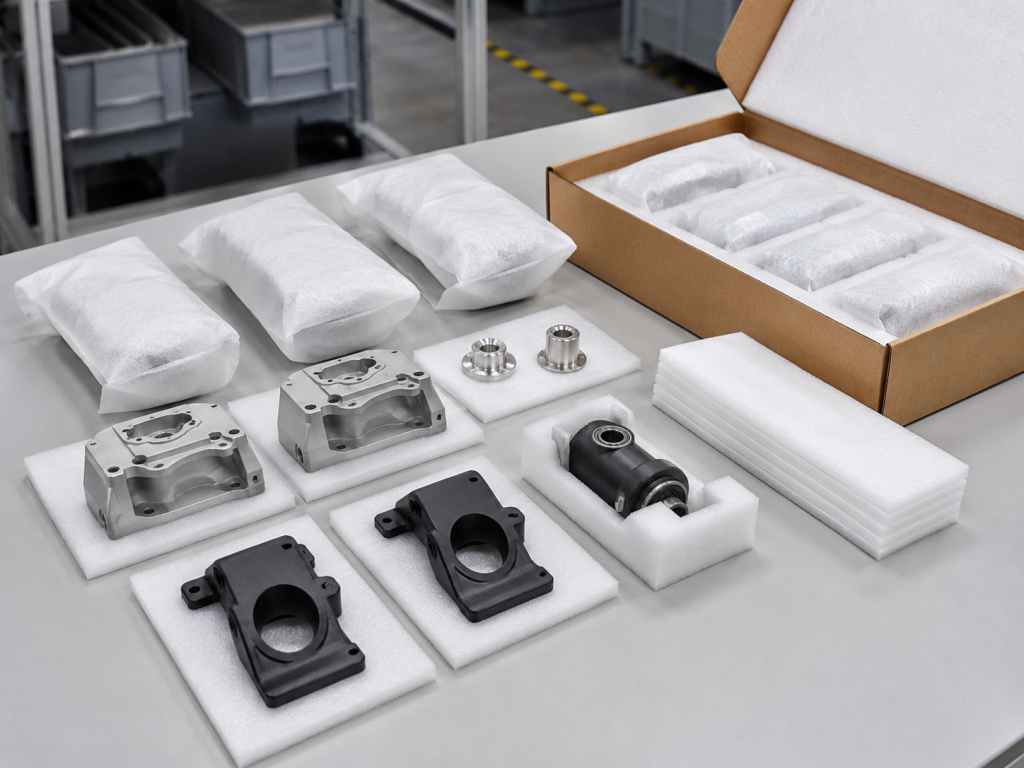
Industrial Parts Packaging Guide: Cushioning, Surface Protection, and Export Carton Support
Industrial parts packaging decisions often fail when the carton looks strong but the parts still rub, shift, crack edges, or arrive with surface marks....
Read cornerstone guide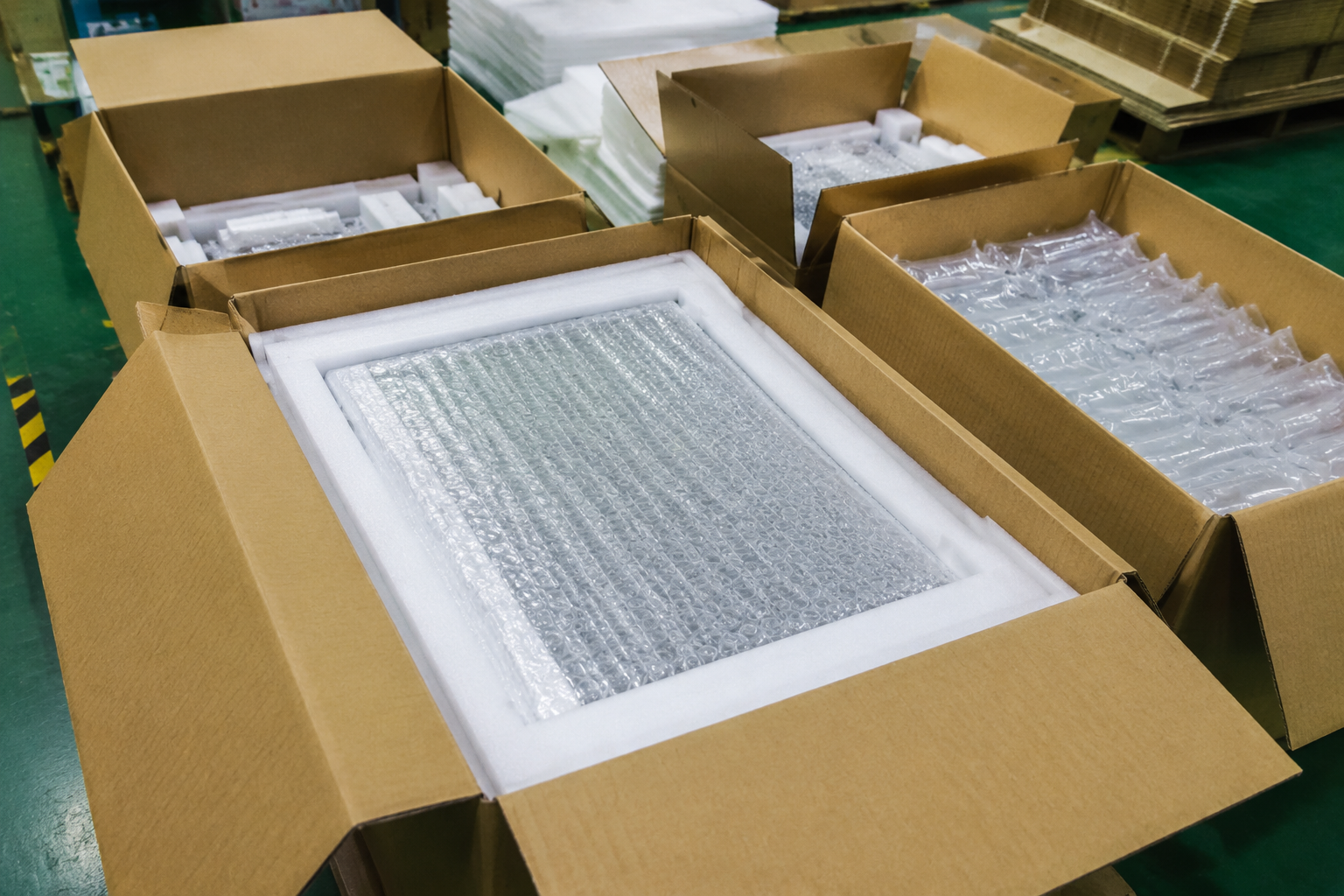
Export Packaging from China: Carton Packing, Palletizing, Labels, and Shipping Preparation
Export packaging from China is not just a carton selection issue. The right setup depends on how the goods will move, how often they...
Read cornerstone guide
E-commerce Packaging Materials Guide for Online Sellers and Fulfillment Warehouses
This guide focuses on the practical packaging choices that affect e-commerce damage rates, packing speed, carton space, and shipping cost. It helps readers decide...
Read cornerstone guide
Warehouse Packing Materials Guide: Improve Packing Speed, Protection, and Carton Efficiency
Warehouse packing problems often start at the station: operators cut material by hand, choose cartons by habit, and add filler until the box feels...
Read cornerstone guide