
Choosing a packaging materials supplier in China is not only a price comparison. Before sending a deposit, approving samples, or using a quotation for internal planning, buyers should review a packaging supplier audit checklist and long-term supplier relationship criteria to confirm whether the company is real, whether its quotation entity and payment account match, and whether it can actually produce or control the packaging being offered. A low unit price can become expensive if the material grade, thickness, dimensions, sealing, printing, carton space, or packing method is unclear.
This article helps overseas buyers turn supplier trust into verifiable evidence. It focuses on business documents, factory evidence, in-house and outsourced processes, sample consistency, export document readiness, communication transparency, and payment consistency. The practical decision is whether the supplier is ready for quotation, sampling, or bulk production based on evidence rather than speed, confidence, or broad promises.
Quick Packaging Decision Guide
| Buyer Question | Practical Reading | What to Check |
|---|---|---|
| Is the supplier a real operating business? | Legal documents confirm existence, but not production ability. | Registration details, company name, quotation entity, and bank beneficiary consistency. |
| Can they make the exact packaging needed? | Broad product claims are not enough for foam, film, bags, cartons, or custom parts. | Equipment, materials, process steps, tolerances, and what is outsourced. |
| Is the sample useful for bulk approval? | A good-looking sample may still fail in fit, sealing, packing speed, or carton use. | Size, thickness, protection performance, surface condition, sealing strength, and repeatability. |
| Does the supplier understand the application? | Reliable suppliers ask before recommending materials or confirming price. | Product size, weight, fragility, surface finish, carton space, quantity, and shipping route. |
| Is the order ready for export handling? | Export packing needs accurate freight, document, and forwarder coordination. | Packing list data, carton details, shipment terms, destination requirements, and document readiness. |
| Should payment be paused? | Payment pressure or changed account details can increase risk before production starts. | PI details, bank account match, company structure, written confirmations, and unresolved inconsistencies. |
Quick Answers Before You Read
Is a business license enough to trust a packaging supplier?
No. It helps confirm legal existence, but buyers still need factory evidence, product-specific capability proof, and consistent payment details.
What information should I send before asking for a quote?
Send product size, weight, fragility, surface protection needs, packing method, carton space, quantity, destination, and any required material or printing details.
How should I judge a sample before bulk production?
Check measurable specifications, fit, protection, sealing or cutting quality, carton compatibility, and whether the approved sample can be repeated in production.
When should I avoid proceeding with a supplier?
Pause if names, payment accounts, factory evidence, specifications, or export details are inconsistent, vague, or avoided.
Start Verification Before You Discuss Price or Pay a Deposit
The right time to verify a packaging materials supplier in China is before ordering, before paying a deposit, and before relying on a quotation for internal cost planning. Once a buyer has paid sample fees, shared a detailed forecast, or accepted a very low price, it becomes harder to step back and ask basic questions about identity, factory capability, production control, and export readiness.
Many supplier problems show early if the buyer asks for evidence instead of accepting broad claims. A supplier does not need to be perfect or own every process in-house, but it should be able to provide consistent, checkable proof. That proof may include company documents, factory videos, equipment details, sample records, export document examples with sensitive information removed, and clear written answers about specifications and packing requirements.
A low price has limited value if the supplier cannot prove what it is quoting. For protective packaging, small differences in material thickness, foam density, bag sealing, carton size, roll length, or packing quantity can change both cost and performance. A buyer comparing quotations without verifying those details may be comparing completely different products.
Why verification should happen before quotation comparison
Quotation comparison only works when the suppliers are quoting the same requirement. For example, an EPE foam insert can vary by foam thickness, density, cutting accuracy, bonding method, and carton packing count. Bubble wrap may differ by bubble size, film weight, roll length, and perforation. Plastic bags may differ by material, thickness, sealing strength, printing, and packing format. Corrugated boxes may differ by board grade, flute type, dimensions, printing, and compression strength.
If those details are not confirmed first, the lowest quote may simply reflect a weaker material, smaller size, lower packing count, or a supplier that has not understood the application. This is why China packaging supplier verification should begin with whether the supplier can understand and define the product properly, not only whether it can reply with a price quickly.
Before requesting final pricing, buyers should confirm that the supplier can discuss the required material, structure, dimensions, tolerances, packing method, and production process in practical terms. If the supplier cannot explain how it would make or control the product, the quotation may not be reliable enough for decision-making.
Set a compliance boundary before accepting supplier claims
Supplier verification should separate marketing language from claims that need proof. Words such as “food grade,” “recyclable,” “compostable,” “export ready,” “factory direct,” “certified,” or “tested” should be treated as starting points for questions, not as final evidence. The buyer should ask what exact material, product version, test report, certificate, standard, destination market, or shipment condition the statement refers to.
This boundary is especially important before artwork approval, retail packaging approval, or deposit payment. If a supplier’s claim will later appear on a product label, customer-facing website, import document, or internal compliance file, the buyer should request supporting documents that match the specific item being ordered. A general certificate, old report, unrelated sample, or statement from a different product line should not be treated as proof for the current order.
What early verification can prevent
Early verification helps reduce several common sourcing risks. One risk is the fake factory claim, where a company presents itself as a manufacturer but cannot show current production evidence. Another risk is the mismatched sample, where the buyer receives an attractive sample but later discovers that bulk production uses a different material, thickness, sealing method, or packing format.
Buyers can also uncover unclear business scope, weak export preparation, and unstable communication before the order becomes urgent. A packaging supplier that cannot explain whether it makes foam, bubble wrap, film products, plastic bags, cartons, or custom protective packaging may be quoting beyond its real control. A supplier that cannot prepare basic shipment information, carton marks, or packing details may create problems later even if the product itself looks acceptable.
The goal is not to eliminate every possible risk. The goal is to identify risks while the buyer still has options. If a supplier avoids basic questions, gives vague answers, or pressures the buyer to pay quickly before providing evidence, that behavior should be treated as part of the verification result.
How to judge “qualified enough” at the first stage
At the first stage, the buyer is not deciding whether to place a bulk order. The buyer is deciding whether the supplier deserves deeper quotation or sampling discussion. A supplier is usually qualified enough for the next step if its company identity is consistent, its product range matches the buyer’s packaging category, and its communication shows practical understanding of the requested material and application.
For a packaging materials supplier in China, the first-stage review should cover identity, capability, sample logic, documentation, communication, and risk judgment. Can the supplier provide a legal company name and basic company documents? Can it show production or sourcing control for the requested packaging type? Can it explain the difference between a stock sample, a custom sample, and a production sample? Can it discuss export packing and shipment information clearly?
If the answers are mostly consistent but incomplete, the buyer can request more proof before moving forward. If the answers are inconsistent, evasive, or unrelated to the product, the safer decision is to pause. Verification is useful because it creates a controlled gate before quotation dependence, sample commitment, or deposit payment.
Build a simple supplier evidence file before the first payment
Before a sample fee or deposit is paid, buyers should keep a small evidence file for each shortlisted supplier. This file does not need to be complicated, but it should collect the items that affect the buying decision: business license, legal company name, quotation, product specification, sample discussion, factory photos or videos, bank details, and any explanation about related export entities or partner workshops.
The value of this file is that it shows whether the supplier’s story stays consistent over time. If the quotation name, PI issuer, factory video, and bank beneficiary all connect logically, the buyer has a stronger basis for moving forward. If the file shows shifting names, changing specifications, vague production claims, or unsupported payment instructions, the risk is visible before money is sent.
Buyers should also record the date and source of each piece of evidence. A factory video received before sampling, a revised quotation after material changes, and a bank confirmation before deposit should not be mixed together without context. A simple dated record makes it easier to trace what was verified at each decision point and prevents old screenshots, outdated certificates, or earlier sample details from being mistaken for current order evidence.
Confirm the Supplier’s Business Registration and Real Operating Scope
Business identity is the first practical check for any packaging materials supplier in China. Buyers should know the legal company name, where the company is registered, where it actually operates, and which entity will issue the quotation, invoice, or export documents. This step does not prove factory capability by itself, but it helps confirm that the supplier is a real business and that its commercial paperwork is not being handled through an unclear or unrelated party.
A company license or registration document should be treated as the starting point, not the finish line. It can help confirm legal identity and operating scope, but it does not tell the buyer whether the supplier can make a custom EPE foam insert, produce a bubble wrap roll to the required length, seal a poly mailer correctly, or prepare corrugated boxes for export handling. Those points require factory evidence and sample confirmation later.
The key is consistency. The name on the company document should make sense when compared with the quotation sheet, email signature, website, sales platform profile if used, proforma invoice, bank beneficiary, and shipping paperwork. If different names appear, the supplier should explain the relationship clearly.
What business documents buyers should request first
Before serious quotation work begins, buyers should request the supplier’s full legal company name in Chinese and English where available, a copy of the business license, the registered address, the operating or factory address, and the contact person’s business details. If the supplier uses a separate export entity, buyers should ask how that entity relates to the factory or sales company.
The quotation header should match the company structure being presented. If the supplier says it is a factory, but the quotation comes from a different trading company, that does not automatically mean the supplier is unreliable. Many legitimate companies use related export or trading entities for international orders. The important point is transparency. The supplier should explain who manufactures, who sells, who receives payment, and who is responsible for quality and shipment communication.
Buyers should also check whether the address information is stable across documents and communication channels. A registered address may differ from an operating workshop address, especially for manufacturing companies, but the supplier should be able to state both without hesitation.
How to read business scope without over-trusting it
The operating scope should reasonably connect to the product being quoted. For packaging suppliers, relevant descriptions may involve packaging materials, plastic products, paper products, foam products, film products, manufacturing, processing, wholesale, import and export, or sales. The exact wording varies by company, so buyers should look for a practical connection rather than expecting one fixed phrase.
At the same time, a broad operating scope is not proof that the supplier can make every packaging product it lists. A company may be registered to sell plastic products but still rely on outside workshops for certain bags, films, or foam components. Another company may manufacture one category directly and coordinate other packaging materials through partner workshops. This can be acceptable if the supplier is honest about what it controls and how it checks quality.
Business scope should answer one question: is the company legally connected to this type of business? It should not be used to answer a different question: can the company reliably produce this exact packaging specification? That second question needs production evidence, samples, and written specification control.
When the legal entity, export entity, and factory location are different, buyers should ask for a simple written map of responsibility. The supplier should identify which company signs the quotation, which company receives payment, which workshop produces the goods, and which contact is responsible for quality issues and shipment coordination. This does not create a guarantee, but it makes the commercial chain traceable before the buyer approves a sample fee or deposit.
Red flags in company identity information
Some warning signs are straightforward. Buyers should be cautious if the supplier refuses to provide basic company documents, gives only a personal name without a company identity, or asks for payment to a personal account before explaining the business structure. Inconsistent company names across the website, quotation, invoice, and bank information also deserve careful review.
Vague address answers are another concern. A supplier does not need to disclose every internal detail immediately, but it should be able to state its registered address, operating location, and whether production is in-house or coordinated through a partner. If the answer changes depending on who is asked, the buyer should slow down.
Copied website content, generic product photos, missing company documents, and unwillingness to explain the relationship between a trading entity and factory entity are also weak signs. None of these points alone proves fraud, but together they show that the supplier is not ready for a deposit or serious order discussion without additional verification.
Separate Real Factory Evidence from Marketing Claims
Factory claims need evidence that is current, specific, and relevant to the product being sourced. A China packaging materials supplier may describe itself as a manufacturer, factory, or protective packaging manufacturer, but buyers should look at what the supplier can actually show. The evidence should connect to the buyer’s packaging category, whether that is EPE foam, bubble wrap, air cushion packaging, plastic bags, film packaging, corrugated boxes, or custom protective packaging.
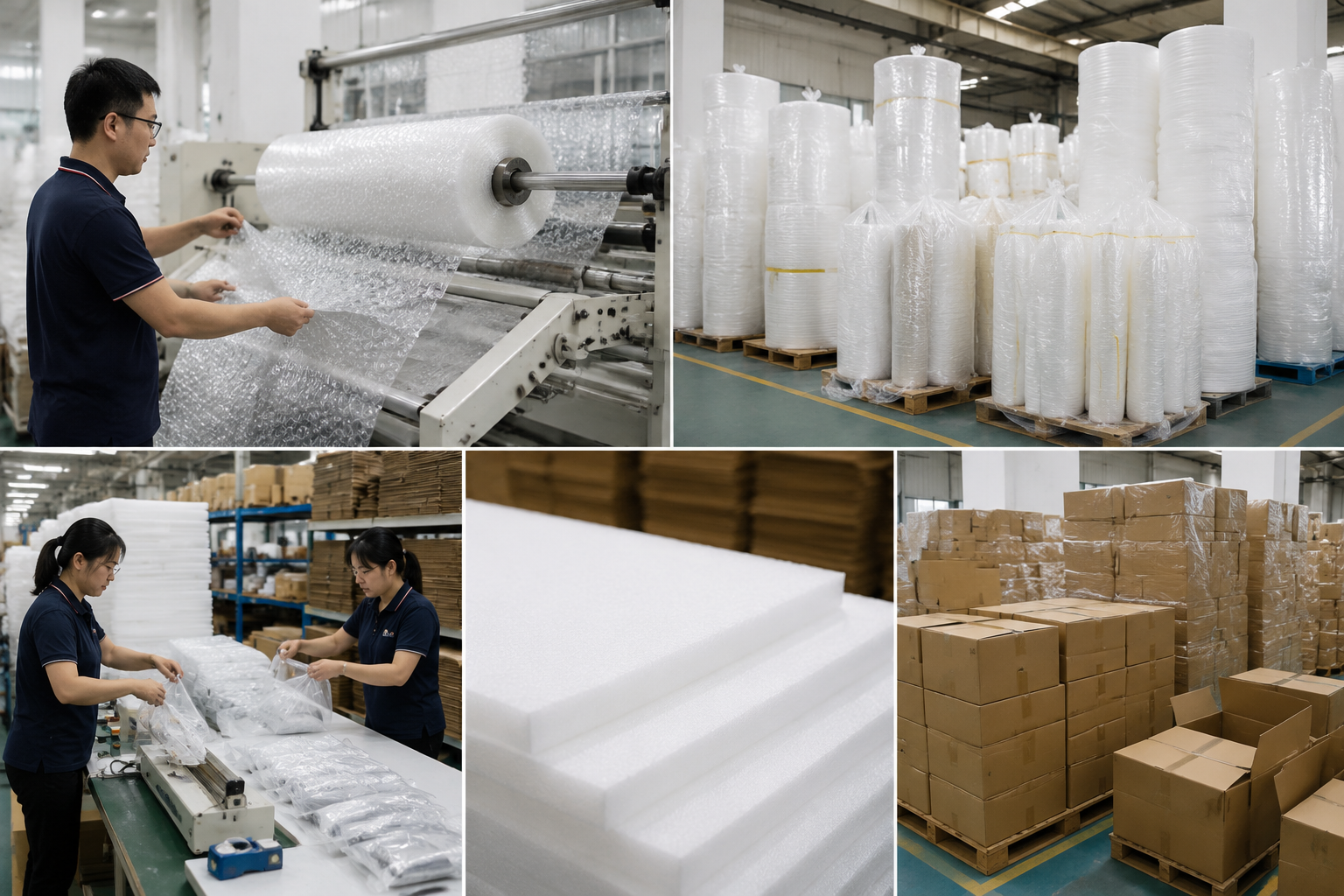
A polished company video can be useful for a general impression, but it is weaker than a recent walk-through video showing real production areas, machines, raw materials, workers, semi-finished goods, finished products, packing areas, and warehouse conditions. The more specific the evidence is to the buyer’s requested product, the more useful it becomes.
Buyers should remember that factory evidence is not always proof of full ownership of every process. Some suppliers manufacture part of the order in-house and coordinate other processes externally. That can work, especially for combined packaging projects, but the supplier should explain the structure clearly and take responsibility for quality control, schedule coordination, and final shipment preparation.
What a useful factory video should show
A useful factory video should show more than a front gate, showroom, or finished product display. It should show the production line related to the requested packaging type. For foam packaging, that may include foam sheets or rolls, cutting tables, die-cutting areas, bonding steps, shaped inserts, or packing of foam bags and pads. For plastic bags or film packaging, buyers may look for sealing, cutting, printing, winding, or packing processes. For corrugated boxes, the video should show carton material, forming or converting steps, printing if relevant, and finished carton stacking.
The video should also show raw material storage, semi-finished goods, finished goods, packing areas, and any visible quality check points. Cleanliness, organization, and material separation matter because they affect consistency. A crowded or disorganized warehouse does not automatically mean the supplier is incapable, but it may raise questions about batch control, labeling, and shipment preparation.
For higher-risk orders, buyers can request a short custom video showing the date, company name, or project reference. This does not need to be complicated. A simple walk-through recorded during current production is often more useful than a heavily edited marketing clip because it shows what is happening now.
Why edited promotional videos are not enough
Promotional videos are designed to present the supplier well. They may be old, generic, or focused on product categories that are unrelated to the buyer’s order. A video that shows only a showroom, a few machines from a distance, or finished cartons without any production context does not provide enough evidence for factory verification.
The risk is especially high when the buyer needs a custom product. A supplier may show general bubble wrap rolls but quote laminated foam pouches. It may display plastic bags but quote printed corrugated boxes. It may show a warehouse full of finished goods but provide no evidence that it controls the cutting, sealing, printing, or packing process required for the buyer’s specification.
Buyers should ask for project-specific evidence when the order involves custom size, special thickness, print requirements, tight tolerances, protective inserts, or export packing. The request can be simple: show the relevant machine, material, sample process, or similar production category. A capable supplier should understand why this matters.
How to verify mixed production and partner workshops
Many packaging orders involve more than one material. A product may need an EPE foam insert, a plastic inner bag, a bubble wrap layer, and a corrugated outer carton. Not every supplier will produce every component in the same workshop. This is not automatically a problem, but the buyer should understand which parts are made in-house and which parts are handled through partner workshops.
A transparent supplier can separate the responsibilities clearly. It should be able to state what it produces directly, what it purchases or coordinates, how it confirms specifications with partner workshops, and how it checks the finished products before shipment. The buyer should also ask whether samples come from the same production route planned for the bulk order.
Weak answers usually sound overly broad: “We can make all packaging, no problem,” without explaining the process. Stronger answers show practical control: which workshop handles which step, how material thickness or carton size is checked, how packing quantities are confirmed, and who is responsible if the delivered products do not match the approved specification.
Verification Note: When possible, buyers should review real factory evidence, current product photos, equipment details, sample records, packing information, and payment documents before treating a supplier claim as verified. Stock images, broad factory labels, and fast replies alone are not enough for a reliable supplier judgment.
Check Whether the Supplier Has the Right Equipment for Your Packaging Type
A broad claim such as “we can make all packaging” is not enough for supplier verification. A real packaging materials manufacturer should be able to explain which machines and production steps apply to the exact product you want to buy. EPE foam packaging, bubble wrap, air cushion packaging, plastic bags, film packaging, and corrugated boxes do not use the same equipment, and they do not fail in the same way during production.
This matters because many problems are created before the order reaches the packing table. A foam insert with inaccurate cutting may not hold the product securely. A poly mailer with weak sealing may open during transit. A printed carton with poor cutting or folding accuracy may slow warehouse packing. Before sampling, buyers should connect the supplier’s equipment, process control, and technical limits to the packaging structure being quoted.
Match machines to the packaging product you need
Each packaging type has a different production logic. EPE foam sheets and rolls require foam material preparation and cutting control. Custom foam inserts may need slicing, die-cutting, bonding, lamination, or shaped assembly, depending on the design. Bubble wrap rolls and sheets depend on bubble film production and roll conversion, while bubble bags require cutting and sealing after the film is made.
Plastic bags and film products bring another set of questions. Poly mailers, garment bags, liner bags, courier bags, and clear packaging bags need the right sealing method, film thickness control, opening style, adhesive strip option, printing process, and packing count. Stretch film depends more on film properties, winding quality, roll width, and core consistency. Corrugated boxes require board selection, cutting, slotting, folding, printing, and carton forming control.
A useful supplier answer should be product-specific. If you ask for die-cut EPE foam inserts, the answer should not stop at “we have foam.” If you ask for printed corrugated boxes, the supplier should discuss board type, flute structure, box style, printing requirements, cutting accuracy, and packing format. If you ask for air column bags, the supplier should be able to explain film structure, inflation method, column size, sealing, and how the product will fit inside the inflated protection.
For custom packaging, ask for photos or short videos of the machines used for the same product category, not only general workshop pictures. A machine list is helpful, but it becomes more useful when the supplier can connect each machine to your required size, thickness, cutting, sealing, printing, or packing method.
Ask what is produced in-house and what is outsourced
A supplier does not need to produce every step in-house to be reliable. Many packaging orders involve mixed processes, especially when a buyer needs foam protection, printed cartons, plastic bags, labels, or pallet preparation in the same project. Outsourcing becomes a problem only when the supplier hides it, cannot control it, or cannot explain who is responsible for quality and timing.
The buyer should ask a direct question: “Which steps are handled in your own factory, and which steps are arranged through partner workshops?” A transparent supplier can usually answer without hesitation. For example, the supplier may produce foam pads in-house but coordinate printed cartons externally, or produce plastic bags while outsourcing a special printing process. That can be workable if the sample, specification, quality check, and delivery schedule are controlled clearly.
The key is responsibility. If an outsourced process causes a color mismatch, cutting error, sealing issue, or carton delay, who reviews it before shipment? Who keeps the approved sample record? Who confirms that the bulk order matches the sample? A supplier who coordinates external work should still manage specification confirmation, production follow-up, finished product inspection, packing review, and communication with the buyer.
From the factory side, Mr. Wang often checks whether cutting, sealing, bonding, or forming details can be repeated during batch production. That same thinking is useful for buyers: do not only ask whether the supplier can make the item once; ask how the supplier controls the same result across the full order quantity.
Confirm technical limits before sampling
Sampling should not begin until the supplier has confirmed the practical limits of the product. These limits may include sheet size, roll width, bag size, film thickness, foam thickness, foam density, carton board structure, printing area, sealing width, adhesive type, die-cut tolerance, folding accuracy, and packing count per carton, with each parameter documented through a packaging supplier audit checklist as part of a long-term supplier relationship before sample approval moves forward. If these details are unclear, the sample may look acceptable but become difficult to repeat in bulk production.
Buyers should also confirm the tolerance range. Packaging materials are often flexible, compressible, or affected by production variation, so a realistic tolerance is better than a vague promise of “exactly the same.” For a foam insert, a small size difference can change product fit. For a plastic bag, sealing position and film thickness affect strength. For a corrugated box, inner dimension, board grade, and folding accuracy affect packing speed and product protection.
Printing and branding details need early confirmation as well. If the order involves printed cartons, printed bags, logo tape, labels, or color-matched film, the supplier should confirm artwork format, print position, color expectations, possible color variation, and sample approval method. A low quotation can become expensive if the supplier later discovers that the requested printing method, size, or material is outside its normal process.
Before approving a sample request, ask the supplier to state the final specification in writing. The written confirmation should cover material, size, thickness or density where relevant, color, printing, sealing, cutting, packing format, carton quantity, and any known tolerance. This step helps expose suppliers who quote products they cannot actually control.
Use Samples to Test Consistency, Not Just Appearance
A sample is not only a sales item. It is a verification tool. Buyers should use samples to check whether the supplier understands the specification, selects the right material, communicates clearly, and can repeat the same result in bulk production. A sample that looks clean on a desk may still fail if it does not fit the product, protect the surface, seal properly, or match the final shipping carton.
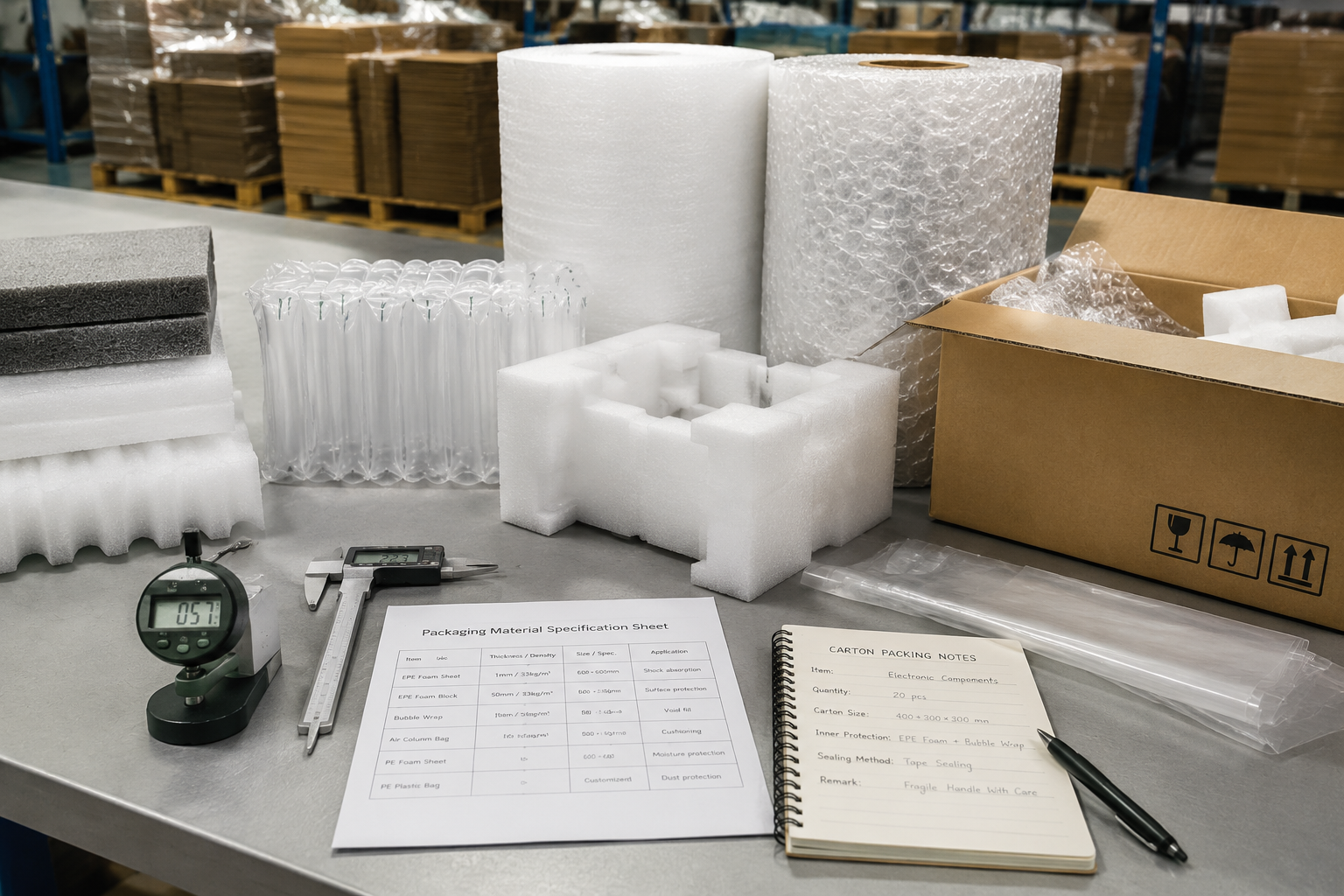
For a custom packaging supplier, the sample process should test measurable performance. The buyer should review structure, size, material feel, material thickness, foam density where relevant, cushioning behavior, bag sealing strength, print accuracy, carton fit, packing method, and ease of use for warehouse workers. The question is not only “Does this sample look good?” The better question is “Can this supplier reproduce this approved sample consistently when the order quantity increases?”
Know the difference between stock, custom, and pre-production samples
Not all samples provide the same level of evidence. A stock sample shows general material type, surface feel, approximate thickness, bubble size, foam softness, bag sealing style, or carton board quality. It is useful early in the discussion, especially when the buyer is still comparing materials. However, a stock sample does not prove that the supplier can produce your exact size, printing, insert shape, packing count, or carton structure.
A reference sample is closer to your requirement but may still come from a previous production run or a similar product category. It helps buyers judge workmanship and application fit, but it should not replace a project-specific sample if the product is fragile, high-value, custom-shaped, branded, or sensitive to surface scratches. For example, a foam pad sample may show material quality, but it does not prove that a custom insert will hold your product securely.
A custom proof sample is made according to your drawings, dimensions, photos, or product information. This sample has stronger verification value because it tests the supplier’s ability to follow your specification. A pre-production sample goes one step further. It should represent the intended bulk order material, structure, printing, packing method, and production process as closely as possible before mass production begins.
Buyers should be careful not to approve a sample only because it arrived quickly or looks neat. The sample type should match the risk level of the order. A standard bubble wrap roll may need a simple material sample, while a die-cut foam insert for a fragile electronic product may need a custom proof sample and a clear sample confirmation record.
Record the approved sample in measurable terms
Once a sample is approved, the buyer should record it in a way that both sides can repeat. A written sample record should include dimensions, material type, thickness, foam density where relevant, film structure, bag sealing method, carton board structure, print file version, color reference, label requirements, packing count, carton size, and approval date. Reference photos are also useful, especially for custom foam shapes, printed bags, air column packaging, and printed corrugated boxes.
This record protects the buyer and the supplier. Without it, a later disagreement can become subjective. One side may say the bulk order is “similar,” while the other side expects an exact match to the sample. Packaging materials often have acceptable production variation, but those limits should be discussed before the order starts. If the buyer needs a strict size, color, printing position, sealing strength, or carton dimension, that requirement should appear in the approved sample record.
For repeat orders, the sample record becomes even more important. A buyer may reorder months later with the same product name, but small details can change: carton quantity, label content, print artwork, film thickness, or foam insert shape. A clear record helps the supplier check whether the repeat order matches the previous approval or needs a new confirmation.
At Daipak, sample confirmation is usually treated as part of specification control, not a separate formality. The sample, quotation, production details, packing method, and shipment preparation need to match each other; otherwise, the order can drift between approval and bulk production.
For higher-control projects, buyers should ask how the supplier will identify the approved sample during production. Useful methods include a signed sample record, dated photos, an internal item code, artwork version number, material description, and a note showing whether the sample was handmade, machine-made, or prepared through a partner workshop. This traceability is especially important when multiple revisions are discussed, because the approved version should be easy to separate from earlier trial samples.
Test the sample against the real shipping or packing scenario
A useful sample review should happen in the same conditions where the packaging will be used. If the product will be packed by warehouse staff, the buyer should check whether the material is easy to handle, fast to wrap, simple to seal, and compatible with the carton size. A protective material that performs well but slows packing too much may increase labor cost or create inconsistent packing quality.
Fit is one of the first checks. The product should not be too tight, too loose, or forced into the packaging. Foam inserts should support the right surfaces and avoid pressure on fragile parts. Bubble wrap should cover edges and corners, not only flat surfaces. Air column bags should inflate evenly and hold the product without excessive movement. Plastic bags should allow practical loading without tearing or stretching beyond their intended use.
Buyers should also check surface protection. Glossy, painted, coated, polished, or easily scratched products may need soft foam, protective film, liners, or separation sheets instead of rough contact with outer cartons. For fragile products, cushioning should be tested with the intended carton and void filling method, not only as a loose sample on its own. The carton space, product weight, shipping distance, and handling environment all affect the result.
If possible, run a small internal packing trial or test shipment before approving a larger order. This does not guarantee that every future shipment will be problem-free, but it helps reveal practical issues such as carton bulging, insufficient void fill, slow packing, label confusion, weak sealing, poor stacking, or damage risk from movement inside the box.
For parcel or distribution-heavy orders, buyers can also ask whether the supplier has experience preparing samples for recognized package-performance test methods rather than relying only on visual inspection. ISTA Procedure 3A is designed around packaged products moving through parcel delivery systems, while ASTM D4169 is a standard practice for performance testing shipping containers and systems under distribution-cycle logic.[1][2] These references do not prove that a specific sample will pass testing, but they give buyers a clearer way to discuss drop, vibration, compression, and handling risks before approving a packaging structure.
Quality Control Note: For packaging materials, buyer confidence depends on visible and measurable quality-control details such as material thickness, foam density, sealing strength, cutting accuracy, print position, carton dimensions, packing count, label placement, and sample-to-bulk consistency. These details should be checked order by order rather than assumed from a supplier name or one attractive sample.
Compare the sample with the supplier’s written production route
A sample has stronger verification value when the supplier can explain how the same result will be produced in bulk. Buyers should ask whether the sample was handmade, made on the normal production machine, or prepared by a partner workshop. A handmade sample can be useful for checking shape or concept, but it may not prove cutting speed, sealing consistency, print registration, carton folding accuracy, or packing repeatability during mass production.
This question is especially important for custom EPE foam inserts, laminated foam bags, printed poly mailers, air column packaging, and printed cartons. If the sample route differs from the bulk production route, the buyer should ask what may change and whether a pre-production sample is needed. The goal is not to reject every handmade or trial sample, but to avoid assuming that a neat one-off sample proves full-order consistency.
Cross-Check Export Experience Through Documents and Process Knowledge
Export experience should be verified through behavior and documents, not only through a statement such as “we export worldwide.” An export packaging supplier should understand how product packing, carton information, labels, commercial documents, shipment dimensions, and freight forwarder communication fit together. For overseas buyers, this matters because a packaging order can be acceptable in quality but still create shipment delays or unexpected freight cost if export preparation is weak.
Protective packaging can be bulky, light, compressible, nested, rolled, or packed in large cartons. Bubble wrap rolls, EPE foam sheets, air cushion film, plastic bags, and corrugated boxes may all create different freight calculations. Accurate carton dimensions, gross weight, net weight, and CBM can affect quotation, booking, warehouse receiving, and loading preparation. A supplier who understands export orders should ask for destination, delivery terms, packing requirements, carton marks, and forwarder contact details when the order reaches shipment planning.
What export documents indicate basic readiness
Basic export readiness usually shows up in the supplier’s ability to prepare clear commercial documents and packing information. Buyers should ask whether the supplier can provide a commercial invoice, packing list, carton marks, product label information, packing photos, and a shipment dimension summary. These documents do not prove every detail of export competence, but they show whether the supplier understands the normal information flow for overseas orders.
The commercial invoice and packing list should align with the quotation and proforma invoice. Product description, quantity, unit count, carton count, gross weight, net weight, and packing details should be consistent. If the buyer has specific label requirements, barcodes, carton marks, item codes, destination marks, or warehouse receiving instructions, those details should be confirmed before production or at least before final packing.
Packing photos are also useful. They help the buyer see how products are arranged in cartons, whether labels and carton marks are applied correctly, and whether the shipment matches the agreed packing method. For custom protective packaging, photos can also show whether foam inserts, bags, rolls, or cartons were packed in a way that reduces deformation, dirt, or handling confusion before pickup.
If an HS code discussion, product description, or special document requirement is involved, buyers should raise it early and confirm who is responsible for each item. Suppliers can support document preparation, but buyers should not assume that a general export document set covers special destination rules or regulated product requirements.
How freight communication reveals supplier discipline
Freight communication often reveals how organized the supplier is. A disciplined supplier can usually provide carton quantity, carton size, gross weight, net weight, CBM, ready date estimate, pickup address, contact person, and loading or packing photos when needed. These details help the buyer and freight forwarder plan pickup, booking, consolidation, warehouse receiving, and final delivery.
Small errors can become expensive. If carton dimensions are understated, freight cost may change after the forwarder measures the cargo. If carton count is wrong, warehouse receiving may be delayed. If labels or carton marks are missing, goods may be difficult to identify after consolidation. If pickup timing is unclear, the buyer may face storage charges, missed vessel schedules, or rushed coordination.
Good suppliers do not need perfect English to communicate well. They need clear, consistent, checkable information. When a forwarder asks for shipment details, the supplier should answer with numbers and documents, not vague promises. For example, “about 30 cartons” is weaker than a packing list showing exact carton quantity, carton dimensions, weight, and total CBM.
For export orders, Mr. Li usually pays attention to carton marks, packing quantity, destination details, and forwarder communication before shipment preparation is finalized. Those details may look administrative, but they can affect freight cost, warehouse handling, and the buyer’s ability to receive the goods smoothly.
When buyers should ask for special compliance proof
Some packaging orders require more than basic export documents. If the packaging will be used for food-contact products, medical-related products, children’s goods, regulated retail channels, environmental claims, recycling labels, or destination-specific requirements, buyers should ask about supporting documents early. These requirements should not be assumed from a supplier’s general product category or export experience.
The supplier should be able to explain what documents are available and what is not available. If a buyer needs a particular compliance report, material declaration, test document, or regulatory statement, the request should be made before quotation confirmation or sample approval. Waiting until the cargo is ready can create delays, rework, or order cancellation risk.
Buyers should also check whether the requested proof applies to the exact material and product being ordered. A document for one film, foam, adhesive, ink, or paper material may not apply to another. A copied or unrelated document should not be treated as reliable evidence. The buyer should confirm the company name, material description, test item, date, and product relationship where applicable.
For many protective packaging orders, standard commercial documents and packing records may be enough. For regulated applications, higher scrutiny is appropriate. The practical rule is simple: if the destination, product use, or customer channel requires proof, ask for it before production risk increases.
Food-contact packaging needs especially careful wording because the relevant proof depends on the material, substance, intended food use, and destination market. The U.S. FDA explains food packaging and food-contact substances as materials that may reasonably be expected to come into contact with food, and FDA’s food-contact substance notification inventory is one route buyers may use when checking whether a supplier’s material claim connects to a recognized notification record.[3][4] For EU-bound food packaging, buyers should also confirm whether the supplier’s documentation is aligned with the European Commission’s food contact materials framework rather than accepting a generic “food grade” statement by itself.[5]
Do not treat compliance documents as universal proof
A certificate or test report should be reviewed for scope, not only for the logo or title on the page. Buyers should check the tested material, product description, applicant or manufacturer name, test date, standard or regulation referenced, and whether the document applies to the same film, coating, adhesive, ink, foam, paperboard, or finished packaging structure being ordered. If the supplier changes the material source, thickness, coating, colorant, printing ink, or lamination structure after the report was issued, the older document may no longer support the current order without further confirmation.
Buyers should also avoid turning supplier-provided documents into stronger claims than they actually support. A material declaration may support a limited material statement, while a third-party test report may support only the tested sample under the listed conditions. Neither should automatically be converted into a broad claim such as “approved for every market,” “safe for all food contact,” “fully recyclable everywhere,” or “compliant for every retailer.” The safer approach is to keep the claim tied to the document scope and ask the buyer’s own compliance team, customer, or importer of record to confirm market-specific requirements when needed.
Verify Recycling, Compostability, and Environmental Claims Separately
Environmental claims are a common source of supplier overstatement. A packaging supplier may describe a bag, film, mailer, carton, or coating as recyclable, biodegradable, compostable, eco-friendly, or sustainable, but those words do not have the same meaning and should not be treated as interchangeable. Buyers should ask what exact claim will appear on the product, carton, website, retail listing, or customer documentation, and then request proof that matches that claim.
For paper and corrugated packaging, recyclability claims should be checked against the material structure and any coatings, laminations, adhesives, labels, or windows added to the pack. Corrugated packaging is widely discussed as a recyclable packaging format by the Fibre Box Association, but that does not automatically prove that every coated, laminated, or combined-material design will be accepted in every local recovery system.[6] If the buyer plans to print a recycling instruction on the packaging, How2Recycle-style labeling guidance is relevant because consumer-facing recycling communication depends on the specific package design and recovery context.[7]
Compostability claims require a different evidence path. ASTM D6400 addresses plastics designed to be aerobically composted in municipal or industrial facilities, while ASTM D6868 addresses biodegradable plastic coatings on paper and other compostable substrates.[8][9] A supplier’s claim that a package is “compostable” should therefore be tied to the exact material construction and applicable certification or test basis, not just to a general material name or a sample from a different product.
Buyers should also be careful with broad green marketing language. The FTC Green Guides are intended to help marketers avoid deceptive environmental claims, including claims around recyclability, degradability, compostability, and similar environmental attributes.[10] For supplier verification, the practical lesson is to request claim-specific evidence before approving artwork, retail copy, or sales language; if the supplier cannot support the claim narrowly, the safer option is to soften or remove the claim.
Keep sustainability claims tied to the exact package design
A packaging design can lose or weaken an environmental claim when small components change. A paper mailer with a plastic window, a corrugated box with heavy lamination, a coated paper cup sleeve, a compostable bag with a non-compostable label, or a recyclable film with incompatible ink or adhesive may need a narrower claim than the base material suggests. Buyers should therefore verify the full construction, not only the main material name.
Before approving environmental artwork, ask the supplier to identify the claim wording, the package components covered by the claim, the test or certification basis, and any disposal conditions that affect the claim. If the claim depends on industrial composting access, local recycling acceptance, consumer separation, or removal of labels and inserts, that limitation should be understood before the buyer prints a simple recycling or compostability message on the package.
Evaluate Communication Transparency Under Real Buying Pressure
Communication quality becomes much easier to judge once the discussion moves from general introductions to real buying pressure. A supplier may sound capable when the question is simple, but the answer often changes when the buyer asks for proof, changes a size, questions a material, or requests a written quotation confirmation. This is where buyers can see whether the supplier understands the packaging application or is only trying to keep the conversation moving.
Transparent communication does not mean the supplier replies instantly to every message. A fast answer can still be weak if it avoids the details that control cost, production, and product protection. For protective packaging, a reliable supplier should ask about product size, weight, shape, surface finish, fragile points, packing method, carton space, order quantity, destination, and delivery expectations before giving firm recommendations. These details affect whether EPE foam, bubble wrap, air cushion packaging, plastic film, corrugated boxes, or a combined structure makes sense.
A good China protective packaging supplier should also be willing to explain trade-offs. For example, bubble wrap may be flexible and easy to pack, but it may not protect exposed corners on a heavy glass item by itself. EPE foam inserts may offer better positioning, but they can require more accurate dimensions and sample confirmation. A supplier who explains these limits is often safer than one who agrees to every request without checking the product risk.
Strong suppliers ask questions before giving final answers
Strong suppliers do not treat all packaging inquiries the same. They usually ask for product photos, drawings, dimensions, unit weight, packing quantity per carton, current damage problems, surface protection needs, and shipping route. If the product has sharp edges, a glossy finish, a fragile handle, or an uneven shape, those details should influence the recommendation. A flat foam sheet, a bubble bag, an air column bag, and a custom corrugated insert solve different problems.
This questioning process also shows whether the supplier is thinking about production and packing reality. A buyer may request a low-cost material, but the supplier should check whether the material can be cut, sealed, printed, packed, and repeated consistently in bulk production. If the buyer’s warehouse needs fast packing, the supplier may suggest pre-cut sheets, bags, or inserts rather than roll material that slows the packing line. If the shipment is export-heavy and cartons may be stacked or handled many times, the supplier should discuss inner protection and outer carton strength together.
Clear questions are not a delay tactic; they are part of specification confirmation. At Daipak, the discussion usually starts with the product details rather than the material name, because the same packaging material can perform very differently depending on weight, surface finish, carton space, and shipping distance. Buyers should see this as a positive sign when the supplier asks practical questions before finalizing price or structure.
Vague agreement is a warning sign
Overly easy agreement can be risky. Answers such as “no problem,” “best quality,” “cheapest price,” or “we can make everything” do not prove that the supplier understands the product or can control the order. A supplier who agrees before seeing the product dimensions, packing method, or required thickness may be quoting on assumptions. Those assumptions can later become sample delays, price changes, weak cushioning, poor carton fit, or inconsistent bulk production.
A stronger answer is more specific. For example: “For this glass product, bubble wrap alone may not control corner impact; we suggest foam edge protection plus an outer carton test.” That kind of answer gives the buyer something to evaluate. It shows the supplier is connecting the material choice to the risk. It may not be the cheapest option, but it is more useful than a vague promise because it explains why the recommendation exists.
Buyers should also be careful not to confuse language imperfections with poor communication. A supplier does not need perfect English to be reliable. The more important question is whether the answers are consistent, specific, and supported by evidence. If the supplier can confirm drawings, revise specifications clearly, send factory or sample proof, and explain production limits, the communication is usually more trustworthy than polished sales language with no technical substance.
Written confirmation protects both buyer and supplier
Verbal agreement is not enough for a packaging order. Packaging specifications can include many small details that affect performance and cost: material type, size, thickness, foam density where relevant, sealing method, print position, bag opening direction, carton size, packing count, label content, carton marks, and pallet requirements. If these details are scattered across chat messages, the chance of misunderstanding increases.
Before moving from quotation to sample, or from sample approval to production, buyers should request written confirmation. A useful confirmation should identify the product, packaging structure, quantity, unit price, packing method, sample status, expected production arrangement, payment terms, shipment terms if applicable, and any buyer-approved changes. If a sample has been approved, the supplier should keep a clear sample record with reference photos, dimensions, material description, color, print file version, and approval date.
Written confirmation also protects the supplier. It reduces last-minute disputes over what was approved, what was quoted, and what should be produced. For custom protective packaging, a small change in size, thickness, printing, or packing count can affect material use, production setup, and carton quantity. A supplier that insists on written confirmation before production is not being difficult; it is showing order discipline.
Compare Supplier Claims Against Independent and Third-Party Evidence
No single document, website, product photo, or sales message should carry the full weight of supplier verification. A reliable check compares the same facts across several sources. The goal is not to collect paperwork for its own sake. The goal is to see whether the supplier’s business identity, factory capability, product range, payment details, sample records, and export process all tell the same story.
For a China packaging supplier, useful cross-checking may include business documents, quotation headers, website information, China packaging supplier guide, online sales profiles, factory videos, product labels, sample packaging, email domains, bank account details, export document examples with sensitive information removed, and live video calls. If the order value or risk is high, buyers may also use a third-party inspection, factory check, pre-shipment inspection, or audit. Cross-verification is usually more reliable than trusting one polished presentation.
The amount of checking should match the order risk. A small trial order for standard bubble wrap rolls may not justify the same inspection process as a custom EPE foam insert project for fragile electronics. But even a small order should have basic business verification, clear specifications, a written PI, and consistent payment details. Higher-value or custom orders deserve deeper proof before deposit payment or bulk production.

Use multiple sources to confirm the same facts
Start by checking whether the company name is consistent across the business license, quotation sheet, PI, email signature, website, and bank beneficiary. A small formatting difference may be normal because Chinese and English company names can be translated in different ways, but the supplier should be able to explain the relationship clearly. If the PI is issued by one company, the factory video shows another name, and the bank account belongs to a third unrelated entity, the buyer should pause and ask for a written explanation.
The same approach applies to address and factory capability. The registered address may not be the production address, especially for companies with separate offices and workshops. That is not automatically a problem, but the supplier should explain where production happens and what work is done there. If the supplier claims to produce EPE foam, bubble wrap, plastic bags, film packaging, and corrugated boxes, buyers should ask which categories are produced in-house, which are coordinated through partner workshops, and how quality is controlled across the process.
Contact person details also matter. The person discussing specifications should understand the product enough to coordinate with production, sampling, and export preparation. If one contact provides a price, another changes the specification, and a third sends payment details without a clear company connection, the buyer should slow down. Good supplier communication keeps commercial, technical, and payment information aligned.
When third-party inspection is worth the cost
Third-party inspection is not necessary for every inquiry. For a low-value order with standard materials, a live video call, current workshop photos, sample confirmation, and consistent company documents may be enough to move forward carefully. But outside inspection becomes more valuable when the order has higher financial exposure or when failure would interrupt the buyer’s own delivery schedule.
Buyers should consider an independent review when placing a first bulk order, ordering custom tooling or die-cut foam inserts, buying packaging for fragile or high-value goods, working under tight delivery timing, or switching away from a supplier that previously caused damage or delays. A pre-shipment inspection can check quantity, appearance, packing method, labels, carton marks, and basic specification match before the goods leave the supplier’s facility. A factory audit or deeper factory check may be useful when the buyer needs to understand production control before building a longer-term supply relationship.
The cost of inspection should be compared with the risk it reduces. If a packaging order is bulky, customized, or difficult to rework after shipment, discovering a problem before loading is far less expensive than discovering it after arrival. Protective packaging often has low unit cost but high consequence if it fails, because poor cushioning, wrong bag size, weak sealing, or incorrect carton marks can disrupt the buyer’s packing line or customer shipments.
Evidence strength: strong, medium, and weak proof
Not all proof has the same value. Buyers should rank evidence by how current, specific, and difficult it is to fake or recycle. A live factory walk-through that shows production areas, raw materials, machines, semi-finished goods, finished cartons, and the buyer’s project reference is much stronger than a generic brochure. A sample record tied to a written specification is stronger than an attractive product photo with no dimensions.
| Evidence Level | Examples | Buyer Judgment |
|---|---|---|
| Strong | Live factory video call, consistent company documents, project-specific sample records, pre-shipment inspection, third-party factory audit | Useful for higher-risk orders because the proof is current, specific, and cross-checkable |
| Medium | Recent workshop photos, online profile history, export document examples with sensitive details removed, product category videos | Helpful when it matches other information, but should not stand alone for major decisions |
| Weak | Copied certificates, generic product images, highly edited promotional clips, unverifiable claims, inconsistent payment accounts | Requires further checking before quotation dependence, deposit payment, or bulk order approval |
The practical takeaway is simple: polished materials are not the same as proof. Buyers should look for consistency across sources and ask for project-relevant evidence when something matters to the order. A supplier that is real and capable may not have perfect presentation materials, but it should be able to provide clear, current, and reasonable proof of what it can produce and how it controls the order.
Review Payment, Deposit, and Bank Account Details Carefully
The payment stage is a final control point before the buyer’s risk becomes real money. By the time a deposit payment, sample fee, or bulk order payment is requested, the buyer should already have checked business identity, factory evidence, sample details, and written specifications. Payment verification does not replace those steps, but it can catch serious inconsistencies before funds are sent.
For any packaging supplier in China, buyers should compare the legal company name, quotation issuer, PI issuer, bank beneficiary, and any export company explanation. The names do not always have to be identical in every case, because some suppliers use a connected export entity or trading company for international payments. The key is that the structure should be documented, consistent, and explained before sending money.
If payment details are unclear, buyers should not rely only on one chat message. Confirm through a known email address, compare the PI with earlier company documents, and ask the supplier to explain any difference in writing. This is especially important when payment instructions change suddenly, the beneficiary name does not match the verified company structure, or the supplier pressures the buyer to pay before details are settled.
Match the bank account to the verified company structure
The bank beneficiary should normally match the legal company, the PI issuer, or a clearly explained export entity. If the business license shows one company name, the PI is issued by another company, and the bank account belongs to a personal name or unrelated business, the buyer should pause. There may be a legitimate explanation in some cases, but it should be provided before payment, not after a problem occurs.
Buyers should ask the supplier to confirm the relationship between the factory entity, sales entity, and payment entity when they are different. For example, a factory may manufacture packaging materials while a related export company handles international invoicing and payment collection. That structure can be workable if the documents are consistent and the supplier explains responsibility for production, quality, shipment, and after-sales communication.
A bank account mismatch is not something to ignore for the sake of speed. Once funds are sent to the wrong beneficiary, recovery can be difficult. The buyer’s internal purchasing team should keep a copy of the business license, PI, bank details, and written explanation together so the payment approval file is complete.
Confirm the proforma invoice includes complete order details
A written PI should be more than a payment request. It should describe the order clearly enough that both sides understand what is being bought, how it will be packed, and what commercial terms apply. At minimum, buyers should expect the PI to include product name, material, size, thickness or density where relevant, color, printing or label details, quantity, unit price, total amount, packing method, payment terms, and company information.
For packaging materials, the packing details can be especially important. Bubble wrap rolls, EPE foam sheets, plastic bags, film rolls, and corrugated boxes may be packed in cartons, bags, rolls, compressed bundles, or pallets depending on the product. The PI or supporting quotation should make the packing format clear enough for shipment planning. If export delivery terms are included, buyers should confirm what is and is not covered, such as local delivery, forwarder warehouse delivery, pallet preparation, carton marks, or loading support.
The PI should also show a validity period or clear basis for the quoted price when material costs may change. If the buyer has approved a sample, the PI should connect to the approved specification rather than using only a general product name. This prevents later disputes such as whether “foam bag” meant a certain thickness, opening style, adhesive strip, size tolerance, or packing quantity.
Pause when payment instructions suddenly change
Unexpected changes in payment instructions should trigger re-confirmation. A supplier may update bank information for legitimate business reasons, but the buyer should not treat a sudden change as routine without checking. Confirm the change through more than one established channel, such as the usual company email and a scheduled call with the known contact person. Do not rely only on a new message thread or an unfamiliar account.
Personal account requests, urgent pressure, unclear beneficiary names, or refusal to issue a proper PI are serious warning signs. The buyer should also be cautious if the supplier pushes for payment before sample details, product specifications, packing method, or shipment terms are confirmed. A deposit should support a controlled order process, not replace basic verification.
If anything feels inconsistent, the safest step is to slow down. Ask for revised documents, a written company explanation, or additional verification before payment approval. A reliable supplier may want the order to move forward, but it should also understand why payment details must be accurate, traceable, and consistent with the verified company structure.
Keep deposit size connected to verified risk
The deposit amount and payment timing should match the evidence already verified. A first order with custom tooling, printed materials, or non-standard dimensions may require a deposit before production, but the buyer should not treat the deposit as a substitute for factory proof, written specifications, and sample approval. The more custom the packaging is, the more important it becomes to confirm what the deposit covers and what happens if the sample or production plan changes.
For standard packaging materials, buyers may be able to reduce risk through a smaller trial order, staged sampling, or payment after clearer production evidence is provided. For custom protective packaging, the buyer should confirm whether sample costs, mold or die costs, artwork changes, material purchases, and bulk production deposits are separate items. Clear payment logic helps both sides avoid later disagreement over whether a fee was refundable, reusable, or tied to a specific specification.
Before approving payment, buyers should confirm return, repair, shipping, and after-sales terms separately if those terms matter to the order. Supplier verification should not assume policies from friendly communication, old quotations, or general website wording; the commercial file should show the current PI, agreed specification, payment beneficiary, shipment basis, and any buyer-approved conditions in writing.
Decide Whether the Supplier Is Ready for Quotation, Sampling, or Bulk Order
After checking identity, factory evidence, equipment, samples, communication, documents, and payment details, the buyer needs to make a practical next-step decision. The question is not whether the supplier looks perfect. The better question is whether the evidence is strong enough for the next purchasing stage.
A supplier may be ready for quotation but not yet ready for sampling. Another supplier may be ready for a custom sample but still need stronger documentation before a deposit. For a first bulk order, the buyer should expect a higher evidence standard because the financial risk, production risk, and shipment risk are all larger.
A useful decision framework has three levels: proceed, proceed with conditions, or do not proceed yet. This keeps supplier qualification tied to evidence instead of personal confidence, friendly communication, or a low price.
Buyers can make this decision more traceable by writing a short reason for the next step. For example, “ready for quotation because identity and product scope are consistent,” “ready for sample only after updated machine video,” or “not ready for deposit because bank beneficiary and PI issuer do not match.” This habit turns supplier selection into an auditable process and helps purchasing, engineering, finance, and warehouse teams understand why a supplier was advanced or rejected.
Proceed when evidence is consistent and product-relevant
A supplier is usually ready for quotation when the basic company identity is clear, the contact person can explain the company structure, and the product category fits the supplier’s real operating scope. At this stage, the buyer should have enough confidence that the supplier is a legitimate business and understands the requested packaging type.
For quotation, the supplier should be able to work from real specifications rather than vague product names. For example, a quote for EPE foam inserts should reflect product dimensions, foam thickness or density requirements, cutting method, packing quantity, and carton arrangement. A quote for bubble wrap bags, poly mailers, air column bags, or corrugated boxes should also show that the supplier understands size, material structure, sealing, printing, packing count, and delivery preparation.
A supplier is usually ready for sampling when the evidence becomes more product-specific. Useful signs include current factory photos or videos, equipment related to the requested packaging type, clear answers about customization limits, and a written sample plan. The supplier should be able to explain what the sample will verify: size, thickness, cushioning performance, surface protection, sealing strength, print accuracy, carton fit, or packing method.
A supplier should move toward bulk order preparation only after sample approval, written specification confirmation, payment verification, and basic shipment documentation readiness. The approved sample should match a clear record, not just a photo in a chat thread. The proforma invoice, packing method, carton marks, label requirements, and export preparation should also align before production starts.
At Daipak, the discussion with overseas buyers usually moves in this same order: confirm the product and risk, confirm the specification, confirm the sample, then prepare production and export packing details. As a China packaging materials supplier and protective packaging manufacturer, Daipak treats this sequence as a practical control process rather than a formality.
Proceed with conditions when proof is incomplete but fixable
Some verification gaps are not automatic deal breakers. A supplier may have enough capability but still need to provide clearer evidence, update a document, or confirm a detail in writing. In that case, the buyer can continue the discussion while placing limits on the next step.
For example, the buyer may request a quote but hold off on a sample payment until the supplier provides a current workshop video. The buyer may approve a stock reference sample but require a custom pre-production sample before any bulk order. The buyer may accept that one process is handled by a partner workshop, but only if the supplier explains who controls quality, schedule, packing, and final inspection.
Conditional approval works best when the missing proof is specific and measurable. Instead of saying “please prove you are reliable,” the buyer should ask for items such as a live video call, equipment photos for the relevant product, a revised proforma invoice, written specification confirmation, updated packing details, or a sample record with dimensions and material information.
For higher-risk orders, a third-party inspection or factory check may be reasonable before deposit or before shipment. This is especially useful for a first order with high value, custom packaging structure, printed packaging, fragile goods, tight delivery timing, or products where packaging failure would create expensive claims. The cost of inspection should be weighed against the order value and the risk of receiving unusable packaging.
Proceeding with conditions should not become an open-ended compromise. The buyer should define exactly what must be resolved before moving from quotation to sample, from sample to deposit, or from deposit to bulk production. If the supplier resolves those points clearly, the risk level can be reduced. If the supplier avoids them, the buyer should reassess.
Do not proceed when the supplier avoids basic verification
A buyer should stop or delay the order when the supplier cannot pass basic checks that a qualified supplier should handle easily. Refusing to provide a legal company name, using inconsistent company names across documents, or giving unclear answers about the factory relationship are serious warning signs. These issues become more concerning if the supplier also pressures the buyer to send money quickly.
Payment inconsistency is another major stop sign. If the business license, quotation, proforma invoice, and bank beneficiary do not match, the supplier should explain the company structure clearly and provide consistent documentation. A request to pay a personal account or an unrelated company without a reasonable written explanation should trigger re-confirmation before any sample fee or deposit is sent.
Buyers should also be cautious when the supplier cannot show product-relevant factory evidence. Stock product images, copied website content, generic certificates, or edited videos that do not show real production are not enough for a custom or bulk packaging order. If the supplier claims to make EPE foam, bubble wrap, air cushion packaging, plastic bags, film products, and corrugated boxes, but cannot explain which processes are in-house and which are coordinated externally, the buyer should not treat the claim as verified.
Vague specification handling is just as risky. A supplier who says “no problem” to every request but does not confirm material, size, thickness, sealing, printing, packing quantity, carton size, or shipment details may not be ready to control production. For protective packaging, small specification gaps can create real problems: foam that is too thin, bags that tear at the seal, cartons that do not fit the product, or void fill that increases freight cost.
Wood pallets, crates, or other solid wood packaging materials add another verification layer for international shipments. IPPC ISPM 15 sets phytosanitary requirements for wood packaging material in international trade, and USDA APHIS explains wood packaging material requirements for import contexts involving treatment and marking expectations.[11][12] If the supplier or forwarder plans to use wood pallets or crates, buyers should confirm treatment marks, pallet responsibility, and destination requirements before loading, instead of treating pallet preparation as a last-minute warehouse detail.
The buyer should not proceed yet if several warning signs appear together. Common stop signs include:
- Company names do not match across the license, quotation, invoice, bank account, and email signature.
- The supplier requests payment to a personal or unrelated account without clear documentation.
- Factory evidence is missing, outdated, heavily edited, or unrelated to the requested packaging type.
- Specifications remain vague after repeated questions about size, material, thickness, printing, packing, or shipment.
- Documents appear copied, altered, or inconsistent with the supplier’s own website or sales profile.
- The supplier pushes for fast payment while avoiding business identity, sample, or production questions.
If the supplier falls into this category, the safest next step is not negotiation. It is either to request stronger evidence, use an independent inspection method if the order justifies it, or move on to another supplier. A low price cannot offset a supplier that avoids basic verification, especially before a first order.
References
[1] International Safe Transit Association, “ISTA Procedure 3A Overview,” packaged-product test overview for parcel delivery systems, available at ISTA Procedure 3A Overview.
[2] ASTM International, “ASTM D4169 Shipping Container Performance Testing,” standard practice reference for performance testing shipping containers and systems, available at ASTM D4169 Shipping Container Performance Testing.
[3] U.S. Food and Drug Administration, “Food Packaging and Food Contact Substances,” consumer-facing reference on packaging and substances that come into contact with food, available at FDA Food Packaging and Food Contact Substances.
[4] U.S. Food and Drug Administration, “Inventory of Effective Food Contact Substance Notifications,” FDA inventory reference for food contact substance notification checks, available at FDA Effective FCS Notifications.
[5] European Commission, “Food Contact Materials,” regulatory framework reference for materials intended to come into contact with food in the EU, available at EU Food Contact Materials.
[6] Fibre Box Association, “Corrugated is Recyclable,” industry resource on corrugated packaging recyclability and recovery context, available at Fibre Box Association Corrugated is Recyclable.
[7] How2Recycle, “How2Recycle Label Guidance,” labeling reference for recyclability communication and consumer-facing recycling instructions, available at How2Recycle Label Guidance.
[8] ASTM International, “ASTM D6400 Compostable Plastics,” standard specification reference for labeling plastics designed to be aerobically composted in municipal or industrial facilities, available at ASTM D6400 Compostable Plastics.
[9] ASTM International, “ASTM D6868 Compostable Coated Packaging,” compostability reference for biodegradable plastic coatings on paper and other compostable substrates, available at ASTM D6868 Compostable Coated Packaging.
[10] Federal Trade Commission, “FTC Green Guides,” U.S. environmental marketing guidance for recyclable, degradable, compostable, and other green claims, available at FTC Green Guides.
[11] International Plant Protection Convention, “ISPM 15 Wood Packaging,” international phytosanitary standard for wood packaging material used in international trade, available at IPPC ISPM 15 Wood Packaging.
[12] USDA Animal and Plant Health Inspection Service, “Wood Packaging Material,” guidance for wood packaging material and ISPM 15 import/export compliance, available at USDA APHIS Wood Packaging Material.
Disclosure: This article is for general supplier verification and purchasing-preparation purposes only. Packaging specifications, prices, sample results, delivery expectations, supplier policies, certificates, environmental claims, export requirements, and compliance documents can change by material, product design, destination market, and order version. Buyers should verify important commercial, technical, regulatory, and shipment details directly with the supplier, their freight partners, and their own compliance or purchasing team before making a purchase decision.
Packaging Supplier Guides cornerstone library
Cornerstone guides for this topic
Keep these Packaging Supplier Guides guides close while you read. They are the standing references for the decisions covered on this page.
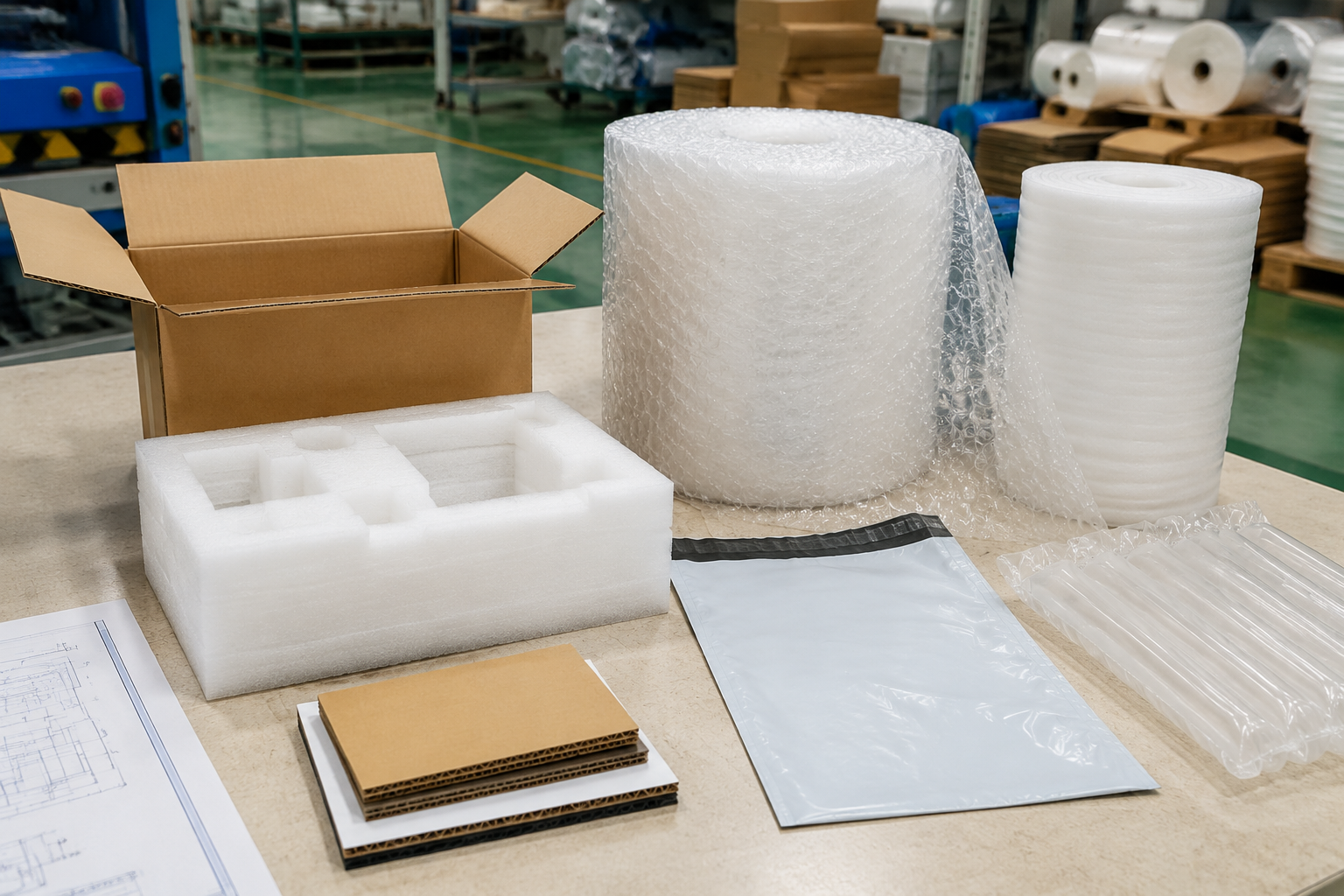
Wholesale Packaging Materials in China: Samples, MOQ, Quotation, and Bulk Order Process
Wholesale packaging materials from China can look simple at the inquiry stage, but the real decision depends on much more than naming a material...
Read cornerstone guide
Packaging Manufacturer vs Trading Company in China: What Overseas Buyers Should Check
When you are sourcing packaging from China, the main decision is not just who gives the quote. It is whether the supplier can handle...
Read cornerstone guide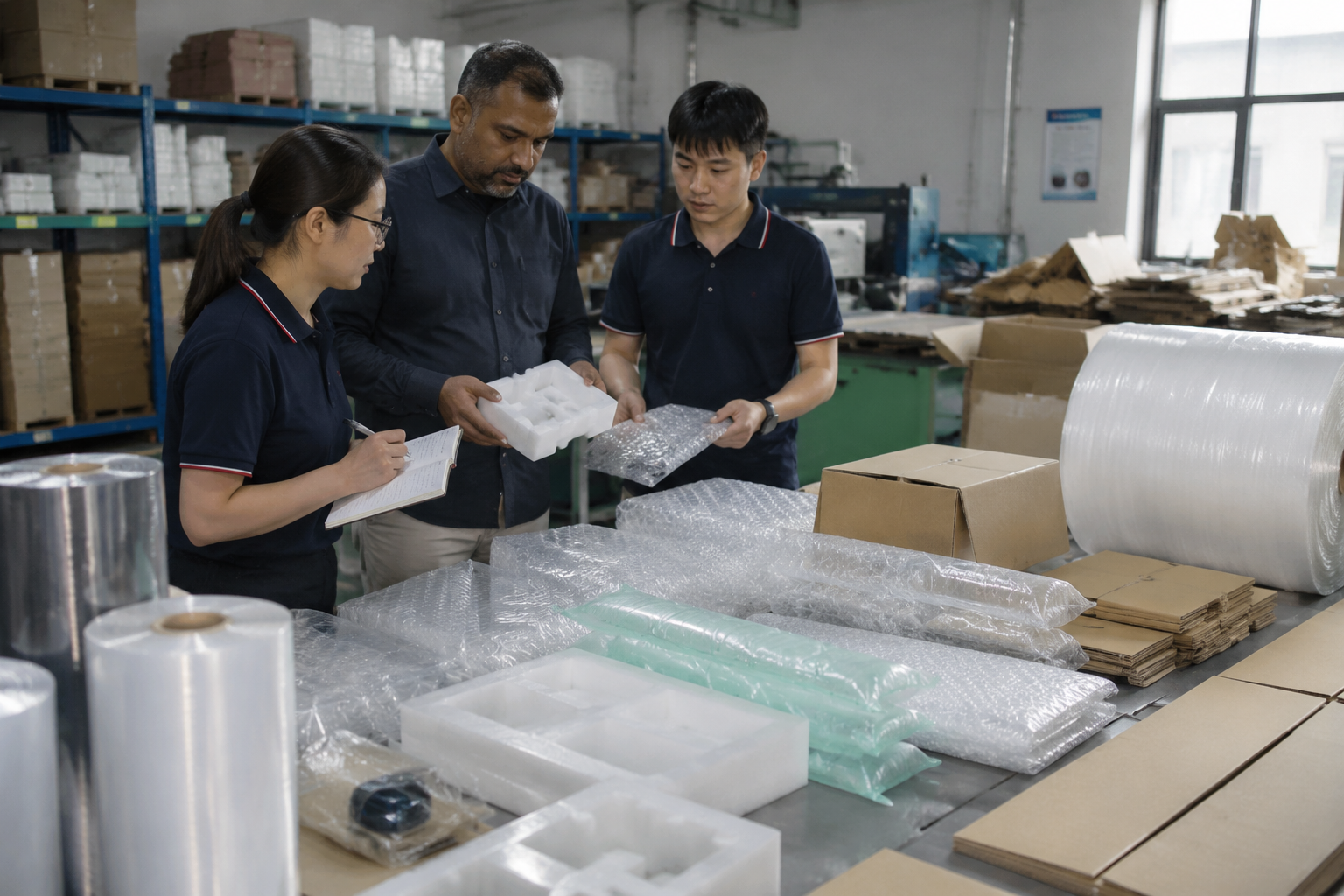
China Packaging Materials Supplier Guide: How to Choose the Right Factory for Custom Packaging
Choosing a China packaging materials supplier is not only about finding a factory that can quote foam, bubble wrap, cartons, film, or plastic bags....
Read cornerstone guide