
Packaging terms from China are easiest to judge when MOQ, lead time, and payment are treated as one production plan rather than separate quotation lines. The practical risk is that a buyer may compare unit prices before confirming product size, weight, fragility, surface protection, packing method, carton space, artwork, quantity, and shipping route, so a structured packaging supplier audit checklist should account for how each specification affects production cost and delivery risk. If those details are still changing, the supplier’s MOQ and schedule may also change because material purchasing, machine setup, printing preparation, sample approval, and export packing are all affected.
This guide helps importers understand when a term is negotiable and when it reflects a real production limit. It is useful for first orders where the packaging has not yet been proven, and for repeat orders where stable specifications can support better planning, clearer price tiers, and fewer last-minute delays.
Quick Packaging Decision Guide
| Buyer Question | Practical Reading | What to Check |
|---|---|---|
| Why does custom packaging need a higher MOQ? | The supplier may need to buy special material, prepare printing, adjust machines, or make tooling before production is efficient. | Material width, thickness, color, artwork, cutting waste, tooling needs, and whether a standard option can work. |
| When is the quoted lead time reliable? | Lead time is most reliable after size, material, artwork, sample status, packing method, quantity, and payment milestone are confirmed. | Approved sample, final files, carton marks, packing quantity, deposit status, and production slot availability. |
| Is the lowest unit price always the best choice? | Not always. A larger order can reduce unit price but increase cash pressure, warehouse space, and design-change risk. | Monthly usage, storage capacity, product stability, reorder plan, and total landed cost. |
| Can samples be skipped to save time? | For a first custom order, skipping samples may hide fit, sealing, printing, cushioning, or carton compatibility problems. | Product fit, fragile areas, surface scratches, packing speed, print position, and carton arrangement. |
| Which terms are safest to negotiate? | Quantity, delivery staging, material alternatives, print simplification, and repeat-order planning are often safer than forcing every term lower. | Standard materials, fewer sizes, simpler structures, realistic forecast volume, and acceptable schedule buffer. |
| How should suppliers be compared? | Compare the full order plan rather than only the product name or unit price. | MOQ logic, sample process, quality reference, payment milestones, packing details, and export preparation support. |
Quick Answers Before You Read
What should I send before requesting a packaging quote?
Send product dimensions, weight, fragility, surface protection needs, packaging size, preferred material, artwork files, order quantity, packing method, destination, and target delivery date.
When is custom packaging worth the extra preparation?
It is worth considering when standard packaging does not fit well, protect the product safely, support efficient packing, match carton space, or meet branding requirements.
How does export packing change the decision?
Export packing can require stronger cartons, clear carton marks, pallet planning, quantity separation, and protection against compression or deformation during longer handling.
Why can payment timing affect delivery?
Payment milestones often allow the supplier to purchase materials, reserve machine time, prepare printing or tooling, and release finished goods for shipment.
When buying packaging from China, MOQ, lead time, and payment terms are not separate details to check at the end of a quotation. They are connected to material purchasing, setup work, sample approval, production scheduling, export preparation, and supplier risk. A standard bubble bag, carton, or film order may move faster with a lower starting quantity, while custom printing, special sizes, foam inserts, tooling, or uncommon materials usually require more preparation and tighter confirmation.
This article helps buyers judge which terms are flexible and which are driven by real production limits. It is especially useful before a first order, when product size, packing quantity, artwork, cushioning needs, carton space, payment timing, and delivery deadlines must be clear enough for a supplier to quote accurately and plan production without repeated changes.
Why MOQ, Lead Time, and Payment Terms Are Connected
When importers start buying packaging from China, MOQ, lead time, and payment terms often look like separate items on a quotation. In practice, they are connected. A supplier does not set these terms only as sales preferences. They usually reflect raw material purchasing, machine setup, printing preparation, labor scheduling, packaging type, customization level, and the commercial risk of starting production before costs are covered.
A small order may be simple for the buyer, but it can be inefficient for the factory if the material must be purchased in larger rolls, sheets, planks, or paperboard lots. An urgent order may be possible for standard bubble wrap rolls or plain plastic bags, but it becomes harder for printed mailers, custom EPE foam inserts, special film structures, or printed corrugated boxes. The more preparation required before production, the more closely MOQ, schedule, and payment timing need to be planned together.
At Daipak, the discussion usually starts with the product details rather than the material name. Product size, order quantity, artwork readiness, sample approval needs, packing method, delivery deadline, and shipping destination all affect the commercial terms. This is especially true for a first order, where the supplier and buyer still need to confirm the specification, production process, and quality expectations before moving into a stable repeat order pattern.
Commercial Terms Reflect Production Cost and Risk
MOQ is often tied to the supplier’s minimum efficient production quantity. Lead time is tied to how quickly materials, machine time, printing preparation, and workers can be arranged. Payment terms are tied to cash-flow exposure, especially when the supplier must purchase materials, reserve capacity, or prepare tooling before the buyer receives finished goods. These three terms influence each other in almost every wholesale packaging order.
For example, a buyer asking for a custom-size poly mailer with full-surface printing is not only buying bags. The supplier may need to check film thickness, confirm bag dimensions, prepare printing plates or cylinders, align colors, adjust sealing settings, run trial material, and pack the finished bags into export cartons. A lower MOQ may still be possible in some cases, but the unit price may rise because setup cost and material waste are spread across fewer pieces.
The same logic applies to protective packaging. A custom foam insert for a fragile product may need product drawings, cavity design, cutting or bonding preparation, and sample fitting before bulk production. If the buyer also needs a tight delivery date, the supplier must judge whether the order can fit into the existing production schedule without increasing quality risk. Payment timing becomes part of that decision because production cannot be planned reliably if key commercial commitments remain open.
Traceability Starts With the Quotation Basis
A reliable packaging quotation should show what the supplier has actually priced, not only the final unit cost. Buyers should ask whether the quoted MOQ is based on a specific material grade, film thickness, board grade, foam density, printing color count, tooling requirement, carton packing quantity, and confirmed order quantity. If any of those assumptions change, the buyer should expect the quotation, lead time, or payment milestone to be reviewed again.
This traceability is especially useful when comparing several China packaging suppliers. One supplier may quote a lower unit price because the material is thinner, the board grade is different, the print area is smaller, or export packing is not included in the same way. Another supplier may quote a higher price but include sample preparation, stronger cartons, clearer packing marks, or a more realistic production buffer. Without comparing the quotation basis, buyers may think they are comparing the same packaging when they are actually comparing different production plans.
Commercial Claims Should Be Confirmed in Writing
Buyers should be careful with broad claims such as “fastest lead time,” “lowest price,” “guaranteed delivery,” “customs-safe shipping,” or “full after-sales support” unless the supplier has clearly explained what those words mean for the exact order. A useful quotation should connect each promise to the product specification, quantity, payment milestone, inspection step, packing method, shipping handoff, and any policy terms that the supplier is actually offering.
This is especially important when comparing suppliers across different product types. A promise that may be realistic for a plain stock-like carton may not apply to a printed mailer, a food-contact package, a foam insert, or a seasonal custom order. Buyers should ask for the operational basis behind commercial claims rather than treating short marketing phrases as proof of schedule, quality, or risk control.
Why First Orders Usually Need More Planning Than Repeat Orders
First orders normally require more coordination because the specification has not yet been proven in production. Even if the buyer knows the product well, the packaging supplier still needs to confirm dimensions, material thickness or density, printing details, packing quantity per carton, carton marks, and any special requirements for storage or export handling. If samples are needed, the timeline must include sample making, sample review, possible revisions, and final approval before bulk production.
Artwork is another common source of delay. A logo that looks correct on screen may need adjustment for printing size, color separation, bleed area, or repeat pattern. Printed corrugated boxes, courier bags, retail cartons, and branded poly mailers can all require extra checks before production starts. If the buyer changes artwork after approval, the schedule and cost may change as well.
Repeat orders can often move faster when the buyer keeps the same size, material, printing file, packing method, and quantity range. The supplier can refer to the previous production record, confirm whether raw materials are available, and plan the order with fewer unknowns. That does not mean repeat orders are automatic, but stable specifications usually make the MOQ discussion, production schedule, and payment process more predictable.
Standard Packaging vs. Custom Packaging Terms
Standard packaging usually allows more flexibility because the supplier may use common materials, familiar machine settings, and regular production methods. Products such as plain bubble wrap rolls, standard EPE foam sheets, common plastic bags, air pillow film, or regular corrugated boxes may have simpler preparation steps than highly customized packaging. If the material and size are close to what the factory already produces, the practical MOQ may be easier to discuss.
Custom packaging changes the equation. Custom size, custom printing, foam inserts, die-cut corrugated structures, special film thickness, or unique sealing requirements all add preparation work. The supplier may need to purchase non-standard material, adjust cutting width, prepare printing setup, make samples, or reserve specific machine time. These steps can raise the practical MOQ and extend the lead time, even when the finished packaging looks simple.
For importers, the useful question is not only “What is the lowest MOQ?” A better question is: “What order quantity gives a realistic price, stable production, and a schedule that fits the delivery plan?” Buyers get better results when they plan quantity, artwork approval, sample timing, payment milestones, and shipping schedule as one connected process.
It is also useful to separate a supplier’s commercial flexibility from the physical limits of the packaging job. A supplier may be willing to support a smaller first order, but that does not always remove film roll minimums, board purchasing rules, foam plank sizes, printing setup loss, or carton packing requirements. When buyers understand which part of the term is driven by production and which part is open to discussion, negotiation becomes more practical and less likely to create quality or delivery pressure.
For first-time importers, this distinction prevents a common misunderstanding. A supplier who asks for more confirmation is not necessarily slowing the order; the supplier may be protecting the buyer from producing the wrong size, wrong print, wrong material, or wrong protective structure. The earlier those details are settled, the easier it becomes to judge whether a quoted MOQ, lead time, or payment term is reasonable for the actual packaging specification.
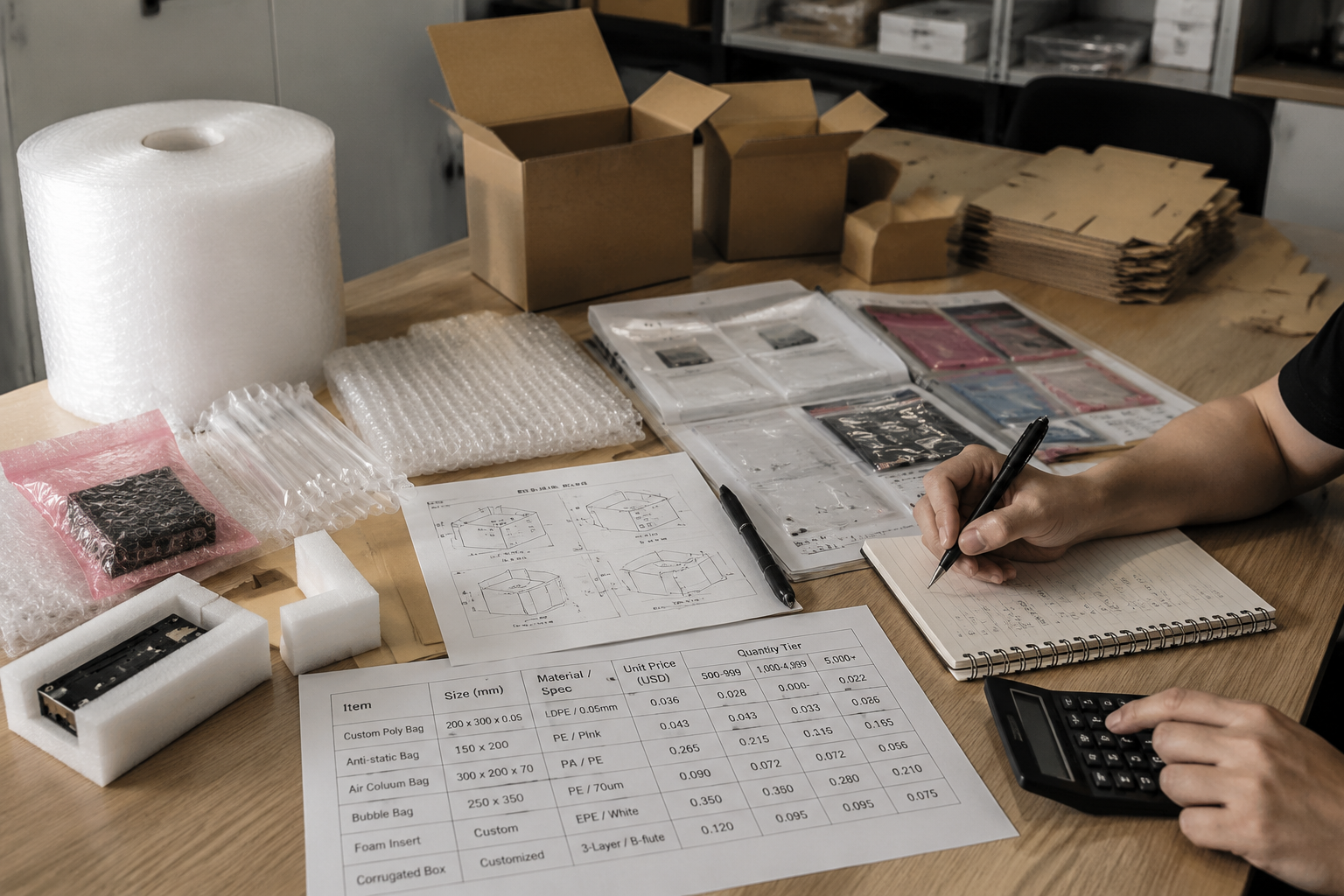
How MOQ Is Set by Material Purchasing and Batch Production
A packaging MOQ is usually shaped by the physical reality of making the product. The minimum order quantity for packaging may come from raw material purchasing, machine setup, cutting plans, printing preparation, converting efficiency, or carton packing. It is rarely a single number that applies to every product category.
For standard materials, the MOQ may be lower because the supplier can use common resin, paperboard, film rolls, bubble material, or EPE foam stock. For custom packaging, the MOQ may rise because the supplier must prepare a special size, thickness, color, print, die, mold, insert structure, or lamination. A small order may still be possible, but it may not reach the most efficient price tier.
Buyers should treat MOQ as a production question, not only a negotiation question. A supplier can sometimes adjust the quantity, but certain cost floors remain. If material is bought in larger rolls, if a printing setup must be prepared, or if a machine needs a long adjustment period, a very small trial order may carry a noticeably higher unit cost.
Raw Material Minimums Often Decide the Floor
Many packaging products begin with materials that suppliers cannot buy in tiny quantities. Plastic bags and poly mailers may require resin, film rolls, adhesive strips, or color masterbatch. Bubble wrap and air cushion packaging may depend on film thickness and roll width. EPE foam sheets, foam bags, or custom foam inserts may depend on foam rolls, planks, density, thickness, or lamination materials. Corrugated boxes depend on paperboard grade, flute structure, sheet size, and sometimes printed liner.
If a buyer requests a custom size or special material, the supplier may need to purchase inputs that exceed the buyer’s requested quantity. That extra material has to be used, stored, or absorbed into the price. This is one reason a custom packaging MOQ can be higher than expected, especially when the specification is not shared with other regular products.
Material color can also affect the floor. Clear film, white mailer film, kraft paperboard, and common foam thicknesses may be easier to plan than unusual colors or special finishes. If the material is not commonly used, the supplier may need a larger purchase quantity from its own upstream supplier. In that case, reducing the finished product MOQ may not solve the raw material issue.
Machine Setup Makes Very Small Orders Expensive
Even when material is available, machines still need setup time. Bag sealing machines may need adjustment for width, length, sealing temperature, perforation, handle position, or adhesive strip placement. Foam cutting or bonding may require setup for thickness, shape, cavity size, or edge fit. Corrugated box production may involve slotting, scoring, die-cutting, folding, gluing, and packing steps. Printing equipment needs alignment and test runs before acceptable output is reached.
Setup time creates cost before the first acceptable finished piece is produced. There can also be adjustment waste while the operator checks size accuracy, sealing strength, cutting position, print registration, or lamination quality. For a very small order, this preparation cost is spread across too few units, which makes the unit price look high compared with a larger batch.
This is why a small order and an efficient batch quantity may receive very different pricing. The factory may spend nearly the same setup time for both, but the larger order uses that setup more effectively. From a buyer’s side, this means the lowest trial quantity is not always the best indicator of long-term cost. It is often useful to ask for a trial quantity, an efficient batch quantity, and a repeat-order quantity for comparison.
Custom Printing and Tooling Raise the Practical MOQ
Printing adds fixed preparation work that does not disappear just because the order is small. Printed cartons, branded poly mailers, custom bubble bags, or printed film products may require artwork checking, plate or cylinder preparation, color matching, ink setup, test printing, and print alignment. If the buyer needs exact brand color control, the approval process may require extra review before bulk production.
Tooling has similar logic. A die-cut corrugated box, shaped EPE foam insert, special air column structure, or custom cavity may require a die, mold, cutting pattern, or fixture. These tools help production repeat the approved shape, but they create upfront cost and time. If the order quantity is too low, the tooling cost becomes a large part of the product cost.
Custom printing and tooling also increase the risk of setup loss. The first pieces may be used for alignment, color checking, sealing checks, or fit confirmation. This waste is normal in production, but it must be included in the commercial calculation. A buyer who wants a very low MOQ, strict print quality, and a low unit price at the same time may be asking for a combination that is difficult to support reliably.
When MOQ May Be Negotiable
MOQ may be more flexible when the buyer chooses standard materials, common sizes, simple structures, or shared specifications that the supplier already uses. Plain bubble wrap rolls, standard foam sheets, common plastic bags, or regular corrugated cartons may allow more room for a smaller trial order than a fully custom printed or tooled product.
There are also practical ways to create flexibility. A buyer may simplify printing, choose a common film thickness, adjust the size to match existing roll width, accept a higher unit price for a small batch, or combine several repeat orders under one production plan. In some cases, the supplier can produce a lower first quantity if the buyer provides a realistic repeat-order forecast and keeps the specification stable.
However, not every MOQ can be negotiated away. If the MOQ is driven by raw material purchase, printing setup, tooling cost, or machine efficiency, pushing below the practical floor may only move the cost elsewhere. The result may be a higher unit price, less favorable payment terms, longer scheduling, or reduced supplier willingness to reserve production capacity.
A useful negotiation starts by asking why the MOQ exists. If the answer is film width, board grade, foam density, print setup, or machine changeover, the buyer can look for practical adjustments. If the issue is simply that a supplier prefers a larger order, there may be more room to discuss a controlled first batch. The buyer does not need to accept every number without question, but the discussion should be based on the actual cause of the MOQ.
How Price Tiers Work Beyond the Unit Price
Packaging price tiers are not just discounts for buying more. They reflect how production cost changes as order quantity increases. Larger orders can spread setup cost over more units, improve material utilization, reduce machine changeover cost per unit, and allow labor to work in a more continuous flow. For wholesale packaging materials, this often explains why the unit price changes noticeably between a trial order, a practical batch, and a larger repeat-order quantity.
Still, the lowest unit price is not always the best commercial decision. Importers also need to consider landed cost, storage cost, cash flow, demand uncertainty, and the risk of packaging becoming outdated. A large bulk packaging order can look attractive on the quotation but become expensive if it fills warehouse space, ties up capital, or no longer matches the product after a design change.
The right price tier depends on where the buyer is in the purchasing cycle. A first order with new specifications should control risk. A repeat order with stable usage data can usually focus more on efficiency. Good budget planning compares the supplier’s price tiers with the buyer’s real storage capacity, sales rhythm, and reorder plan.
Why Larger Orders Usually Reduce Unit Cost
Larger orders usually reduce unit cost because fixed preparation work is spread across more pieces. The supplier may need similar time to confirm the specification, set up the machine, prepare printing, check sealing, or arrange packing whether the order is small or large. When more units are produced in one run, each unit carries a smaller share of that preparation cost.
Material purchasing can also improve at higher quantities. If the supplier can buy film, foam, resin, adhesive, paperboard, or ink more efficiently, part of that efficiency may appear in the price tier. Production continuity matters as well. A longer run can reduce frequent machine changes, repeated adjustment waste, and labor interruptions.
Waste ratio is another factor. Every production run has some setup loss, test pieces, trimming, or checking waste. In a very small order, that waste may be a meaningful part of total cost. In a larger order, the same preparation waste becomes a smaller percentage of the finished quantity. This is why a buyer may see a better price tier once the order reaches a more efficient batch size.
Where a Lower Unit Price Can Create Higher Total Cost
A lower unit price can create higher total cost if the buyer orders more packaging than the business can use safely. Packaging takes warehouse space, and bulky materials such as bubble wrap rolls, foam sheets, corrugated boxes, and air cushion packaging can occupy more volume than their unit price suggests. Storage cost may not appear on the supplier’s quotation, but it affects the buyer’s real budget.
Cash flow is another risk. A large order may reduce the unit price, but it also requires more capital upfront. If the buyer is still testing a product, launching a new e-commerce line, or unsure about seasonal demand, over-ordering packaging can create pressure. The money tied up in packaging inventory may be needed for products, freight, marketing, or other operating costs.
Design stability also matters. Printed cartons, branded poly mailers, retail packaging, and custom inserts can become outdated if the logo, barcode, product size, regulatory label, or sales channel changes. A buyer who orders too much too early may save on unit price but lose flexibility. For first orders, a slightly higher unit price can be a safer choice if it reduces the risk of unused inventory.
How First Orders and Repeat Orders Should Use Different Price Logic
First orders should usually focus on control. If the packaging specification is new, the buyer needs to confirm fit, protection, packing speed, carton quantity, warehouse handling, and customer response before committing to a large batch. This is especially important for custom protective packaging, printed packaging, and packaging that affects the buyer’s outer carton size or shipping cost.
A controlled first order gives the buyer real information. Does the foam insert fit the product consistently? Does the poly mailer seal well during warehouse packing? Does the printed carton hold up through handling? Does the bubble wrap thickness match the product’s fragility? These answers are more valuable than chasing the lowest price tier before the packaging has been tested in normal use.
Repeat orders can use different logic. Once the buyer knows actual monthly usage, damage performance, packing labor needs, and storage capacity, larger planned batches may make better sense. Stable repeat orders allow the supplier to plan materials and production slots more efficiently, and they help the buyer build a more predictable packaging budget without taking unnecessary first-order inventory risk.
Buyers should also compare price tiers against the cost of mistakes. If an untested package causes product movement, surface scratches, slow packing, carton bulging, or customer complaints, the saving from a lower unit price may be small compared with replacement cost, labor cost, and delayed shipments. A price tier is most useful after the packaging has already been matched to the product and shipping route.
Quality Control Note: For packaging orders, buyer confidence depends on visible and measurable quality-control details such as material thickness, board grade, seal strength, print position, color tolerance, carton size, packing quantity, and sample match. These details should be checked against the approved specification rather than assumed from a product name, factory description, or low unit price alone.
What Really Determines Packaging Lead Time
Packaging lead time is not only the number of days a machine runs. For importers, the practical timeline includes specification confirmation, sample approval when needed, material sourcing, printing preparation, production scheduling, manufacturing, inspection, carton packing, and export preparation. If any of these steps is unclear, the schedule can move even before production begins.
The lead time when buying packaging from China should be counted from order readiness, not from the first inquiry. A supplier can estimate timing during quotation, but a real production schedule usually depends on confirmed size, material, thickness, quantity, artwork, packing method, payment milestone, and available production slot. This is especially important for custom packaging, where a small detail such as a revised bag size, changed carton mark, or adjusted foam cavity can affect material planning and machine setup.
Lead Time Usually Starts After Full Confirmation
Buyers often ask for a shipment date before all details are ready. That is understandable when they are working backward from a retail launch, warehouse deadline, or vessel booking. From the factory side, however, production cannot be scheduled accurately until the order is technically and commercially confirmed.
For a standard packaging order, confirmation may be simple: product type, size, material grade, quantity, packing quantity per carton, shipping destination, and payment arrangement. For a custom order, the supplier may also need approved drawings, artwork files, color references, die-line confirmation, sample approval, and tolerance requirements. If a printed poly mailer, EPE foam insert, air column bag, or printed corrugated box has not been approved, the schedule remains conditional.
Payment timing also matters. If a deposit or other agreed milestone is required before packaging supplier quote comparison material purchasing, printing preparation, or capacity reservation, production planning may not begin until that step is complete. For overseas buyers, a packaging supplier audit checklist can help connect these commercial gates with technical readiness before commitments are locked. A buyer who wants a firm delivery deadline should align technical approval and commercial approval at the same time, not treat them as separate conversations.
Pre-Production Steps Can Take Longer Than Buyers Expect
Pre-production is where many packaging schedules stretch. The product may look simple after it is finished, but the preparation behind it can involve several checks. A sample may need to be made, shipped, reviewed, revised, and approved. Artwork may need adjustment for print area, bleed, color, barcode placement, warning marks, or carton layout. If tooling, printing plates, dies, or molds are involved, those also need preparation before batch production can move forward.
Material sourcing can also affect packaging lead time. Standard film, foam, bubble material, or corrugated board may be easier to arrange, while a special thickness, unusual color, laminated structure, high-density foam, or non-standard paperboard may require additional purchasing time. The issue is not only whether the material exists; it is whether the right material is available in the correct width, thickness, density, color, or grade for the confirmed order.
Sample revisions are another common delay. If a foam insert is too tight, a bubble bag opening is difficult to use, a printed color does not match the buyer’s reference, or a carton structure needs stronger flaps, the supplier may need to adjust the design and confirm again. This is useful work because it prevents larger mistakes later, but it should be included in the schedule buffer.
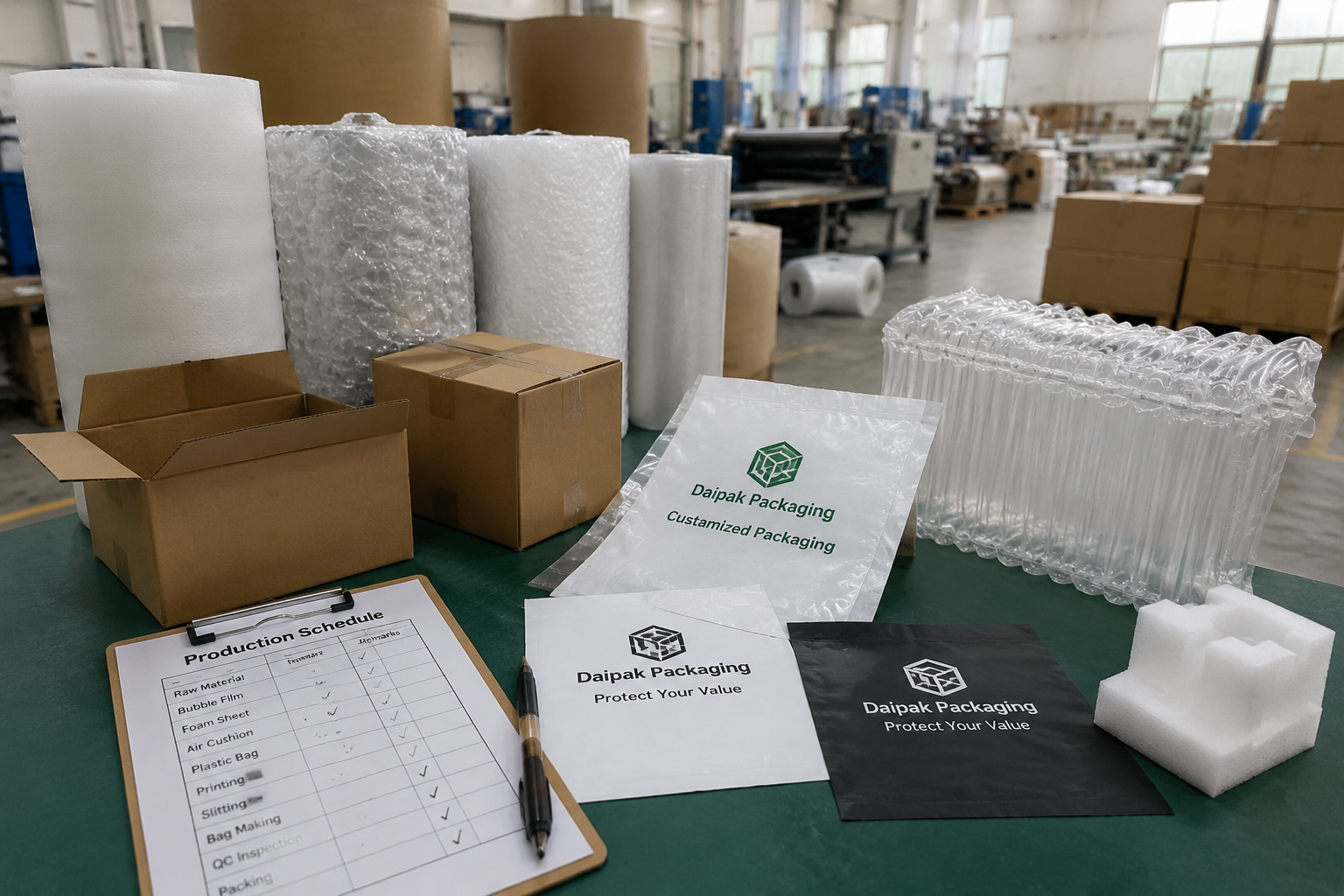
Actual Production Time Depends on Product Type and Complexity
Not all packaging products carry the same production burden. Plain plastic bags, standard bubble wrap rolls, basic foam sheets, and common corrugated boxes usually have fewer preparation steps than printed or shaped products. If the size and material are common and the order fits available production planning, the manufacturing stage may be relatively straightforward.
Custom packaging adds more variables. Printed mailers require artwork control, printing setup, color alignment, curing or drying considerations depending on the process, cutting, sealing, and packing. Custom EPE foam inserts require material preparation, cutting accuracy, bonding or shaping if needed, cavity fit, and repeatable thickness or density control. Air column bags need correct structure, sealing quality, inflation performance, and size matching to the product. Corrugated boxes may require board selection, printing, slotting, die-cutting, folding, and bundling.
Order volume also affects timing. A small order may fit into a production gap, but it may still need setup. A larger order may run more efficiently once started, but it needs more material, machine time, labor allocation, cartons, and storage space before shipment. During busy periods, the factory queue can be as important as the actual machine time.
Inspection, Packing, and Export Preparation Also Need Time
Finished goods are not ready to ship the moment they come off the line. Packaging products still need quantity checks, size or appearance review, sealing or cutting checks where relevant, and packing into export cartons. For printed packaging, the supplier may also check print position, color consistency, and carton labeling. For protective packaging, practical review may include whether foam pieces, bubble bags, or air packaging match the approved structure and are packed in a way that avoids deformation during transit.
Export preparation can involve carton marks, packing lists, pallet preparation if required, shipment coordination, and documentation support. If a buyer needs special labels, SKU separation, mixed-item carton planning, pallet height limits, or warehouse receiving marks, those details should be confirmed before packing starts. Late changes to carton marks or packing quantities can slow release even after production is finished.
A realistic schedule therefore includes three parts: pre-production preparation, actual manufacturing, and shipment preparation. Buyers who plan only for manufacturing days may leave too little room for sample approval, inspection, packing, inland logistics, and export coordination. The safer approach is to confirm the target delivery deadline early and ask the supplier which steps are on the critical path.
Lead time should also be reviewed against the buyer’s receiving process. Some warehouses need appointment booking, pallet labeling, SKU separation, or carton barcode rules before goods can be received. If those requirements are not shared until after packing, the supplier may need to relabel cartons or adjust documents. That delay is not part of machine production, but it still affects when the packaging becomes usable for the buyer.
Before accepting a quoted lead time, buyers should confirm what evidence will mark each stage as complete: approved sample or drawing, final artwork, material confirmation, production start, in-process check if needed, finished quantity, carton packing details, and shipment release requirements. This does not remove all schedule risk, but it makes delays easier to trace and discuss.
Evidence-Based Checks That Can Change Packaging Terms
Some packaging requests need more than a normal commercial discussion because the buyer is asking the supplier to support a performance, regulatory, or environmental claim. If the package must survive a parcel delivery route, support a food-contact application, or carry a compostable or recyclable claim, the quotation should identify the standard, test method, documentation need, and approval step before bulk production. These requirements can affect MOQ, lead time, sample cost, and payment timing because they may add material validation, third-party testing, label review, or additional supplier documentation.
For transport performance, buyers should not treat a stronger-looking carton or thicker cushion as proof that the finished packed product will survive the intended distribution route. ASTM D4169 is a recognized standard practice for performance testing shipping containers and systems, while ISTA Procedure 3A is designed around packaged products for parcel delivery systems; using these references as planning tools can help buyers decide whether they need a simple sample check or a more formal packaged-product test plan.[1][2]
For environmental claims, wording matters. Compostable packaging claims should be tied to recognized compostability standards or certification routes rather than general “eco-friendly” language; ASTM D6400 covers plastics designed to be aerobically composted in municipal or industrial facilities, and BPI provides a certification reference for compostable products and packaging.[3][4] If a buyer wants recycling instructions on consumer-facing packaging, How2Recycle provides labeling guidance that can help avoid vague or misleading disposal language.[5]
Food-contact packaging also needs early clarification. U.S. rules for indirect food additives include separate federal regulations for paper and paperboard components under 21 CFR Part 176 and polymer materials under 21 CFR Part 177, so a food-contact request should be handled as a compliance and documentation question, not only as a material-price question.[6][7] If the buyer does not specify the end use, food type, temperature exposure, and market destination, the supplier may quote a material that is commercially available but not appropriate for the buyer’s compliance expectations.
How to Read Supplier Evidence Without Over-Interpreting It
Traceability is strongest when the evidence matches the exact packaging being ordered. A material data sheet, sample photo, previous test report, or certificate can be useful, but buyers should check whether it applies to the same material grade, thickness, coating, adhesive, ink, structure, and supplier batch. A document for a similar film, board, or foam should not be treated as proof for a different custom specification unless the supplier can explain the connection clearly.
Buyers should also separate three types of evidence: material information, finished-package performance, and order-specific production evidence. Material information helps identify resin, paperboard, foam density, or coating characteristics. Finished-package performance relates to drop, vibration, compression, sealing, or fit behavior. Order-specific evidence may include approved samples, photos of bulk goods, carton marks, packing quantities, and inspection notes. These evidence types answer different questions, so one should not be used to replace the others.
Documentation Limits and Claim Boundaries
Supplier documents can support a purchasing decision, but they should not be stretched beyond their scope. A previous test report may not cover a new size, changed material, different ink system, altered coating, new adhesive, or revised packing method. A buyer who needs a claim for retail, marketplace, food-contact, export, or sustainability purposes should confirm whether the document applies to the exact package and destination market before printing the claim on artwork or using it in product listings.
Buyers should also avoid assuming that a certificate, factory profile, or product photo guarantees every future order. Commercial evidence is strongest when it is tied to the confirmed quotation, approved sample, production batch, and finished packing details. If the supplier cannot connect the evidence to the current order, it may still be useful background information, but it should not be treated as proof of compliance, performance, or shipment readiness for that specific purchase.
How Customization Changes MOQ, Price, and Schedule
Customization can make packaging fit the product better, improve brand presentation, or reduce damage risk. It can also change the commercial terms quickly. A custom size, custom printing, special material thickness, shaped foam insert, die-cut corrugated structure, or unique bag design may require different material purchasing, machine setup, sample confirmation, and production planning than a standard item.
This is why a custom packaging supplier cannot always quote custom protective packaging like a stock product. The added cost is not only the visible feature. It may come from preparation work, setup loss, tooling cost, lower material yield, slower production speed, and extra approval steps. Before asking for aggressive MOQ, price, or schedule terms, buyers should make sure product dimensions, packing method, artwork file, tolerance requirements, and expected order quantity are stable.
Size and Structure Affect Material Yield
Custom size decisions directly affect material use. A bag that is only slightly wider may require a different film roll width. A foam pad with a non-standard dimension may create more offcut waste from a foam sheet or plank. A corrugated box with unusual depth or flap structure may use more board than expected or require a different cutting plan. These details influence both the minimum order quantity and the unit price.
Material yield matters because packaging production is usually planned around rolls, sheets, boards, or planks, not single pieces. If the confirmed size fits the available material width efficiently, the order may be easier to produce. If the size leaves large trim waste or requires special raw material, the supplier must account for that waste in the price or MOQ. This is one reason two bags with similar finished dimensions can have different commercial terms.
Structure also changes production flow. A simple flat poly bag, a bubble pouch with adhesive closure, a shaped foam insert, and a die-cut corrugated box all require different equipment settings and labor handling. The more steps involved, the more important it becomes to confirm drawings, samples, and packing method before bulk production.
Printing Adds Artwork, Color, and Setup Control
Custom printing adds preparation before production and control during production. The supplier may need to review the artwork file, confirm print size and position, prepare plates or other printing setup, match colors as closely as the process allows, and allow for setup waste before stable output begins. If the buyer changes a logo, barcode, warning text, or color reference after approval, the preparation work may need to be repeated.
Printed poly mailer bags, printed corrugated boxes, and branded film packaging all need clear artwork approval. Buyers should provide usable files, confirm color references where relevant, and check whether the print must match a strict brand standard or only a general visual direction. Strict color expectations may require more review and should not be handled at the last minute.
Printing can also raise the practical MOQ because setup work must be spread across enough units to make production reasonable. A very small printed order may carry a high unit cost or may not be efficient to produce. If the buyer is still testing a new brand design, a simpler print version or a controlled first order may be safer than committing to a large quantity before the market response is clear.
Foam Inserts and Special Structures Need More Confirmation
Custom EPE foam inserts, air column packaging, molded-like foam structures, and special corrugated inserts need more product information than basic packaging. The supplier may need the product sample, accurate drawings, product weight, fragile points, surface finish, and carton arrangement. A foam cavity that looks correct in a drawing may still need adjustment after testing the real product fit.
Fit is especially important for protective packaging. If the cavity is too tight, packing workers may struggle or the product surface may be scratched. If it is too loose, the product may move during transport and lose the benefit of the insert. Tolerance, compression, edge protection, stacking direction, and carton space should all be reviewed before bulk production.
From the production side, Mr. Wang often checks whether cutting, bonding, sealing, or forming details can be repeated consistently during batch production. This type of review is practical, not decorative. A custom structure must protect the product and also be stable enough for repeated manufacturing, packing, and shipment.
Specification Changes After Approval Can Reset the Timeline
Late specification changes are one of the most common reasons custom packaging schedules move. A revised size, new print file, different material thickness, changed foam cavity, updated carton structure, or new packing quantity can affect material purchasing, tooling, machine setup, sample approval, and production scheduling. Even if the change appears small to the buyer, it may require the supplier to restart part of the preparation work.
The risk is larger after materials have been purchased or production has been scheduled. A film roll, foam sheet, paperboard grade, printing plate, die, or mold prepared for one specification may not work for the revised version. If the supplier has already reserved machine time, a change may also push the order behind other confirmed jobs.
Buyers can reduce this risk by locking the specification before sample approval and treating the approved sample as the production reference. If a change is necessary, it should be raised immediately with a clear explanation of what changed and whether the delivery deadline can move. For custom packaging, speed usually comes from stable decisions, not from rushing every step after approval.
Customization should also be judged by what it improves. A custom print may support branding, but it may not improve product protection. A thicker foam may improve cushioning, but it may reduce carton efficiency or increase freight volume. A smaller bag may save material, but it may slow packing if workers struggle to insert the product. Good custom packaging decisions compare protection, appearance, packing labor, carton space, and total logistics cost together.
Payment Terms: What They Cover and Why Suppliers Use Milestones
Packaging payment terms are part of production planning and risk control. They are not only a finance detail at the end of negotiation. For a supplier, payment milestones help cover material purchasing, printing preparation, tooling, capacity reservation, production labor, finished-goods storage, and shipment release. For an importer, they affect cash flow, order confirmation timing, and the point at which production can realistically begin.
Payment terms with China suppliers can vary by product type, order history, customization level, and commercial relationship. A first order for custom packaging usually carries more supplier risk than a repeat order with stable specifications. The supplier may need to buy material, prepare printing, or reserve production time before the buyer has any finished goods to inspect. That is why milestones are often used to share risk between both sides.
Deposit Payments Support Material Purchasing and Scheduling
A deposit commonly supports the early cost of an order. The supplier may need to purchase resin, paperboard, film, foam, ink, adhesive, or other inputs before production starts. For printed or custom packaging, the supplier may also need to prepare plates, tooling, dies, or samples. Without an agreed payment milestone, reserving material and production capacity for an unconfirmed order creates commercial exposure.
The timing of the deposit can also affect the production schedule. If the buyer approves the artwork but delays payment, the supplier may not be able to lock material or assign machine time. In a busy production period, this can move the order behind other confirmed jobs. Buyers planning around a fixed shipment date should treat payment approval as part of order readiness, not as a separate administrative step.
For first order payment planning, importers should include deposits, sample costs, tooling charges if any, bank processing time, and internal approval time. A purchasing team may approve the unit price quickly but lose days waiting for finance approval. That delay can matter when the delivery deadline is tight.
Balance Payments Are Usually Linked to Shipment Risk
Balance payment is often connected to finished-goods control and shipment release. Once packaging has been produced, the supplier has invested in material, labor, machine time, packing cartons, and storage. If goods are released before the agreed balance is settled, the supplier carries the risk of delayed or unpaid payment after the products leave its control.
From the buyer’s side, balance timing should be coordinated with inspection and shipping plans. Some buyers want photos, packing details, quantity confirmation, or third-party inspection before final payment. Those requirements should be discussed before production starts, not added after goods are ready. If inspection is required, the buyer should leave time for scheduling, review, and any reasonable correction before shipment.
Shipment release also depends on practical export preparation. Finished goods may need carton marks, palletizing, loading coordination, packing lists, and shipping documents. If the balance payment, inspection approval, or forwarder instructions arrive late, goods may sit in the warehouse and miss the intended shipment window.
Sample, Tooling, and Printing Setup Fees May Be Separate
Sample fees, tooling fees, and printing setup fees may appear separately from the product unit price because they cover preparation work that is not part of normal per-piece production. A custom foam insert may need sample cutting or a dedicated tool. A printed bag or carton may need plate preparation or artwork setup. A special corrugated structure may require a die or design adjustment before bulk production.
Whether these fees are refundable, partially absorbed, or separate from the bulk order depends on the agreement. Buyers should confirm this clearly before approving the project. For example, a supplier may treat sample work as a development cost, or may agree to apply part of it to a later bulk order if the order reaches an agreed level. There is no single rule that applies to every product and every supplier.
The practical point is to compare total project cost, not only unit price. A low unit price with high setup cost may not be attractive for a short trial order. A higher unit price with lower preparation cost may be better for early testing. For repeat orders, the impact of tooling or setup fees may become smaller because the same approved specification can be used again.
Repeat Orders May Create More Flexible Terms
Repeat orders usually give both buyer and supplier more certainty. The specification is already confirmed, artwork is stable, material requirements are known, and previous production issues, if any, can be corrected. The buyer also has real usage data from the warehouse, packing line, or sales channel, which makes quantity planning more reliable.
Payment flexibility may improve when there is a stable order history, predictable purchasing cycle, and clear communication. A supplier can plan raw materials and production slots with less uncertainty, while the buyer can forecast cash flow and inventory needs more accurately. This does not mean every term will change automatically, but it creates a stronger basis for discussion.
For importers, the best way to improve future terms is to keep specifications stable, pay according to agreement, share reorder forecasts early, and communicate changes before they become urgent. A repeat-order relationship works best when commercial terms, production planning, and delivery expectations are managed together.
Payment terms should be documented with the same care as product specifications. Buyers should confirm what payment stage starts material purchasing, what stage starts production, what evidence is provided before balance payment, and what is required before shipment release. Clear payment language reduces disputes because both sides understand which milestone controls each step of the order.
Payment Traceability Helps Avoid Schedule Confusion
For budget planning, buyers should connect each payment milestone to a practical production action. One milestone may allow material purchasing, another may allow bulk production, and another may be required before shipment release. The exact structure should be confirmed with the supplier, but the buyer’s internal approval process should mirror the production timeline so that finance delays do not become hidden lead-time delays.
It is also useful to keep a simple approval trail for first orders: quotation version, final specification, sample approval, artwork approval, agreed payment stage, production start notice, finished-goods photos or inspection record where applicable, carton packing details, and shipment instructions. This record helps both sides identify whether a later issue came from specification change, payment timing, production execution, or shipment preparation.
Commercial Policies Should Not Be Assumed
Buyers should not assume that every packaging order includes the same return terms, refund rules, repair support, replacement policy, shipment protection, or after-sales process. These items depend on the supplier’s written terms, the product type, whether the order is standard or custom, and when the issue is discovered. For custom packaging, a problem caused by an approved specification is usually different from a problem caused by production not matching the approved sample.
Before paying a deposit, buyers should confirm how the supplier handles sample revisions, production defects, shortage claims, carton damage, delayed pickup, changed shipment instructions, and documentation corrections. This does not require a long contract for every small order, but it should be clear enough that both sides know which evidence is needed and which deadline applies if a dispute appears.
Which Terms Can Be Negotiated—and Which Ones Should Not Be Forced
Packaging supplier negotiation works best when both sides understand which terms are flexible and which are tied to real production limits. A buyer can often discuss order quantity, delivery timing, material options, packing method, and price tiers. Those items may have room for adjustment because the supplier can change the production plan, combine materials, simplify preparation, or spread work across a more efficient batch.
Other demands are much riskier. Asking for a very low price, very fast lead time, strict custom quality, and delayed payment at the same time usually creates conflict. Something has to absorb the pressure: material grade, setup time, inspection time, machine scheduling, or supplier confidence. For a custom packaging order, forcing the wrong concession can lead to poor fit, weak sealing, color variation, delayed shipment, or a supplier who is less willing to reserve capacity for the next order.
Negotiable Areas: Quantity, Timing, Specification, and Repeat Forecast
MOQ negotiation is most realistic when the buyer gives the supplier another way to keep production efficient. For example, a supplier may have more flexibility if the buyer accepts a shared material specification, reduces the number of sizes, uses a common film thickness, or places a smaller first order with a higher unit price. The same logic can apply to bubble wrap rolls, EPE foam pads, poly mailer bags, air cushion film, and corrugated cartons. The issue is not only the number of pieces; it is whether the order can be produced without excessive setup loss or leftover material.
Timing can also be negotiated when the buyer has some room in the delivery plan. Instead of asking for all goods to ship urgently, a buyer may request staged delivery: one portion first for immediate packing needs and the balance later under a normal production schedule. This can be useful for wholesale packaging materials, seasonal packaging, or warehouse replenishment where the full order is not needed on the same day.
Specification choices are another practical negotiation point. A printed carton with multiple colors, a special coating, and a custom structure may have less flexibility than a plain corrugated box in a standard grade. A custom foam insert with multiple cavities may require more confirmation than simple EPE foam sheets or foam bags. If the buyer can simplify printing, use a standard carton style, adjust carton quantity per bundle, or accept a material alternative that still protects the product, the supplier may be able to offer better commercial terms without weakening the packaging.
Repeat-order forecasts can help more than aggressive bargaining. A China packaging materials supplier can plan material purchasing and production slots more confidently when the buyer shares expected monthly, quarterly, or seasonal usage. The forecast does not need to be a binding promise unless both parties agree, but it gives the supplier a clearer picture of whether the first order is a one-time trial or the start of a repeat purchasing pattern.
Risky Concessions: Rushed Production, Skipped Samples, and Unrealistic Pricing
Lead time negotiation becomes risky when the schedule leaves no room for setup, sample review, printing alignment, cutting checks, sealing checks, or packing inspection. Some urgent orders are manageable for simple standard packaging, especially when materials are available and the specification is familiar. But rushing a new custom size, printed design, foam insert, or structured protective package increases the chance of mistakes. The production line may be able to move faster, but color control, fit accuracy, sealing strength, and packing quantity still need attention.
Skipping sample approval is one of the most common ways buyers create avoidable risk in custom packaging sourcing. A drawing or artwork file may look correct on screen, but custom packaging supplier guide checks still require the real package to match the product size, surface finish, carton space, and packing method. A bubble bag that is slightly tight may slow packing. A foam insert cavity that is too loose may allow movement during transit. A printed poly mailer with artwork placed too close to the seal area may look poor after conversion. These are not small issues when the same mistake repeats across a bulk order.
Unrealistic price negotiation can also damage results. A lower price may be possible by changing thickness, density, board grade, printing method, packing quantity, or production batch size. Those changes should be named clearly. If the buyer asks for a lower price but insists that every material, size, print, and inspection requirement remain unchanged, the supplier may have little safe room to move. The risk is not only quality risk; it can also become delivery risk if the order is pushed behind more practical confirmed work.
Late artwork changes are another costly concession to force. After printing plates, cylinders, digital files, carton layouts, or production instructions are confirmed, even a small revision can reset preparation. The supplier may need to recheck colors, remake tooling, adjust print position, or reschedule production. For importers working against a fixed shipment date, late design changes often cost more time than expected.
How to Ask for Better Terms Without Increasing Risk
The best way to ask for better terms is to give the supplier useful planning information. Instead of only saying “lower MOQ” or “faster delivery,” buyers should explain what they can adjust. Can the order use a standard material? Can the artwork be simplified? Can the delivery be split? Can the buyer accept a practical trial quantity at a higher unit price before moving to a larger repeat order? These questions turn negotiation into production planning rather than pressure.
A buyer can usually improve the discussion by preparing three points before contacting a supplier: the target first-order quantity, the expected repeat demand, and the delivery deadline that truly matters. If the deadline is tied to a product launch, warehouse replenishment, retail promotion, or export shipment, the supplier should know that early. If the first order is mainly for market testing, the buyer should say so, because a smaller controlled order may be more sensible than pushing for the lowest unit price.
For custom packaging, locking the specification early is one of the safest ways to improve commercial terms. Confirm the product dimensions, material thickness or foam density, printing file, color reference, tolerance, packing method, and carton requirements before asking for aggressive pricing or fast delivery. A stable specification reduces revision time and gives the supplier more confidence in quoting price tiers, scheduling production, and preparing materials.
| Buyer Request | Usually Safer Approach | Risk If Forced Too Hard |
|---|---|---|
| Lower MOQ | Accept standard material, fewer sizes, or higher unit price for trial quantity | Excess waste, poor supplier commitment, or unsuitable material substitution |
| Shorter lead time | Confirm specs, artwork, payment, and sample approval early | Production errors, missed shipment date, or reduced inspection time |
| Lower price | Review material grade, packing method, structure, and batch size openly | Weaker protection, thinner material, color issues, or hidden total cost |
| Custom packaging approval | Use sample confirmation before bulk production | Poor fit, print errors, slow packing, or protection failure |
How Peak Season and Capacity Planning Affect Commercial Terms
Commercial terms can change when factory capacity tightens. During busy periods, suppliers may have less room to accept small custom orders, rush printing, hold production slots without confirmation, or adjust schedules at the last minute. This does not mean terms become unreasonable; it means the packaging production schedule is shaped by confirmed orders, material availability, printing queues, and the number of buyers trying to ship within the same window.
Importers planning e-commerce promotions, retail holiday packaging, seasonal product launches, or warehouse replenishment should treat timing as part of the cost. Waiting too long can increase the chance of longer packaging lead time from China, reduced MOQ flexibility, higher urgency cost, or limited options for sample revision. Repeat-order buyers usually have an advantage because they can confirm stable specifications earlier and give the supplier a clearer production plan.
Factory Capacity Is Reserved by Confirmed Orders
An inquiry does not normally reserve production time. A supplier may discuss price, MOQ, and delivery schedule during quotation, but the factory production queue usually depends on confirmed specifications, approved samples where needed, agreed payment milestone, and complete order details. Until those items are settled, the supplier may not be able to purchase materials or hold machine time with confidence.
This matters most for custom and printed packaging. Printed corrugated boxes, custom poly mailers, branded bubble bags, EPE foam inserts, and air column packaging may require artwork review, material preparation, cutting or sealing setup, and packing instructions. If another buyer confirms earlier with complete details, that order may enter the queue first. From a factory perspective, confirmed work is easier to schedule than a discussion that still has open drawings, unclear quantities, or uncertain payment timing.
Buyers can reduce this risk by separating “quotation target” from “production-ready order.” A quotation target may include estimated size, quantity, and deadline. A production-ready order should include final size, material, print file, sample decision, packing method, carton marks if needed, and payment arrangement. The closer the buyer gets to production-ready information, the more reliable the supplier’s schedule discussion becomes.
Material and Printing Queues Can Extend Custom Order Timelines
Peak season capacity is not only about machine time inside the packaging factory. Raw materials may also be in stronger demand. Film rolls, resin, paperboard, foam material, ink, adhesive, and special grades may need more planning when many buyers are placing orders at the same time. If the buyer needs a non-standard thickness, special color, unusual carton grade, or uncommon roll width, material sourcing can add pressure to the timeline.
Printing can become a separate bottleneck. Artwork review, plate preparation, color matching, ink setup, drying time, and print alignment all take coordination. When many buyers need printed cartons, printed poly mailers, branded film packaging, or retail-ready packaging close to the same selling season, printing queues can extend the pre-production stage even before the main converting process begins.
Tooling and structure changes also need time. A new foam insert, die-cut corrugated structure, special bag shape, or custom air column design may require drawings, samples, and adjustment before bulk production. If the buyer changes the product size or artwork after approval, the order may lose its place in the schedule or require a new preparation cycle. That can be more disruptive during a busy period than during a slower production window.
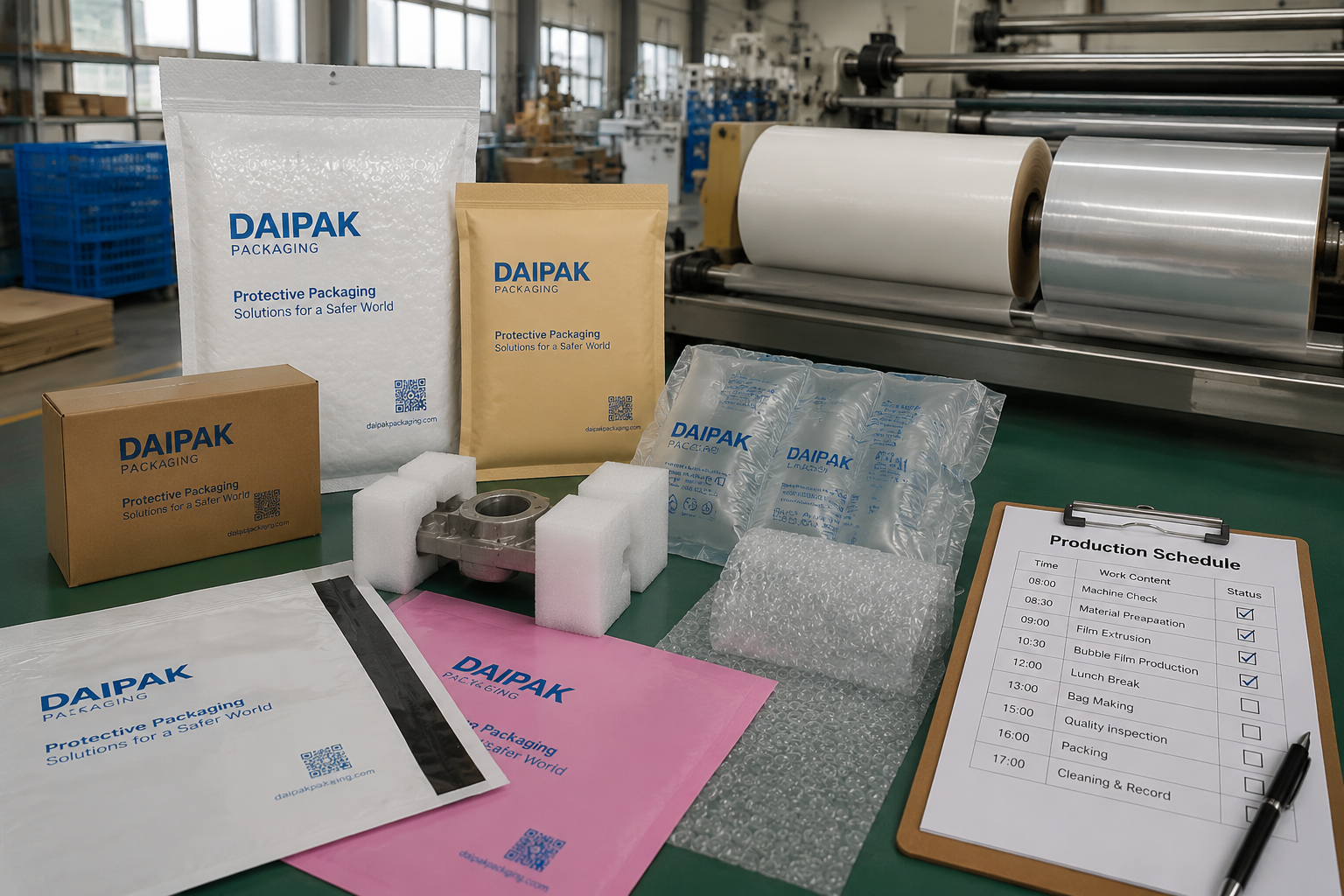
Delivery Buffers Protect Importers From Costly Last-Minute Decisions
A delivery buffer is not wasted time. It protects the buyer from expensive choices that appear when the schedule is already too tight. Without a buffer, the buyer may feel forced to skip a sample, accept incomplete artwork checking, rush production, reduce inspection time, or use more expensive freight. Any one of those choices can raise the total cost beyond the savings gained from waiting to order.
A practical buffer should cover more than manufacturing. Buyers should allow time for sample making and sample shipping if needed, artwork confirmation, material preparation, production, inspection, carton packing, labeling, pallet preparation where required, inland logistics, and international shipping coordination. For export packaging, carton marks, packing quantities, and shipment preparation should be confirmed early enough that they do not become last-minute corrections.
Reorder points are especially useful for repeat orders. Instead of waiting until the warehouse has almost no packaging left, buyers can set a trigger based on average weekly use, supplier lead time, transit time, and a safety stock level. This is important for packaging materials that directly affect outbound shipping. If an e-commerce warehouse runs out of the correct mailer, foam insert, carton, or void-fill material, the product may be ready to sell but not ready to ship safely.
A buffer also gives the buyer more choices. With enough time, the buyer can compare a standard option with a custom option, review sample performance, adjust carton packing, and choose a practical shipping method. When the schedule is already urgent, the buyer may have to accept the first workable solution even if it is not the most efficient long-term packaging plan.
How Buyers Should Prepare a Quote Request for Realistic Terms
A clear quote request gives the supplier enough information to provide realistic MOQ, lead time, price tier, and payment-term discussion. A vague request usually leads to a cautious answer because the supplier has to assume unknowns: material grade, size tolerance, printing complexity, packing quantity, sample needs, and delivery pressure. For a packaging quotation from China, better details usually mean fewer revisions and a more useful commercial comparison.
At Daipak, the discussion usually starts with the product details rather than the material name. A buyer asking for “foam packaging” or “custom bags” may receive several different options depending on product size, weight, surface finish, fragility, carton space, and shipping route. The more clearly those details are shared, the easier it is for a supplier to recommend a practical structure and quote quantity levels that match the buyer’s budget and schedule.
Information Needed for Standard Packaging
For standard packaging, the buyer should still provide more than a product name. “Bubble wrap roll,” “poly mailer,” “stretch film,” or “corrugated box” can describe many different specifications. Roll width, roll length, bubble size, film thickness, bag size, board grade, carton dimensions, closure type, and packing quantity can all affect price and production planning.
A useful standard packaging request should include the product type, required size, material preference, thickness or grade if known, quantity, packing method, and target delivery date. If the packaging will be used on a packing line, in a warehouse, for e-commerce parcels, or for export cartons, the supplier should know that too. Packing speed, carton space, storage condition, and shipping distance can influence whether a basic stock-like item is enough or whether a small specification adjustment would be safer.
Buyers should also mention destination and shipment expectations. Even when the packaging itself is simple, export packing may require carton labels, carton marks, pallet preparation, or specific packing quantities per master carton. These details can affect the final quotation and shipment preparation, especially for bulk orders.
Information Needed for Custom Packaging
A custom packaging quote needs more complete information because the supplier may need to calculate material yield, printing setup, tooling, sample work, and production time. For custom printed poly mailer bags, the buyer should provide bag size, material thickness, closure style, artwork file, printing colors, print position, and quantity range. For printed corrugated boxes, the supplier may need dimensions, board grade, structure, printing area, color reference, and packing requirements.
For custom protective packaging, drawings and product samples can be especially helpful. EPE foam inserts, shaped foam pads, air column bags, and structured inner protection need to fit the product, not only look correct in a file. The supplier may need product dimensions, weight, fragile points, surface scratch risk, compression risk, and how the item sits inside the outer carton. If the product has a coating, sharp edge, handle, screen, glass area, or uneven shape, photos from several angles can reduce misunderstanding.
Buyers should also state tolerance requirements and sample expectations. A loose tolerance may be acceptable for a simple liner bag, but not for a foam insert holding a precision component. A color reference may be optional for plain protective packaging, but important for branded retail packaging. If sample approval is required before bulk production, it should be included in the timeline from the beginning, not added after the buyer has already asked for the fastest possible shipment date.
How Quantity Ranges Help Suppliers Offer Better Price Tiers
Asking for one quantity gives the buyer one answer. Asking for several quantity levels gives a clearer view of how cost changes as the order becomes more efficient. For example, a buyer can request pricing for a trial quantity, a normal replenishment quantity, and a larger repeat-order quantity. The supplier can then show where setup cost, material purchasing, printing preparation, and labor efficiency begin to improve.
Quantity ranges also help with MOQ discussion. If the buyer’s target quantity is below the practical production level, the supplier may suggest a higher unit price, simplified specification, shared material, or adjusted packing quantity. If the buyer is close to a more efficient batch size, a small increase may reduce unit cost enough to make sense. Without quantity ranges, both sides may spend too much time negotiating a single number that does not show the real cost curve.
For budget planning, buyers should compare price tiers with landed cost and inventory risk. A larger quantity may reduce unit price, but it also uses more cash, warehouse space, and storage time. This is especially important for printed packaging, seasonal designs, or packaging tied to a product that may change. Quantity tiers are useful only when they are compared against actual usage and reorder planning.
Why Repeat-Order Forecasts Can Improve Planning
A repeat-order forecast helps the supplier understand whether the buyer is testing a new package or building a stable supply program. If the buyer expects regular demand, the supplier can discuss more practical material planning, production slot planning, and price tier options. This can be helpful for packaging materials used continuously in warehouses, fulfillment centers, export packing lines, or distributor inventory.
Forecasts also reduce unnecessary redesign and re-quoting. Once the buyer confirms the package size, material, printing, carton packing, and performance in real use, repeat orders can often move with fewer open questions. The supplier can refer to the approved specification and focus on timing, quantity, and shipment preparation. That stability improves commercial predictability for both sides.
A good quote request does not need to be complicated, but it should be complete enough for a real answer. Buyers should include what they know, identify what is still uncertain, and ask the supplier where specification choices affect MOQ, price, or lead time. That approach leads to more useful terms than asking for the lowest price and fastest delivery before the packaging is fully defined.
How Daipak Helps Importers Plan First Orders and Scalable Repeat Orders
Daipak Packaging works with overseas buyers as a China packaging materials supplier and protective packaging manufacturer, so the discussion usually starts with practical order planning rather than only a product name. For importers, the key question is not simply whether a supplier can make bubble wrap, EPE foam, plastic bags, film packaging, corrugated boxes, or custom protective packaging. The more useful question is how the selected specification will affect MOQ, price tiers, lead time, sample approval, payment milestones, and repeat-order stability.
A first order often carries more uncertainty. The buyer may still be testing product fit, carton space, warehouse handling, packing speed, or customer response to printed packaging. A repeat order is different because the material, size, artwork, packing quantity, and shipment preparation may already be proven. Daipak’s role is to help connect those commercial terms with the actual production requirements, so the buyer can plan a packaging budget and delivery schedule with fewer surprises.
Matching Specifications to Commercial Terms
Commercial terms become clearer when the packaging specification is clear. A poly mailer bag with standard film and simple printing will not have the same production logic as a custom EPE foam insert, a printed corrugated box, or an air column bag made for a specific product shape. Product size, material thickness, foam density, printing area, sealing method, carton packing quantity, and order volume all affect the practical MOQ, the unit price, and the production schedule.
For example, a buyer asking for a custom foam insert should share the product dimensions, weight, fragile points, surface finish, and carton layout. If the foam needs cavities, bonding, or edge protection, the production discussion must include cutting accuracy and fit tolerance. For printed poly mailer bags or printed cartons, artwork files, color requirements, print position, and revision risk become part of the quotation logic. A small change in size or print coverage can change material use, setup preparation, and the price tier.
At Daipak, the review usually compares the buyer’s target result with the practical production route. If a buyer needs lower cost for a first order, the discussion may include standard material options, simplified printing, adjusted carton quantities, or a more efficient size. If the buyer needs stronger protection for export handling, the answer may be a combined structure, such as EPE foam or bubble wrap inside a corrugated carton, rather than relying on one material alone.
This matters because a quotation is only useful when it reflects the real packaging job. A low unit price based on an unclear specification can lead to later changes, revised samples, or a delayed production slot. A more complete specification lets the supplier provide quantity tiers, sample needs, payment timing, and schedule expectations that are closer to the buyer’s actual order plan.
Supporting Sample Confirmation Before Bulk Production
Sample confirmation is especially important for a first custom packaging order. It gives the buyer a chance to check fit, appearance, material feel, printing position, sealing quality, folding structure, cushion coverage, and packing method before committing to a larger batch. For protective packaging, the sample review should not stop at appearance. The buyer should also check whether the product can be packed efficiently, whether the protection covers the risky areas, and whether the finished pack fits the intended carton.
For EPE foam packaging, sample review may include cavity position, thickness, density, bonding, and whether the part is easy for warehouse staff to insert and remove. For bubble bags or air cushion packaging, the buyer may need to confirm cushion coverage, bag size, sealing, and carton fill. For printed bags or corrugated boxes, artwork alignment, print clarity, folding, closing, and carton marks may need review before production starts.
Sample approval can also protect the delivery schedule. If a size issue, artwork error, weak seal, or poor fit is found after bulk production, the correction is more expensive and may affect the buyer’s shipment date. Finding the issue during sample review is usually easier to manage. It may still require a revision, but it helps avoid turning a production order into a larger quality or delivery problem.
Buyers should treat sample confirmation as part of commercial planning, not as a separate formality. The approved sample becomes the reference point for bulk production, quality review, packing arrangement, and repeat orders. If the buyer later changes the product, artwork, material thickness, or packing quantity, the supplier should review whether the previous sample still applies.
Verification Note: When possible, buyers should review real sample photos, production-reference details, carton markings, packing method, material thickness, print alignment, and fit results before approving bulk production. Stock images, broad product names, and verbal specifications alone are not enough for a reliable judgment on custom packaging performance.
Planning Repeat Orders With Stable Specifications
Repeat orders are usually easier to plan when the specification stays stable. Once the buyer confirms the material, size, print file, carton packing quantity, labeling requirements, and shipment preparation method, the supplier can review future orders with less uncertainty. This can support more practical price-tier discussions, better production coordination, and clearer reorder timing.
For importers, usage data is valuable. After the first order, the buyer can track how many units are used per month, whether warehouse staff can pack at the expected speed, whether cartons are too tight or too loose, and whether the packaging holds up during storage and delivery. That information helps decide whether the next order should remain conservative or move to a more efficient bulk packaging order.
Stable repeat orders can also reduce the need for repeated artwork checks, repeated sampling, and last-minute specification clarification. If the buyer shares a reorder forecast early, Daipak can discuss material planning and production scheduling more realistically. This does not remove the need to confirm each order, but it gives both sides a better basis for discussing quantity tiers, lead time, and payment milestones.
The best repeat-order plan is not always the largest possible order. It is the order size that matches the buyer’s demand, storage space, cash flow, and packaging stability. If the product design, brand artwork, or sales channel is still changing, a controlled repeat order may be safer. If the packaging has already been proven and demand is predictable, a larger planned batch may lower unit cost and simplify purchasing. The right approach depends on the buyer’s real use pattern, not only on the quoted unit price.
Final Practical Checklist Before Confirming Packaging Terms
Before confirming MOQ, lead time, and payment terms, buyers should review whether the packaging specification is ready enough for production. The most important details are usually product dimensions, product weight, fragile areas, surface protection needs, packaging size, material grade, printing file, packing quantity, carton arrangement, destination, and delivery deadline. If any of these details are still uncertain, the quotation may need a buffer because the supplier may have to revise material planning, machine setup, or sample approval later.
Buyers should also confirm what the quoted lead time includes. Some quotations refer only to production days after approval, while others include sample time, material preparation, packing, and export readiness. A buyer comparing suppliers should ask when the schedule starts, what must be confirmed first, and which step is most likely to affect timing. This avoids comparing one supplier’s production-only estimate with another supplier’s full order timeline.
For payment planning, the buyer should know which milestone triggers material purchasing, which milestone allows production to begin, and which milestone releases finished goods for shipment. Internal finance approval, bank processing time, inspection scheduling, and forwarder instructions should all be planned early enough that they do not delay the order after technical details are already confirmed.
A practical final check is to ask whether the first order supports the buyer’s next order. If the first order is too small to represent real packing conditions, the buyer may not learn enough. If it is too large before fit and performance are proven, the buyer may carry unnecessary inventory risk. A balanced first order should confirm the package in real warehouse use, while leaving room to improve quantity planning, price tiers, and production timing for repeat orders.
A practical approval trail should connect the final quote, approved sample, artwork version, material specification, payment milestone, production schedule, packing details, and shipment instructions. Buyers should confirm return, repair, shipping, and after-sales terms before ordering, because commercial policies can vary by supplier and should not be assumed from the product category alone.
When the buyer and supplier treat MOQ, lead time, and payment terms as connected parts of the same packaging plan, the discussion becomes more reliable. The buyer can compare suppliers with clearer criteria, the supplier can quote with fewer assumptions, and both sides can reduce the risk of late changes, missed delivery dates, or packaging that does not perform as expected in normal use.
References
[1] ASTM International, “ASTM D4169 Standard Practice for Performance Testing of Shipping Containers and Systems,” packaging performance testing standard reference, available at ASTM D4169 Shipping Container Performance Testing.
[2] International Safe Transit Association, “ISTA Procedure 3A Overview,” packaged-product test overview for parcel delivery systems, available at ISTA Procedure 3A Overview.
[3] ASTM International, “ASTM D6400 Standard Specification for Labeling of Plastics Designed to be Aerobically Composted in Municipal or Industrial Facilities,” compostable plastics standard reference, available at ASTM D6400 Compostable Plastics.
[4] Biodegradable Products Institute, “BPI Certified Compostable Products and Packaging,” certification reference for compostable products and packaging, available at BPI Certified Compostable Products and Packaging.
[5] How2Recycle, “How2Recycle Label Guidance,” recyclability communication and consumer-facing recycling instruction reference, available at How2Recycle Label Guidance.
[6] Electronic Code of Federal Regulations, “21 CFR Part 176: Indirect Food Additives: Paper and Paperboard Components,” U.S. federal food-contact regulation reference, available at 21 CFR Part 176 Paper and Paperboard.
[7] Electronic Code of Federal Regulations, “21 CFR Part 177: Indirect Food Additives: Polymers,” U.S. federal food-contact regulation reference for polymer materials, available at 21 CFR Part 177 Polymers.
Disclosure: This article is for general commercial planning and buyer-education purposes. MOQ, lead time, price tiers, payment terms, documentation requirements, shipping expectations, and after-sales policies can vary by supplier, specification, quantity, destination, and order timing. Buyers should verify important commercial terms, compliance documents, sample approvals, inspection steps, and shipment responsibilities directly with the supplier before confirming an order.
Packaging Supplier Guides cornerstone library
Cornerstone guides for this topic
Keep these Packaging Supplier Guides guides close while you read. They are the standing references for the decisions covered on this page.
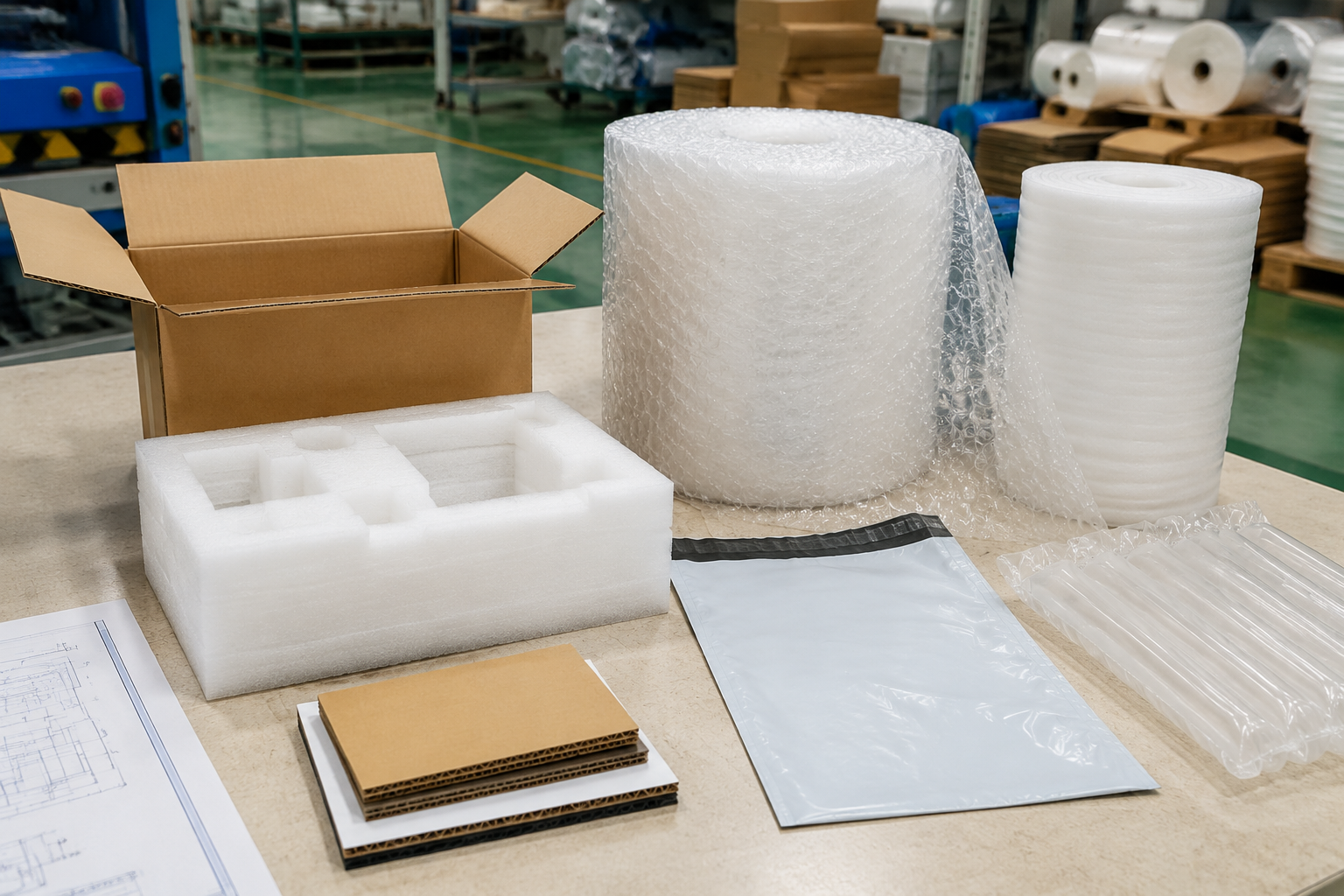
Wholesale Packaging Materials in China: Samples, MOQ, Quotation, and Bulk Order Process
Wholesale packaging materials from China can look simple at the inquiry stage, but the real decision depends on much more than naming a material...
Read cornerstone guide
Packaging Manufacturer vs Trading Company in China: What Overseas Buyers Should Check
When you are sourcing packaging from China, the main decision is not just who gives the quote. It is whether the supplier can handle...
Read cornerstone guide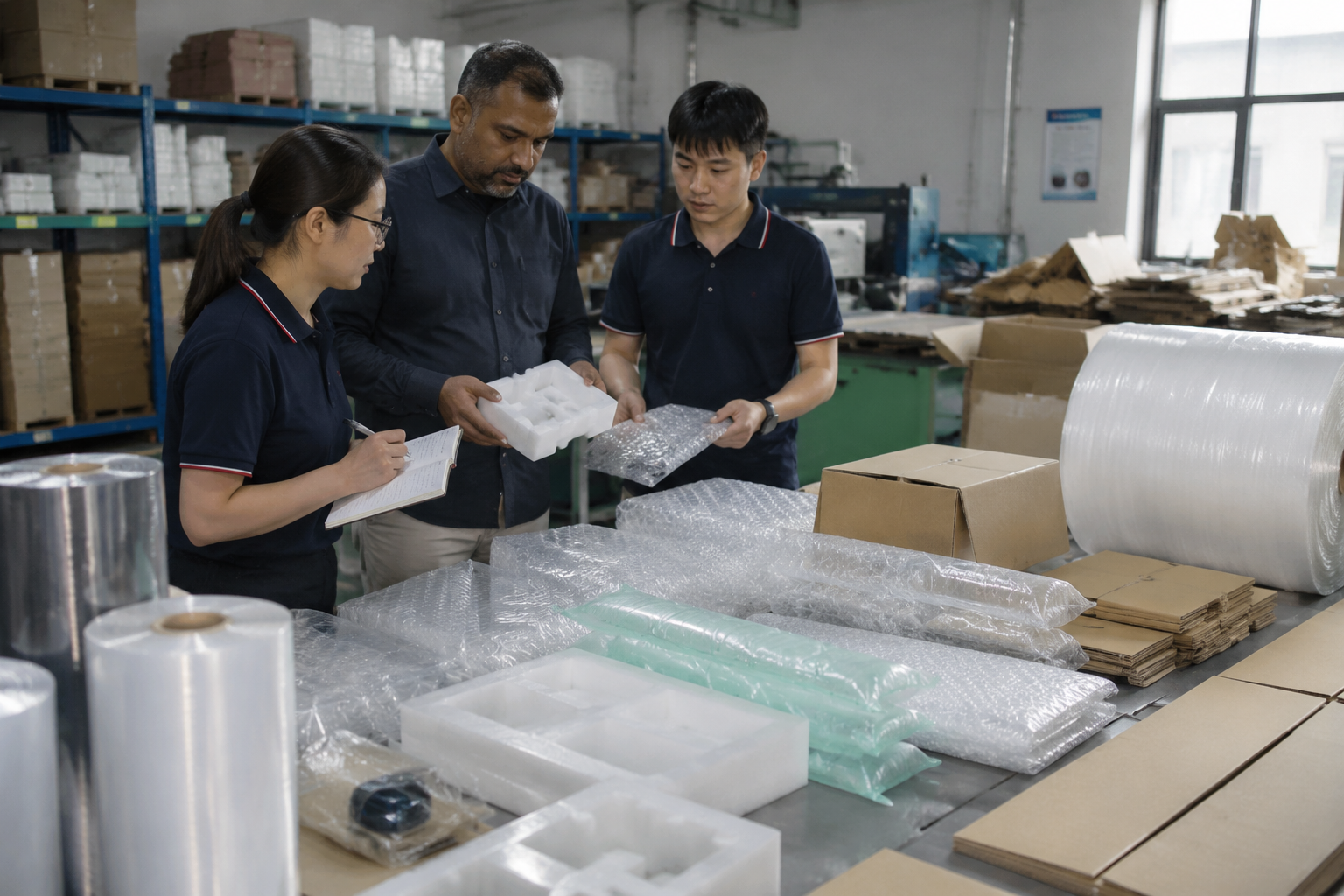
China Packaging Materials Supplier Guide: How to Choose the Right Factory for Custom Packaging
Choosing a China packaging materials supplier is not only about finding a factory that can quote foam, bubble wrap, cartons, film, or plastic bags....
Read cornerstone guide