 By Chunjie Zheng, Technical Director, YK Door Industry · 17 years in fire door engineering · Technically reviewed by Yulin Zhang, General Manager
The short answer: In a listed vs tested door comparison, the difference is follow-up. “Tested to” means one specimen passed a named test. “Listed” or “certified” means a third party also controls the product range and inspects the factory, and the door carries a label. “Classified” turns test results into a rating code under a classification standard. Check the issuer, model, configuration and current status before relying on any of them.
A supplier’s data sheet says “certified to EN 1634-1.” Attached is a single test report from a laboratory, covering one door of one size. Nothing is wrong with the report; it may be an excellent test. The problem is the word. EN 1634-1 is a test method, a report proves that one specimen passed it, and no one is checking whether the doors in the next shipment are built the same way. The buyer who reads “certified” and stops there has accepted much less than the word implies. A few precise definitions prevent this.
Listed vs tested door: the vocabulary ladder
Each evidence word describes a different kind of document. The table compares them by purpose and by the controls behind them.
| Word | Issued by | What it proves | What it does not prove |
|---|---|---|---|
| Tested to | A laboratory, in a test report | One specimen met the test’s criteria | That production doors match the specimen |
| Classified | A laboratory or certifier, in a classification report | The test results expressed as a rating code under a classification standard | Certification or type approval of the product |
| Listed | A certification agency, in a public directory | A product family meets the standard within stated limits, under follow-up service | That an individual door is inside the limits |
| Labeled | The manufacturer, under the agency’s control | That this unit was made under the listing | That it was installed correctly |
| Certified | A certification body under a scheme | Ongoing conformity of production, with surveillance | Performance outside the scheme’s scope |
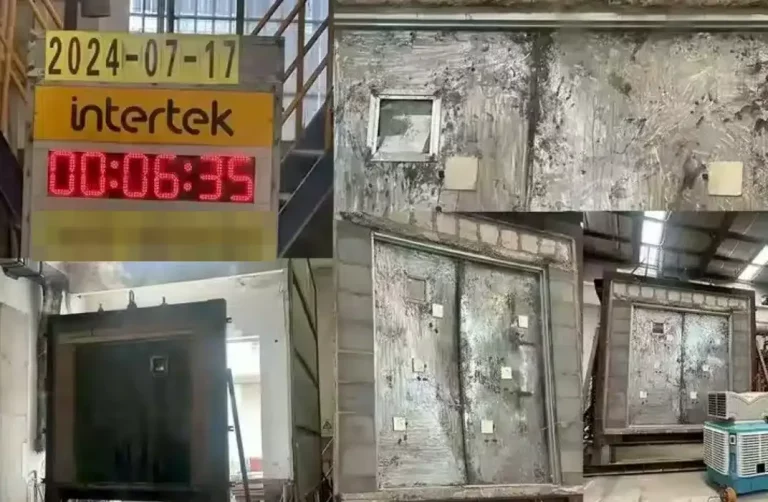
The test is the foundation. A fire test result on its own applies only to the sample that was tested, which is why schemes exist to decide how far the evidence can be extended [1]. A classification report adds a standard way of expressing the result, but one classification report states plainly that it does not represent type approval or certification of the product [5]. Listing and certification add the piece that matters most to buyers: a third party publishes which products are approved and within what limits [3], and keeps checking. For the broader question of what each kind of door paperwork can prove, see our guide on how to verify what a door’s paperwork proves.
Why follow-up service is the real difference
The step from “tested to” to “listed” adds product evaluation and continuing control of production. When a door is listed by an agency such as UL or Intertek, the agency’s inspectors visit the factory, usually without notice, to check that production matches what was tested, that labels are controlled, and that changes are reported. The label on each door is the visible end of that system; without follow-up service, a label would be just a sticker [4]. A one-off test report has no such link to production, so check how the manufacturer shows that production still matches the tested door.
This is also why a listing can be withdrawn and a test report cannot. If a factory changes its core material or its hardware supplier without notice, the agency can suspend the listing. A test report from three years ago remains a record of what happened that day, regardless of what is being built now, so also check the current revision and any supersession notice from the issuer.
Construction labels and other half-claims
Some claims sit between the rungs and cause confusion. A construction label, used on some US doors, means the door was made with the same materials and methods as the manufacturer’s listed products, but it does not mean the door provides a fire rating; acceptance is up to the authority having jurisdiction [2]. Phrases such as “meets the requirements of,” “equivalent to” or “designed to” usually mean no third-party test exists for that configuration. “Approved” without naming who approved it says nothing at all.
These phrases are not always misleading. “Designed to” is an honest description of engineering work that has not been tested, and it is a legitimate first step for project-specific doors. The point is to know which rung each claim sits on and to ask for the document that supports it.
How we word our own evidence
We use four evidence levels in every document: designed, tested, certified and project-accepted. Every performance claim on our site and in our submittals lands on one of them. Certification is stated model by model. YK-S90 is UL 10B/10C listed at 90 minutes for a single leaf and 60 minutes for a double leaf, and WH (Intertek) listed; YK-S60-CE is CE marked under EN 16034 with the classification EI2 60-C5 + Sa, DoP issued under AVCP System 1; and our FD90 door is tested to EN 1634-1 as YK-S90. YK-B4 is listed to UL 752 and YK-F12 is FM approved to ANSI/FM 2510. Our other series rest on third-party test reports, worded as “tested to,” or on project evidence. ISO 9001:2015 covers our quality management system, and we do not use a management system certificate as proof of product performance. The full list by series is on our page of door certifications from a China door maker.
From the factory floor
The evidence word buyers misread most is ‘tested to’, read as ‘certified’. In our quotations we keep listed, certified and tested to apart and name the model in the same paragraph.Chunjie Zheng, Technical Director
The same words in US and European practice
In the United States, the listing is the center of the system. Fire door listings are published in certification directories such as UL Product iQ, where a code official or architect can search by manufacturer or file number and see the product categories, ratings and limits covered [6]. NFPA 80 and the building codes then rely on the label on each door and frame to show that the unit came from that listed production. When a label is missing or damaged on a door already installed, the remedy is not a new test but field labeling: the listing agency inspects the door on site and, if it can confirm the construction, applies a label [7].
Europe uses the same rungs with different names. A fire test to EN 1634-1 produces a test report, and a classification report then expresses the result as a class such as EI2 60 under EN 13501-2 [9]. For a door sold in the European Union, CE marking under EN 16034 adds factory production control, a notified body under AVCP System 1 and a Declaration of Performance that lists the declared classes [10]. The CE mark sits on the same rung as a US listing and label: it tells the buyer that someone other than the manufacturer is checking production.
Borrowed and counterfeit labels
The evidence words matter most when someone is trying to stretch them. Facility safety offices have issued alerts about counterfeit fire door labels, where a door carries a label that looks genuine but was never issued under a listing [8]. A borrowed claim is more common and harder to spot: a trading company quotes a door with a real manufacturer’s listing number, but the doors it ships are made somewhere else. In both cases the label or number is real enough to pass a glance and fails a check.
The check is simple. Look the file number up in the agency’s directory and confirm that the manufacturer named there is the one on the proforma invoice, that the product category matches the door type, and that the size and rating on the schedule fall inside the listing [6]. A label should name the manufacturer or carry a serial number that the listing agency can trace. If the names differ, ask for the private-label or manufacturing authorization and confirm it with the issuing body.
A worked example: one supplier pack, read rung by rung
Imagine a supplier sends three documents for a steel door: a test report to EN 1634-1, a classification report stating EI2 60, and a UL directory page. Read each on its own rung. The test report proves that one specimen, of the size and construction described in it, met the criteria on the test day. The classification report converts that result into a class, but it does not cover production. The directory page is the only document of the three that speaks about the doors you will receive, and only if the manufacturer, category, rating and size limits on it match your schedule.
Now compare the words in the quotation. If it says “UL certified to EN 1634-1,” ask what scheme is meant: US fire door listings are issued against standards such as UL 10C, and EN 1634-1 is a test method, not a certification. If it says “tested to EN 1634-1, classified EI2 60, and UL listed for 90 minutes under UL 10C,” each phrase sits on its proper rung and points to a document you can check. The second wording is longer, but every part of it can be verified.
Mistakes buyers make with evidence words
The most common mistake is reading one strong word and stopping. A buyer sees “certified” and does not ask by whom, for what or within which limits. The second is treating a management system certificate, such as ISO 9001, as proof of product performance; it proves that a quality system exists, not that a door resists fire. The third is accepting a test report for a different size, a different core or different hardware, on the assumption that it is “the same door.” The fourth is forgetting that listings and certificates can lapse, so a directory entry should be checked when the order is placed, not only when the supplier was first approved.
Frequently asked questions
Does a fire test report expire?
A test report records what happened on the test day and does not expire as a record. Whether it is still accepted depends on the scheme, the standard edition and the authority having jurisdiction, so ask whether the standard has been revised since the test.
Is a classification report the same as a certificate?
No. A classification report expresses test results as a class under a classification standard, and it does not by itself control production. Certification or CE marking adds that control.
What happens if a fire door label is missing on site?
The door cannot be assumed to be rated. In the United States, the listing agency can carry out field labeling if it can confirm the construction on site [7].
Does ISO 9001 prove that a door performs?
No. ISO 9001 shows that the factory runs a quality management system. Product performance is shown by test reports, listings and certifications for the specific product.
Who decides whether the evidence is acceptable?
The authority having jurisdiction decides for code compliance, and the owner or specifier decides what the contract requires. Both decisions are easier when the specification names the evidence word it expects.
Writing the right word into your specification
The simplest protection is to choose the word in the specification rather than accept whatever word the supplier uses. If the code or the owner requires a listed product, write “listed by [agency] for [rating], labeled, with directory reference provided for each door type.” If a tested product is acceptable, write “tested to [standard and edition] by an accredited laboratory, with the full test report and the field of application provided.” If a European classification is needed, ask for the classification report and, for CE-marked doors, the Declaration of Performance.
Then check what arrives against what you wrote. For a listing, look it up in the directory, as described in how to check a fire door listing. For a report, read the specimen description and scope, using how to read a fire door test report. For CE-marked doors, check the notified body’s role, explained in notified bodies and AVCP System 1. The words are short; the difference between them is the difference between one good door in a laboratory and a verified product on your site.
Sources
- British Woodworking Federation Fire Door Alliance, Question of the week: Do I have to have doors tested to call them fire doors? https://firedoors.bwf.org.uk/uncategorised/question-of-the-week-do-i-have-to-have-doors-tested-to-call-them-fire-doors-and-what-affects-their-certification/
- Lori Greene, Construction Label, iDigHardware, January 2010. https://idighardware.com/2010/01/construction-label/
- Lori Greene, Certified Product Directories, iDigHardware, April 2014. https://idighardware.com/2014/04/certified-product-directories/
- UL Solutions, Doors, Windows and Related Hardware Application Guide. https://www.ul.com/thecodeauthority/knowledge/ul-fire-rated-doors-guide
- ift Rosenheim, example classification report on extended application, 23-002804-PR01 (published by AGC Pyrobel). https://agc-pyrobel.com/nl-nl/product-selector/dac672c6332502adf413135f56a8389b10461fc1/download/Ift_clas%20on%20EXAP_23-002804-PR01_EN.pdf
- Lori Greene, Learn About UL’s Product iQ, iDigHardware, 10 July 2023. https://idighardware.com/2023/07/learn-about-uls-product-iq/
- Lori Greene, Field Labeling of Fire Doors and Frames, iDigHardware, September 2015. https://idighardware.com/2015/09/field-labeling-of-fire-doors-and-frames/
- University of Rochester Environmental Health & Safety, Safety alert on counterfeit fire door labels. https://www.safety.rochester.edu/fire/safetyalerts/pdf/CounterfeitFireDoors.pdf
- Siniat, What is Fire Classification? https://siniat.helpjuice.com/fire/1767362-what-is-fire-classification
- BWF-CERTIFIRE, Guide to CE marking of fire doorsets to EN 16034 (April 2023). https://firedoors.bwf.org.uk/assets/guide-to-ce-marking-_en-16034_230415.pdf