
Packaging quotes can look easy to compare when each supplier gives a unit price, but the real decision depends on whether China supplier questions clarify the same product, packing method, and delivery scope, including MOQ lead time and payment terms, before selection. A lower price may come from thinner film, lower foam density, smaller usable dimensions, weaker board grade, fewer printed colors, different carton packing, or trade terms that leave freight and handling costs outside the quote.
This article helps buyers slow down the comparison before choosing. It focuses on checking measurable specifications, sample terms, print charges, lead time, carton volume, order quantity, inspection points, and repeat-order consistency so the final choice reflects protection, fit, shipping cost, and supplier reliability rather than the cheapest headline number.
Quick Packaging Decision Guide
| Buyer Question | Practical Reading | What to Check |
|---|---|---|
| Are all quotes for the same packaging specification? | Product names alone are not enough for comparison. | Size, usable dimensions, thickness, density, board grade, printing, and tolerances. |
| Why is one supplier much cheaper? | The lower price may exclude details or use a lighter structure. | Material grade, packing quantity, sample terms, setup charges, and inspection items. |
| Does printed packaging change the comparison? | Yes, print method and artwork details can shift cost significantly. | Logo size, color count, print sides, color matching, plates, and repeat-order pricing. |
| Will carton packing affect total cost? | Bulky packaging can cost more in freight and storage even with a low unit price. | Pieces per carton, carton size, gross weight, loading efficiency, and warehouse space. |
| Are lead time and trade terms truly comparable? | Timelines and prices depend on where supplier responsibility starts and ends. | Sample approval date, production time, inspection, labeling, EXW, FOB, CIF, or delivered scope. |
Quick Answers Before You Read
Should I choose the lowest packaging quote?
Not until the specifications, packing details, lead time, trade terms, and quality checks are clear enough to compare side by side.
What information should I send before requesting a quote?
Send product size, weight, fragility, required material, printing needs, order quantity, packing method, shipping route, and any sample or inspection requirements.
Why do sample terms matter in a packaging quote?
Stock samples help confirm material, while custom samples confirm fit, structure, printing, and the details that should be approved before production.
How can export terms change the real packaging cost?
EXW, FOB, CIF, and delivered pricing include different responsibilities, so freight scope, carton volume, destination charges, and handover point must be confirmed.
Packaging quotes can look easy to compare when each supplier gives a unit price, but the real decision depends on whether the offers describe the same product, packing method, and delivery scope. A lower price may come from thinner film, lower foam density, smaller usable dimensions, weaker board grade, fewer printed colors, different carton packing, or trade terms that leave freight and handling costs outside the quote.
This article helps buyers slow down the comparison before choosing. It focuses on checking measurable specifications, sample terms, print charges, lead time, carton volume, order quantity, inspection points, and repeat-order consistency so the final choice reflects protection, fit, shipping cost, and supplier reliability rather than the cheapest headline number.
Start by Checking Whether the Quotes Describe the Same Packaging Product
The first rule when you compare packaging supplier quotes is simple: do not compare prices until you confirm the quotes describe the same product. Two offers may both say “custom poly mailer,” “EPE foam insert,” “bubble bag,” or “corrugated box,” but the actual line items can be very different. A lower price is not very useful if the quoted size, material, thickness, printing, packing quantity, or shipment terms are not the same.
This is not about assuming the cheapest packaging supplier quotation is poor. A lower price can be reasonable when the supplier has a simpler structure, a more efficient packing method, or a better match for your order quantity. The risk comes from comparing a complete quote with an incomplete one. If one quote clearly states the film thickness, print color, carton packing, sample terms, and trade terms, while another quote only gives a product name and unit price, the two prices are not ready for fair comparison.
Quotation Titles Can Hide Specification Differences
Packaging product names are often too broad to support a decision. A “poly mailer” could be 60 microns or 70 microns, with different sealing strength, opacity, printing coverage, and tear resistance. A “bubble bag” could use different bubble sizes, film thicknesses, flap styles, or adhesive strips. An “EPE foam insert” could be quoted with a different foam density, thickness, cavity size, or lamination method. A “corrugated box” could be single-wall or double-wall, with different flute types and paper grades.
These details change both cost and performance. A slightly thinner mailer may reduce the unit price but increase puncture risk for heavy or sharp-edged items. A foam insert with less thickness may still look acceptable in a photo but provide less spacing between the product and the carton wall. A corrugated box with a weaker board structure may be fine for light e-commerce parcels but less suitable for export cartons stacked on pallets.
Buyers should also check whether each quote includes the same printing and packing assumptions. “With logo” may mean a small one-color logo on one side in one quote and a larger two-color print in another. “Packed in cartons” may mean different pieces per carton, different carton dimensions, or different gross weights. These differences can affect freight, warehouse handling, and repeat-order consistency.
A practical packaging quote comparison starts with this question: if these suppliers all produced exactly what they quoted, would the finished packaging be the same in size, material, thickness, printing, packing quantity, and usable performance? If the answer is no, the unit prices are not yet comparable.
Another useful way to test a quotation title is to imagine the warehouse team receiving the order without any extra explanation. If the carton label only says “foam insert” or “mailer bag,” the receiving team still cannot confirm whether the product is correct. They need a measurable reference: size, thickness, color, structure, quantity, and approved packing method. A quotation should support that same level of clarity before the order is placed, not only after a problem appears.
This is especially important when several departments are involved in the purchase. A sourcing manager may focus on unit price, a packaging engineer may care about fit and protection, a warehouse manager may care about carton volume, and a sales team may care about branded appearance. If the quote title is too general, each person may assume a different standard. Clear specifications reduce those internal misunderstandings before supplier comparison begins.
Compliance-sensitive wording should also be treated as part of the specification check. Phrases such as “certified,” “food safe,” “recyclable,” “compostable,” “export ready,” or “tested” should not be used as shortcuts for proof. A supplier can use those words in a quote, but the buyer should ask what product version, material structure, market, test method, or document the statement refers to before assigning value to the claim.
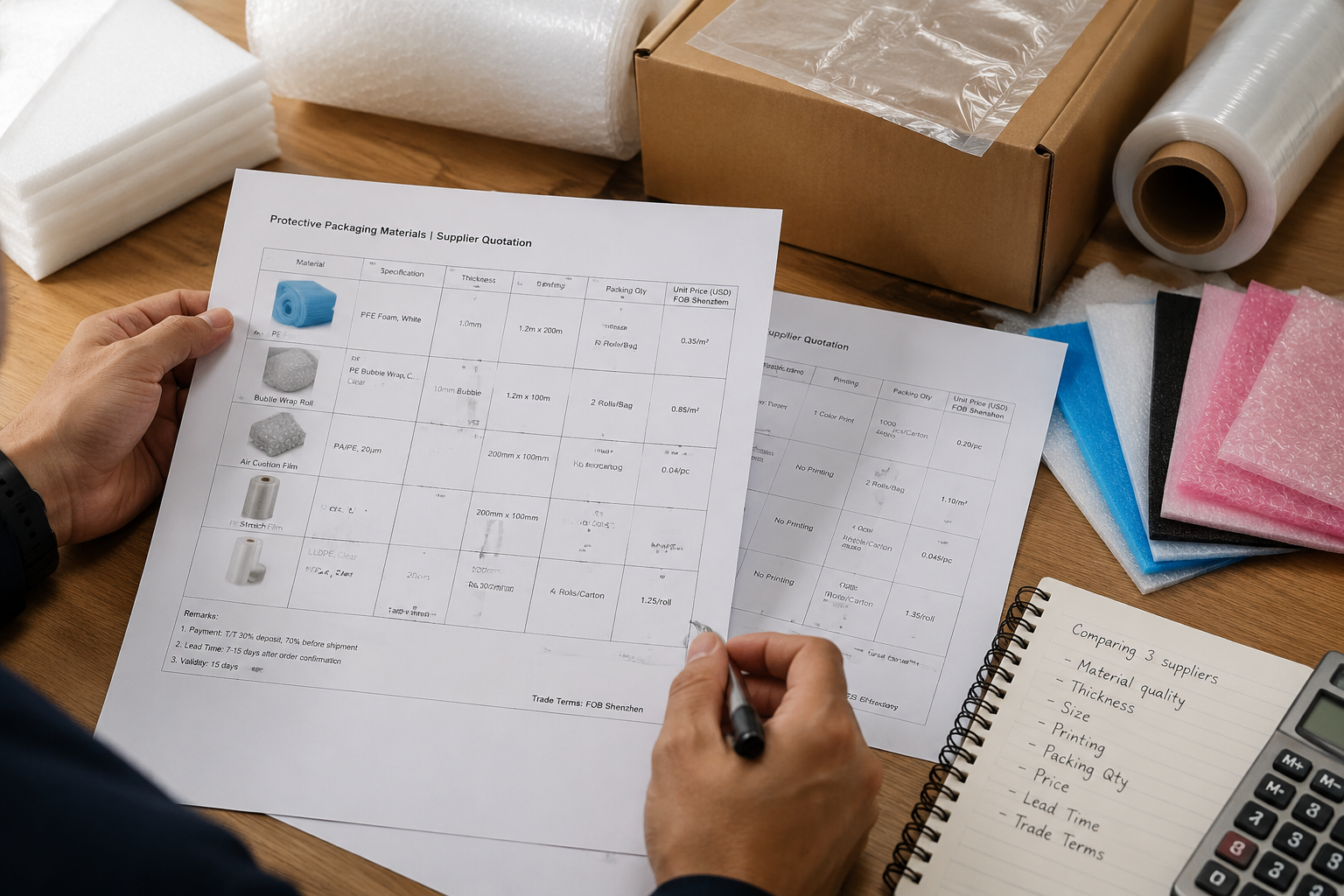
Create a Side-by-Side Specification Table Before Comparing Price
Before choosing a supplier, place each custom packaging quote into a side-by-side comparison sheet. This does not need to be complicated, but it should separate the product description from the price. The goal is to see which supplier has quoted a clear, measurable specification and which quote still needs follow-up.
| Quote Field | What to Check | Why It Matters |
|---|---|---|
| Item name | Product type and structure | Confirms whether the same packaging product is being quoted |
| Size | Inner size, outer size, finished size, or usable size | Prevents fit problems during packing |
| Material | Film type, foam type, bubble structure, or corrugated board | Shows whether material performance is comparable |
| Thickness or grade | Microns, gauge, foam thickness, foam density, or board grade | Often explains price and protection differences |
| Tolerance | Accepted variation in size, cutting, sealing, or cavity fit | Important for custom packaging and repeat orders |
| Printing | Logo size, color count, print area, and print method | Affects setup cost, unit cost, and appearance control |
| Packing quantity | Pieces per carton, roll length, carton size, and gross weight | Changes freight volume and warehouse handling cost |
| Sample terms | Stock sample, custom sample, charge, and approval step | Reduces uncertainty before bulk production |
| Lead time and terms | Starting point, trade term, and included services | Clarifies timing and delivered cost responsibility |
Once the information is arranged this way, price differences become easier to understand. If Quote A is higher because it includes thicker film, more print coverage, stronger carton packing, and clearer sample approval, the higher price may reflect a more complete offer. If Quote B is lower but leaves out thickness, carton quantity, and trade terms, the buyer should request clarification before treating it as the better option.
At Daipak, the discussion usually starts with the product details rather than the material name. For a fair comparison, buyers should send product dimensions, weight, photos or drawings, packing method, order quantity, and shipping destination where possible. That information helps the supplier quote the same packaging requirement instead of guessing from a short product title.
A side-by-side sheet also helps buyers avoid changing the comparison halfway through negotiation. For example, if one supplier improves the thickness after the buyer asks questions, the updated quote should be compared against the updated specification, not against the first lower price. If another supplier changes the carton packing from 500 pieces per carton to 300 pieces per carton, the buyer should revise the freight estimate before judging the total cost. This kind of disciplined comparison may feel slower at the beginning, but it usually saves time before approval, payment, and production.
For better traceability, give every quote a simple revision record. The record can show the supplier name, date, quoted version, material specification, quantity level, trade term, and the reason for any change. This prevents a common comparison mistake: using Supplier A’s revised specification against Supplier B’s first estimate. A quote is only comparable when the version being reviewed is clear.
Quality Control Note: For packaging quote comparison, buyer confidence depends on visible and measurable quality-control details such as finished dimensions, material thickness, board grade, print position, sealing quality, carton quantity, gross weight, and packing method. These points should be checked quote by quote rather than assumed from a product name or low unit price alone.
Compare Material Thickness, Grade, and Structure Before Looking at Unit Price
Packaging material specifications are one of the main reasons two quotes for the “same” item can be far apart in price. Material thickness, film gauge, foam density, bubble size, corrugated board grade, and structural design all affect material usage, production cost, and protection level. A quote that looks expensive may include a stronger material or more complex structure. A quote that looks cheap may be based on thinner material, lower weight, or less protection.
The right choice is not always the thickest or strongest material. Over-specifying packaging can waste cost and increase shipping volume. Under-specifying it can create breakage, scratches, poor carton stacking, or slower packing work. The buyer’s job is to understand what each quote includes and whether that material level fits the product risk, shipping distance, and packing process.
Film, Bag, and Mailer Quotes Need Thickness and Material Clarity
For poly mailers, courier bags, garment bags, clear plastic bags, stretch film, liners, and protective film, the quoted thickness is a basic comparison point. A 60-micron mailer and a 70-micron mailer may look similar in a quotation title, but they do not use the same amount of material and may not perform the same under pulling, sealing, puncture, or handling pressure. For stretch film, gauge and roll length affect not only price but also how many pallets or cartons can be wrapped from one roll.
Buyers should also ask what material blend or structure is being quoted where relevant. Some bags need better tear resistance. Some garment bags focus more on dust protection and presentation. Some courier bags need opacity, sealing quality, and print surface control. Protective film may need suitable adhesion and clean removal depending on the product surface. These details should not be replaced by vague phrases such as “standard material” or “good quality.”
Printing can also change the material discussion. A printed mailer or bag may require a suitable print surface, color count, and sealing area. If one quote includes one-color logo printing and another includes full-area printing or more colors, the price difference may come from print coverage rather than from the base bag alone.
Film specifications should also be checked against the actual packing operation. A mailer used for soft apparel may not need the same puncture resistance as a mailer used for boxed accessories with hard corners. A clear bag used for retail presentation may need better clarity and sealing consistency than a liner used inside a shipping carton. A protective film used on a glossy panel may need a different adhesion level from one used on a rougher surface. The most useful quote is the one that connects the film specification to the product’s handling risk, not just to a generic material name.
Foam and Cushioning Quotes Need Density, Thickness, and Shape Details
Foam and cushioning quotes need more than a product name because cushioning performance depends on structure. For EPE foam sheets, rolls, bags, inserts, and pads, buyers should compare foam thickness, density, layering, cutting method, and whether the foam is flat, shaped, laminated, bonded, or made into a custom insert. A thinner foam sheet may be enough for surface separation, while a thicker or shaped foam insert may be needed for fragile parts, corners, or products with uneven weight.
Bubble wrap and bubble bags should be compared by bubble size, film thickness, roll width, bag size, flap design, and air retention expectations. Smaller bubbles may work well for surface protection and light cushioning, while larger bubbles may provide more spacing for certain fragile products. Air cushion film and air column bags also need structural clarity. The number of air chambers, film thickness, product fit, and sealing quality can affect how the package performs during vibration and handling.
For cushioning materials, a lower price may simply mean less material around the product. That may be acceptable for low-risk items or short-distance shipping, but it can be risky for fragile, coated, heavy, or irregularly shaped products. Buyers should review the product’s weak points, such as edges, corners, glossy surfaces, glass parts, electronics housings, or painted finishes, before deciding whether a lower cushioning specification is enough.
It is also useful to separate surface protection from impact cushioning. A thin foam sheet or small-bubble bag may reduce scratches between parts, but it may not provide enough spacing for a heavy product dropped inside an outer carton. A shaped EPE insert may hold the product away from carton walls, but it may add volume and require more storage space. Air column packaging can provide strong spacing for some shapes, but it still needs a correct chamber layout and sealing quality. These tradeoffs should be discussed before the quote is accepted, because the cheapest cushioning structure may solve only one part of the protection problem.
Corrugated Box Quotes Need Board Grade and Construction Details
Corrugated box quotes should be compared by board structure, not just box size. Single-wall and double-wall cartons have different material usage and stacking behavior. Flute type, paper weight, board grade, and carton style affect compression strength, edge performance, print result, and suitability for storage or export handling. A quote for a “40 x 30 x 20 cm corrugated box” is incomplete if it does not say whether the dimensions are inner or outer size and what board construction is included.
For e-commerce shipping, a lighter single-wall carton may be practical when the product has enough inner protection and the shipment route is not severe. For heavier goods, export cartons, or palletized storage, stronger board or double-wall construction may be more appropriate. The quote should match the actual product weight, stacking condition, carton filling method, and handling route.
Buyers should ask suppliers to make board details measurable where possible. Instead of accepting “strong carton,” request the flute type, wall structure, paper grade or agreed board description, carton size definition, printing requirements, and packing quantity. This helps separate a genuine price difference from a missing specification.
Corrugated construction should also be reviewed together with inner packaging. A stronger outer box may not solve damage if the product can move freely inside the carton. A weaker outer box may still perform acceptably if the inner packaging supports the product, fills the void, and distributes pressure. The best comparison is therefore not “which box is strongest” in isolation, but which complete packing system fits the product weight, stacking route, shipment duration, and warehouse handling method.
Material traceability should connect the quoted grade to a real purchasing decision. Buyers can ask whether the supplier’s material description is based on an internal grade, a supplier code, a paper weight, a film thickness, a foam density, or a recognized design or recovery requirement. Packaging optimization standards treat fit-for-purpose design as a system issue rather than a simple “use more material” rule, so the better quote is usually the one that explains why the selected structure is sufficient for the product and route.[14]
Check Dimensions, Tolerances, and Usable Fit Instead of Only Quoted Size
Packaging dimensions and tolerance can decide whether a low quote works in real packing. A quotation may show the same numbers, but those numbers may describe inner size, outer size, finished size, cutting size, or a general custom size. If the supplier and buyer understand the size differently, the packaging may arrive too tight, too loose, hard to pack, or inefficient inside the shipping carton.
Fit matters because packaging is used by people on a packing table, not just reviewed on a spreadsheet. A bag that is slightly too narrow can slow packing and increase tearing at the seal. A foam insert with a cavity that is too tight can make workers force the product into place. A box that is oversized may need more void fill and take more pallet space. These problems can turn a lower quote into higher labor, freight, or damage cost.
Inner Size, Outer Size, and Finished Size Are Not Always the Same
Size language changes by product type. For plastic bags and mailers, buyers should confirm the inner usable size, flap length, seal area, side sealing width, and whether the quoted size includes the flap. A “25 x 30 cm” bag may not provide a full 25 x 30 cm usable space once sealing and material thickness are considered. For garment bags, the hanger opening, bottom seal, side gusset, and usable length may also matter.
For corrugated boxes, inner and outer dimensions are not the same because board thickness takes space. A box quoted by outer size may not fit the product if the buyer expected that measurement to be the usable internal space. For postal boxes, zipper boxes, moving boxes, and printed cartons, the folding structure can also affect the final usable area.
For foam inserts, the quoted outer size is only part of the story. The product cavity size, corner clearance, depth, tolerance, and position of cutouts matter more for fit. A line such as “foam insert according to sample” should still be supported by a drawing, product measurement, or approved sample detail before bulk production.
When a product has accessories, labels, instruction sheets, cables, or protective sleeves, the buyer should include them in the size discussion. A box or bag that fits the main product alone may become too tight once the complete retail or shipping set is packed. This is a common reason samples seem acceptable at first but create difficulty during bulk packing. The quote should therefore reflect the full packed unit, not only the largest visible product dimension.
Tolerance Matters More When Packaging Must Fit a Product Closely
Production tolerance is normal in packaging, but the acceptable range depends on how the packaging is used. A small variation may not matter for loose void fill, general wrapping, or simple dust protection. The same variation can create problems for foam inserts, air column bags, custom boxes, product-specific mailers, or garment packaging where the product must fit neatly and consistently.
For close-fit packaging, buyers should confirm the product’s actual dimensions, weight, shape, surface finish, and fragile areas. Photos help, but drawings or measured samples are better when the fit is tight. If the product has a protruding handle, sharp corner, polished coating, display surface, or assembled accessory, the quote should reflect those details rather than only the overall length, width, and height.
Tolerance also affects packing speed. A design that fits perfectly in one sample may become difficult if the allowed variation is too narrow for batch production. From a factory perspective, the confirmed size, cutting method, sealing position, and cavity tolerance should be realistic enough to repeat consistently in bulk orders.
The buyer should also be realistic about product variation. If the product itself varies slightly between production batches, the packaging may need extra clearance. This is often seen with assembled goods, textile items, molded parts, or products packed with optional accessories. A supplier cannot quote a reliable close-fit insert or box if the product size is treated as fixed when it actually changes. Sharing the largest and smallest expected product measurements helps the supplier recommend a fit that is practical for real production.
Oversized Packaging Can Create Hidden Shipping and Storage Cost
Choosing a slightly larger package can make packing easier, but oversized packaging has a cost. More empty space may require extra bubble wrap, air pillows, paper fill, or foam pads. Larger inner packaging may force a larger outer carton. Larger cartons increase shipping volume, warehouse storage space, pallet height, and sometimes handling difficulty.
This is especially important for bulky protective packaging such as EPE foam sheets, bubble wrap rolls, air cushion packaging, and corrugated cartons. Even when the material itself is lightweight, volume can drive freight cost. A quote with a low unit price but inefficient dimensions may not be the lowest-cost option once carton size and shipment volume are included.
Before approving a quote, buyers should test the size against the real packing method. Confirm whether the product slides in smoothly, whether workers can seal or close the package without forcing it, whether the packed item fits the master carton, and whether the carton quantity per pallet is practical. A fair quote comparison should include usable fit, not only the numbers printed on the quotation sheet.
For overseas orders, oversized packaging can also affect container planning. A few millimeters may not matter for one piece, but it can matter when thousands of pieces are packed into cartons, cartons are stacked on pallets, and pallets are loaded into a container. Buyers comparing quotes should therefore ask for carton dimensions early enough to estimate the total cubic volume. That volume can become a major part of the true landed cost.
Review Printing Method, Color Requirements, and Artwork Setup Charges
A printed packaging quote needs more review than a plain packaging quote because the cost is not only the bag, box, film, or mailer itself. Printing method, logo size, color count, artwork file condition, setup cost, and color expectations can all change the final price. A quote that clearly lists these details may look higher at first, but it is often easier to control than a cheaper line that only says “with logo.”
This matters for many printed packaging items: poly mailers with brand graphics, garment bags with a logo, printed corrugated boxes, printed bubble mailers, labels on carton packaging, or protective film with simple markings. Two suppliers may both quote the same size and material, but one may include a one-color small logo while another assumes a two-color large print area. Those are not the same production job.
Before comparing unit price, buyers should separate the packaging specification from the printing specification. If the quote does not state what is included in the printed portion, the buyer cannot know whether the supplier has priced the real artwork or only a rough assumption.
“With Logo” Is Not Enough Information
The phrase “with logo” is too vague for a serious packaging quotation. A small one-color logo on one side of a poly mailer is very different from a large two-color design covering most of the surface. A simple black logo on a carton is not the same as a large branded panel that requires tighter artwork control. Even if the base packaging material is identical, the printing area and color count can change the price and production preparation.
Buyers should ask each supplier to confirm the logo size, print position, number of printed sides, color count, and whether the print is a simple mark or a larger design. For bags and film products, the supplier should also know whether the printing is on the outside surface, inside surface, or a treated surface. For corrugated boxes, the quote should clarify whether the printing is on one panel, multiple panels, or a larger area across the carton.
The artwork file also matters. A clean vector file is easier to review and prepare than a low-resolution image copied from a website. If the supplier needs to adjust artwork, redraw a logo, separate colors, or confirm print layout, that work may affect cost or timing. Buyers should not assume artwork adjustment is included unless the quote clearly says so.
Print location should be checked against sealing, folding, cutting, and carton assembly areas. A logo that looks correct on a flat drawing may move closer to an edge after the bag is sealed or the box is folded. For mailers, the adhesive strip, flap, and seam position can limit the available print area. For corrugated boxes, creases and slotting can interrupt artwork. A clear layout helps prevent a quote from being based on an unrealistic print area.
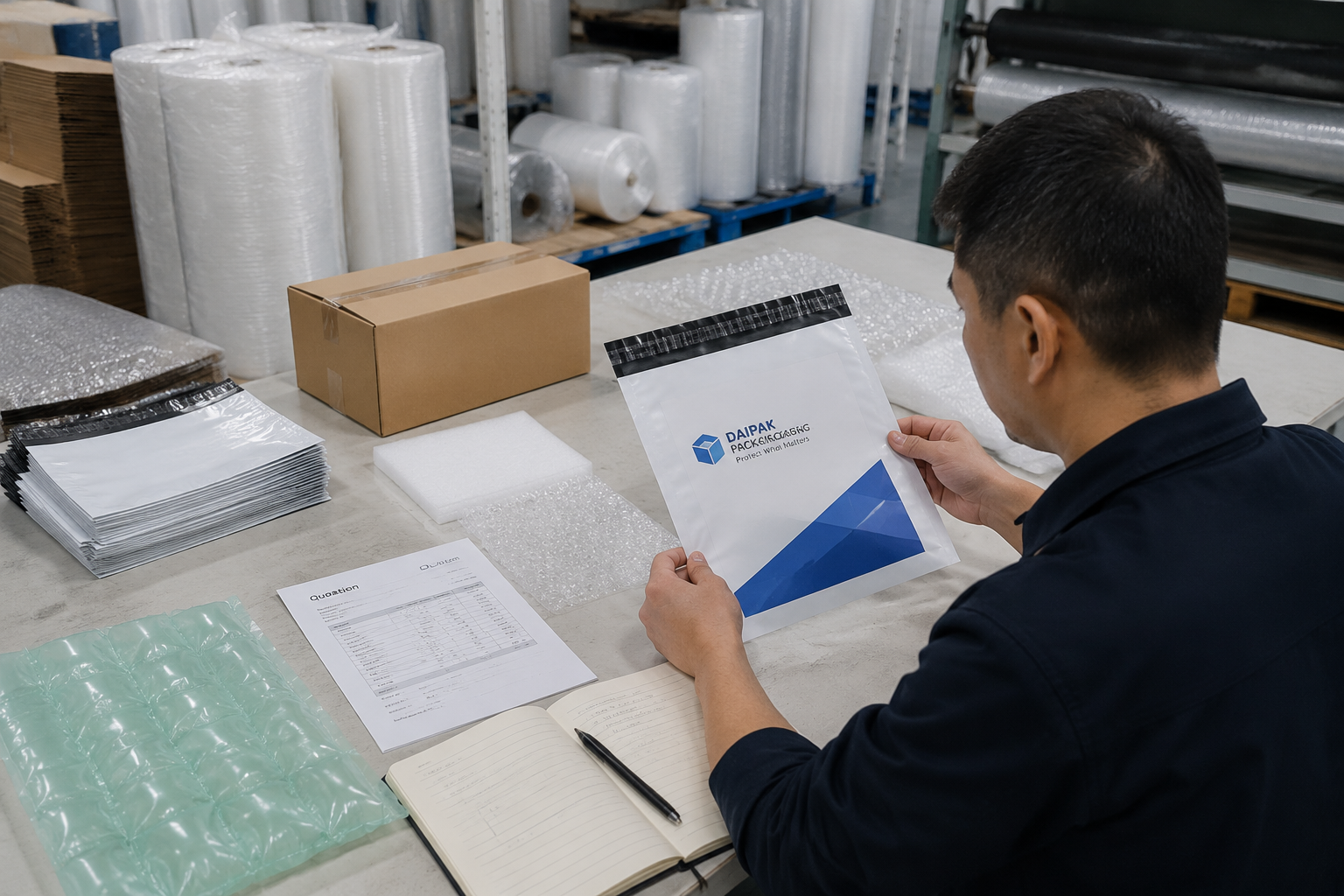
Separate One-Time Printing Costs from Repeat-Order Unit Costs
Printing charges are not always handled the same way from one supplier to another. Some suppliers include setup costs or plate charges in the unit price. Others list them separately. Some may quote a lower unit price but add plate cost, sample printing cost, or artwork preparation cost later. This can make the first order look cheaper than it really is.
For fair comparison, buyers should separate one-time costs from repeat-order costs. A plate charge or setup charge may apply only to the first order if the artwork does not change. The repeat order may then have a different cost structure. On the other hand, if the logo size, color, print position, or packaging size changes, a new setup may be needed. This should be confirmed before the buyer compares long-term supply cost.
A practical quote review should ask these questions before approval: compare packaging MOQ terms with supplier capacity, confirmed lead times, payment milestones, inspection requirements, questions for a China packaging supplier, damage repair responsibilities, replacement cycle planning, and retirement disposal procedures before issuing a purchase order.
- Is the printing setup cost included in the unit price or charged separately?
- Is there a plate charge, mold charge, or artwork preparation charge?
- Does the quoted price include a printed sample, or only digital artwork confirmation?
- If the order is repeated with the same artwork, will the unit price or setup cost change?
- What happens if the buyer changes the logo size, color count, or print area later?
The goal is not to avoid every setup cost. Some printed packaging requires preparation before production. The goal is to understand whether the first-order cost and repeat-order cost are being compared on the same basis.
Buyers should also keep setup charges tied to a specific artwork version. If a supplier quotes a plate charge for a one-color logo at one size, that charge may not apply to a larger design, a second printed side, or a new bag size. The quotation should state what the setup covers so that future changes can be priced clearly. This is especially helpful when a buyer expects repeat orders across several product sizes or seasonal artwork versions.
Confirm Color Expectations Before Sample Approval
Color is another area where a cheap printed packaging quote can create misunderstanding. A supplier may quote “red logo” or “blue logo,” while the buyer expects a specific brand color. Standard ink color, a buyer-provided color reference, and a precise color target are different levels of control. If the quote does not mention color matching expectations, both sides may think they have agreed, but the sample may still look wrong to the buyer.
Buyers should provide the best available reference before sample approval. This may include an artwork file, a physical printed sample, a brand color reference, or a recognized color number if the buyer uses one. Even then, color can vary depending on material surface, ink, printing method, film color, paper color, and lighting conditions. A white logo on kraft paper, for example, will not appear the same as the same logo printed on white film.
The quote should clarify whether color matching is included, whether a printed sample is available, and what level of color variation is acceptable. For branded packaging, buyers should not approve bulk production based only on a screen image if color is important. A physical sample or clear written approval standard helps reduce disputes later, especially for repeat orders where consistency matters.
Color approval should also consider the viewing context. A carton printed for warehouse identification may not need the same color control as consumer-facing branded packaging. A poly mailer used for e-commerce delivery may need a strong visual impression, but small color variation may be acceptable if the brand standard allows it. A retail garment bag, however, may need closer control because the customer sees it before opening the product. The quote should match the real importance of color in the buyer’s use case.
Separate Unit Price from Packing Quantity, Carton Packing, and Loading Efficiency
Packaging total cost is not only the unit price shown on the quotation. Carton packing, pieces per carton, carton dimensions, gross weight, and loading efficiency can change the real cost of receiving and using the packaging. This is especially true for bulky protective packaging such as bubble wrap rolls, EPE foam sheets, air cushion film, air column bags, and corrugated boxes.
Two suppliers may quote the same unit price but pack the goods very differently. One quote may include more pieces per carton and tighter carton packing, while another uses larger cartons with fewer pieces. The product price looks equal, but the shipping volume, warehouse handling, storage space, and unloading work may not be equal. For overseas buyers, these packing details can affect freight planning before the order even leaves the factory.
A quotation that only lists “price per piece” or “price per roll” is incomplete if the buyer needs to calculate shipment cost. The buyer should also know how the product will be packed for transport and how much space it will take. A lower unit price can become less attractive if the goods require more cartons, larger storage space, or less efficient loading.
Pieces Per Carton Can Change the Real Cost per Shipment
Pieces per carton may look like a small detail, but it affects carton count, handling work, labeling, warehouse receiving, and freight volume. If one supplier packs 500 bags per carton and another packs 300 bags per carton, the order may require many more cartons even if the product quantity is the same. More cartons can mean more labels, more carton marks, more unloading steps, and more warehouse space.
Gross weight also needs attention. A carton that is too heavy may be difficult to handle safely. A carton that is too light but oversized may waste freight space. For protective packaging products, the right carton packing method balances product protection, handling convenience, and loading efficiency. Tight packing can reduce volume, but over-compression may deform foam, bubble packaging, or finished bags if the material cannot recover properly.
Buyers should compare the packing quantity and carton size line by line. A quote with a slightly higher unit price may still be more practical if the carton packing is clearer, easier to store, and better prepared for export handling.
Carton packing should also match the buyer’s receiving process. Some warehouses prefer lighter cartons for manual handling, while others prefer palletized loads with fewer carton counts. Some buyers need inner bags, carton labels, item codes, batch numbers, or mixed-carton restrictions. If these requirements are added after the supplier quotes, the packing cost and preparation time may change. The best time to discuss them is before final price comparison.
Bulky Protective Packaging Needs Volume-Based Cost Review
Some packaging materials are light but take up a lot of space. Bubble wrap rolls, EPE foam rolls, foam sheets, air cushion rolls, and assembled corrugated cartons often create volume-based cost pressure. In these cases, weight alone does not tell the buyer enough. A quote that does not show roll size, carton size, or packing volume can make freight planning unreliable.
For bubble wrap rolls, the buyer should confirm roll width, roll length, outer diameter, core size if relevant, and how many rolls are packed per bag or carton. For EPE foam sheets, sheet size, stacking quantity, compression method, and carton size affect shipping volume. For air cushion film, roll length and roll diameter matter. For corrugated boxes, flat-packed bundle size, pieces per bundle, carton or pallet packing, and board thickness can all affect storage and loading.
The cheapest quote is not always the lowest-cost quote if the product is bulky. A small difference in how rolls, sheets, or cartons are packed can affect the number of cubic meters used in shipping and the amount of warehouse space needed after arrival.
For example, a buyer comparing two foam sheet quotes should not stop at the sheet price. The buyer should ask how many sheets fit in a carton, whether the sheets are compressed, whether compression affects recovery, and how many cubic meters the full order occupies. The same logic applies to bubble wrap rolls and air cushion film. A lower unit price may be offset by a larger roll diameter, fewer rolls per carton, or a packing method that uses more space in the container.
Ask for Packing Details Before Final Price Comparison
Buyers should request packing information before making the final price comparison, not after the order is ready to ship. Once production is finished, changing carton packing may be difficult, especially for custom sizes, printed packaging, foam inserts, or large-volume protective materials. Early packing confirmation also helps the buyer estimate freight, warehouse receiving, and pallet needs more accurately.
A practical quotation should confirm:
- Pieces per carton, rolls per carton, sheets per carton, or bundles per pallet, depending on the product
- Export carton size and whether the dimensions are approximate or final
- Net weight and gross weight per carton
- Total carton quantity for the quoted order volume
- Pallet packing option, if the shipment or warehouse requires pallets
- Carton marks, labels, or item identification requirements
- Loading information if available for larger bulk orders
These details help buyers compare quotes on a real shipment basis. They also help prevent surprises such as more cartons than expected, larger shipping volume, or packing that does not fit the buyer’s receiving process.
If a supplier cannot provide final packing information before production, the buyer can still ask for the best current estimate and the conditions that may change it. For custom packaging, carton size may depend on final sample approval or production stacking method. For printed packaging, packing may depend on drying, folding, or surface protection requirements. A preliminary packing estimate is still useful if the supplier explains what is fixed and what remains adjustable.
Verify Sustainability, Food-Contact, and Compostability Claims Before Comparing Price
Some low quotes rely on environmental or compliance language such as recyclable, compostable, or food-contact safe. Those phrases should be treated as specification items, not marketing filler, because environmental claims need substantiation and recycling labels need to match the actual packaging structure and communication method.[1][2][3]
If a supplier says the packaging is suitable for food contact, ask which market and which material basis the quote is using. The European Commission’s food-contact overview and U.S. CFR Part 177 both show that food-contact packaging is a regulated material category, but they do not turn a generic quotation into proof that every version of the product is suitable for every food application.[4][5]
For compostable packaging, ask whether the claim is tied to a recognized standard such as ASTM D6400 for compostable plastics or ASTM D6868 for compostable coated packaging. If the supplier cannot point to the exact structure being quoted, the safer comparison is to price the package as ordinary packaging and treat the sustainability claim separately until it is verified.[6][7]
Traceable sustainability comparison should stay tied to the exact quoted structure. A recyclable claim may change if the buyer adds lamination, a heavy label, metallic ink, mixed-material windows, or adhesive systems that affect recovery. A compostable claim may apply to one film or coating but not to the complete bag, print, label, or closure. A food-contact claim may depend on the exact polymer, paper, coating, ink, and intended food type. Buyers should ask suppliers to identify which component the claim covers and whether the finished packaging version is the same version being quoted.
Buyers should be careful with absolute claim wording in quotations. Words such as “fully recyclable,” “100% compostable,” “food grade,” or “eco-friendly” may be meaningful only when the supplier identifies the exact material, structure, market, test basis, and intended use. If that support is missing, the quote should be compared on measurable material and performance details first, while the claim remains unverified until documentation is reviewed.
Compare Sample Terms and Approval Steps Before Committing to Bulk Production
Packaging sample confirmation is part of quote evaluation, not just a step after price negotiation. A complete quote should explain whether samples are available, what type of sample is being offered, whether sample charges apply, and how the approved sample will connect to bulk production. Without this, the buyer may approve a price before confirming the actual size, material feel, printing, sealing, fit, or packing method.
Sample terms are especially important for custom packaging. A foam insert, printed poly mailer, air column bag, custom corrugated box, or shaped EPE foam part may look simple in a quotation, but the final result depends on dimensions, material thickness, cutting accuracy, sealing quality, print position, and how the product is packed. A sample gives the buyer and supplier a practical reference before bulk production begins.
As a China packaging materials supplier working with overseas B2B buyers, Daipak usually treats sampling and specification confirmation as connected steps. The purpose is not only to show what the material looks like, but to reduce misunderstanding before production, packing, and shipment preparation.
Stock Samples and Custom Samples Serve Different Purposes
Stock samples are useful when the buyer wants to check material type, general thickness, color, surface feel, bubble size, foam flexibility, bag sealing, or corrugated board appearance. They can help a buyer decide whether a material direction is suitable. However, a stock sample does not prove that the final custom size, printing, fit, or structure will match the buyer’s order.
Custom samples are more useful when the packaging must fit a real product or match a branded requirement. A custom foam insert should be checked with the actual product or a reliable product drawing. A printed mailer should be checked for logo position, print size, color impression, and sealing area. A custom box should be reviewed for inner fit, folding method, board strength, and packing process. These details cannot be confirmed by a generic sample alone.
Buyers should not treat all samples as equal. A stock material sample can support material selection, while a custom packaging sample supports production confirmation. If the quote does not clarify which type of sample is included, the buyer should ask before comparing the offer against suppliers that provide a more complete approval path.
The buyer should also ask whether the sample is made by the same process as bulk production. Some quick samples are hand-cut, digitally printed, or made from available material to confirm general size and structure. That can be useful, but it may not show the exact print result, sealing finish, edge quality, or material batch used in mass production. The sample’s purpose should be clear: material reference, structural reference, print reference, or full production reference.
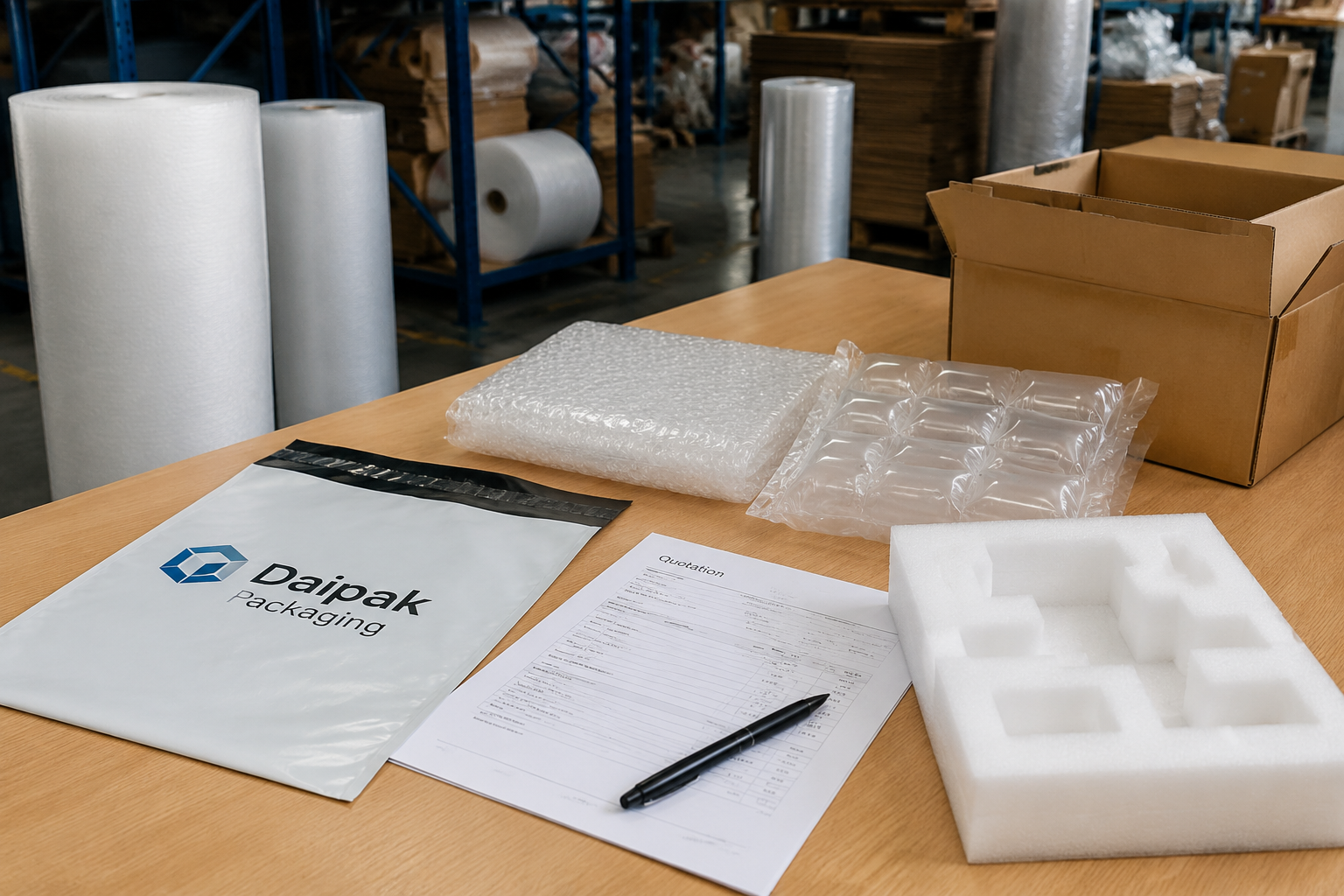
Sample Approval Should Confirm More Than Appearance
A sample should not be approved only because it looks acceptable at first glance. For packaging, the real question is whether the sample works in the buyer’s packing process and protects the product as expected. A bag may look good but be too tight for fast packing. A foam insert may look clean but hold the product too loosely. A printed box may look attractive but use a structure that slows packing or wastes carton space.
During sample review, buyers should check the finished size, material thickness, sealing strength, opening direction, adhesive area if used, print position, print clarity, and packing method. For cushioning products, the review should include product fit, compression behavior, surface protection, and whether fragile parts have enough support. For printed items, the buyer should confirm whether the logo position and color are acceptable before approving production.
If the sample needs revision, the change should be documented clearly. A small adjustment to flap length, foam cavity size, box inner dimension, or print position can affect material use, price, and production preparation. The revised sample or revised drawing should become the new reference, not a casual message buried in the discussion.
It is useful to test the sample under conditions close to real packing. Workers should try inserting the product, closing the seal, folding the box, stacking the packed unit, and placing it into the master carton. If the packaging is used on a packing line, the sample should be checked for speed and repeatability, not only for appearance on a desk. A sample that requires careful handling by one person may not be practical for bulk packing by a warehouse team.
Verification Note: When possible, buyers should review real sample photos, measured dimensions, material thickness, print layout, seal areas, carton packing, and any fit-test results before approving bulk production. Stock photos and general supplier descriptions alone are not enough for a reliable packaging quote judgment.
Record Approved Details Before Production Starts
Before bulk production begins, buyers should make sure the approved sample details are written into the final order confirmation. This should include the final size, material, thickness or density where relevant, printing details, color reference, packing quantity, carton packing, and acceptable tolerance. If the supplier has provided a drawing, layout, or specification sheet, the buyer should check that it matches the approved sample.
Written confirmation is important because different people may handle quotation, sampling, production, packing, and shipment preparation. Clear records reduce the chance that production follows an earlier version of the specification. They also help with repeat orders, because the buyer and supplier can return to the same approved standard instead of rebuilding the details from memory.
Sample approval does not remove every possible production variation, but it gives both sides a practical control point. For custom packaging, that control point is often the difference between a quote that is only low-priced and a quote that is ready for real production.
The approval record should also state what happens if the buyer changes the product after the sample is approved. A small product change can affect foam cavity fit, bag width, carton inner size, or air column layout. If the supplier is not informed, the packaging may be produced correctly according to the old approval but fail against the new product. Buyers should treat approved packaging specifications as linked to a specific product version.
Read Lead Time, Production Conditions, and Order Quantity Carefully
A packaging production lead time is only useful when the quote explains what starts the clock. A line that says “production time: 15 days” may sound clear, but it can mean different things depending on the supplier. It may start after deposit, after artwork approval, after sample confirmation, after final size confirmation, or after the required material is ready for production.
This matters because timing risk often appears after the buyer has already compared prices. A quote can look attractive on unit price but still be difficult to use if the production schedule depends on unclear conditions. For custom packaging production, the buyer should separate sample preparation, production, inspection, carton packing, labeling, and shipment handover instead of treating all timing as one simple number.
For a bulk packaging order, buyers should also check whether each supplier quoted the same order quantity. A price based on a larger quantity may look lower because material setup, printing setup, cutting, sealing, or carton packing costs are spread across more units. That does not make the quote wrong, but it does mean the comparison needs to be normalized before a decision is made.
Lead Time Should Have a Clear Starting Point
The first timing question should be: “When does the quoted lead time begin?” If the supplier answers “after deposit,” the buyer still needs to know whether artwork, size, material, and sample approval must already be complete. If the quote is for printed poly mailers, printed corrugated boxes, EPE foam inserts, air column bags, or custom bubble bags, any unresolved detail can delay production preparation.
A practical quote should connect timing to specific approval steps. For example, a printed packaging order may need final artwork files before printing plates or setup can be arranged. A foam insert may need product drawings or a physical sample before the cavity size can be confirmed. A custom carton may need inner dimensions, board structure, print position, and carton marks approved before bulk production starts.
Buyers should be careful with rush order promises that do not mention current production queue, material availability, or approval conditions. A faster quote is not automatically better if it assumes immediate artwork approval or standard materials that have not been confirmed. Direct factory communication can help clarify which steps are already fixed and which ones still depend on buyer approval.
Seasonal demand, holiday schedules, and upstream material availability can also affect timing. Packaging orders often depend on film, paper, foam, ink, adhesive, or printing setup that may not be controlled entirely by the final supplier. A realistic lead time should allow for these conditions where relevant. If timing is critical, the buyer should ask which materials are in stock, which processes need scheduling, and which approvals could delay the start date.
Compare Prices at the Same Order Quantity
A quote for 10,000 pieces and a quote for 50,000 pieces should not be compared as if they represent the same buying condition. Larger order quantities can affect material purchasing, machine setup, printing cost allocation, carton packing efficiency, and labor arrangement. Smaller orders may carry higher unit cost because setup work still needs to be done even when the final quantity is lower.
Buyers should ask each supplier to quote the same quantity levels, especially when comparing custom packaging. If one supplier provides a single price and another provides price breaks, request a matching quantity table. This makes it easier to see whether the cost difference comes from material specification, production method, packing method, or simply from order volume.
Order quantity can also affect timing. A small repeat order using confirmed artwork and approved specifications may be easier to coordinate than a new custom order with uncertain details. A large bulk order may need more material preparation, longer production arrangement, and more carton packing time. The quote should make these conditions clear enough for the buyer to plan purchasing, warehouse receiving, and shipping schedules.
Quantity comparison should also include usable inventory planning. Buying more packaging may reduce the unit price, but it may increase storage cost, tie up cash, or create waste if the product design changes. Buying too little may cause frequent reorders, repeated setup charges, or higher freight cost per unit. The best order quantity is not only the one with the lowest unit price; it is the quantity that fits consumption speed, storage space, product stability, and reorder lead time.
Separate Production Time from Shipping Preparation
Production time is not the same as shipment-ready time. After the goods are produced, the supplier may still need to inspect finished products, count quantities, pack cartons, apply labels, prepare carton marks, organize export packing, and coordinate handover. These steps are especially relevant for overseas orders because missing labels, unclear carton marks, or incomplete packing information can create delays even after production is finished.
For bulky protective packaging such as bubble wrap rolls, EPE foam sheets, air cushion rolls, and corrugated cartons, packing and loading preparation can take meaningful time. The supplier may need to confirm roll length, roll diameter, pieces per carton, carton size, gross weight, and whether pallet packing is required. These details affect both shipment planning and warehouse receiving at the buyer’s side.
A more complete quote should separate the timeline into practical stages: sample time if needed, production time, inspection and packing time, and shipping preparation. The buyer does not need a complicated schedule, but the quote should be clear enough to show what must happen before the goods can leave the factory or be handed over to a forwarder.
Shipment preparation should also include documentation and communication with the buyer’s forwarder when needed. Even when the product is finished, the order may not move smoothly if packing lists, carton marks, pickup address, contact person, or loading time are unclear. For export packaging orders, the buyer should confirm whether the supplier will coordinate directly with the forwarder and what information must be provided before handover.
Check Trade Terms, Freight Responsibility, and Destination Costs
Packaging supplier quote terms can change the real cost more than buyers sometimes expect. A low product price may only cover goods at the factory, while another quote may include inland transport to a China port, export packing support, or a freight estimate. If the trade terms are different, the unit prices are not directly comparable.
For overseas packaging buyers, EXW, FOB, CIF, and delivered options shift responsibility for different parts of the shipment. The practical issue is not the abbreviation itself. The issue is what the buyer must still pay for after accepting the quote: factory pickup, local transport, export handling, sea freight, destination charges, customs clearance, local delivery, or warehouse unloading.
A China packaging materials supplier may quote the same item in several ways depending on the buyer’s request. One quote might include only the packaging product. Another might include delivery to a named port. A third may include an estimated freight cost based on current carton packing information. Before choosing the cheaper offer, buyers should ask what is included, what is excluded, and which costs may change after final packing details are confirmed.
EXW and FOB Quotes Are Not Directly Comparable
An EXW quote usually places more responsibility on the buyer because the price is based on pickup from the factory or supplier location. The buyer or forwarder may need to arrange local pickup, export handling, and onward shipment. This can be workable for buyers with strong logistics support, but it should not be compared directly with a quote that includes delivery to a port.
An FOB quote usually includes delivery to a named port and export-side handling up to the agreed point. That added service can make the unit price or total quote look higher, but it may reduce work for the buyer. If one supplier quotes EXW and another quotes FOB, the buyer should add the missing inland and export costs to the EXW quote before judging which offer is actually lower.
Mr. Li often reminds overseas buyers to confirm the named place or port, carton marks, and handover requirements early because those details affect quotation clarity and shipment preparation, much like a custom packaging factory guide that helps align factory terms with delivery expectations. This is not only a logistics detail. It can change whether the quote reflects the buyer’s real delivered cost or only a partial cost.
Buyers should also confirm whether the quoted trade term matches their company’s import process. Some buyers have appointed forwarders and prefer EXW or FOB because they control freight. Others need a supplier-supported freight estimate because they do not ship from China frequently. Neither approach is automatically better. The important point is to compare quotes under the same responsibility boundary and to avoid treating a factory pickup price as equal to a port-delivered or destination-supported price.
Freight Estimates Need Volume, Weight, and Packing Details
Freight estimates depend on reliable packing information. Protective packaging can be light but bulky, so shipping volume may matter as much as weight. Bubble wrap rolls, EPE foam sheets, air cushion film, and corrugated boxes can take up significant space even when the gross weight is not high.
A freight estimate based on incomplete packing data should be treated as preliminary. If the quote does not confirm carton size, pieces per carton, roll diameter, net weight, gross weight, or pallet option, the freight cost may change after production packing is finalized. This is why product price and delivered cost should be reviewed together.
Buyers should also check whether the freight estimate includes only sea freight or whether it includes local charges, documentation, destination handling, customs-related costs, or final delivery. A quote that includes a freight number without explaining the scope can create confusion later, especially when the buyer compares it with another supplier’s product-only price.
Freight estimates should be refreshed when the specification changes. A thicker foam insert, larger carton, added pallet, or different pieces-per-carton plan can change cubic volume. A revised print method or additional inner packing may also affect packing time and carton count. If the buyer negotiates the product specification after receiving a freight estimate, the logistics cost should be checked again before the order is approved.
Ask What Is Included and What Is Excluded
A clear overseas quote should make the cost boundary visible. Buyers do not need every logistics detail in the first conversation, but they should know whether the supplier price includes product cost only, inland delivery, export carton packing, palletizing if required, export documents, freight estimate, or destination-side services.
Useful confirmation questions include: Which trade term is quoted? What is the named factory, port, or destination? Are carton marks and labels included? Are pallets included or optional? Does the price include local transport in China? Are export documents included where required? Does the freight estimate include destination charges, or only transport to the destination port?
These questions help buyers avoid comparing a partial quote with a more complete quote. A lower price may still be the right choice, but only after the buyer knows which responsibilities remain outside the supplier’s offer.
The same included-and-excluded review should be used for services around the packaging order. If the buyer needs barcode labels, item stickers, mixed SKU packing, pallet wrapping, special carton marks, or inspection photos, those requirements should be listed before the quote is finalized. Small service items may not change the material cost, but they can affect labor, lead time, and shipment readiness.
Buyers should avoid treating shipping estimates, customs handling, delivery timing, or destination charges as guaranteed unless the supplier’s written quote clearly states the scope, assumptions, and responsibility boundary. Freight markets, final carton volume, destination procedures, and local handling requirements can change the landed cost. A comparison is safer when the buyer records which parts are fixed, which parts are estimated, and which parts remain the buyer’s responsibility.
Confirm Export Packaging Rules When the Quote Uses Wood Pallets or Crates
If the quotation includes wooden pallets, crates, or other wood-based shipping supports, ask whether the shipment needs ISPM 15-compliant wood packaging material. USDA APHIS and the IPPC both treat wood packaging in international trade as a regulated export issue, so treatment and marking can change the real landed cost of a quote.[8][9]
This matters because a quote that looks cheaper on product price can become less attractive if the buyer later has to add pallet replacement, treatment, or export-compliance handling. The safest comparison is to separate the packaging product itself from any wood packaging required to move it safely through export logistics.
Look for Missing Inspection, Quality Control, and Packing Review Details
Packaging quality control should be part of quote comparison, not a separate topic left until shipment. If a quote does not say what will be checked, the buyer should ask. Clear inspection details help confirm that the supplier understands the required size, thickness, material, printing, sealing, quantity, carton packing, labels, carton marks, and visible workmanship expectations.
This is especially important for custom protective packaging because the acceptable result is not only how the packaging looks. Foam inserts need to fit the product. Air column bags need the right shape and air retention for the product being packed. Bubble bags need suitable sealing and coverage. Corrugated boxes need dimensions and board structure that match packing and stacking needs. The quote should support these checks before the goods are shipped.
At Daipak, quality control is usually treated as a process that starts with confirmed specifications and continues through production, finished product review, packing, and shipment preparation. That does not replace buyer approval or eliminate normal production tolerance, but it helps reduce misunderstanding before bulk orders and repeat orders.
A Complete Quote Should Support Measurable Checks
A quote that only says “good quality” is not enough for a buyer to inspect against. The supplier should be able to confirm measurable or visible points such as finished size, material thickness, foam density where relevant, film gauge, print color count, print position, sealing quality, cutting accuracy, quantity per carton, carton size, gross weight, and carton marks.
For film and bag products, inspection may include thickness, seal strength appearance, opening direction, flap size, adhesive strip placement, print clarity, and packing quantity. For foam products, checks may include thickness, cavity size, bonding or lamination condition, surface cleanliness, and whether the shape matches the product. For corrugated boxes, checks may include inner size, board structure, slotting, folding, print position, and carton strength expectations appropriate to the application.
The buyer should ask which inspection points are included before shipment and whether photos, packing lists, or other confirmation records can be provided when needed. The goal is not to create excessive paperwork. The goal is to make sure the quote describes a product that can actually be checked.
Inspection points should be practical enough for both sides to use. A buyer may want detailed laboratory testing for some projects, but many packaging orders are controlled through size checks, visual checks, material confirmation, fit review, print review, quantity count, and packing verification. The quote should make these checkpoints visible. If a requirement is critical, such as tight foam fit or accurate printed logo placement, it should not be left as a general quality expectation.
For traceability, buyers can ask suppliers to connect inspection points to the quote line itself. Instead of a separate message saying “we will check quality,” the quote or order confirmation should identify the actual control points: finished size range, material thickness target, board structure, print location, carton count, gross weight, and packing marks. This makes the inspection record useful later because it shows which version of the packaging was checked and which quotation it belongs to.
Custom Protective Packaging Needs Fit and Function Review
Custom protective packaging often fails in practical use for reasons that a unit price cannot show. A foam insert may be slightly too tight and slow down packing. An air column bag may not support the product at the right points. A bubble bag may protect the surface but leave a corner exposed. A corrugated insert may fit the product but waste too much carton space.
For these items, the quote should connect inspection to function. Buyers should confirm whether the supplier will check product fit, cavity tolerance, cushioning structure, sealing condition, folding position, and carton packing method. If the packaging is intended for export handling, the inner protection and outer carton need to work together rather than being reviewed separately.
Mr. Wang’s factory-side view is useful here: the confirmed sample, drawing, or specification should be something production can repeat consistently. If the approved design depends on a hand-cut adjustment or an unclear product sample, the bulk order may carry more variation than the buyer expects.
Function review should include the product’s most vulnerable points. A glossy surface may need separation from abrasive contact. A sharp corner may require more clearance or stronger material. A heavy item may need bottom support rather than only side cushioning. A product with a display, lens, coating, or delicate accessory may need protection in a specific direction. A quote that understands these details is more useful than one that simply lists a generic cushioning material.
Repeat Orders Need the Same Approved Standard
Repeat orders are easier to compare and control when the approved standard is kept in writing. Buyers should save final drawings, product dimensions, artwork files, color references, approved samples, material specifications, packing quantity, carton dimensions, labels, and carton marks. These records help both sides avoid restarting the same discussion with every order.
Consistency matters because small changes can affect cost and use. A slightly thinner film, a different foam thickness, a changed board grade, or a revised carton packing quantity may not be obvious from the product name, but it can affect packing speed, product protection, freight volume, or warehouse handling. If a repeat quote changes, the buyer should ask whether the change comes from material cost, specification adjustment, quantity difference, or packing method.
A practical repeat-order quote should refer back to the approved specification rather than relying only on the previous item name. That gives the buyer a cleaner way to compare price changes and gives the supplier a clearer standard for production and packing review.
Repeat orders should also be checked when market conditions or supplier processes change. Material costs may move, available board grades may shift, or a supplier may adjust carton packing for efficiency. These changes are not always problems, but they should be visible. If the buyer accepts a repeat quote without checking the specification line, a small unmentioned change can become a packing issue later.
Ask for Transit-Test Basis When Packaging Must Survive Shipping
When packaging must survive long-haul freight, parcel networks, or repeated stacking, ask whether the supplier is quoting to any test basis at all. ASTM D4728 covers random vibration testing, ASTM D642 covers compression resistance, ASTM D4169 covers distribution-cycle performance testing, and ISTA Procedure 3A gives an overview for packaged products moving through parcel delivery systems.[10][11][12][13]
This does not mean a supplier’s quote is invalid if no test method is listed. It does mean the buyer should not assume a low-priced carton or insert has been evaluated for the same shipping risk as a more carefully validated design. If the supplier mentions testing, the quote should name the actual method, the product format, and the packaging version that was tested.
Build a Quote Traceability File Before Final Approval
A packaging quote becomes easier to trust when the buyer can trace how the final decision was made. The file does not need to be complicated, but it should collect the final quote, revised specification, approved drawing or artwork, sample photos, packing estimate, trade term, and inspection points in one place. This helps the buyer see whether the selected supplier won because of a real total-cost advantage or because some details were never compared.
The traceability file should also record rejected assumptions. If one supplier’s price was excluded because the thickness was unclear, if another quote used a different order quantity, or if a freight estimate was based on preliminary carton dimensions, those notes are useful. They keep the comparison honest and make it easier to explain the decision internally to purchasing, logistics, product, and finance teams.
For repeat orders, the same file becomes the baseline. Buyers can compare the new quote against the last approved version and ask targeted questions: Has the material changed? Has the carton quantity changed? Is the artwork the same? Are the trade terms the same? Is the freight estimate based on the same packing volume? This prevents a repeat order from drifting away from the approved packaging standard without anyone noticing.
The file should also separate confirmed facts from supplier assumptions. A confirmed fact may be an approved inner size, a signed artwork file, a measured carton quantity, or a named trade term. An assumption may be a preliminary freight estimate, an approximate carton size, a pending compliance claim, or a lead time that depends on material availability. This distinction protects the buyer from treating every line in a quote as equally firm when some points still need final confirmation.
Use Supplier Questions to Separate a Complete Quote from a Risky Quote
Once several packaging quotes are on the table, the next step is not to pick the lowest number. It is to find out which offer is complete enough to compare, which one still needs clarification, and which one leaves too much room for cost or delivery problems later. A complete quote gives the buyer enough detail to understand what is being purchased, how it will be packed, and what conditions apply before production starts.
A quote that needs clarification is not automatically a bad quote. It may still be from a capable supplier, but the buyer should ask before ordering and get the missing details confirmed in writing. A risky quote usually depends on a low unit price while leaving out the details that matter most: material specification, thickness, packing method, sample path, delivery conditions, and inspection expectations. For overseas buyers, this is where a practical China packaging supplier can save time by tightening the quotation, sample, and shipment discussion before bulk order approval.
Quotes Ready for Comparison Have Complete Specification Lines
A quote is ready for comparison only when it describes the same product in enough detail to make the price meaningful. That means the line item should state the material, thickness or grade, size definition, printing method if applicable, packing quantity, sample terms, lead time conditions, trade terms, and inspection points. If those items are written clearly, the buyer can compare two suppliers line by line instead of guessing what each price really includes.
In practical terms, a complete offer answers questions such as: What thickness is quoted? Are the dimensions inner or outer? How many pieces per carton? What print color count is included? Does the price include sample confirmation, or only bulk production? Which shipping term is used? If the supplier can answer those questions without changing the product definition, the quote is much easier to trust. At Daipak, that is usually the point where quotation review becomes productive, because the buyer can compare real differences instead of title-only descriptions.
- Specification: material, thickness, size, structure, and finish are clearly stated.
- Packing: pieces per carton, carton size, and loading method are visible.
- Commercial terms: sample cost, lead time trigger, and trade term are included.
- Quality points: inspection or approval steps are not left open-ended.
A complete quote also makes internal approval easier. Purchasing can explain the price, engineering can check fit and protection, marketing can review print details, and logistics can estimate freight. When the quote is incomplete, each department may need to ask separate questions, which slows the order and increases the chance of conflicting instructions. A clear quotation is therefore not only a supplier document; it is also a working reference for the buyer’s team.
Quotes Needing Clarification Are Not Automatically Bad
Some quotes are missing details simply because the supplier expects a follow-up discussion. That is common in custom packaging, especially when the buyer has sent only a product photo, a rough size, or a sample reference. A quote can still be useful if the missing points are easy to resolve through quotation clarification, sample confirmation, and a written update before production starts.
The key is to separate a fixable gap from a real risk. If the supplier can confirm the thickness, packing quantity, print method, and trade term after a short exchange, the quote may still be worth keeping in the running. What matters is that the final specification is documented before the buyer places the order. Ms. Tang often treats this as part of the order flow rather than a side issue: the earlier the buyer confirms the details, the less chance there is of a mismatch during production or packing.
Useful follow-up questions usually include:
- Can you confirm the quoted thickness, material grade, or board structure?
- Are the dimensions inner size, outer size, or finished size?
- Does the printed price include logo setup or plate charges?
- How many pieces are packed per carton, and what is the carton size?
- When does lead time start: after deposit, sample approval, or artwork confirmation?
Clarification should be handled before the buyer uses the quote for final negotiation. If a supplier answers verbally or through a short message, the buyer should ask for an updated quote or written order confirmation that includes the corrected details. This avoids a common problem: the buyer remembers the clarified specification, while the production team works from the old quotation line. Written updates keep the commercial and production records aligned.
Quotes Carrying Risk Depend Too Much on Low Price
A quote becomes risky when it relies on a low price while leaving several important fields blank or vague. If the supplier does not state thickness, material, packing quantity, sample path, or inspection detail, the buyer may be comparing a finished offer against an incomplete one. That can create hidden cost later through rework, oversized cartons, packing inefficiency, or a product that does not fit the use case.
Common warning signs include vague wording such as “standard material,” “with logo,” “as per request,” or “delivery time depends,” without any measurable detail behind it. Another red flag is a quote that does not explain what is included and what is excluded, especially for export orders. A low EXW number may look attractive until the buyer adds freight, packing, labeling, or destination charges. In those cases, the cheapest quote often becomes the most expensive option to manage.
The safest way to act is simple: compare only the offers that describe the same product, ask for written clarification where details are missing, and choose the complete offer instead of the lowest headline price. That approach helps buyers separate a real quotation from a risky one before bulk production starts.
A risky quote is not always dishonest; sometimes it is simply underdeveloped. However, the buyer still carries the consequence if the missing details lead to poor fit, weak protection, unexpected freight volume, delayed approval, or extra charges. The better response is not to reject every low quote immediately, but to require the same level of specification from every supplier before making the decision. If the supplier can complete the quote clearly, the price can be reconsidered. If the supplier cannot, the low number should not control the purchase.
References
[1] Federal Trade Commission, “Green Guides,” truth-in-advertising guidance on environmental marketing claims, available at FTC Green Guides.
[2] How2Recycle, “How2Recycle Label Guidance,” consumer-facing recycling label and instruction resource, available at How2Recycle Label Guidance.
[3] Sustainable Packaging Coalition, “Packaging Design,” guidance on packaging design decisions and recovery-oriented design, available at Sustainable Packaging Coalition Packaging Design.
[4] European Commission, “Food Contact Materials,” regulatory overview for materials that come into contact with food, available at EU Food Contact Materials.
[5] eCFR / U.S. Government, “21 CFR Part 177 — Polymers,” federal regulations for polymer food-contact contexts, available at 21 CFR Part 177 Polymers.
[6] ASTM International, “ASTM D6400 Compostable Plastics,” standard specification for plastics designed to be aerobically composted, available at ASTM D6400 Compostable Plastics.
[7] ASTM International, “ASTM D6868 Compostable Coated Packaging,” standard for compostable coated paper and similar substrates, available at ASTM D6868 Compostable Coated Packaging.
[8] USDA APHIS, “Wood Packaging Material,” guidance on wood packaging material in trade, available at USDA APHIS Wood Packaging Material.
[9] International Plant Protection Convention, “Regulation of wood packaging material in international trade,” ISPM 15 guidance, available at IPPC ISPM 15 Wood Packaging.
[10] ASTM International, “ASTM D4728 Random Vibration Testing,” shipping container vibration test method, available at ASTM D4728 Random Vibration Testing.
[11] ASTM International, “ASTM D642 Compression Resistance,” shipping container compression resistance test method, available at ASTM D642 Compression Resistance.
[12] ISTA, “Procedure 3A Overview,” packaged-product test overview for parcel delivery systems, available at ISTA Procedure 3A Overview.
[13] ASTM International, “ASTM D4169 Shipping Container Performance Testing,” performance testing standard for distribution cycles, available at ASTM D4169 Shipping Container Performance Testing.
[14] ISO, “ISO 18602 Packaging Optimization,” packaging optimization reference for fit-for-purpose packaging and source reduction discussions, available at ISO 18602 Packaging Optimization.
Disclosure: This article is for general educational and quotation-comparison purposes only. Packaging specifications, material claims, environmental statements, food-contact suitability, sample terms, testing references, lead times, trade terms, freight estimates, availability, and supplier policies can change by product version, order quantity, destination, and confirmed written quotation. Buyers should verify important details directly with the supplier before making a purchase decision.
Packaging Supplier Guides cornerstone library
Cornerstone guides for this topic
Keep these Packaging Supplier Guides guides close while you read. They are the standing references for the decisions covered on this page.
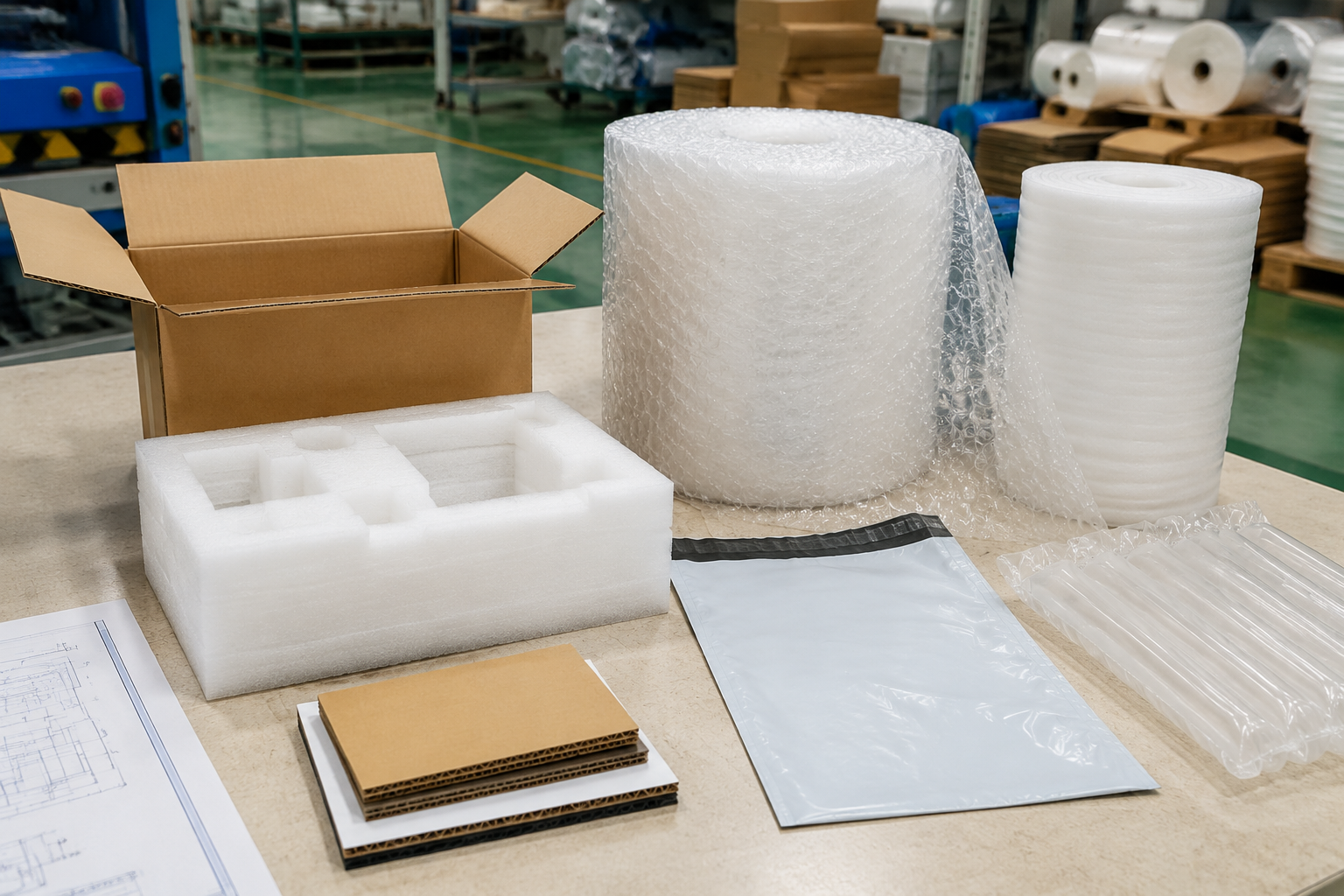
Wholesale Packaging Materials in China: Samples, MOQ, Quotation, and Bulk Order Process
Wholesale packaging materials from China can look simple at the inquiry stage, but the real decision depends on much more than naming a material...
Read cornerstone guide
Packaging Manufacturer vs Trading Company in China: What Overseas Buyers Should Check
When you are sourcing packaging from China, the main decision is not just who gives the quote. It is whether the supplier can handle...
Read cornerstone guide
China Packaging Materials Supplier Guide: How to Choose the Right Factory for Custom Packaging
Choosing a China packaging materials supplier is not only about finding a factory that can quote foam, bubble wrap, cartons, film, or plastic bags....
Read cornerstone guide