
Choosing a packaging manufacturer in China is not only about finding a low unit price. The real risk in China supplier support for SMEs is accepting a quote, sample, bulk order supplier questions, certificate, lead time, or payment request before the packaging details are measurable and confirmed. For protective packaging, custom foam, bubble wrap, air cushions, corrugated boxes, plastic bags, or export packing, small gaps in thickness, density, carton strength, tolerances, packing quantity, or shipment terms can become damage claims, delays, or cost disputes later.
This article helps buyers separate normal supplier differences from warning signs. It focuses on what can be checked before payment or production: written specifications, sample approval, document matching, production responsibility, inspection evidence, realistic schedules, and after-sales handling. Use it to judge whether a supplier is reducing uncertainty or simply asking you to trust unclear promises.
Quick Packaging Decision Guide
| Buyer Question | Practical Reading | What to Check |
|---|---|---|
| Is the low quote reasonable? | It may be acceptable if tied to standard sizes, existing tooling, simpler packing, or clear material choices. | Thickness, density, tolerances, carton strength, packing quantity, sample cost, and shipment terms. |
| Are the specifications detailed enough? | Vague wording gives the supplier too much freedom during production. | Measured dimensions, material grade, surface protection needs, sealing method, printing details, and approved sample. |
| Can certificates or documents be trusted? | Documents only help when they match the quoted product, material, company, date, and stated requirement. | Readable files, valid dates, correct company names, product match, and third-party testing when needed. |
| Is the lead time realistic? | Fast schedules are risky if they ignore sampling, artwork, material preparation, inspection, packing, or export handling. | Sample approval date, production steps, packing plan, inspection timing, and export preparation. |
| Who is responsible for production quality? | Outsourcing can work only when one supplier controls specifications, samples, changes, and final responsibility. | Factory role, inspection points, finished-goods photos, carton labels, quantity records, and shipment evidence. |
| When should payment be delayed? | Pause if the supplier pressures payment before written confirmation or changes company and bank details unexpectedly. | Invoice consistency, bank information, approved sample, packing method, shipment terms, and written order confirmation. |
Quick Answers Before You Read
Is a very low packaging quote always a red flag?
No. It becomes a concern when the supplier cannot explain what material, size, packing method, tolerance, or production condition makes the price possible.
What should I confirm before paying a packaging manufacturer?
Confirm written specifications, sample approval, invoice details, packing method, shipment terms, company information, and bank information.
How do I compare two China packaging suppliers fairly?
Compare the same material, dimensions, thickness or density, carton packing, inspection process, lead time assumptions, and responsibility for problems after shipment.
Why is sample approval important for custom or protective packaging?
It checks fit, cushioning, surface protection, printing, sealing, and carton space before the order moves into full production.
Compliance Boundary for Supplier Claims
Packaging sourcing claims should be treated as buyer-verifiable statements, not as automatic guarantees. A supplier can say a carton is strong, a bag is recyclable, a foam insert is protective, or a shipment schedule is fast, but those claims become useful only when they connect to a written specification, sample record, test basis, production responsibility, or documented packing plan.
Buyers should be especially cautious with absolute language such as “best quality,” “no problem,” “fully compliant,” “waterproof,” “guaranteed delivery,” “any market,” or “same as required” when the supplier has not defined the material, test condition, destination market, or responsibility limit. The safer reading is that the claim is unverified until the supplier shows the exact scope and the buyer confirms that it fits the project.
This does not mean every order needs a formal laboratory report or a long legal review. It means the buyer should separate marketing language from operational proof. For ordinary protective packaging, sample fit, material description, production photos, packing photos, and inspection checkpoints may be enough. For food-contact, environmental, export wood packaging, or regulated shipping requirements, the proof standard should be higher and tied to the destination market.
A practical rule is to ask, “What does this claim apply to, and what does it not apply to?” A supplier that can explain limits is often safer than one that promises every requirement without checking. Clear boundaries reduce disputes because both sides know whether the discussion is about appearance, protection, regulatory paperwork, transit performance, packing efficiency, or after-sales review.
When a Low Price Looks Good but Does Not Match the Packaging Requirement
A low quote is not automatically a problem. In China sourcing, a packaging manufacturer in China may price lower because of better production efficiency, a simpler structure, an existing mold, or a standard size that does not need much adjustment. The red flag is a quote that looks far below the rest without any technical explanation. In that case, the buyer should pause and verify what was removed from the specification to make the number look attractive.
That difference matters because a lower custom packaging quote can hide thinner film, lower EPE foam density, weaker carton board, smaller air cushion dimensions, lower bubble height, or looser packing quantities. A quote may still look acceptable on paper, but if the material grade or packing method is reduced, the result can be product damage, carton collapse, inconsistent sizes, or shipment disputes after payment.
For a buyer comparing a protective packaging supplier for a bulk packaging order, the first question is not “who is cheapest?” It is “what exactly is being offered at this price?” A serious supplier should be able to explain the cost difference in practical terms, not with vague confidence. If the answer is only “same quality, lower price,” that is usually too thin to trust.
One useful way to read a low quote is to separate price efficiency from specification reduction. Price efficiency may come from a standard roll width, a common carton size, available raw material, or a repeat production process. Specification reduction may come from lower density foam, thinner film, weaker adhesive, smaller bubble height, reduced carton board strength, or fewer pieces in a carton than expected. The first can be a real advantage; the second may only move cost from the supplier’s quotation to the buyer’s damage, repacking, or customer complaint cost.

Warning Signs in an Unrealistic Quote
An unrealistic quote often leaves out the details that actually determine cost. If thickness, density, size tolerance, printing detail, packing quantity, carton size, shipping terms, or sample cost are missing, the buyer is not comparing the same item across suppliers. That is how a quote can look cheaper while quietly describing a different product.
Watch for pricing that changes the moment you ask basic follow-up questions. If the supplier quoted bubble wrap but did not mention bubble height, roll width, or roll length, or quoted a corrugated box without flute type, board grade, or carton strength, the low price may depend on assumptions the buyer has not approved. The same risk applies to film products, foam parts, printed cartons, and air column packaging.
Another warning sign is a quote that avoids pack-out details. If the supplier does not state how many pieces go into each carton, how the cartons are marked, or whether the goods are packed for export handling, the low unit price may later be offset by poor packing efficiency or extra damage risk. In packaging, the hidden cost often appears after the order is already in production.
Verification Actions Before Comparing Prices
Before comparing quotes, ask each supplier for a line-by-line specification. That should show material type, thickness or density, dimensions, tolerance, printing requirements, packing quantity, carton size, and shipment terms. A simple number is not enough when the product is custom or sensitive to pressure, scratches, or vibration.
It also helps to request material photos and a sample confirmation step. If the supplier cannot show what material is being used or cannot explain how the sample matches the quoted structure, the buyer is comparing guesswork instead of real offers. For custom orders, the price should always be tied to a specific sample, drawing, or written specification sheet.
A useful follow-up question is: why does this price differ from the others? The answer may be legitimate. A supplier might use existing tooling, standard sizes, or a simpler print layout. But if the supplier cannot explain the difference clearly, the quote should be treated as unverified rather than as a bargain.
How a Reliable Supplier Should Answer
A reliable answer includes trade-offs. The supplier may say a lower price comes from thinner material, simpler printing, fewer color changes, a standard carton format, or reduced customization. That kind of reply helps the buyer judge whether the lower number still fits the product risk.
What the buyer should not accept is a reply built only on “best price” or “same quality.” A serious factory knows that price and structure are linked. If the supplier is willing to explain how material choice, production efficiency, or simplified packing affects the quote, that is a better sign than a vague promise of savings.
At Daipak, the discussion usually starts with the product details rather than the price alone. When the product size, weight, fragility, and packing method are clear, it becomes easier to see whether a low quote is a real efficiency advantage or a hidden quality downgrade.
Vague Specifications That Leave the Supplier Too Much Room to Decide
Unclear specifications are one of the fastest ways to lose control of a custom packaging order. If a buyer says “same as sample,” “normal thickness,” or “strong enough,” the supplier has too much room to interpret the job. For a custom packaging manufacturer or China protective packaging supplier, that kind of language can lead to substitution, misunderstanding, or batch-to-batch inconsistency.
The risk is not only that the wrong item arrives. The deeper problem is that the supplier may think the order is flexible while the buyer expects exact repeatability. That gap creates the classic complaint: “This is not what we expected.” In bulk packaging, that complaint is often expensive because the mistake may already be repeated across thousands of pieces.
Specifications should be measurable. Foam thickness, EPE foam density, bag film thickness, closure type, bubble diameter, layer structure, air column size, valve design, carton flute, board grade, printing color, tolerance, and packing quantity all affect the final result. If those points are not written down, they can change without anyone noticing until the goods reach the warehouse or shipping dock.
Risk Signals in Supplier Language
Some supplier phrases sound reassuring but actually hide weak control. “Standard quality,” “don’t worry,” “we know,” “similar material,” and “factory normal” are not useful unless they are backed by measurable details. A buyer should treat those phrases as placeholders, not as confirmation.
The same caution applies when the supplier avoids direct answers. If a question about thickness gets a response about general strength, or a question about size gets a response about “no problem,” the supplier may be leaving the decision open for later. That is risky because the buyer has no written boundary to enforce when the order is produced.
For packaging projects, vague language often appears when the order is still in quotation stage. That is exactly when the buyer should slow down. A clearer discussion now is much cheaper than correcting wrong sizes, wrong seal strength, or a sample mismatch after production has started.
Specification Details Buyers Should Put in Writing
Buyers do not need to know every technical term at the start, but they do need a written specification sheet before payment or sample approval. At minimum, that sheet should cover dimensions, tolerance, material thickness or density, color, printing, sealing, adhesive, carton packing, labeling, and inspection points.
For example, a poly mailer should not be described only by outer size. Film thickness and closure type matter because they affect puncture resistance and sealing reliability. A corrugated carton should not be approved only by size either; flute and board grade influence stacking strength and export handling performance. A foam insert should specify thickness and density so the supplier does not substitute a softer or thinner piece that looks similar but protects less.
Even when a product seems simple, the buyer should write down how it will be packed and checked. That includes pieces per carton, inner packing method, carton marks, and any visual inspection points. A good supplier can help translate the protection need into measurable terms, but the final written record should still be clear enough to stop guesswork.
Corrective Option Before Payment
If the specification is still vague, the safest move is to pause the order. Do not release payment until the supplier confirms the details in writing and attaches them to the proforma invoice or purchase order. That step gives both sides a shared reference if a dispute appears later.
This is especially important when the order includes custom dimensions, printing, or structure changes. A supplier may be ready to move quickly, but speed is not the same as control. When the written specification is weak, the buyer is effectively approving whatever the factory decides is close enough.
The practical rule is simple: if the supplier cannot repeat the requirement in measurable terms, the order is not ready. Confirm the details, attach them to the commercial documents, and only then move forward.
No Clear Sample Workflow Before Tooling or Mass Production
A missing or rushed sample process is a major red flag for custom protective packaging. This is where many projects lose control, especially for foam inserts, printed bags, air column packaging, special-size cartons, and e-commerce mailer packaging. A supplier who pushes a buyer to skip sampling may be inexperienced, overconfident, or trying to avoid revealing a production limitation.
Not every order needs a long sample cycle, but custom size, custom printing, custom foam shape, or a new material combination usually does. The purpose of sampling is not to slow the project down. It is to catch fit problems, sealing problems, printing problems, and packaging errors before mass production creates waste.
There are different sample stages, and buyers should not treat them as the same thing. A reference sample shows a past style. A handmade sample can show the concept but may not match final production exactly. A digital artwork proof confirms the layout and text. A pre-production sample is closer to the actual order, and a mass-production confirmation sample shows how the finished goods are expected to look before full shipment.
When Skipping Samples Is Especially Risky
Skipping samples is most risky when the packaging has to fit tightly or protect a fragile product. Custom foam inserts need exact dimensions and enough density to hold the product without crushing it. Fragile-product packaging needs confirmation that corners, surfaces, and edges are protected under real handling conditions.
Printed poly mailers and printed packaging bags also deserve sampling because color, logo position, and sealing performance can change between proof and production. Air column bags need fit and valve checks, while corrugated inserts and special-size cartons need strength and size control. If the packaging is supposed to match a product closely, a sample is not optional in practice.
Even a small mismatch can become a major issue in bulk production. A carton that is slightly too tight can slow packing and raise damage risk. A foam insert that is slightly too loose can let the product move inside the box. A printed bag with a shifted logo may still be usable, but it can create quality objections from the buyer’s own customer.
What a Real Sample Approval Should Include
A real sample approval should be more than “looks okay.” It should include photos, dimensions, material confirmation, test fit, artwork approval, packing method, and written buyer approval. If the product is sensitive, the buyer should also check cushioning, sealing, printing position, and carton packing before signing off.
When possible, the sample should be evaluated against the actual product, not only against a drawing. That is the only way to see whether the packaging performs under real conditions. A good sample process helps both sides catch issues before the order reaches mass production, where corrections become slow and expensive.
Ms. Tang often treats sampling and specification confirmation as one order flow rather than two separate tasks. That approach helps keep the sample, the written requirement, and the production plan aligned before the factory commits material.
Warning Signs During Sample Communication
Late replies are one warning sign, especially when the buyer is asking for a pre-production sample or a revision. Changing sample explanations are another. If the supplier keeps rephrasing what the sample is supposed to prove, the workflow may not be under control.
Be cautious if the supplier refuses to provide measurement photos, avoids revision requests, or asks for mass payment before sample confirmation. Those signals suggest that the project is moving forward without a stable reference point. Once that happens, the buyer may have little leverage if the bulk order does not match expectations.
The safest path is to approve the sample only after the fit, material, print, and packing method are checked and written down. If those points are still open, the project is not ready for production.
Certificates, Compliance Claims, and Factory Proof That Cannot Be Verified
Certificates, test reports, and factory documents can help buyers understand a packaging supplier, but they should not be treated as automatic proof of reliability. A document is useful only when it matches the product being quoted, the material being used, the company receiving payment, the issue date, and the buyer’s actual requirement. A certificate for one plastic film, one carton board, or one production site may not apply to a different bag, foam insert, bubble wrap structure, or printed box.
The red flag is not simply that a packaging materials supplier in China does not provide every possible document. Many ordinary protective packaging items do not require special regulatory paperwork unless the buyer’s product, destination market, or internal purchasing policy requires it. The bigger risk is a supplier using vague, expired, unreadable, or unrelated files to push the order forward without explaining what the document proves.
Buyers should treat certificates as part of supplier verification, not as a substitute for specifications, samples, and inspection. A readable document may support a claim, but it does not prove that the bulk order will be made with the same material, thickness, density, adhesive, ink, or board grade. For custom packaging, the document trail still needs to connect back to the approved sample and written specification.
A traceable compliance record should connect five points: the supplier identity, the quoted material, the approved sample, the production batch, and the document being used as evidence. If one of those points is missing, the document may still be useful for background review, but it should not be treated as proof that the exact order meets the buyer’s requirement.
Document Red Flags Buyers Should Check
A common warning sign is a mismatched company name. If the quotation, proforma invoice, bank account, certificate, and factory document all show different names, the buyer should ask for a clear explanation before paying. Sometimes there is a normal relationship between a manufacturer, export company, or related entity, but the supplier should be able to explain it directly and consistently.
Unreadable files are another concern. A blurred scan, cropped certificate number, missing issuing organization, or hidden product description makes certificate verification difficult. If a supplier refuses to provide a readable copy, or only sends a screenshot with key details covered, the buyer should not rely on that document as proof.
Other red flags include expired dates, product categories that do not match the order, missing test standards, or documents that appear to describe a different material. For example, a report for a general plastic sheet may not support a claim about a printed poly mailer. A carton board report may not confirm the strength of a finished export carton with a specific flute, size, and loading condition. A document for one foam density may not apply to a custom EPE foam insert quoted with another density.
Buyers should also be careful with broad claims such as “approved for all markets,” “safe for any product,” or “same as required” when no actual document is linked to the quoted item. Claims that sound too wide are often less useful than a modest but specific document that clearly states the tested material, date, and applicable scope.
Questions That Reveal Whether the Claim Is Real
The best way to test a certificate claim is to ask practical questions. A reliable packaging materials manufacturer should be able to explain what the document covers, which material was tested, whether it applies to the exact product being quoted, and whether the document is current. The answer does not need to sound legal or complicated. It needs to be specific.
Buyers can ask:
- What product or material does this document apply to?
- Does the tested material match the thickness, density, structure, ink, adhesive, or board grade in the quote?
- Who issued the document, and is the copy readable enough for review?
- Is the document still current for this order?
- Does the company name match the supplier or payment recipient?
- If the order changes material or structure, does the same document still apply?
The supplier’s reaction often tells the buyer as much as the document itself. A careful supplier may say, “This report applies to this material only,” or “This document does not cover that special requirement; we need to check.” That kind of limited answer is usually better than a confident but unsupported claim. A supplier who becomes impatient, avoids the question, or says “all documents are the same” is creating risk for the buyer.
For buyers with internal approval processes, the proof request should be made before final quotation approval. If the purchasing team, compliance team, or end customer needs a specific file format, product name, test item, or current date, that requirement should be raised early. Waiting until bulk production is finished can lead to shipment delays, rework, or disputes that could have been avoided.
When to Ask for Third-Party Testing
Third-party testing may be useful when the packaging is tied to a regulated market, a sensitive product category, or a buyer-specific compliance requirement. It may also be appropriate when a large bulk order depends on a material claim that cannot be confirmed by existing documents. The need depends on the product, the destination, and the buyer’s own risk standard.
This should be planned before production, not after goods are packed. Testing may require a confirmed sample, exact material description, production batch information, and enough time for review, so SME importer support should include clear testing obligations before any materials are purchased. If the buyer needs testing for a printed bag, foam insert, air column bag, corrugated carton, or film product, the supplier should know the requirement before purchasing materials or starting mass production.
Third-party testing is not a replacement for normal production control. It can support a specific requirement, but it does not check every detail of size, sealing, print position, packing quantity, or carton marking. Buyers should still keep written specifications, approved samples, production photos, and pre-shipment inspection evidence as part of the full procurement record.
Supplier Claims vs. Buyer-Verifiable Evidence
Many sourcing mistakes happen because a buyer treats a supplier claim as if it were already evidence. In packaging procurement, phrases such as “factory direct,” “export quality,” “strong material,” “professional QC,” or “same as your request” may sound useful, but they do not prove the item will match the buyer’s actual protection requirement. A claim becomes useful only when it can be connected to measurable details, sample records, production photos, inspection points, or written responsibility.
This distinction is especially important when the buyer is far from the factory and cannot inspect the order in person. A supplier may have real production capability but still give incomplete answers. Another supplier may communicate smoothly but outsource key steps without controlling the result. Buyers should avoid judging reliability only by confidence, fast replies, or polished product photos. The practical question is whether the supplier can show how the quoted packaging will be made, checked, packed, and corrected if it does not match the approved requirement.
| Supplier Claim | Useful Evidence | Buyer Judgment |
|---|---|---|
| “We are factory direct.” | Production process explanation, workshop photos related to the product, sample records, and clear responsibility for defects. | Helpful only if the supplier controls the order, not just the conversation. |
| “The material is strong enough.” | Thickness, density, board grade, bubble height, film structure, or test-fit result. | Strength should match product weight, fragility, packing method, and shipping route. |
| “We check quality before shipment.” | Inspection points, measurement photos, packing photos, finished-goods review, and nonconformance handling. | Quality control is credible when the check is tied to the approved sample and written specification. |
| “The delivery time is no problem.” | Timeline showing sampling, artwork, material preparation, production, inspection, packing, and export preparation. | A fast promise is safer when the supplier explains which steps are already controlled. |
For a buyer, this is not about distrusting every supplier. It is about keeping the decision grounded in what can be reviewed before the order becomes difficult to change. If a supplier’s claim is true, supporting evidence should usually be possible. If the supplier refuses to connect the claim to specifications, samples, or inspection, the buyer should treat the claim as unverified and keep the order on hold.
Trust Signals That Should Be Visible Before Supplier Approval
A trustworthy packaging supplier does not need to make dramatic promises. The stronger signal is a calm ability to show how the order will be controlled: what specification is final, which sample is approved, which material will be used, which inspection points matter, and who is responsible if the goods do not match. Buyers should give more weight to this visible control than to broad claims about being experienced, low-cost, or factory direct.
Before approving a supplier, buyers can look for consistency across the entire order trail. The quotation, specification sheet, sample photos, invoice, artwork proof, packing plan, and shipment terms should all describe the same product. If the quote says one thickness, the sample shows another structure, and the invoice uses only a vague product name, the supplier may not be intentionally dishonest, but the order is not controlled enough for bulk production.
Good trust signals are also practical rather than decorative. A supplier who provides measurement photos, explains material limits, confirms carton packing, shows finished-goods checks, and states what cannot be guaranteed is usually reducing buyer risk. A supplier who only sends polished catalogue images, broad certificates, or repeated reassurance may still be unable to control the custom order once payment is made.
Traceable Order Records That Reduce Hidden Supplier Risk
A traceable packaging order should leave a clear record of how the buyer’s requirement moved from inquiry to quotation, sample, production, inspection, and shipment preparation. This record does not need to be complicated, but it should make the order reviewable by someone who was not part of the original chat. If a warehouse manager, purchasing supervisor, or quality engineer cannot understand what was approved from the documents, the order record is too weak.
The most useful record connects the approved sample to the final production details. Buyers should keep the sample version, sample photos, measurement notes, material description, artwork file, carton packing plan, and any revision history in one place. If the supplier changes thickness, density, carton size, label layout, printing position, or packing quantity after sample approval, that change should be written down and accepted before production continues.
Traceability is especially important when several packaging items work together. A foam insert, plastic bag, bubble wrap layer, corrugated carton, and outer shipping mark may each look simple by itself, but the full protection result depends on how they fit together. If one part changes without updating the packing plan, the buyer may receive packaging that is technically “close” but no longer protects, stacks, or ships as intended.
Buyers should also treat traceability as a practical filter for supplier behavior. A supplier who can identify the sample version, quote basis, material batch, inspection photos, carton count, and shipment preparation details is usually easier to manage than one who only remembers the order through chat history. When the order value is high or the packaging is custom, poor record control should be treated as a real sourcing risk rather than a minor administrative gap.
Unclear Production Ownership and Too Much Outsourcing
Packaging supply often involves more than one process. A project may include EPE foam inserts, bubble wrap sheets, plastic bags, stretch film, printed cartons, labels, and export packing requirements. Some coordination across material categories can be normal, especially when the buyer wants one supplier to manage a combined packaging set. The risk is not coordination itself. The risk is not knowing who makes the product, who controls the specification, who checks quality, and who is responsible when something goes wrong.
A China packaging materials supplier or protective packaging manufacturer should be able to explain the production flow in practical terms. Buyers do not need every internal detail, but they do need enough clarity to understand where the order will be controlled. If the supplier cannot explain how samples are confirmed, where materials are prepared, who checks finished goods, or how changes are communicated, the buyer may be dealing with order passing rather than accountable production coordination.
Unclear production ownership becomes more serious in custom packaging. A slight change in foam density, cutting tolerance, bag sealing method, carton board strength, or print position can affect product protection and packing speed. If several parties are involved but no one owns the final result, the buyer may receive mixed answers, inconsistent samples, or bulk goods that do not match the approved version.
Normal Coordination vs. Risky Order Passing
Normal coordination has structure. The supplier confirms specifications, controls sample records, names the major production steps, follows up with the workshop or partner process, checks the finished goods, and prepares packing information for shipment. Even if some supporting process is not handled in one building, the buyer still has one accountable contact who understands the order and can answer technical questions.
Risky order passing feels different. The supplier may quote quickly but cannot explain production details. Answers change from one conversation to another. One person says the item is made in-house, another says it comes from a partner, and no one can provide material confirmation or production photos. If a problem appears, the supplier may blame an unnamed factory and avoid responsibility.
For combined packaging, normal coordination can be useful. A product may need foam for surface protection, bubble wrap for wrapping, a plastic bag for dust protection, and a corrugated carton for outer packing. What matters is that the supplier connects these materials into one controlled packaging plan rather than treating each item as a separate, unmanaged purchase.
At Daipak, the practical discussion usually starts with the product and packing method, then moves into which materials and production steps need to be coordinated. That approach helps keep foam, bubble, film, and corrugated packaging connected to the same protection goal instead of becoming separate items with unclear responsibility.
Questions Buyers Should Ask About Production Control
Buyers can reduce risk by asking direct questions before payment or sample approval. The goal is not to challenge the supplier unnecessarily. The goal is to understand whether the supplier has real control over the order.
- Who confirms the approved sample and keeps the sample record?
- Who purchases or prepares the main materials?
- Which production steps are handled directly, and which steps require outside coordination?
- Who checks finished goods against the approved specification?
- Who handles defective products if the goods do not match the order?
- Who communicates production changes before they affect the bulk order?
Good suppliers answer these questions with specific process language. They may explain that foam cutting, bag sealing, printing, carton packing, or material preparation follows a defined review step. Weak suppliers often answer only with “don’t worry” or “we have many factories.” That type of answer does not tell the buyer who is responsible for size, material, sealing, packing, or final inspection.
If the order is complex, buyers should also ask how changes are approved. A change in carton size, packing quantity, film thickness, or foam structure should not be made casually during production. It should be confirmed in writing because it can affect unit cost, carton loading, shipment volume, and product protection.
Evidence That Builds Confidence
Useful evidence does not need to be dramatic. Production photos, sample records, material confirmation, packing photos, inspection notes, and clear technical answers can all help buyers judge whether the supplier is actively controlling the order. The evidence should match the stage of the project. Before production, buyers may need sample photos and material details. During production, they may ask for process photos. Before shipment, packing photos and finished-goods checks become more useful.
For protective packaging, evidence should connect to actual risk. Foam inserts should show size and shape. Bubble wrap or air cushion packaging should show structure and inflation condition where relevant. Plastic bags should show opening, sealing, thickness indication, or closure style. Corrugated boxes should show size, printing, carton marks, and packing quantity when export preparation matters.
Consistent answers are also evidence. If the supplier gives the same technical explanation across quotation, sampling, production, and shipment preparation, the buyer has a better chance of receiving consistent goods. If each stage brings a different story, the buyer should slow down and verify before the order becomes harder to control.

Lead-Time Promises That Ignore Materials, Custom Work, and Export Preparation
Fast delivery is not always a problem. Standard packaging materials, repeat orders, or simple stock-size products may move quickly when materials are ready and the specification is already confirmed. The red flag is a promised schedule that ignores the actual work required. A custom packaging supplier who says “very fast” without asking about sample approval, material structure, printing, quantity, packing method, or export preparation may be guessing rather than planning.
Lead time is a supplier-risk signal because it reveals how the supplier thinks. A realistic timeline should include the steps that affect production, not only the number of days before shipment. For custom printed bags, foam inserts, air column packaging, special-size cartons, or combined protective packaging, the schedule may depend on artwork confirmation, tooling or die-cut setup, material preparation, printing, drying or curing where applicable, inspection, carton packing, marks, and shipment preparation.
For overseas buyers, the issue is not only delayed shipment. A rushed schedule can lead to skipped samples, wrong artwork, weak sealing, poor cutting accuracy, incorrect carton labels, or packing quantities that do not match the buyer’s warehouse plan. If the supplier compresses every step without explaining the trade-off, the buyer may save a few days on paper and lose much more time fixing the problem later.
Red Flags in Fast Delivery Claims
A major warning sign is a supplier promising immediate mass production before the sample is confirmed. This is especially risky for custom foam inserts, printed poly mailers, air column bags, die-cut corrugated inserts, or packaging that must fit tightly around a product. If the first production run becomes the real sample, the buyer carries most of the risk.
Another red flag is ignoring artwork. Printed packaging needs artwork size, color reference, print position, logo direction, warning text, barcode placement, or carton mark details to be confirmed before production. A supplier who promises fast delivery but has not reviewed the artwork may later discover that the file is incomplete, the color expectation is unclear, or the print area does not fit the packaging structure.
Quantity and complexity also matter. A supplier should ask whether the order is a small trial, a bulk packaging production run, a mixed-size shipment, or a combined order with several materials. A large order with foam, film, cartons, and printed items needs coordination. If the same fast delivery promise is given for every project, regardless of size and customization, the buyer should verify the production schedule in more detail.
What a Credible Timeline Should Show
A credible timeline breaks the order into stages. It does not need to be complicated, but it should show that the supplier understands the work. For a custom packaging project, buyers should expect the schedule to separate sample confirmation, material preparation, production, inspection, packing, and shipment preparation. If tooling, printing, bonding, lamination, drying, or special cutting is involved, those steps should be considered as well.
The timeline should also show dependencies. Production should not begin before the key specifications are confirmed. Printing should not begin before artwork approval. Export packing should not be finalized before carton quantity, carton marks, and shipment method are clear. When a supplier explains these dependencies, the buyer can see which decisions must be made quickly and which delays would affect shipment.
For export orders, carton marking and packing details should not be treated as last-minute decoration. Marks, labels, quantity per carton, pallet needs, and loading preparation can affect warehouse receiving and destination handling. An export packaging supplier that builds these steps into the schedule is usually planning more carefully than one that only promises a ship date.
Corrective Action for Urgent Orders
If the order is genuinely urgent, the buyer should not rely only on pressure. The better approach is to reduce uncertainty. That may mean choosing standard sizes, simplifying printing, using available material, reducing the number of custom structures, or confirming priority items first. In some cases, splitting shipments can help the buyer receive critical packaging earlier while the remaining quantity follows later.
Buyers should ask the supplier which part of the order controls the timeline. It may be material availability, printing, tooling, foam cutting, carton production, packing labor, or shipment preparation. Once the bottleneck is clear, both sides can decide whether to adjust the specification or accept a more realistic timeline.
A reliable supplier will explain limits instead of promising every request. If a schedule is possible, the supplier should say why: existing material, repeat specification, simple structure, available production window, or confirmed artwork. If the schedule is risky, the supplier should say where the risk sits. That honesty helps buyers decide whether to proceed, simplify the project, or choose a different plan before the order becomes a delayed shipment problem.
Quality Control Talk Without Inspection Points or Responsibility
A supplier saying “we check quality” is not enough. For packaging, quality control only becomes meaningful when the supplier can explain what will be checked, at which stage, against which approved sample or written specification, and what happens if the finished goods do not match. Without those details, the buyer may not discover defective goods, inconsistent quality, wrong quantity, or poor packing until the shipment arrives.
A protective packaging manufacturer should connect inspection to the actual packaging item. EPE foam packaging may need size, thickness, density, cutting accuracy, and bonding checks. Bubble wrap may need bubble height, inflation, roll width, sheet size, and bag sealing review. Plastic bags and poly mailers may need film thickness, seal strength, adhesive closure, print position, and bag opening checks. Corrugated boxes may need board strength, flute type, folding accuracy, printing, carton marks, and packing quantity review. The risk is not only whether the material looks acceptable; it is whether it will perform consistently in the buyer’s packing line and shipping route.
Strong quality control does not remove every shipping risk, especially when export handling, pallet loading, or courier delivery conditions vary. It does, however, reduce avoidable surprises before shipment. A serious packaging materials manufacturer should be able to show how the finished product is compared with the approved sample, how production records are reviewed, and how packing cartons are checked before goods leave the factory.
Weak Quality-Control Answers
Weak answers usually sound confident but contain no inspection method. Phrases such as “our worker will check,” “same as sample,” “don’t worry,” or “no problem” may be acceptable in casual conversation, but they are not enough for a bulk packaging order. The buyer should ask what “same” means: same size, same thickness, same foam density, same print position, same sealing strength, same carton quantity, or same outer carton marks?
A red flag appears when the supplier cannot move from general reassurance to measurable checkpoints. For example, if a printed poly mailer order has no print tolerance, no film thickness confirmation, and no adhesive closure check, “quality is good” does not protect the buyer. If a foam insert must fit around a fragile product, the supplier should not only say the size is correct; they should confirm the key dimensions, tolerance, cut shape, and fit against the product or drawing.
Another weak answer is blaming all problems on transport before shipment even happens. For export packing, the carton and inner protection need to work together. If a supplier will not discuss carton strength, quantity per carton, stacking condition, or carton marking before goods ship, the buyer may face a dispute later with very little evidence to separate production defects from logistics damage.
Packaging-Specific Inspection Points
Useful inspection points depend on the material and the job the packaging must do. A supplier does not need to create an overly complicated report for every simple stock item, but custom packaging and repeat bulk orders should have enough checkpoints to prevent misunderstanding. The more closely the packaging fits the product, protects a surface, carries a printed brand image, or supports export handling, the more specific the inspection should be.
| Packaging Item | Inspection Points to Confirm | Risk If Ignored |
|---|---|---|
| EPE foam inserts, pads, bags, or sheets | Dimensions, thickness, density, cutting accuracy, bonding, fit to product | Loose fit, poor cushioning, surface contact marks, inconsistent protection |
| Bubble wrap rolls, sheets, or bags | Width, length, bubble height, inflation condition, layer structure, seal quality | Weak cushioning, short rolls, air loss, bag failure during packing |
| Air column bags or air cushion packaging | Air retention, valve condition, film thickness, chamber size, inflation test | Leakage, under-protection, unstable void filling, product movement in carton |
| Plastic bags, courier bags, or poly mailers | Film thickness, bag opening, seal strength, adhesive closure, printing position | Tearing, poor closure, packing delays, brand or label misalignment |
| Corrugated boxes and printed cartons | Carton size, board strength, folding lines, print accuracy, carton marks, quantity | Carton collapse, wrong packing fit, warehouse confusion, export handling problems |
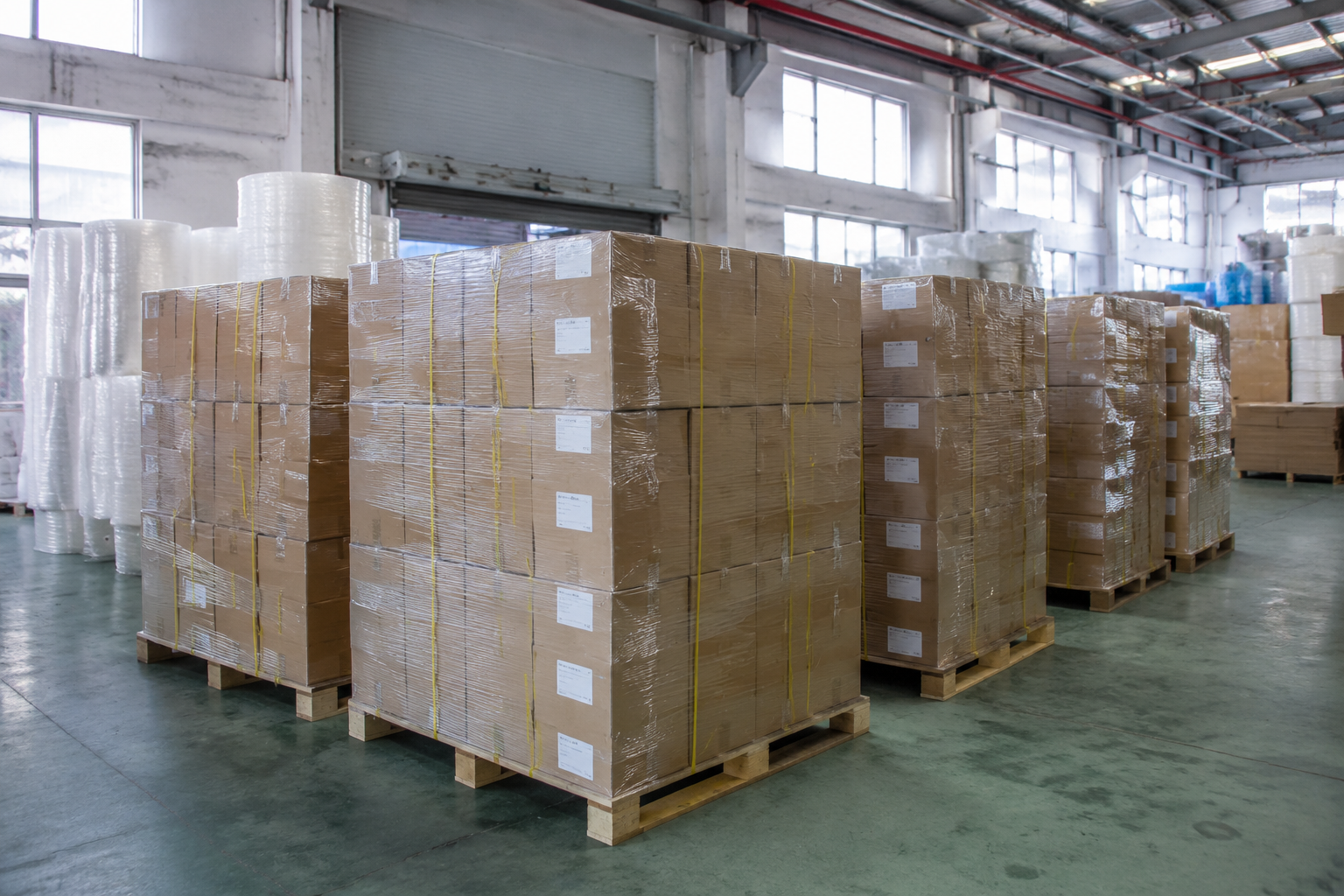
The buyer should also confirm how quantity is counted and packed. A wrong quantity per carton can affect warehouse receiving, freight calculation, pallet preparation, and repeat-order planning. Carton labels and outer carton marks are part of quality control, not just decoration, because they help identify product type, size, color, order number, and destination handling needs.
What Buyers Should Request Before Shipment
Before shipment, buyers should ask for evidence that connects the finished goods back to the approved sample and written specification. This does not always require a formal third-party inspection. For many packaging orders, clear factory photos, short videos where useful, measurement photos, packing photos, and written confirmation of key specifications can already reveal many problems before goods leave the supplier.
Useful requests include photos of measured dimensions, close-ups of sealing or bonding areas, print position checks, air retention checks for inflatable packaging, carton packing photos, and carton label or marking photos. For custom foam inserts, a test-fit photo with the product or product model is especially useful. For printed bags or boxes, buyers should review artwork position, color appearance, barcode or label area, and the direction of printing before shipment approval.
Buyers should also ask what happens if finished goods do not match the approved sample. A supplier who has a real inspection process can usually explain whether the issue can be sorted, reworked, replaced in production, or documented for discussion. A supplier who gives only a vague answer may be leaving the buyer to carry the full risk after shipment.
QC Evidence Should Match the Actual Failure Risk
Pre-shipment photos are useful only when they show the risks that matter for the packaging type. A general photo of stacked cartons may confirm that goods exist, but it does not confirm film thickness, foam density, air retention, print position, sealing quality, carton strength, or quantity per carton. Buyers should ask for evidence that matches the most likely failure mode of the order.
For example, a fragile-product foam insert should be checked with fit photos, key dimensions, thickness confirmation, and surface-contact review. A printed mailer should be checked for print placement, bag opening, seal strength, adhesive strip condition, and carton count. A corrugated export carton should be checked for size, board structure, carton marks, packed quantity, and outer carton condition. The more specific the evidence, the easier it is to catch a problem before shipment.
This kind of QC request also tests supplier discipline. A careful supplier may not have a formal report for every order, but it should be able to explain which checkpoints are relevant and provide practical proof where the order risk justifies it. If a supplier sends unrelated photos or refuses basic measurement evidence, the buyer should treat shipment approval as premature.
QC photos reduce uncertainty, but they do not remove every risk. Buyers should review whether the photos show the exact order, the approved specification, the correct carton count, and the visible failure points that matter for the packaging type, rather than relying on stock images or general warehouse photos.
Payment Pressure Before Critical Details Are Confirmed
Deposit payment is common in custom packaging and bulk packaging production. Materials may need to be purchased, printing plates or cutting tools may need preparation, and production time must be reserved. The red flag is not the request for a deposit by itself. The risk appears when a packaging supplier in China pushes the buyer to pay before the basic commercial and technical details are clear.
Payment timing reveals supplier behavior. A reliable supplier should be willing to confirm the specification, sample status, quantity, packing method, production schedule, shipment terms, and company information before asking the buyer to move forward. If the supplier repeatedly says “pay now” or “rush payment” while avoiding written details, the buyer should slow down. Once a custom packaging project enters material purchase or mass production, correcting mistakes becomes harder and more expensive.
For wholesale packaging materials supplier relationships, the safest approach is to connect payment with documentation. The quotation, specification sheet, proforma invoice, purchase order, sample approval, artwork confirmation, and packing details should tell the same story. If those documents conflict, or if important details are missing, buyers should pause payment and request proof before sending funds.
Normal Deposit Requests vs. Risky Pressure
A normal deposit request comes after the supplier has provided enough information for the buyer to understand what is being purchased. The buyer should know the material, size, thickness or density, printing requirement, order quantity, packing quantity, carton size where relevant, shipment terms, and sample approval status. The supplier should also be clear about whether the order is a stock item, a repeat order, or a new custom production.
Risky pressure looks different. The supplier may avoid attaching specifications to the proforma invoice, refuse to update the invoice after a size or material change, push for mass production before sample approval, or claim that details can be settled later. That is dangerous because packaging details are not minor afterthoughts. A small change in film thickness, foam density, carton board, adhesive closure, or packing quantity can affect cost, performance, and shipment condition.
Buyers should also be careful when payment urgency is used to bypass normal checks. A supplier may say the price will expire immediately, production space will disappear, or material will not be available unless payment is sent at once. Some urgency can be real, especially during busy production periods or material price changes, but a serious supplier should still document the agreed requirements before asking the buyer to commit.
Documents to Confirm Before Payment
Before sending a deposit, buyers should confirm that the key order documents are complete and consistent. This is especially important for custom foam inserts, printed poly mailers, air column bags, special-size cartons, and combined packaging sets where several materials must work together. If the buyer later needs to resolve a dispute, written documents carry more weight than chat messages with vague promises.
The practical document set usually includes the quotation, specification sheet, proforma invoice, purchase order, artwork approval where printing is involved, sample approval record, and packing details, with each file aligned to a custom packaging supplier guide for procurement control, clear specification handling, shipment terms, and order review.
Company and payment details should also match. The buyer should check that the supplier name, invoice name, and receiving account information are consistent with the agreed business relationship. If bank information changes suddenly, or if the receiving company is not explained clearly, the buyer should stop and verify through a trusted communication channel before making payment. This is practical procurement caution, not an accusation; it protects both the buyer and the legitimate supplier.
When Buyers Should Pause
Buyers should pause payment when the order feels commercially urgent but technically unfinished. If the supplier refuses to document agreed requirements, leaves the invoice vague, avoids sample approval, or changes important details without updating the paperwork, the buyer does not yet have a stable basis for production. Paying at that point may turn a correctable misunderstanding into a costly bulk-order problem.
- Changed bank details: Verify the change through a separate trusted channel before sending payment.
- Missing company information: Ask who the buyer is paying and whether the invoice, account, and supplier identity match.
- Vague invoice descriptions: Request material, size, quantity, packing, printing, and shipment details in writing.
- No sample approval for custom work: Confirm whether the approved sample, artwork proof, or pre-production sample is final.
- Unclear defect responsibility: Ask how nonconforming goods will be reviewed before and after shipment.
- Pressure to skip confirmation: Slow the order down until the supplier provides clear written proof.
A reasonable supplier should not object to clear documentation. In many cases, the problem can be solved by updating the proforma invoice, attaching the specification sheet, confirming the approved sample, and summarizing the production requirements in writing. If the supplier becomes more aggressive when asked for basic confirmation, that behavior itself is a warning sign.
No Clear After-Sales Responsibility When Problems Appear
After-sales responsibility in B2B packaging does not mean the supplier can guarantee every logistics outcome or promise a simple consumer-style remedy. Packaging moves through factories, warehouses, forwarders, ports, couriers, pallets, and receiving teams. Damage or defects can come from different sources. The important question is whether the supplier has a clear process to review problems, compare goods against approved samples, and support practical correction.
A responsible China packaging materials supplier should be willing to separate different problem types. Shipping damage is not the same as wrong specifications. Production defects are not the same as product misuse. Poor carton condition after rough handling is not the same as weak carton board or insufficient inner protection. Without this separation, every complaint becomes an argument instead of a defect review.
For a custom packaging supplier, after-sales support should also protect repeat orders. If a foam insert is slightly too tight, a poly mailer seal is not strong enough, an air column bag loses air too quickly, or carton marks confuse the warehouse, the next order needs correction. The supplier should be able to review evidence, update specifications, revise inspection points, and make the next production batch clearer.
Red Flags in Complaint Handling
The strongest red flag is silence after payment or shipment. If a supplier responds quickly before the order but ignores defect photos, receiving reports, or unpacking evidence afterward, the buyer may have no practical support when problems appear. Slow response is not always bad, especially if the supplier needs time to check production records, but no response or repeated avoidance shows weak responsibility.
Instant blame is another warning sign. If the supplier immediately blames the buyer, the forwarder, the warehouse, or the end customer without reviewing photos, specifications, sample records, or inspection references, the complaint process is not serious. A responsible supplier may disagree with a claim, but they should first understand what happened and compare the issue against the agreed order details.
Other red flags include no approved sample record, no production inspection reference, no packing photos, no carton quantity record, and refusal to discuss corrective action. If the supplier cannot identify which batch was produced, what specification was followed, or what inspection was completed, it becomes difficult to decide who is responsible or how future orders should be improved.
Evidence Buyers Should Keep for Disputes
Buyers can reduce after-sales confusion by keeping evidence from the beginning of the order. The goal is not to create conflict; it is to make any later discussion factual. When specifications, sample approvals, packing photos, and receiving photos are available, both sides can review the issue more quickly and avoid relying only on memory or chat history.
Useful evidence includes approved sample photos, written specifications, artwork approval files, proforma invoice details, carton photos, unpacking photos, defect photos, quantity records, and shipping condition notes. If goods arrive with crushed cartons, buyers should photograph the outer carton condition before unpacking. If the product count is wrong, buyers should record carton numbers, labels, and quantity received. If the packaging itself is defective, close-up photos and measurements are more useful than a general statement that the goods are “bad.”
For packaging used on a production line or packing table, buyers should also record how the problem affects use. A bag opening that is too tight may slow packing. Foam that is too soft may allow product movement. Weak adhesive may open during courier delivery. A carton with unclear marks may cause warehouse sorting mistakes. These details help the supplier understand whether the issue is cosmetic, functional, or shipment-critical.
How Responsible Suppliers Support Repeat Orders
Responsible suppliers use after-sales feedback to improve the next order. This may mean correcting the written specification, adjusting foam thickness or density, improving bag sealing, revising print position, changing carton packing quantity, strengthening outer cartons, adding clearer carton marks, or creating more specific inspection points before shipment. The correction should be documented so the same problem does not repeat.
At Daipak, after-sales discussion is usually most useful when it stays tied to the approved sample, written specification, and shipment evidence. That keeps the conversation practical: what was agreed, what was produced, what arrived, and what should change next time. It also helps repeat orders become more stable instead of starting from the same unclear discussion again.
Good after-sales support is not only about compensation. In B2B packaging, it is also about traceability, communication, and production correction. A supplier who can review problems calmly, ask for the right evidence, and update the next order is usually safer for long-term sourcing than one who only promises that “next time will be better” without changing the specification or inspection process.
Environmental Claims, Food-Contact Claims, and Export-Handling Claims Need Separate Proof
Packaging suppliers often use words such as recyclable, eco-friendly, compostable, or paper-based as shorthand for a greener option. Those claims should still be checked against the actual material structure, the intended end-of-life path, and the market where the package will be discarded or collected.[1]
For buyers, recyclability is not only a label issue. It depends on package design, labels, adhesives, coatings, and the instructions that apply in the destination market. Guidance from How2Recycle and APR is useful because it ties communication to the design choices that affect whether a package is realistically recoverable.[2][3]
That means a supplier should be able to explain whether a corrugated box is plain, coated, laminated, or mixed with other materials; whether labels, inks, or liners may affect recovery; and whether the claim is being made for a specific market or as a general statement. If the supplier cannot explain those basics, the sustainability claim should be treated as marketing language, not procurement evidence.
Food-Contact Packaging Requires Market-Specific Confirmation
If the packaging will touch food directly or indirectly, the buyer should ask for the correct compliance statement for the target market before approving the order. The European Commission treats food-contact materials as a separate compliance area, and U.S. polymer and paperboard requirements are set out in 21 CFR Parts 177 and 176.[4][5][6]
This does not mean every box, bag, or cushion material needs the same paperwork. It means the supplier should know whether the order is ordinary protective packaging or packaging intended for food-contact use. A vague answer such as “food safe” is not enough if the buyer has not confirmed the substrate, coating, ink, adhesive, and destination market.
For procurement, the safest workflow is simple: confirm the packaging function, ask which contact layer matters, and check whether the supplier can tie the claim to the exact material and destination. If the answer stays general, the buyer should not assume the same material is suitable for every market.
Export and Transit Checks for Fragile Orders
When packaging must survive parcel delivery, pallet loading, warehouse stacking, or export handling, it helps to ask whether the supplier has considered distribution conditions rather than just appearance. ASTM D4169 and ISTA Procedure 3A are common references for shipping-container and parcel-distribution testing.[7][8]
That matters because a box can look fine at the factory and still fail under compression, vibration, or repeated handling. Buyers do not need to commission every test on every order, but they should know whether the supplier has thought about the route the packaging will actually travel.
If the shipment uses wooden pallets or wooden crates, the buyer should also confirm the export compliance story for wood packaging material. IPPC ISPM 15 and USDA APHIS guidance are the relevant references there, especially for international shipments where untreated or undocumented wood can create avoidable border problems.[9][10]
The safest question is not “is the packaging strong?” It is “what handling condition has this packaging been designed to survive?” That keeps the discussion tied to the real transit risk rather than to generic sales language.
These checks do not replace the core procurement controls in the rest of the article. They simply close three common loopholes: unsupported green claims, loose food-contact claims, and export packaging assumptions that only become visible after the order is already moving.
A Practical Trust Standard for Packaging Supplier Selection
The most reliable supplier discussions are not built on one impressive certificate, one fast quote, or one attractive sample. They are built on repeatable agreement: the supplier can describe the product, show the material, confirm the sample, document the packing method, and explain how the finished goods will be checked before shipment. Buyers should treat this repeatability as a practical trust standard.
This standard is especially useful when comparing suppliers that look similar on price. If one supplier is slightly cheaper but vague about inspection, and another supplier is more specific about thickness, carton packing, sample approval, and corrective action, the second offer may carry less operational risk even if the unit price is higher. Procurement cost should include the cost of rework, delay, damage, repacking, complaint handling, and lost selling time.
Trust also depends on whether the supplier can say “this part needs checking” or “this claim does not apply to that material.” Limited, careful answers are often more useful than broad confidence. A supplier who explains boundaries helps the buyer make a controlled decision; a supplier who promises that every requirement is easy may be hiding uncertainty until production exposes it.
How to Decide: Continue, Verify, Pause, or Change Suppliers
Choosing a packaging manufacturer in China should not feel like guessing which warning sign matters most. Some problems are ordinary communication gaps. Others show weak control over a custom packaging project. The buyer’s job is to separate correctable issues from risks that can damage the order after deposit, tooling, sample approval, or mass production.
A useful decision framework looks at two questions: Can the issue be verified before money or production is committed? and Is the supplier willing to put the answer in writing? A China packaging materials supplier does not need to be perfect in the first conversation, but it should be able to explain specifications, quote logic, sample steps, production responsibility, inspection points, payment details, and follow-up procedures clearly enough for a buyer to make a controlled decision.
The table below gives a practical way to judge packaging sourcing risk without treating every concern as the same level of danger.
| Risk Level | Typical Signal | Buyer Action |
|---|---|---|
| Low | Missing detail that can be clarified, such as carton quantity, size tolerance, or sample photo | Continue only after written clarification |
| Medium | Unclear quote, weak inspection explanation, vague schedule, or uncertain production control | Request proof before payment or tooling |
| High | Payment pressure, unverifiable documents, refusal to sample, changing company details, or no responsibility after shipment | Pause payment and consider changing suppliers |
This framework is not meant to reject every supplier who misses one detail. Packaging projects involve many moving parts: EPE foam thickness, bubble wrap structure, poly bag sealing, air column size, corrugated carton strength, printing approval, packing quantity, carton marks, and shipment preparation. A serious supplier may need time to check the details. The real concern appears when the supplier avoids checking, refuses to document the answer, or keeps pushing the buyer forward while important details remain open.
A buyer can also use this framework across internal teams. Purchasing may focus on price, engineering may focus on fit and protection, warehouse staff may focus on carton quantity and labeling, and the sales or customer service team may focus on how the final package looks when received. When these concerns are not brought together before approval, a supplier can appear acceptable to one department while still creating risk for another. A controlled supplier decision should consider the full packaging journey, not only the quotation sheet.
Low-Level Risk: Clarify Before Moving Forward
Low-level risk usually means the supplier has not provided enough detail yet, but the missing information is specific and easy to confirm. For example, a quote may list “EPE foam sheet” but omit density, thickness tolerance, or sheet size. A poly mailer quote may include dimensions but not film thickness, adhesive closure style, or printing position. A corrugated box quote may state the outer size but not flute type, board strength, printing color, or packing quantity per bundle.
These gaps should not be ignored, but they do not always mean the supplier is unreliable. Some buyers send a short inquiry, and the supplier replies with a short price. The corrective action is simple: ask for a written specification sheet, product photos, material description, packing method, sample status, and quotation assumptions. If the supplier responds clearly and updates the quote or proforma invoice with measurable details, the buyer can usually continue the discussion.
For low-level issues, the buyer should avoid approving anything based only on casual wording such as “normal thickness,” “same quality,” or “standard packing.” A better approach is to move the conversation from general descriptions to controlled details: dimensions, tolerance, material grade, thickness or density, color, printing, sealing, carton packing, labels, and inspection points. Once those details are written down, both sides have a more reliable basis for sample approval and bulk production.
The key judgment is whether the supplier helps reduce uncertainty. If a buyer asks for measurement photos, a material comparison, or a revised quotation, and the supplier provides a practical answer, the risk may remain manageable. If the supplier treats every request as unnecessary, the issue may move from low-level clarification to a more serious verification problem.
Medium-Level Risk: Request Evidence Before Payment
Medium-level risk appears when the supplier’s answer affects cost, quality, lead time, or accountability, but the problem may still be correctable with evidence. Examples include a price that is much lower than other quotes, a lead-time promise that ignores sample approval, a vague quality-control statement, or unclear production ownership for a project involving foam, plastic film, bubble packaging, and cartons together.
At this stage, buyers should not rely on reassurance. They should request proof before deposit, tooling, or mass production. Useful proof may include sample photos with measurements, material photos, a revised specification sheet, artwork confirmation, pre-production sample approval, inspection records from similar production, packing photos, carton mark confirmation, or a clear explanation of who handles each production step. The point is not to create paperwork for its own sake. The point is to check whether the supplier can control the order in a way that matches the buyer’s product risk.
Medium-level risk is common in custom packaging projects because many problems are hidden until production starts. A foam insert that is 2 mm too tight may slow packing or deform the product. A weaker carton may look acceptable at the factory but collapse during pallet stacking. A poly bag seal may hold during packing but fail during warehouse handling. A printed mailer may pass a quick visual check but have poor artwork position in bulk production. These are not abstract risks; they create real disputes when the buyer and supplier did not agree on inspection standards early.
A good supplier response at this level should include trade-offs. For example, the supplier may explain that a lower unit price uses thinner film, fewer colors, smaller bubble height, lighter carton board, simpler printing, or more compact packing. That kind of answer gives the buyer a choice. A weak answer only says “same quality” or “don’t worry” without showing what will actually be produced.
If the supplier can provide evidence and update the order documents, the buyer may continue with tighter control. If the supplier delays, changes explanations, or avoids measurable details, the buyer should pause payment and keep comparing alternatives. Medium-level risk becomes high-level risk when the supplier refuses verification but still asks the buyer to proceed.
High-Level Risk: Pause or Change Supplier
High-level risk means the buyer may lose control after payment, tooling, or production starts. This is where the safest action is usually to pause, request final proof, or change suppliers if the answer does not improve. The risk is not just a poor batch of packaging. It may include wrong specifications, missed delivery, unusable printed materials, weak export packing, unclear responsibility, or no meaningful response after a complaint.
Several signals should make buyers stop and review the relationship carefully:
- Payment pressure before confirmation: the supplier asks for deposit or balance payment before specifications, samples, company details, or shipment terms are clear.
- Unverifiable documents: certificates or reports have wrong company names, expired dates, unclear product coverage, blurred scans, or no readable details.
- Refusal to sample: the supplier pushes mass production for custom foam inserts, printed bags, air column packaging, or special cartons without a reasonable approval step.
- Inconsistent identity or banking details: the company name, invoice information, payment account, or contact explanation changes without a clear reason.
- No after-sales responsibility: the supplier cannot explain how defects, wrong quantities, damaged cartons, or repeat-order corrections will be reviewed.
These issues are serious because they affect trust before the buyer has protection. If the supplier will not confirm what is being made, who is making it, how it will be inspected, and what happens if it does not match the approved sample, the buyer should not treat the order as ready. A low price or fast promise does not offset the risk of unclear responsibility.
Before walking away, buyers can give the supplier one clear opportunity to correct the problem. Ask for a written specification sheet, readable company and payment details, sample approval record, production timeline by stage, inspection points, and packing confirmation. Set a practical deadline. If the supplier answers directly, the buyer can reassess. If the supplier becomes evasive, pushes for payment, or changes the topic, changing suppliers is often less expensive than trying to recover a failed bulk order later.
For Daipak Packaging, the practical starting point is usually the product and the order risk: product size, weight, fragility, surface finish, packing method, carton space, quantity, destination, and export handling. Whether the final solution uses EPE foam, bubble wrap, air cushions, plastic film, corrugated boxes, or a combined structure, the buyer should be able to see how the recommendation connects to the product and the shipment. That is the standard buyers should apply when deciding whether to continue, verify, pause, or change suppliers.
References
[1] Federal Trade Commission, “Green Guides,” truth-in-advertising guidance on environmental marketing claims, available at FTC Green Guides.
[2] How2Recycle, “How2Recycle Label Guidance,” consumer-facing recycling label and instructions resource, available at How2Recycle Label Guidance.
[3] Association of Plastic Recyclers, “APR Design Guide Overview,” plastic packaging design-for-recycling guidance, available at APR Design Guide Overview.
[4] European Commission, “EU Food Contact Materials,” food-contact materials regulatory overview, available at EU Food Contact Materials.
[5] eCFR, “21 CFR Part 177 Polymers,” U.S. federal regulations for polymers used in food-contact contexts, available at 21 CFR Part 177 Polymers.
[6] eCFR, “21 CFR Part 176 Paper and Paperboard,” U.S. federal regulations for paper and paperboard components in food-contact contexts, available at 21 CFR Part 176 Paper and Paperboard.
[7] ASTM International, “ASTM D4169 Shipping Container Performance Testing,” shipping container performance testing reference, available at ASTM D4169 Shipping Container Performance Testing.
[8] ISTA, “ISTA Procedure 3A Overview,” packaged-product test overview for parcel delivery systems, available at ISTA Procedure 3A Overview.
[9] International Plant Protection Convention, “IPPC ISPM 15 Wood Packaging,” wood packaging material standard for international trade, available at IPPC ISPM 15 Wood Packaging.
[10] USDA APHIS, “Wood Packaging Material,” guidance on wood packaging compliance and import/export treatment, available at USDA APHIS Wood Packaging Material.
Disclosure: This article is for general procurement education and supplier-comparison purposes only. Packaging requirements, certificates, test reports, lead times, prices, availability, shipment conditions, after-sales terms, and regulatory expectations can vary by product, material, destination market, and seller agreement. Buyers should verify important specifications, compliance claims, payment details, inspection evidence, and supplier policies directly with the supplier before making a purchase or production decision.
Packaging Supplier Guides cornerstone library
Cornerstone guides for this topic
Keep these Packaging Supplier Guides guides close while you read. They are the standing references for the decisions covered on this page.
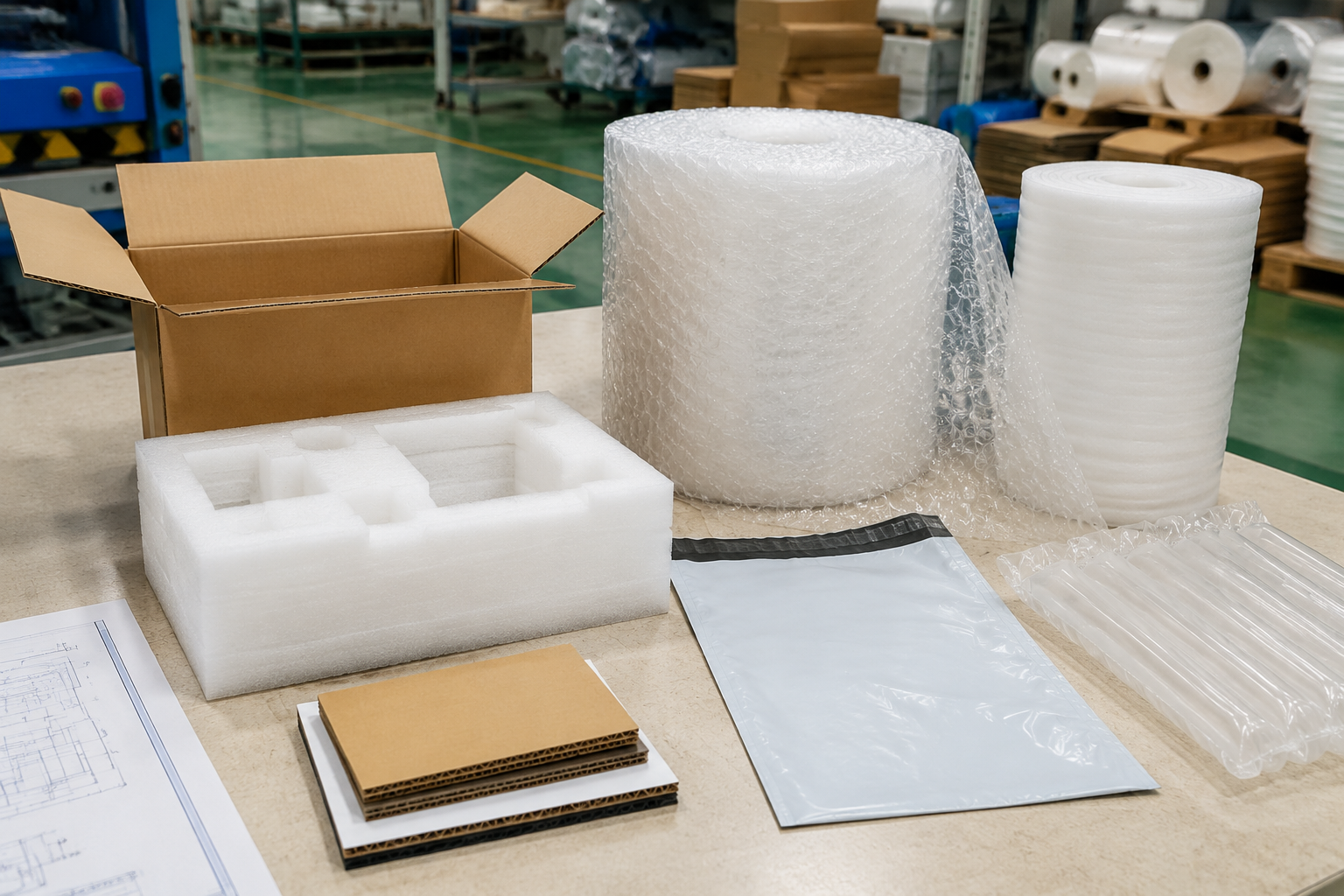
Wholesale Packaging Materials in China: Samples, MOQ, Quotation, and Bulk Order Process
Wholesale packaging materials from China can look simple at the inquiry stage, but the real decision depends on much more than naming a material...
Read cornerstone guide
Packaging Manufacturer vs Trading Company in China: What Overseas Buyers Should Check
When you are sourcing packaging from China, the main decision is not just who gives the quote. It is whether the supplier can handle...
Read cornerstone guide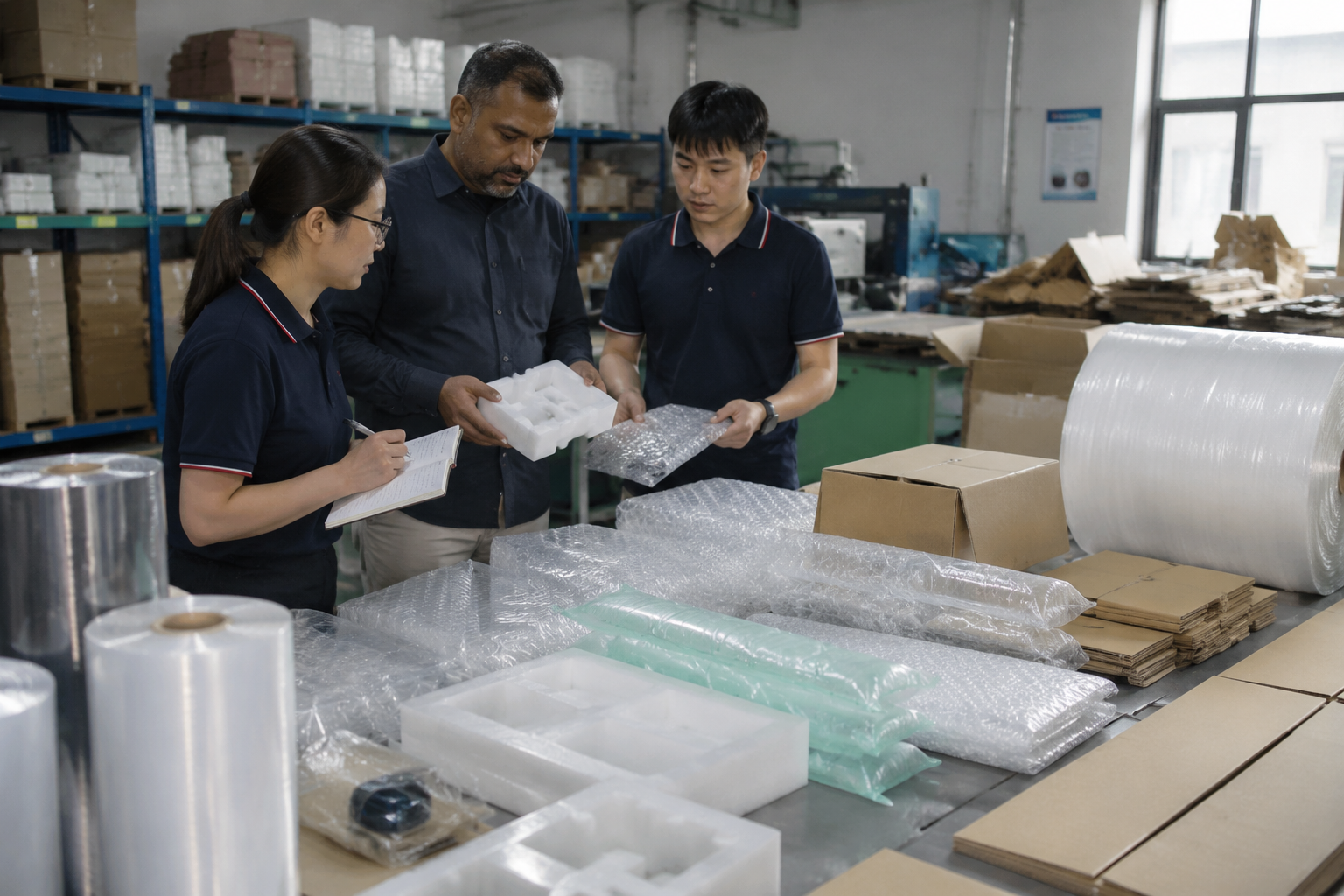
China Packaging Materials Supplier Guide: How to Choose the Right Factory for Custom Packaging
Choosing a China packaging materials supplier is not only about finding a factory that can quote foam, bubble wrap, cartons, film, or plastic bags....
Read cornerstone guide