
This guide helps packaging buyers communicate clearly with suppliers before cost, sampling, production, and shipment decisions become difficult to change. The main risk is not simply choosing the wrong material; it is allowing the supplier to quote or produce from incomplete assumptions about product size, weight, fragility, surface protection, carton space, shipping route, order quantity, printing, and packing method.
Use the article as a practical control checklist for B2B packaging orders. It explains what to send in the first inquiry, how to compare quotations fairly, when a sample is ready for approval, what to confirm during production, and how to document defects or revisions so repeat orders remain consistent.
Quick Packaging Decision Guide
| Buyer Question | Practical Reading | What to Check |
|---|---|---|
| Have I given the supplier enough product information? | The supplier can only recommend the right packaging when it understands fit, protection, handling, and transport risk. | Dimensions, weight, fragile points, surface finish, stacking limits, photos, drawings, and shipping route. |
| Is the lowest quote actually comparable? | A lower unit price may exclude material grade, printing, packing, sampling, setup work, or shipment preparation. | Thickness or density, tolerance, printing scope, carton quantity, setup fees, sample fees, freight terms, and exclusions. |
| Do I need a prototype or a pre-production sample? | The right sample depends on whether the buyer needs to check structure, fit, printing, bulk process, or packing method. | Sample version, material, size, artwork, sealing, carton packing, product fit, and written approval record. |
| What should be watched during production? | Production updates should prove that the approved version is being repeated, not quietly changed. | Raw material, measurements, print position, sealing quality, cutting accuracy, packing method, and deviation reports. |
| When is the shipment ready to release? | Shipment should be released only after goods, documents, labels, inspection, and handoff details match the order record. | Final quantity, carton marks, packing list, invoice, inspection photos, loading plan, pickup date, and responsibility. |
| How should defects be handled after delivery? | A claim is stronger when it connects the defect to the approved sample, specification, packing record, and receiving evidence. | Photos, measurements, affected quantities, carton numbers, approved version, issue log, and corrective action. |
Quick Answers Before You Read
What should I send before requesting a packaging quote?
Send product dimensions, weight, fragile areas, surface protection needs, order quantity, packing method, shipping route, target date, and photos or drawings that show the product clearly.
How can I compare packaging suppliers more fairly?
Compare the same specification across each quote: material grade, size, tolerance, printing, carton packing, sample costs, setup charges, lead time, shipment term, and exclusions.
When should I approve a packaging sample?
Approve only a named sample version after checking fit, material, size, print, sealing, packing method, and any open exceptions in writing.
What makes a defect report useful?
A useful defect report includes photos, affected quantities, measurements, carton or pallet numbers, the approved specification, and a clear request for cause review and corrective action.
Supplier communication affects packaging cost, fit, lead time, and shipment risk long before production starts. This guide focuses on how buyers can move from a clear inquiry to a controlled shipment by giving the supplier enough information about product size, weight, fragility, surface protection, stacking limits, shipping route, order volume, print requirements, and target dates. A vague request often leads to mismatched materials, unclear quotations, sample confusion, or preventable production delays.
The article also explains how to read quotations, approve samples, confirm production details, and handle defects with records instead of assumptions. It helps buyers judge whether a supplier has understood the order correctly, what should be confirmed in writing, and how to keep repeat packaging orders consistent through specifications, photos, measurements, packing instructions, and issue logs.
What to Prepare Before You Contact a Packaging Supplier
Good packaging supplier communication starts before the first email. If the buyer only sends a product name and asks for “best price,” the supplier has to guess the material, size, packing method, print requirements, and shipping risk. Those guesses may look fast at the beginning, but they often create quotation changes, sample revisions, or production arguments later.
A useful inquiry preparation package does not need to be complicated. It should give the supplier enough facts to understand what the packaging must do, how it will be packed, and where it will travel. For a China packaging materials supplier, this information is especially important because the quotation may involve material selection, custom cutting, printing, carton packing, export preparation, and sample planning across time zones.
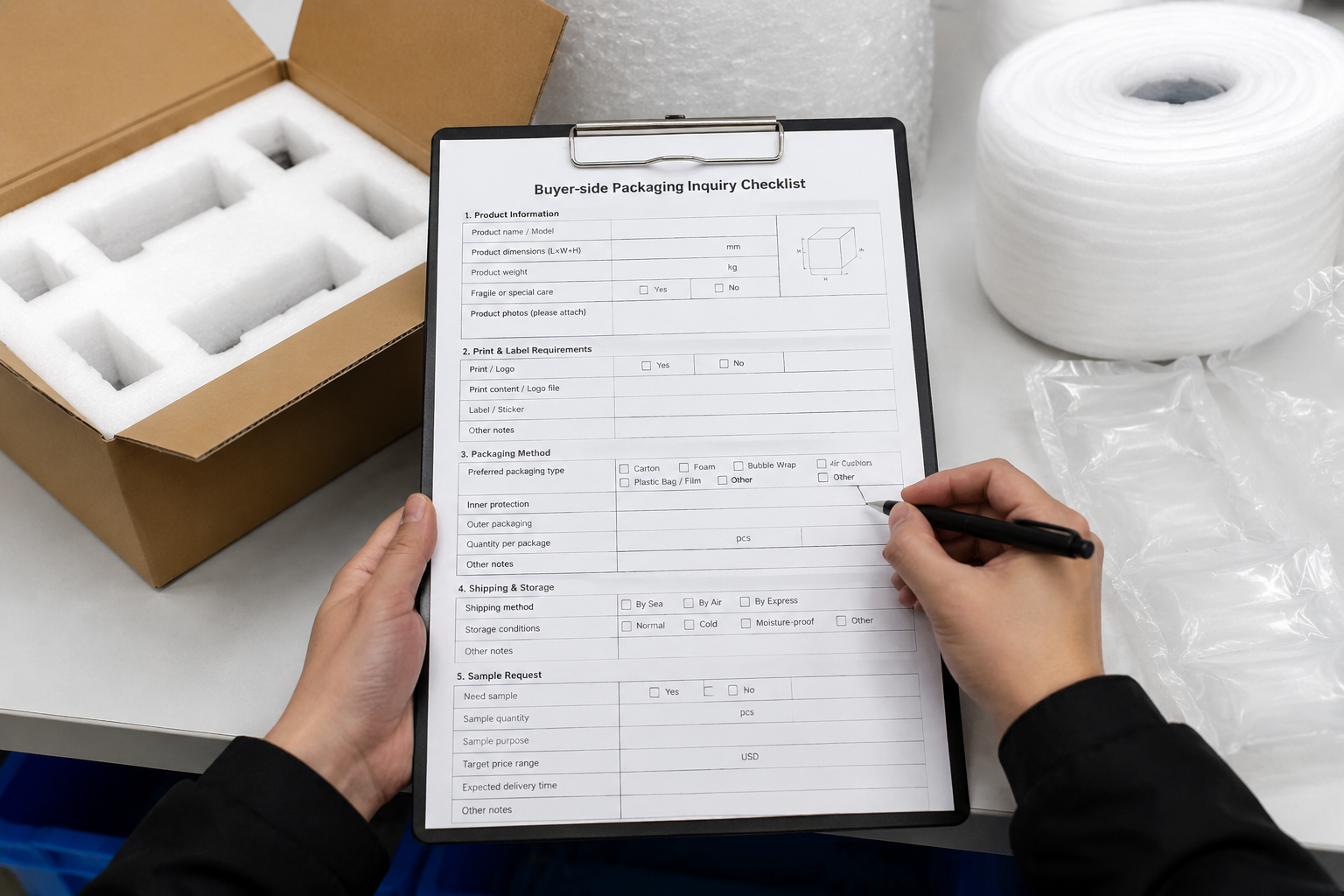
Before contacting a standard or custom packaging supplier, prepare a short RFQ pack or packaging requirement summary. This can be a spreadsheet, PDF, email brief, or product spec sheet. The format matters less than the completeness of the information. A clear summary helps the supplier answer with a realistic material suggestion, accurate unit price, practical lead time, and fewer assumptions.
A strong preparation file should also separate facts from preferences. Product weight, product dimensions, required carton quantity, and destination are facts that the supplier can quote against. Preferred material, preferred color, retail appearance, and cost target are useful, but they should not replace the measurable data that determines whether the packaging will fit and protect the product.
What product details the supplier needs first
The first data set should describe the product itself. At minimum, include the product dimensions, product weight, order quantity, fragility level, surface sensitivity, stacking limits, and shipping route. These details directly affect whether the supplier recommends EPE foam, bubble wrap, air cushions, plastic bags or film, corrugated boxes, or a combined packaging structure.
Product dimensions should include length, width, height, and any irregular shape that affects wrapping or fitting. A rectangular electronic accessory and a curved metal part may have the same approximate size, but they may need different protection. If a buyer gives only the outer carton size, the supplier may not know whether the product needs foam separation, bubble wrapping, an inner bag, or a custom insert.
Weight changes the protection logic. A light item may only need surface protection and void filling, while a heavy item may compress soft material during stacking or transport. Fragility also needs to be described in practical terms. “Fragile” is less useful than “glass surface,” “thin plastic corner,” “painted finish scratches easily,” or “assembled part cannot bear pressure on the top face.”
Surface sensitivity is often missed in early inquiries. A product may not break, but it may still be rejected if the finish is scratched, rubbed, or marked. For coated parts, polished metal, acrylic displays, electronics housings, and retail goods, surface protection may be as important as cushioning. In these cases, the supplier may need to review foam sheet thickness, bag material, protective film, or product separation inside the carton.
Stacking limits and shipping route help the supplier judge compression and handling risk. A domestic warehouse transfer, an e-commerce parcel shipment, and an export pallet shipment do not face the same conditions. If cartons will be stacked, palletized, or moved through multiple handling points, the inner protection and outer carton need to work together.
At Daipak, the discussion usually starts with the product details rather than the material name. A buyer may ask for bubble wrap, but after reviewing the product weight, surface finish, carton space, and shipping distance, the better answer may be bubble wrap plus corner protection, EPE foam pads, or a revised corrugated carton structure.
What order context changes the recommendation
The same product can need different packaging depending on how it will be used. A warehouse team may prioritize fast packing and product separation. An export shipper may care more about carton strength, pallet preparation, moisture exposure, and handling during long-distance transport. An e-commerce seller may need compact packaging that protects the item through parcel sorting without making the carton oversized.
Order volume also changes the discussion. For a small trial order, the supplier may suggest a standard-size material or simple cut-to-size solution to reduce setup work. For a larger repeat order, a custom size, printed bag, die-cut foam insert, or optimized carton may reduce packing time and material waste. The lowest material price is not always the lowest order cost if warehouse labor becomes slow or the carton becomes too large.
The target ship date should be shared early. If the buyer needs samples, artwork proofing, material preparation, printing, cutting, sealing, packing, and export shipment preparation, the schedule must allow for each step. A supplier can only give a practical timeline when it knows whether the buyer needs a stock product, a size adjustment, a printed version, or a fully custom packaging sample.
Print needs should also be stated before the quote. A plain plastic bag, a printed poly mailer, a printed corrugated box, and a labeled export carton involve different files, setup work, and checking points. If artwork is not ready, say so. If a print file is available, tell the supplier whether it is final or still under review. This avoids quoting a plain package when the buyer actually needs printed production.
Storage and transport conditions should not be treated as minor details. Packaging stored in a dry warehouse for quick turnover may not need the same material choice as packaging stored for a long period, exposed to humidity, or shipped in mixed cartons. If the product has a strong odor sensitivity, dust protection need, moisture concern, or retail appearance requirement, state it in the packaging requirement summary.
What files or photos reduce misunderstanding
Photos and drawings reduce the amount of guessing in the first quote. A supplier can understand a product much faster when it can see the shape, corners, surface finish, vulnerable parts, and current packing method. Even simple phone photos are useful if they show the product from several angles and include a ruler or reference object for scale.
For custom packaging, drawings or marked dimensions are better than product descriptions alone. A product spec sheet should show the exact dimensions that matter for fit. If the packaging must slide over the product, cover only one surface, protect a corner, or separate units inside a carton, mark those areas clearly. A small missing clearance can change the material size, cutting method, and final packing quantity.
Dielines and artwork files matter when printing or shaped packaging is involved. If the buyer already has a dieline for a printed box, courier bag, foam insert, or retail package, send the latest file and identify whether it is approved. If the buyer only has a reference photo from a previous supplier, explain which details must match and which can be adjusted.
Sample photos are also useful, but they need explanation. A message that says “make same as this” can create risk if the photo does not show thickness, density, sealing edge, printing color, or exact size. Mark the photo with notes such as “same bag opening,” “change thickness,” “logo position fixed,” or “foam insert needs tighter fit.” The more specific the reference, the less likely the supplier will copy the wrong feature.
If the buyer has a current packing problem, include photos of damaged goods, crushed cartons, loose products inside boxes, or scratched surfaces. These images help the supplier understand whether the issue is impact, vibration, compression, abrasion, moisture, or poor carton fit. Without that context, the supplier may quote a material that looks correct on paper but does not solve the real packing risk.
When Evidence or Compliance Language Must Be Confirmed
Some packaging claims need more than supplier reassurance. If a buyer asks for compostable, recyclable, food-contact, export-ready, or transit-tested packaging, the inquiry should identify which claim must be supported and what document the supplier can provide. In the United States, food-contact polymer and paper or paperboard components may fall under FDA indirect food additive regulations, so buyers should not treat a general “food grade” statement as a complete compliance record without checking the material and intended use context.[1]
Environmental claims also need careful wording. A supplier may use terms such as recyclable, biodegradable, compostable, eco-friendly, or sustainable, but the buyer should ask whether the claim is based on a recognized standard, certification, design guideline, or local recycling pathway. The FTC Green Guides are relevant because they address environmental marketing claims such as recyclable and compostable claims in U.S. consumer communication, so buyers should avoid placing broad green claims on packaging artwork unless the claim can be supported for the actual package and market.[2]
For compostable packaging, the buyer should ask whether the claim is tied to the material type and intended composting environment, because plastic compostability, coated paper compostability, and certification programs can rely on different evidence paths. ASTM D6400 is commonly used for plastics designed to be aerobically composted in municipal or industrial facilities, ASTM D6868 addresses biodegradable plastic coatings on paper and other compostable substrates, and BPI provides a certification reference for compostable products and packaging.[7][8][9]
Transit performance claims should be handled as test-scope claims, not as vague promises. ASTM D4169 is a standard practice for performance testing shipping containers and systems, while ISTA Procedure 3A is used for packaged products moving through parcel delivery systems; neither source proves that a specific supplier’s carton has passed testing unless the supplier provides a matching report for the actual package, product, and distribution route.[3][4]
A practical buyer message is: “If the quotation includes recyclable, compostable, food-contact, export, compression, vibration, or parcel-test claims, please state the exact basis for the claim and send the supporting certificate, test report, regulation reference, or design guideline before artwork approval.” This keeps evidence attached to the claim that will appear on the purchase order, carton mark, retail artwork, or customer-facing document.
Supplier claim language should be treated as a starting point, not the final proof. Buyers should connect each claim to the exact material, structure, destination market, artwork wording, test scope, and document date before approving printed packaging or customer-facing statements.
Verification Note: For packaging orders, buyer confidence should come from traceable evidence rather than broad supplier wording. When possible, buyers should review real sample photos, material descriptions, measurement records, print proofs, packing photos, and any claim-specific certificates or test reports before approving artwork, production, or shipment release.
How to Write the First Inquiry So the Quote Is Usable
The first inquiry should make it easy for the supplier to quote based on the real requirement, not on assumptions. A good inquiry email does more than ask for price. It asks the supplier to confirm material, size, tolerance, printing, sample type, packing method, quantity, destination, and lead time in writing.
This matters because a quotation request becomes part of the order record. If the first message is vague, later discussions may become difficult to trace. If the first message is structured, the buyer can compare supplier responses, check whether the quoted scope is complete, and avoid approving a low price that does not include the actual work needed.
A practical inquiry can be short, but it should be specific. The buyer does not need perfect packaging knowledge before contacting the supplier. The buyer does need to explain the product, the intended use, and the points that must be confirmed before price and sampling move forward.
Questions that must be asked in the first email
The first email should include direct questions that force a clear supplier response. These questions should be tied to cost, quality, timing, or responsibility. If a question does not affect one of those areas, it can usually wait. If it does, it should be written clearly from the start.
A buyer can use this structure as a starting point:
- Material: Please advise the recommended material and thickness or density based on the product weight, surface finish, and shipping method.
- Dimensions: Please quote based on the attached product size and confirm the finished packaging size you recommend.
- Tolerance: Please confirm the normal size tolerance, cutting tolerance, sealing tolerance, or printing tolerance for this item.
- Printing: Please confirm whether the attached print file is suitable, and advise if a print proof or artwork adjustment is needed.
- Sample: Please advise whether you recommend a prototype, printed sample, pre-production sample, or digital proof before bulk order.
- Quantity: Please quote based on the listed order quantity and advise if price changes at different quantity levels.
- Packing method: Please confirm unit packing, carton packing quantity, carton size if available, and whether pallet packing is needed.
- Destination and timing: Please confirm estimated production time based on delivery to the stated destination or shipping handoff point.
These questions help the supplier show how it understands the job. For example, a buyer asking for foam bags should not only ask for “foam bag price.” The inquiry should specify product size, foam thickness or required cushioning level, bag opening direction, sealing requirement, packing quantity per carton, and whether the surface needs scratch protection. Each detail can affect material use, labor, carton quantity, and sample accuracy.
For printed packaging, the buyer should ask whether the quote includes printing setup, artwork checking, print proofing, and carton labels. A plain quote for a printed corrugated box may not be comparable with another quote if one includes print preparation and the other does not. The first inquiry should make these scope differences visible.
What a strong supplier reply looks like
A strong supplier reply is specific, measurable, and confirmable. It does not simply say “yes, we can make it.” It restates the important details and shows the buyer what the quote is based on. This gives the buyer a written reference for sample checking and later production confirmation.
For example, a useful reply might say: “We recommend 2 mm EPE foam bag with one-side opening for this painted metal part. Finished bag size will be 220 x 160 mm, tolerance about plus or minus 3 mm. Unit packed in foam bag, then 100 pieces per export carton. Printed logo is not included in this price. Sample can be made after size confirmation.” This type of reply gives the buyer several points to verify.
A strong response also separates recommendation from assumption. If the supplier does not know the carton size, it should say so. If the buyer has not confirmed artwork, the supplier should state that the printing quote is based on pending artwork review. If the material thickness is recommended rather than specified by the buyer, that should be clear.
Lead time should be expressed with conditions. A practical answer might say production timing starts after sample approval, artwork confirmation, deposit, or final specification confirmation, depending on the order terms. This is more useful than a simple number because it tells the buyer what must happen before the schedule is real.
For custom packaging, a strong supplier reply may also suggest questions the buyer has not asked. If the product is heavy, the supplier may ask about stacking. If the product has a polished surface, it may ask about scratch risk. If the packaging is for export shipment, it may ask about carton marks, pallet requirements, or destination handling. These follow-up questions are a good sign when they are tied to practical risk rather than vague upselling.
What weak answers should trigger follow-up
Weak answers are often short, friendly, and risky. Phrases such as “we can do it,” “same as your request,” “quality is good,” or “price is best” do not give the buyer enough information to check the quote. They may sound positive, but they do not confirm material, dimensions, tolerance, printing scope, packing method, or delivery basis.
A low price with missing specifications should trigger follow-up before the buyer compares it against other quotes. The supplier may have quoted a thinner material, smaller size, plain version, loose carton packing, no sample, or different shipment term. If the quote does not state what is included, the buyer cannot know whether it is truly cheaper or simply incomplete.
Follow-up questions should stay neutral and precise. Instead of arguing about the quote, frame the exchange around China packaging supplier support and a factory direct packaging comparison to ask the supplier to restate the scope: “Can you confirm the material thickness, finished size, tolerance, printing included, carton packing quantity, and sample cost for this quote?” This keeps the conversation factual and creates a written record.
If the supplier avoids confirming tolerance, print proof, sample format, or packing method, the buyer should slow down before placing the order. These details are not small paperwork items. They affect whether the sample can be judged fairly, whether production can repeat the approved version, and whether the shipment arrives packed as expected.
A weak answer does not always mean the supplier is unreliable. Sometimes it means the inquiry was incomplete. The buyer’s job is to close the information gap before price approval. If the supplier still cannot provide clear answers after receiving the missing details, that is a stronger warning sign.
How to Handle Samples, Revisions, and Approval
Samples should turn the quote into something the buyer can check. They are not only a visual reference. A sample confirms whether the material, size, fit, surface protection, printing, sealing, cutting, and packing method can meet the requirement before mass production starts.
The risk in sampling is version confusion. A buyer may approve a physical sample, then request a small size change, then review a new photo, then send updated artwork. If those changes are not named and recorded, the supplier may produce according to an old file or a sample that no longer matches the final requirement.
Good sample confirmation keeps three questions clear: what was reviewed, what was changed, and what is approved for production. This is especially important for custom packaging samples where small differences in dimensions, foam density, bag sealing, print position, or carton structure can affect bulk order consistency.
How to request the right sample format
The sample format should match the decision the buyer needs to make. If the buyer only needs to confirm size and structure, a prototype may be enough. A prototype can help check product fit, opening direction, insert shape, corner coverage, or carton structure before printing or final finishing is added.
If the buyer needs to confirm bulk production quality, a pre-production sample is more useful. This should reflect the planned material, dimensions, process, and packing method as closely as practical. For example, an EPE foam insert should show the expected thickness, cut shape, and fit. A bubble bag should show the bubble size, sealing edge, and opening style. A corrugated box should show the structure, board selection, and folding performance.
For printed packaging, a digital proof and a printed sample serve different purposes. A digital proof helps confirm layout, logo position, text, barcode placement, and basic artwork direction. It does not fully show print color on the final material. A printed sample is more useful when color, logo sharpness, ink coverage, or retail appearance matters. Buyers should be careful not to approve a digital proof as if it confirms every physical production detail.
For simple standard items, a stock sample may be enough to review material and general quality. But if the final order needs a custom size, special sealing, printed logo, carton label, or fixed packing quantity, the buyer should state which parts of the stock sample are only for reference and which parts must match the bulk order.
A practical sample request might say: “Please make one pre-production sample based on version V2 drawing, using the quoted material and final size. Please also send photos of product fit, sealing edge, and carton packing method before shipping the sample.” This wording gives the supplier a clear sampling target and gives the buyer specific items to check.
How to document revision comments clearly
Revision comments should be written so that someone who was not on the call can still understand the change. Verbal comments are easy to misunderstand, especially when they involve small size changes, print movement, material adjustments, or packing details. After every sample review, the buyer should send written comments with photos, marked areas, and a version name.
Use simple version control. Name the first sample V1, the next revised sample V2, and so on. If artwork changes separately, identify the artwork file name and date. If the sample is physical, take photos and mark the areas that need revision. A comment such as “make it tighter” is not enough. A better comment is “reduce inner width from 105 mm to 100 mm so the product does not slide inside the foam insert.”
Revision comments should also separate required changes from optional suggestions. If a change is mandatory for approval, label it clearly. If a point is only preferred but not critical, say that too. This helps the supplier decide whether a new sample is needed or whether the change can be confirmed by photo, drawing, or written specification.
For printed packaging, revision comments should identify the exact file and visual issue. “Logo too low” can be interpreted differently by different people. “Move logo 8 mm upward from current V1 position; keep centered left to right; use artwork file BrandBox_Final_0320” is much easier to execute and check.
Ms. Tang often keeps sampling and specification confirmation connected in order discussions, because a small revision can affect material use, carton quantity, production preparation, and final inspection. From the buyer side, this means every revision should update the same approval record rather than live only in scattered messages.
What counts as final approval
Final approval should be a written confirmation of a specific version, not a general statement that “the sample is okay.” A proper approval record should name the sample version, approval date, approved material, finished size, tolerance if agreed, printing file, packing method, and any exceptions that remain open.
If the buyer approves only part of the sample, that should be stated clearly. For example, the buyer may approve the foam thickness and product fit but still require a revised carton label. Or the buyer may approve the box structure but not the print color. A partial approval can be useful, but it must not be confused with full production release.
Final approval should also confirm what happens if later changes appear. If the buyer changes artwork, dimensions, material, packing quantity, or label requirements after approval, the supplier should review whether the quote, sample, or lead time changes. One sample approval should not automatically cover later modifications.
A clear final approval message might say: “We approve sample V3 dated April 15 for mass production. Approved details: 2 mm EPE foam bag, finished size 220 x 160 mm, one-side opening, no printing, 100 pieces per inner carton, carton mark as attached file CM_V3. Please produce according to this version and notify us before any deviation.” This gives both sides a traceable production reference.
The safest approval record is boring and specific. It does not rely on memory, chat history, or a photo without context. It tells the supplier exactly what can move forward and gives the buyer a clear basis for production follow-up, inspection, and repeat orders.
How to Read the Quotation and Catch Missing Assumptions
A packaging quotation is useful only when it shows what the supplier has actually priced. A low unit price can look attractive during quotation comparison, but it may not cover the same material grade, printing process, packing method, tolerance, tooling fee, or shipment scope as another offer. Before issuing a purchase order, the buyer should slow down and check whether the quote matches the approved requirement, not just whether the number is lower.
The safest approach is to treat every quotation as a written assumption sheet. If a supplier quotes bubble wrap bags, EPE foam inserts, printed corrugated boxes, or plastic film packaging, the buyer should be able to trace the price back to size, material, thickness or density, printing, conversion work, carton packing, and delivery terms. If those details are missing, the quotation may still be a rough estimate rather than a production-ready offer.
What should be included in the unit price
The unit price should first make clear what physical product is being supplied. For protective packaging, this means material type and grade, product size, thickness or density where relevant, sealing or cutting method, printing if required, and any finishing process. A quote for an EPE foam bag, for example, should not only say “foam bag.” It should confirm the foam thickness, bag dimensions, opening style, sealing method, quantity, and whether the price includes cutting and conversion into finished bags.
Printing is another common source of misunderstanding. If the order needs a printed corrugated box, printed courier bag, printed tape, or branded protective film, the quotation should say whether printing is included, how many colors are priced, whether artwork proofing is included, and whether the print plate or setup cost is charged separately. A buyer can ask directly: “Please confirm whether the unit price includes printing, plate cost, artwork adjustment, and finished product packing.” This simple question often reveals whether the supplier has priced the complete job or only the base material.
Packing should also be part of the price review. Packaging materials are often bulky, and the way they are packed affects labor, carton use, loading volume, and damage risk during transport. Bubble wrap rolls, air pillow film rolls, foam sheets, plastic bags, and custom inserts may each need a different carton quantity, roll size, compression method, or pallet arrangement. If the quote does not state the inner packing, carton quantity, carton size, or pallet requirement, the buyer should not assume it is included in the way they need.
A strong quotation usually names the specification and scope clearly: material, size, tolerance, print, packing quantity, carton details, sample or setup cost, lead time reference, and shipment term. A weak quotation may give only a unit price with broad wording such as “as requested,” “standard packing,” or “same as sample” without naming the sample version. Those phrases are not always wrong, but they need follow-up before the buyer relies on the number.
What must be confirmed as excluded
Some costs are not part of the unit price unless they are written into the quote. Tooling, molds, cutting dies, print plates, sample charges, special color matching, inspection fees, export documents, freight, local tax, and rework responsibility can all become later disputes if they are not clarified early. The buyer does not need to make the conversation difficult; a clear question is enough: “What is excluded from this quotation, and which charges may be added before shipment?”
Tooling and setup costs deserve special attention for custom packaging. A custom EPE foam insert, shaped corner protector, die-cut sheet, printed corrugated box, or air column structure may need a mold, cutting die, plate, or setup process. If one supplier includes this cost and another does not, the unit prices cannot be compared directly. In quotation comparison, the buyer should separate the first-order cost from the repeat-order unit price so the total packaging cost is visible.
Samples also need clear treatment. A supplier may offer a simple material sample at no charge, but charge for a printed sample, pre-production sample, custom die-cut sample, or courier delivery. The buyer should confirm whether the sample cost is refundable, included in the order, or separate. No assumption should be made unless the supplier writes it into the quotation or follow-up confirmation.
Shipment scope is another area where low quotes can hide missing work. The quotation should state whether the price is based on factory pickup, delivery to a forwarder, export preparation, or another agreed term. If export documents are needed, the buyer should ask which documents the supplier can provide and which must be arranged by the buyer, forwarder, or importer. This should be checked according to the buyer’s destination and order requirements rather than assumed as a standard service.
Inspection and rework should be discussed before problems occur. If the buyer requires a third-party inspection, special packing check, extra counting process, or replacement procedure for confirmed defects, the quotation may need to reflect the extra labor or responsibility. A useful follow-up question is: “If production does not match the approved specification, what correction process is included, and what would be treated as extra work?” This keeps defect handling tied to the agreed specification instead of a later argument about expectations.
How to tell whether the quote is based on the right spec
The best sign is that the supplier restates the requirement in specific terms. For example, instead of replying “price for foam insert attached,” a stronger response would confirm the foam type, density or thickness, outside dimensions, cavity size, tolerance, quantity per carton, and whether the quote follows drawing version V2. The more the quotation repeats measurable details, the easier it is to catch mistakes before the purchase order.
A quote may be based on the wrong spec if it uses old dimensions, ignores a revised artwork file, does not mention tolerance, or prices a general material instead of the requested structure. This happens often when discussions move across email, messaging apps, drawings, photos, and sample comments. The buyer should ask the supplier to confirm again using one clean reference: “Please quote based on drawing V3 dated June 12, printed artwork file V2, foam thickness 20 mm, tolerance ±2 mm, and 1,000 sets packed 50 sets per carton.”
The buyer should also check whether the quoted packing method supports the real product flow. A quote for loose foam sheets may not be suitable if the warehouse needs bundled sets for fast assembly. A quote for bubble bags in bulk cartons may not work if the packing line needs counted inner packs. A quote for printed cartons may look complete but still miss carton marks, barcode labels, or pallet requirements. The price should match how the packaging will be received, stored, and used.
For custom packaging, Daipak usually needs the product size, weight, photos, packing method, order quantity, and shipping destination before making a practical recommendation. Without those details, a supplier may still give a number, but the number may be based on a rough guess. A buyer can reduce this risk by asking for a final supplier response review before purchase order release: material, dimensions, tolerance, printing, packing, excluded charges, lead time, and shipment term all confirmed in one message.
Supplier reputation can be useful background, but it should not replace version-specific order checking. The safest comparison is tied to the exact specification, sample version, material description, packing method, and written exclusions for the order being purchased.
What to Confirm During Production and QC
After the purchase order is placed, communication should not stop until the goods are finished and packed. Production follow-up is the stage where an approved sample becomes a bulk order, and small misunderstandings can multiply quickly. The goal is not to supervise every factory step from a distance. The goal is to make sure the packaging materials manufacturer keeps the approved version, agreed specification, and packing plan visible during production.
Quality control starts before the first batch is made. If the material, artwork, tolerance, size, or packing method is unclear at production release, final inspection may only discover a problem after time and material have already been used. Good communication during production helps catch wrong material, print mismatch, size drift, sealing problems, bonding issues, packing errors, and quantity inconsistencies early enough to correct them.
If the order depends on compression or vibration performance, the QC conversation should name the evidence standard separately from the supplier’s normal inspection. ASTM D642 covers compressive resistance testing for shipping containers, and ASTM D4728 covers random vibration testing for shipping containers; these references can help buyers ask for the right type of test language, but they should not be treated as proof that a batch passed unless a report for the actual packaging system is provided.[5][6]
Quality Control Note: Packaging quality should be judged order by order, based on visible QC details such as material grade, thickness or density, finished dimensions, tolerance, print position, sealing quality, carton packing, label accuracy, and deviation records. A supplier name or previous order history can help context, but it should not replace checking the actual batch against the approved specification.
What to confirm before production starts
Before production begins, the buyer should ask the supplier to restate the locked specification. This pre-production confirmation should include the approved sample version, material type, thickness or density, dimensions, tolerance, color, printing file, packing method, quantity, carton packing, and any labels or carton marks. If the product is a custom foam insert, the cavity size and product orientation should also be confirmed. If it is printed corrugated packaging, the artwork file and print position should be checked again.
A useful buyer message is: “Please confirm before production that the order follows sample version S2, drawing V3, artwork file V2, material thickness 3 mm, size tolerance ±2 mm, and packing 100 pieces per carton.” This wording gives the supplier a clear checklist and creates a written record. If the supplier replies only “OK, we will arrange,” the buyer should ask for the details to be repeated, especially for custom sizes or printed work.
Material lot or material preparation can also matter. For EPE foam, bubble wrap, plastic film, or corrugated board, a change in thickness, density, color tone, surface finish, or board grade may affect performance and appearance. The buyer does not need to request technical data for every simple order, but for sensitive packaging the supplier should confirm that the prepared material matches the approved sample or agreed specification.
The packing plan should be locked before production, not decided after the goods are finished. This includes pieces per bag, pieces per carton, carton size, carton weight target, pallet requirement, and any special protection for the packaging materials themselves. If the buyer’s warehouse needs packaging supplied in counted sets, bundles, rolls, or labeled cartons, the supplier should know this before cutting, sealing, printing, or packing starts.
What to ask during in-process QC
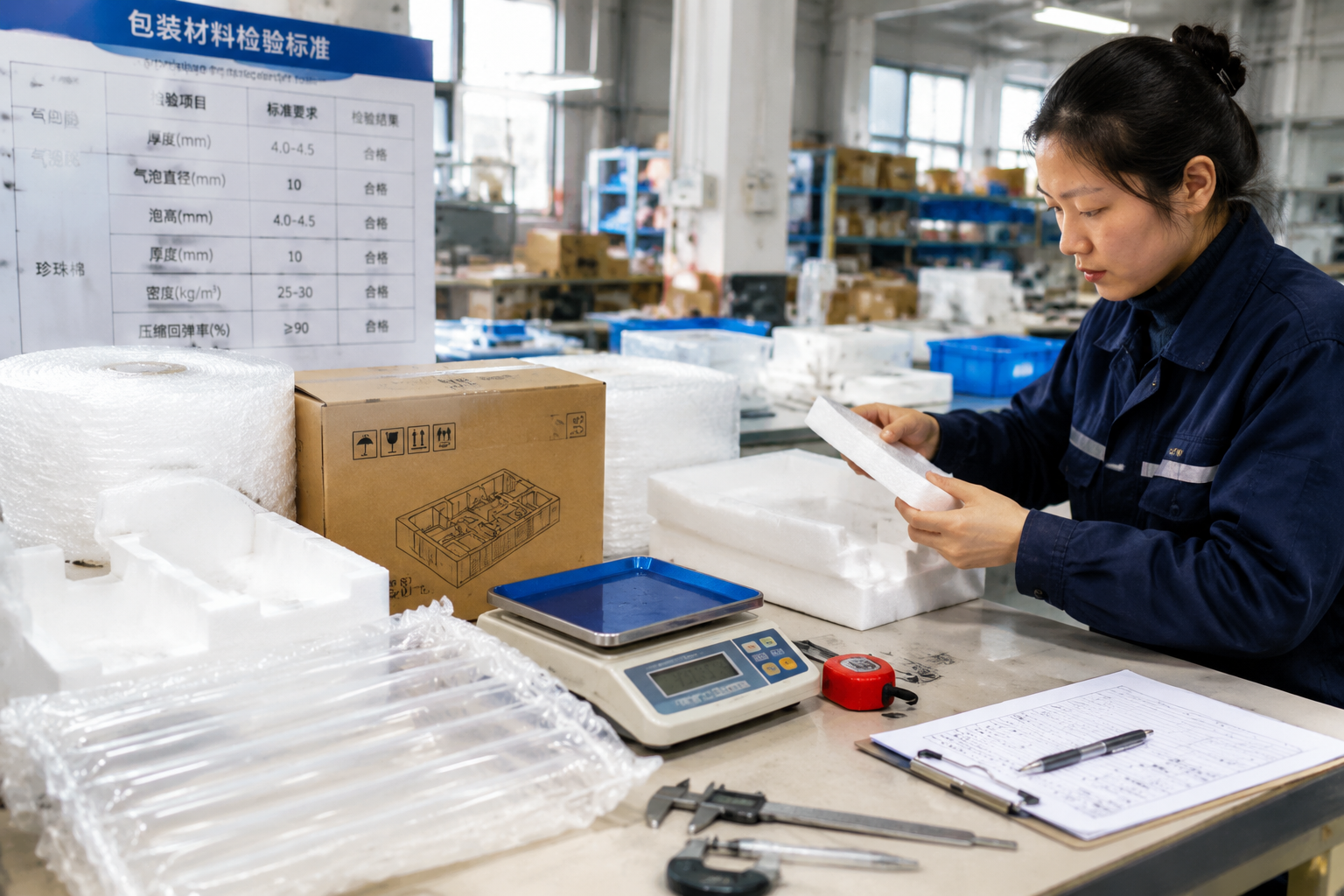
During production, buyers should request updates that show the order is following the approved version. Useful evidence may include photos of raw material, first finished pieces, print color and position, measurement checks, sealing or bonding details, carton packing, and quantity labels. A short video can help for flexible products such as bubble wrap bags, air cushion packaging, stretch film, or plastic bags, where sealing quality and roll condition may be easier to see in motion.
The buyer should agree on update timing based on order risk. A standard repeat order may only need a start-of-production confirmation and finished goods photos. A new custom packaging order may need first-piece photos before full production continues. Printed work, shaped foam, die-cut inserts, and export cartons usually deserve closer confirmation because mistakes can affect the entire batch.
In-process inspection should include more than appearance. Depending on the product, the supplier may need to check size, thickness, density, print clarity, sealing strength, cutting accuracy, folding line, bonding position, quantity per pack, and carton packing. The buyer can ask: “Please send photos of measurement checks and report any deviation from the approved sample before continuing.” This makes it clear that silent changes are not acceptable.
Defect rate reporting does not need to be complicated, but it should be factual. If the supplier finds misprinted cartons, weak sealing, wrong cut size, uneven foam bonding, or damaged outer cartons during packing, the buyer should receive a short report with quantity affected, cause if known, correction plan, and whether shipment timing changes. A vague message such as “small problem, already handled” is not enough for a production update on a custom or export order.
How to respond when a deviation appears
When a deviation appears, the first decision is whether production should pause. A small issue outside the approved feature, such as outer carton scuffing that does not affect use, may only need documentation. A deviation in size, material, printing, sealing, or packing quantity can affect product fit, buyer branding, warehouse use, or shipment handling, so it should be reviewed before the supplier continues.
The buyer should ask for three things: clear evidence, affected quantity, and proposed correction. Photos should show the problem beside the approved sample, drawing, measurement tool, or packing instruction, while custom packaging factory criteria should remain linked to the same approved specifications during review. If the issue relates to color, print position, cut size, density, or carton mark, the reference file or approved sample version should be named. This keeps the discussion tied to the agreed requirement, not to personal judgment.
If the deviation can be corrected, the supplier should confirm how and when. If it cannot be fully corrected, the buyer must decide whether to accept, reject, rework, or separate the affected goods. Any acceptance of deviation should be written, specific, and limited. For example: “We accept the 2 mm print position deviation for this batch only, based on the photos sent today. Future orders must follow artwork file V2.” Without that limit, the supplier may treat the deviation as a new standard.
From the factory side, Mr. Wang often checks whether a confirmed cutting, sealing, bonding, or packing detail can be repeated consistently during bulk production. That same thinking helps the buyer decide whether a deviation is isolated or likely to continue through the full order. If the cause is not clear, the buyer should request correction evidence before allowing production to restart.
How to Lock Packing, Inspection, and Shipment Details
The final stage is not simply asking whether the goods are ready to ship. Shipment confirmation should close the order by matching finished goods, packing method, inspection result, labels, carton marks, pallet requirements, and documents against the agreed order record. If this stage is handled too casually, the goods may be correct but delayed because cartons are marked incorrectly, packing quantities do not match the packing list, or documents are not ready for the forwarder.
For an export packaging supplier, the final handoff should be written and practical. The buyer should know what is packed, how it is packed, how many cartons or pallets are ready, what documents are available, and what shipment date or pickup plan is being used. A packing confirmation is not the same as shipment release. Shipment release means the buyer has reviewed the final information and allowed the goods to leave according to the agreed arrangement.
What to confirm in the final packing method
The final packing method should confirm unit packing, inner packing, master carton packing, palletizing if required, and special handling instructions. For example, bubble wrap bags may be counted into inner bundles before carton packing. Foam inserts may need to be stacked in a fixed direction to avoid deformation. Plastic bags or film products may need moisture protection or clean inner liners. Corrugated boxes may need flat packing, bundling, or carton packing depending on how the buyer’s warehouse will use them.
Carton quantity and carton weight should be checked before dispatch. If the carton is too heavy, it may create handling risk or warehouse complaints. If the carton is too loose, the packaging materials can shift, crease, compress, or arrive in poor condition. If the buyer has a pallet height limit, container loading plan, barcode label, or warehouse receiving rule, this should be confirmed before the order is released.
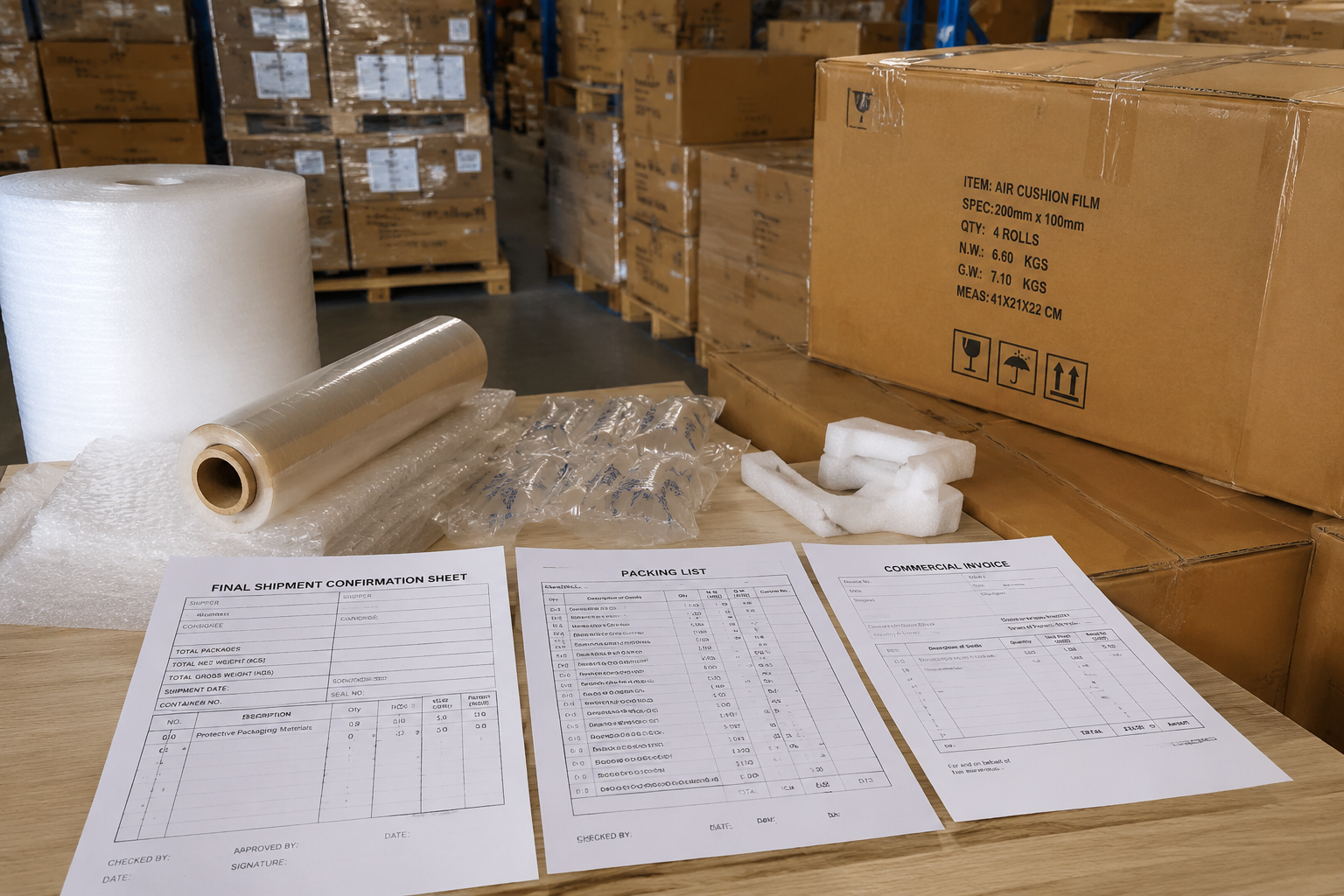
Carton marks are often small details with large consequences. The supplier should confirm item name or code, quantity per carton, carton number, gross and net weight if required, dimensions, destination marks, and any buyer-specific label format. If carton marks are missing or inconsistent, the buyer may have trouble receiving, sorting, or matching the shipment to the purchase order.
For export orders, Mr. Li usually pays attention to carton marks, packing quantity, destination, and delivery requirements before shipment preparation is finalized. These details do not replace freight or customs arrangements, but they help prevent avoidable confusion between the supplier, buyer, warehouse, and forwarder.
Which shipment documents should be checked in writing
Before release, the buyer should check the packing list, commercial invoice, final quantity summary, carton or pallet count, labels, inspection notes, and shipment date confirmation. Depending on the order and destination, other documents may be needed, but those requirements should be confirmed separately with the buyer’s importer, forwarder, or compliance team. The supplier should not be assumed responsible for documents that were never requested or agreed.
The packing list should match the physical packing. If the packing list says 80 cartons but the loading photos show 78 cartons, the discrepancy needs to be resolved before pickup. If the invoice description does not match the buyer’s purchase order or product code, it can create receiving or clearance delays. If carton labels show a different item number from the documents, the buyer should request correction before shipment.
Inspection records should be specific enough to support release. This may include finished goods photos, carton packing photos, quantity check notes, product measurement photos, print confirmation, and any accepted deviation record. A simple message saying “inspection passed” is useful only if the buyer already knows what was inspected. For custom packaging, the final inspection should connect back to the approved sample, drawing, artwork, and packing method.
Loading photos can also be helpful, especially for export shipments or bulky packaging materials. They can show carton condition, pallet wrapping, label visibility, container loading condition, and whether cartons were loaded according to the agreed method. The buyer should ask for these records before dispatch if they are needed for internal receiving, claim prevention, or shipment tracking.
How to release the order for dispatch
The buyer should release the order only after the final quantity, packing method, carton marks, inspection status, documents, shipment date, and pickup or delivery arrangement are confirmed in writing. A good release message is simple: “We confirm release for dispatch based on the final packing list, inspection photos, carton marks, and shipment date shared today.” This gives both sides a clear cutoff point.
If any item is still open, the release should be conditional or delayed. For example, if the goods are finished but carton labels are wrong, the buyer can ask the supplier to correct labels and resend photos before release. If the documents are not aligned with the packing list, shipment should wait until the supplier revises them. If the buyer’s forwarder has not confirmed pickup details, the supplier should not assume the schedule is final.
The final release should also record who is responsible for the next step. The supplier may prepare goods for pickup, deliver to a local warehouse, or coordinate with the buyer’s forwarder depending on the agreed terms. The buyer should confirm contact person, pickup address, loading time, carton or pallet count, and any warehouse entry requirement. This is especially important when the goods are bulky, fragile, printed, or packed on pallets.
Shipment release closes the production stage, but it also protects the next conversation. If cartons arrive with missing labels, wrong quantities, damaged packing, or document mismatch, the written release record helps both sides review what was confirmed and where the issue occurred. That record is not only useful for solving a problem; it also improves the next order by making the final handoff easier to repeat.
How to Handle Defects, Claims, and the Next Order
Even with careful inquiry, sampling, production follow-up, and shipment confirmation, problems can still appear after delivery. A carton may arrive with fewer pieces than expected. A printed bag may have a color shift. Foam inserts may be cut slightly off from the approved size. A bubble wrap bag may have weak sealing, or carton labels may not match the buyer’s warehouse receiving system. The goal at this stage is not to argue first. The goal is to make defect handling factual, traceable, and useful for both the current order and the next one.
A good claim starts with a clear written confirmation record. That record should connect the problem to the approved sample, final specification, packing confirmation, shipment documents, and receiving result. Without that connection, the discussion can become vague quickly: the buyer says the goods are wrong, while the supplier cannot see whether the issue came from production, packing, transport, warehouse handling, or a changed expectation after approval.
Keep the tone firm and professional. A message such as “some products are bad, please solve it” does not give the supplier enough information to review the issue. A better message identifies the order, item, quantity affected, photos, carton numbers, approved version, and the requested next step. This helps the supplier review production records, packing notes, and inspection details instead of guessing.
What evidence to collect when something is wrong
Useful claim evidence should show what happened, how often it happened, and how it differs from the confirmed requirement. Start with clear photos, but do not rely on close-up images alone. A close-up can show a torn bag, weak seal, miscut foam edge, print defect, crushed carton, or wrong label. A wider photo can show carton condition, packing layout, pallet condition, carton mark, and whether the issue appears across many cartons or only one area of the shipment.
For packaging defects, quantity matters. If 20 pieces out of 10,000 have a minor cosmetic issue, the discussion is different from 2,000 pieces with the same defect. Record how many cartons were checked, how many pieces were inspected, how many pieces failed, and whether the problem appears randomly or in the same carton batch. If the issue involves size, thickness, film width, foam density, sealing position, print location, or carton dimensions, include measurement photos with a ruler, caliper, or scale where appropriate.
The buyer should also collect the approval references that define what “correct” means. This may include the final sample photo, approved artwork proof, version name, purchase order, quotation, packing list, carton mark confirmation, or email approval. If the approved sample was a foam insert with a specific slot depth, a plastic bag with a certain sealing style, or a printed corrugated box with a confirmed layout, show that reference next to the actual received item. The comparison helps avoid subjective comments and keeps the discussion tied to the agreed specification.
- Order information: purchase order number, item name, supplier item code if available, shipment date, and received date.
- Defect description: what is wrong, where it appears, and whether it affects function, appearance, packing speed, or resale use.
- Photo evidence: close-up photos, full-product photos, carton photos, label photos, and comparison photos against the approved sample.
- Quantity count: number checked, number affected, carton numbers, pallet numbers, and whether the issue is isolated or repeated.
- Approval record: final sample version, written approval date, artwork proof, specification sheet, and packing confirmation.
For export packaging, receiving teams should avoid discarding cartons, labels, liners, or pallet photos before the issue is reviewed. Those details may show whether damage came from production, inner packing, carton compression, pallet handling, moisture exposure, or destination warehouse handling. The more complete the record, the easier it is to discuss responsibility confirmation without turning the conversation into a dispute based only on opinion.
How to ask for a corrective action response
After the evidence is organized, the buyer should send a concise written claim and ask the supplier to review the issue against the confirmed order record. The wording should be direct but not accusatory. The supplier needs enough information to check production, packing, inspection, and shipment preparation records. If the buyer asks only for a replacement without showing the defect scope, the supplier may not be able to confirm the cause or propose a realistic next step.
A practical message can use this structure: “We received the shipment for PO number ____. During incoming inspection, we found ____ pieces affected by ____. Please see attached photos, carton numbers, and the approved sample reference. Please confirm responsibility and advise the next step.” This keeps the request clear. It also gives the supplier room to review whether the solution should be replacement, rework, sorting, credit discussion, partial sorting, revised packing, or a production correction for the next order.
Corrective action should answer three questions: what happened, what will be done for the current order, and how the same issue will be prevented next time. For example, if EPE foam inserts are too tight and slow down packing, the response should not only say “we will improve.” It should identify whether the cutting size, drawing tolerance, material rebound, or product dimension assumption caused the problem. If printed courier bags have a repeated logo position error, the supplier should confirm whether the artwork proof, printing plate, or production setup needs correction.
Buyers can ask for the response in a simple but complete format:
- Issue confirmation: “Please confirm whether you recognize the defect shown in the attached photos.”
- Cause review: “Please advise the likely cause based on your production and packing records.”
- Current order action: “Please confirm whether replacement, rework, sorting, or another agreed action is possible.”
- Prevention step: “Please confirm what will be changed before the next production batch.”
- Updated record: “Please update the specification or packing instruction if this affects future orders.”
The best supplier replies are specific. They refer to the order number, product version, affected quantity, likely cause, proposed action, and timing to respond further. Weak replies often use general wording such as “no problem next time,” “worker mistake,” or “same as before” without explaining what will change. Those answers should trigger follow-up because they do not create a usable record for repeat order support.
At Daipak, after-sales follow-up is most useful when the buyer’s evidence is tied to the approved specification. Ms. Tang often keeps these discussions focused on the order record, because a clear issue file helps operations separate a real production defect from a packing change, transit issue, or receiving misunderstanding.
How to carry the lesson into the next order
Closing the current claim is only half of the work. The other half is preventing the same issue from entering the next purchase order. Repeat orders often go wrong because both sides assume the previous order is understood, but no one updates the file. If a carton label was confusing, a foam slot needed 2 mm more clearance, a plastic bag seal needed to move, or a bubble wrap length needed tighter control, that change should become part of the next written specification.
A simple issue log can make the next quotation and production cycle cleaner. The log does not need to be complicated. It should state the order number, issue, affected quantity, evidence file, agreed action, specification change, and whether the next order must use a revised sample or updated artwork proof. This record is especially useful for custom packaging, where small changes in size, thickness, cutting, printing, sealing, or packing method can affect cost and production preparation.
| Issue Found | Record to Update | Why It Matters Next Time |
|---|---|---|
| Foam insert too tight | Drawing size, tolerance, sample version | Prevents slow packing, product pressure marks, or repeated resampling. |
| Printed bag color or logo position off | Artwork proof, print position file, approval photo | Reduces print disputes and helps the supplier set up production correctly. |
| Carton mark missing or unclear | Carton label file, packing instruction, shipment checklist | Helps warehouse receiving, pallet sorting, and export shipment identification. |
| Quantity mismatch per carton | Packing method, carton quantity, packing list format | Reduces receiving disputes and improves final shipment checking. |
Before placing the next order, the buyer should send a short reminder: “This repeat order should follow the revised specification dated ____. Please confirm the changes from the previous order: ____.” This is more reliable than saying “same as last time,” especially if there were defects, revisions, or packing comments after delivery. The supplier should confirm the updated version in writing before quotation, sampling, or production begins.
For ongoing purchasing, the strongest communication record is not a long email chain that no one can follow. It is a controlled set of files: final specification, approved sample reference, artwork proof, packing method, issue log, and corrective action record. When those files stay current, repeat orders become easier to quote, easier to produce, and easier to inspect. More importantly, both buyer and supplier can discuss problems based on confirmed facts rather than memory.
Compliance Boundary Checklist for Buyer Messages
Every request should identify whether the buyer is asking for a material recommendation, a production instruction, a customer-facing claim, or a test-related statement. That distinction matters because a specification note can be discussed casually, while a printed claim on a carton or retail sleeve should only be used when the exact package, market, and evidence basis are known.
When a supplier describes a package as recyclable, compostable, food-contact ready, or transit-tested, the buyer should ask what exactly supports that statement and whether it applies to the current material, size, and destination. Recycling and compostability language can depend on the material system and the market’s recovery pathway, while food-contact wording may depend on the specific material and intended use context.[1][2][7][8][9]
For shipping performance, ask whether the evidence refers to the actual pack-out, carton size, and route rather than a generic packaging style. Compression and vibration references are useful, but they should be treated as test-scope language, not as a promise that every shipment or every configuration will behave the same way.[3][4][5][6]
Safer wording for sensitive claims
- Recyclable: state the market and recovery route instead of assuming every region accepts the same material.
- Compostable: state the applicable standard or certification basis and the intended composting environment.
- Food-contact: state the intended use and the relevant material specification instead of using a broad approval phrase.
- Tested: state the method, sample configuration, and date or document reference if available.
For repeat orders, the cleanest rule is to keep every claim tied to one named version. A printed box, carton label, or product insert should not carry a broader statement than the evidence supports. If the artwork changes, the claim scope should be reviewed again before production approval.
How to prevent claim drift across versions
Claim drift happens when the sample, the quotation, the artwork file, and the purchase order stop matching each other. To reduce that risk, label every approved file with a version number, keep the exact approved sample photo in the order record, and ask the supplier to confirm any change before print or bulk production. This matters most when a package includes environmental wording, food-contact wording, or performance wording that might be reused on later orders.
If a supplier suggests adding a marketing claim to the packaging, the buyer should ask whether the claim is necessary, whether it is document-backed, and whether it will still be correct after any material or structure change. If the answer is uncertain, it is better to keep the artwork factual and limited to the confirmed specification.
References
[1] U.S. Food and Drug Administration, “21 CFR Part 177 Polymers,” federal regulations for indirect food additives involving polymers used in food-contact contexts, available at 21 CFR Part 177 Polymers; U.S. Food and Drug Administration, “21 CFR Part 176 Paper and Paperboard,” federal regulations for indirect food additives involving paper and paperboard components, available at 21 CFR Part 176 Paper and Paperboard.
[2] Federal Trade Commission, “FTC Green Guides,” U.S. guidance for environmental marketing claims including recyclable, degradable, compostable, and related green claims, available at FTC Green Guides.
[3] ASTM International, “ASTM D4169 Shipping Container Performance Testing,” standard practice reference for performance testing shipping containers and systems, available at ASTM D4169 Shipping Container Performance Testing.
[4] International Safe Transit Association, “ISTA Procedure 3A Overview,” packaged-product test overview for parcel delivery systems and small package shipping contexts, available at ISTA Procedure 3A Overview.
[5] ASTM International, “ASTM D642 Compression Resistance,” test method reference for determining compressive resistance of shipping containers and related packaging strength discussions, available at ASTM D642 Compression Resistance.
[6] ASTM International, “ASTM D4728 Random Vibration Testing,” random vibration test reference for shipping containers and transit packaging validation, available at ASTM D4728 Random Vibration Testing.
[7] ASTM International, “ASTM D6400 Compostable Plastics,” standard specification reference for labeling plastics designed to be aerobically composted in municipal or industrial facilities, available at ASTM D6400 Compostable Plastics.
[8] ASTM International, “ASTM D6868 Compostable Coated Packaging,” compostability reference for biodegradable plastic coatings on paper and other compostable substrates, available at ASTM D6868 Compostable Coated Packaging.
[9] Biodegradable Products Institute, “BPI Certified Compostable Products and Packaging,” certification reference for compostable products and packaging, available at BPI Certified Compostable Products and Packaging.
Disclosure: This article is for general educational and comparison purposes only. Packaging claims such as recyclable, compostable, food-contact, or transit-tested should be verified against the exact material, structure, market, and document basis for the order. Buyers should confirm specifications, sample versions, artwork, and supplier terms before approving production or shipment.
Packaging Supplier Guides cornerstone library
Cornerstone guides for this topic
Keep these Packaging Supplier Guides guides close while you read. They are the standing references for the decisions covered on this page.
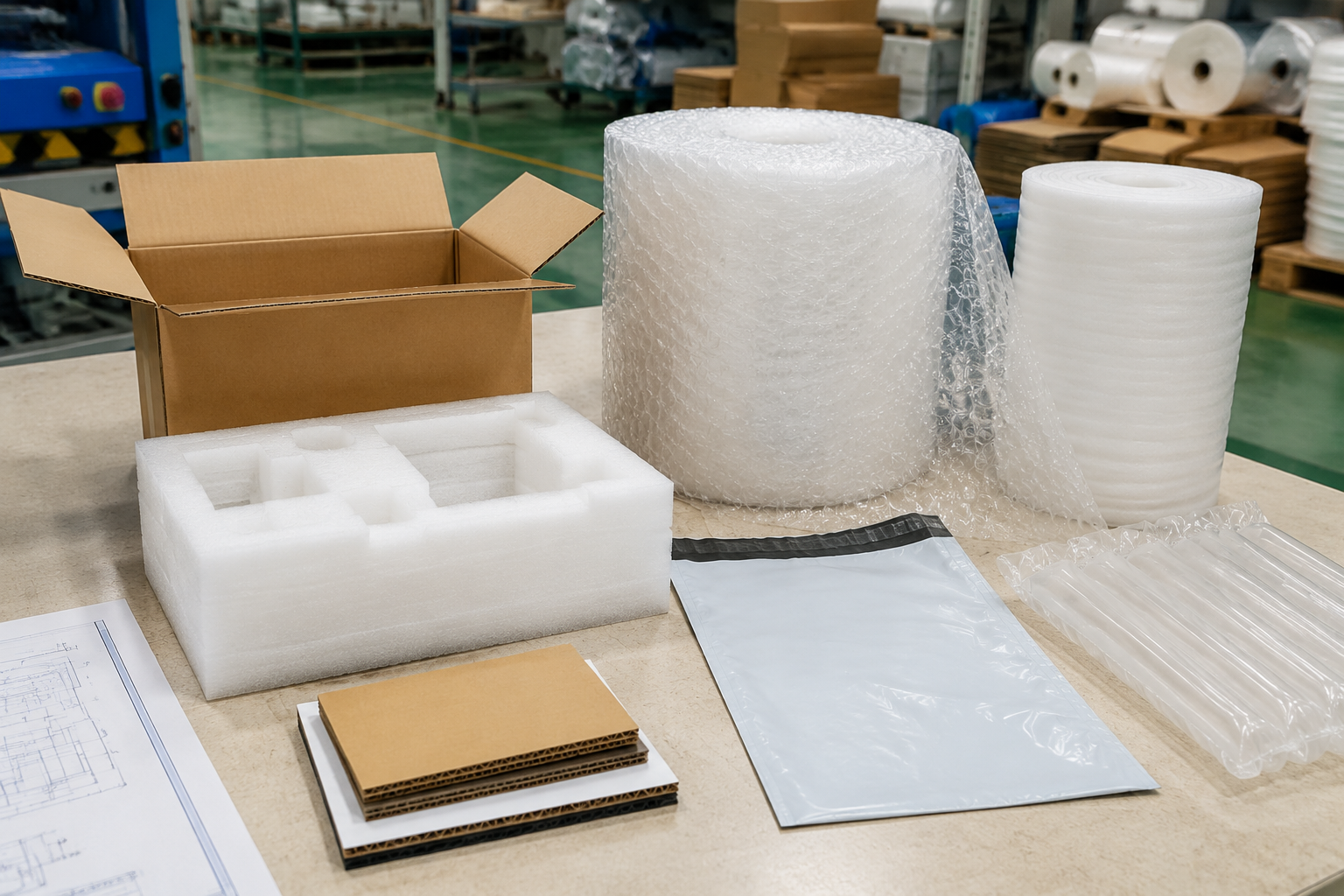
Wholesale Packaging Materials in China: Samples, MOQ, Quotation, and Bulk Order Process
Wholesale packaging materials from China can look simple at the inquiry stage, but the real decision depends on much more than naming a material...
Read cornerstone guide
Packaging Manufacturer vs Trading Company in China: What Overseas Buyers Should Check
When you are sourcing packaging from China, the main decision is not just who gives the quote. It is whether the supplier can handle...
Read cornerstone guide
China Packaging Materials Supplier Guide: How to Choose the Right Factory for Custom Packaging
Choosing a China packaging materials supplier is not only about finding a factory that can quote foam, bubble wrap, cartons, film, or plastic bags....
Read cornerstone guide