
Building a long-term relationship with a packaging supplier in China is less about finding one good quote and more about proving repeatable performance across orders. For repeat buyers, the real question behind factory direct packaging is whether the supplier can keep packaging consistent when product sizes change, export timing tightens, or the buyer needs stronger protection, tighter carton control, or a different packing method.
This article helps buyers turn supplier management into a measurable system. It focuses on the practical signals that matter most: forecast sharing, written specifications, defect feedback, delivery performance, price review, corrective action, and development support. The goal is to help you decide whether a supplier should be retained, developed, or replaced based on evidence instead of promises.
Quick Packaging Decision Guide
| Buyer Question | Practical Reading | What to Check |
|---|---|---|
| Can I trust a supplier after one smooth order? | Not yet. One order shows capability, but repeat orders show whether the supplier is stable. | Defect trend, delivery record, sample consistency, and response to changes. |
| What matters more than the unit price? | Total operating cost matters more than a low quote if defects or delays increase later work. | Rework, inspection time, packing speed, shipment risk, and price stability. |
| How do I know if the specifications are clear enough? | The buyer and supplier should be able to repeat the same result from the same written standard. | Approved sample, drawing, tolerance, packing method, carton marks, and revision history. |
| When is a defect serious enough to escalate? | A defect is serious when it affects fit, protection, export handling, or customer-facing appearance. | Batch scope, severity, business impact, and whether the issue repeats. |
| What makes a supplier useful for development work? | A strong supplier asks the right questions and can turn new requirements into workable samples. | Product size, weight, fragility, shipping route, carton space, and revision control. |
| When should I consider replacing a supplier? | When repeated issues continue after clear feedback and the risk keeps rising. | Repeat defects, missed corrective actions, inconsistent documents, and late deliveries. |
Quick Answers Before You Read
What should I send before asking for a quote?
Send product dimensions, weight, fragility, surface protection needs, packing method, carton requirements, quantity, and shipping route. The better the input, the easier it is for the supplier to quote the right structure.
How should I compare two packaging suppliers in China?
Compare the same specifications, material scope, packing method, quality record, delivery reliability, service response, and development support. A fair comparison only works when the scope is identical.
Is the lowest material price usually the best option?
No. A lower unit price can cost more if it creates defects, repacking, extra inspection, or delivery problems. The better choice is often the supplier with the lower total operating risk.
Do approved samples still matter on repeat orders?
Yes. Approved samples and written specifications help keep the same fit, protection level, printing result, and packing method from one order to the next.
Why long-term supplier management matters more than one-time purchasing
A repeat buyer should not manage a packaging supplier in China the same way they manage a trial order. A trial order answers a narrow question: can this supplier produce and ship this item once under the agreed terms? Long-term supplier management asks a wider question: can this supplier keep quality, delivery, cost, and communication stable across repeat orders, seasonal demand changes, packaging updates, and export schedules?
This difference matters because packaging problems often appear over time. A bubble wrap roll may look acceptable on the first shipment, but later orders may show changes in roll length, film thickness, perforation quality, or packing quantity. An EPE foam insert may pass the first sample, then drift in cutting accuracy when the order moves to bulk production. A corrugated carton may be quoted well, but if board strength, printing color, carton marks, or packing method are not controlled, the buyer may face rework, warehouse delays, or product damage later.
A good quote is not the same as a good supplier. The lowest unit price may help one purchase order, but it does not prove that the supplier can support consistent quality, on-time delivery, pricing stability, or practical problem solving. A reliable supplier should be judged by performance records, not by a friendly message, a fast quotation, or one smooth shipment. For buyers who reorder packaging materials every month or every season, the real value comes from predictable outcomes.
Long-term supplier management also gives buyers a stronger basis for annual negotiation. Instead of arguing only about price, the buyer can review defect history, delivery performance, quotation accuracy, response time, and improvement actions. This makes the discussion more factual. It also helps both sides decide whether the supplier should be retained as a stable partner, developed with clear corrective targets, or replaced because the risk is too high.
One order can look good even when the supplier is weak
A single successful order can hide weak supplier systems. The supplier may have had open capacity that week, enough material on hand, or extra attention from the sales team because the buyer was new. That does not prove that the same supplier can perform well during a peak season, after a material price change, or when the buyer adds new sizes, printed cartons, custom foam inserts, or mixed container loading.
For example, a first order of courier bags may arrive on time with acceptable sealing and printing. The next order may include more sizes, tighter delivery timing, and updated carton marks. If the supplier does not control artwork confirmation, production scheduling, packing quantity, and inspection records, the buyer may see wrong labels, uneven sealing, or shipment delays. The problem was not visible in the first order because the first order was simple.
This is why repeat buyers should avoid judging a long-term supplier only by isolated experience. One good shipment deserves credit, but it should not remove the need for measurement. One bad shipment also needs investigation before the buyer makes a final decision. The useful question is whether the result reflects a one-time exception or a repeatable pattern.
Long-term value comes from trend stability
The strongest supplier relationships are built on trend stability. Buyers should track whether the supplier maintains the same specification standard, keeps delivery promises, responds clearly to order changes, and handles issues with discipline. The trend across several orders is more valuable than a single pass or fail result because packaging supply depends on repeated coordination between sales, production, inspection, packing, and shipment preparation.
Stable supply does not mean that every order is perfect. Packaging materials can be affected by raw material availability, production queues, artwork changes, destination requirements, and buyer-side forecast changes. What matters is whether the supplier communicates early, explains constraints clearly, corrects problems, and prevents the same issue from returning. A supplier that reports a risk early and proposes a workable adjustment may be more valuable than one that stays silent until the delivery date is already missed.
For a repeat buyer, long-term value usually appears in practical details: fewer specification disputes, fewer urgent corrections, faster repeat quotations, more accurate samples, cleaner carton labeling, smoother export preparation, and more useful development support. These details may not appear on the first quotation sheet, but they affect the buyer’s total operating cost. A packaging supplier becomes a long-term supplier only when their performance can be trusted across normal orders, urgent orders, and product updates.
What to measure in a supplier scorecard
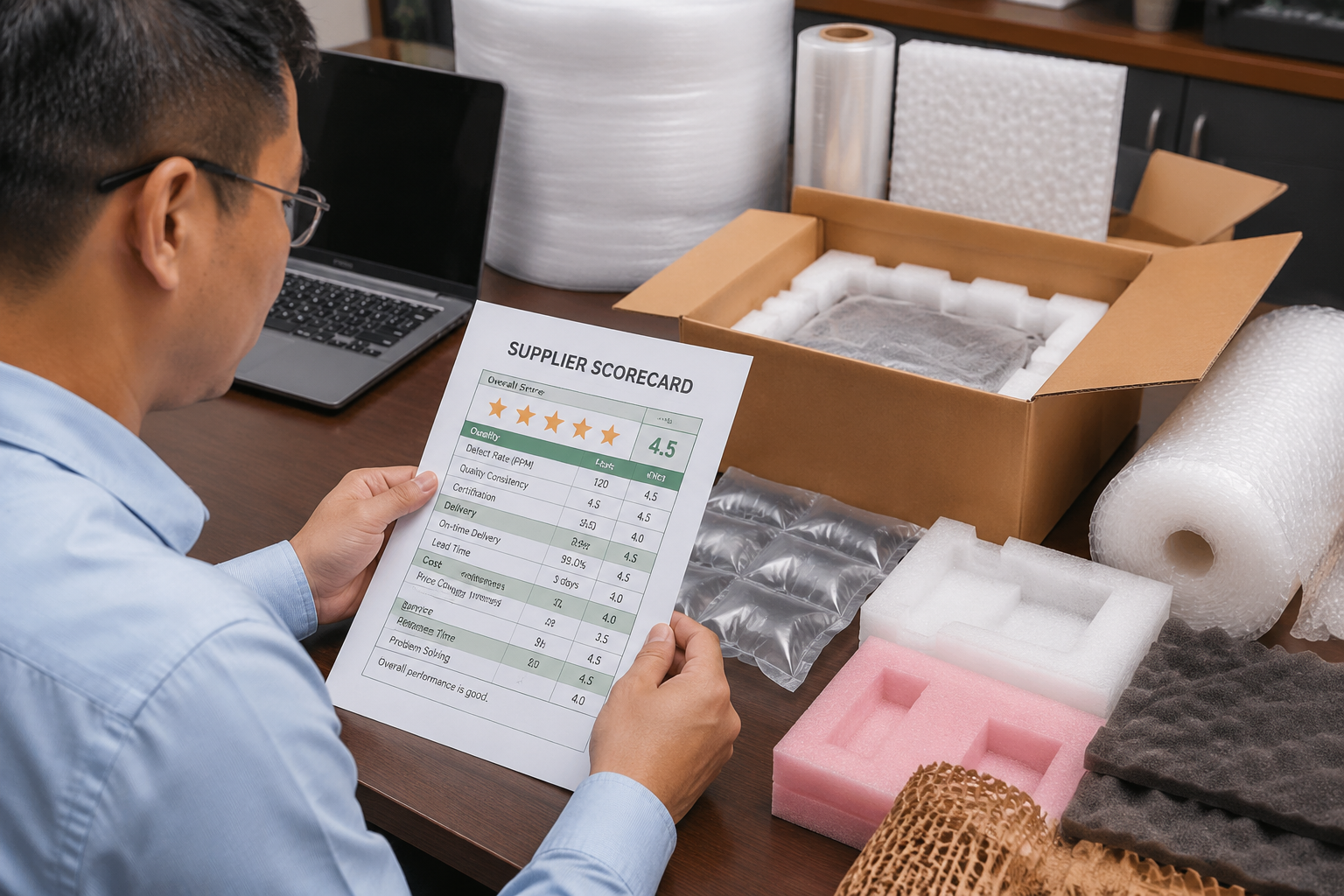
A supplier scorecard turns packaging supplier evaluation into a working management tool. It gives the buyer a way to compare supplier performance across quality, delivery, cost, service, and improvement capacity. Without a scorecard, supplier decisions often depend on memory: one recent complaint, one late shipment, or one attractive quotation. With a scorecard, the buyer can see whether the supplier is improving, declining, or staying stable.
The scorecard does not need to be complicated, but it must be practical. Each category should reflect a real business risk. For a buyer sourcing corrugated boxes for e-commerce fulfillment, delivery reliability and carton consistency may carry more weight than rapid sample development. For a buyer ordering custom EPE foam inserts for fragile products, cutting accuracy, sample control, and defect correction may be more important. The right weighting depends on how the packaging affects the buyer’s production line, warehouse flow, customer complaints, and export schedule.
A useful scorecard also separates normal exceptions from repeated weakness. One late shipment caused by an unusual port disruption should not carry the same meaning as repeated late production completion. One small color variation may be manageable if it stays within an agreed tolerance, while repeated printing errors on retail-facing packaging may require immediate review. The point is not to punish the supplier for every issue; it is to identify whether the supplier should be retained, developed, placed under review, or replaced.
Quality should be measured by defects, consistency, and specification match
Quality measurement should start with defects that affect packaging performance, packing efficiency, or customer presentation. For protective packaging, this may include wrong size, uneven thickness, weak sealing, poor cutting accuracy, loose bonding, crushed cartons, unclear printing, incorrect labels, or inconsistent roll length. A vague statement such as “quality was not good” is not enough. The buyer should record what failed, how often it happened, and whether it affected use.
Defect rate is useful, but it should not be the only quality measure. A small number of defects can still be serious if they affect export cartons, retail packaging appearance, or protection for fragile goods. For example, a low defect count on EPE foam inserts may still matter if the wrong slot size prevents the product from fitting. A minor surface mark on an inner liner bag may be less serious than a weak seal on a courier bag used for direct shipping.
Specification match is the bridge between quality and order control. The supplier should be measured against the approved sample, drawing, material grade, thickness or density, tolerance, printing file, packing quantity, and carton requirements. If the standard is not clear, both sides may argue about whether the product is defective or merely different from expectation. Quality scores become much more useful when the buyer can point to a written requirement.
Delivery should be measured by reliability, lead-time discipline, and shipment readiness
Delivery performance is more than the final shipping date. Buyers should measure whether the supplier confirms the schedule clearly, starts production according to plan, finishes packing on time, prepares carton marks correctly, and communicates shipment readiness before the goods are needed. A supplier may claim that production was completed, but if packing lists, labels, pallet preparation, or export documents are not ready, the buyer can still face a delay.
Missed delivery affects more than the purchasing department. If packaging materials arrive late, the buyer’s production line may wait for inner bags, foam pads, bubble wrap sheets, or printed cartons. An e-commerce seller may miss a fulfillment window. A distributor may need to split shipments or use temporary packing materials that increase labor and damage risk. For this reason, on-time delivery should be reviewed by order, by product type, and by season.
Lead-time discipline also includes how the supplier handles changes. If the buyer changes quantity, artwork, carton size, or packing method late, the schedule may need adjustment. A strong supplier explains the effect early. A weak supplier accepts every change without checking production reality, then misses the delivery date. In a long-term relationship, both sides should treat schedule promises as operating commitments, not casual estimates.
Cost should be measured beyond unit price
Unit price is easy to compare, but it does not show the full cost of packaging supply. A lower price can become expensive if the material causes product damage, slows packing speed, increases carton space, requires rework, or creates repeated inspection problems. For repeat buyers, cost review should include price stability, specification accuracy, packing efficiency, and the hidden cost of defects.
For example, a thinner bubble wrap may reduce the material price, but it may require more layers to protect the product. A lower-cost corrugated box may save money per piece, but if it compresses during stacking or export handling, the buyer may pay more through claims, repacking, or customer complaints. A cheaper plastic bag may look acceptable in a quote comparison, but weak sealing can slow warehouse packing and increase replacement work.
Cost should also be reviewed over time. If a supplier frequently changes pricing without clear reasons, the buyer cannot plan purchasing budgets well. If price adjustments are tied to material changes, order volume, new printing requirements, or packaging structure changes, the discussion is easier to manage. A fair cost score should recognize both price competitiveness and the supplier’s ability to keep commercial terms understandable.
Service and improvement potential should be scored separately
Service quality should not be mixed into product quality. A supplier may produce acceptable goods but respond slowly, provide unclear quotations, or fail to follow up on open issues. Another supplier may have a few early problems but communicate well, correct details quickly, and improve after feedback. These two situations should not receive the same evaluation.
Response time, quotation accuracy, sample follow-up, document clarity, and issue tracking all affect the buyer’s workload. If the buyer must repeatedly chase for carton dimensions, packing quantity, artwork confirmation, or delivery updates, the relationship becomes costly even when the product price looks attractive. For overseas buyers, clear communication is part of supply reliability because time zones, export documents, and shipping windows leave less room for confusion.
Improvement capacity deserves its own score because long-term cooperation depends on whether the supplier can learn from problems. A packaging supplier that can adjust a foam insert after fit testing, improve bag sealing after defect feedback, revise carton structure after compression issues, or recommend a better packing method for a new product has future value. A supplier that only promises improvement but shows no change in the next order should remain under review.
How to lock down standard specifications before problems start
Many packaging disputes begin before production starts. The buyer says “same as last order,” while the supplier works from an old quotation, a similar sample, or an incomplete message history. For repeat orders, standard specifications must be written, confirmed, and easy to reference. This is how buyers turn packaging requirements into a stable operating standard instead of relying on memory.
A written standard should cover the details that affect function, appearance, packing, and delivery acceptance. For bubble wrap, this may include roll width, roll length, film thickness, bubble size, perforation, core, and carton packing. For EPE foam, it may include sheet size, density or thickness, color, cutting tolerance, bonding detail, and whether the foam is supplied as sheets, bags, pads, or custom inserts. For plastic bags and film, sealing style, thickness, printing, size tolerance, and packing quantity matter. For corrugated boxes, board structure, dimensions, printing color, carton marks, and packing method should be fixed.
Verbal agreement is not enough for repeat purchasing. People change, message threads become hard to search, and small wording differences can create large production differences. A buyer who wants stable supplier performance should keep approved drawings, photos, material references, samples, carton labels, and packing instructions together with the purchase record. The supplier should confirm the same file before production, especially when there is a size change, artwork revision, or material adjustment.
At Daipak, specification confirmation usually starts with the product and packing method, not only the material name. A fragile coated part, a lightweight e-commerce item, and a heavy export component may all use protective packaging, but the acceptable tolerance, cushioning structure, and carton packing standard can be very different.
Use standards as boundaries, not as decoration
When specifications become more technical, buyers should separate internal preference from recognized testing or compliance language. ISO 18602 is a packaging optimization standard that can be used as a reference point when discussing source reduction and fit-for-purpose packaging, but it should not be used as a shortcut to prove that a specific supplier design is automatically safe, strong, or suitable for every shipping route.[1] In practical supplier management, this means a buyer can ask for lighter or simpler packaging, but the final decision still needs to respect product protection, handling conditions, packing speed, and acceptance criteria.
If the packaging will touch food or food-contact surfaces, the buyer should treat material compliance as a separate specification item rather than a general quality promise. U.S. FDA information identifies food packaging and food contact substances as a regulated area, and U.S. federal rules include separate provisions for polymers and for paper and paperboard components used in food-contact contexts.[2] A supplier relationship is stronger when the buyer records the intended use, requested material basis, declaration scope, and any destination-market documents instead of accepting vague claims such as “food grade” without supporting paperwork.
Which details must stay fixed across repeat orders
The most important repeat-order details are the ones that affect fit, protection, packing speed, and customer presentation. Product-facing dimensions should be fixed first. If an EPE foam insert is too tight, it can slow assembly or press against fragile parts. If it is too loose, the product may move inside the carton. If a courier bag is slightly short, warehouse workers may struggle to seal it properly. These are not small differences when thousands of pieces are packed.
Material structure should also stay controlled. Buyers should confirm thickness, density, film structure, corrugated board type, adhesive or sealing style, and any laminated or printed surface. If the supplier changes a material to control cost or simplify production, the buyer should approve the change before bulk production. Even when the appearance looks similar, the packaging performance may change during stacking, vibration, storage, or export handling.
Printing, color, labeling, and carton packing need the same discipline. Retail-facing packaging may require closer color control than inner protective packaging. Export cartons may need fixed carton marks, item codes, quantities, gross weight, net weight, destination marks, or pallet labels. Buyers should also define acceptable variation, such as size tolerance, color range, roll length allowance, or carton quantity difference, where appropriate. If the acceptable variation is not written, both sides may interpret the same shipment differently.
How sample approval becomes the baseline for future orders
An approved sample is not only a pre-production formality. For repeat buyers, it becomes the baseline for future orders. The sample shows the supplier what the buyer accepted in size, material feel, structure, printing, sealing, cutting, and packing style. It also helps the buyer compare later shipments against a real reference instead of relying only on memory or photos.
Sample approval works best when it is connected to a written standard. A sample without a specification can be useful, but it may not explain which details are critical and which details allow normal production variation. The buyer should record the sample date, version, material, drawing number, artwork file, size tolerance, and any special acceptance points. If the sample is revised, the old version should not remain active in the order discussion.
For custom packaging, the approved sample should also reflect the actual packing process. A foam insert may look correct on a table but still slow down packing if workers must force the product into place. A bubble bag may cushion the item but take too long to seal in daily warehouse use. A corrugated box may pass a visual check but waste carton space or make pallet stacking unstable. Sample approval should therefore include fit, handling, packing quantity, carton use, and shipment preparation where relevant.
When the approved sample and written standard are clear, repeat orders become faster and less risky. The buyer can reorder with confidence, the supplier can prepare production with fewer open questions, and both sides have a fair reference if a dispute appears. This does not remove the need for inspection, but it gives inspection a clear basis.
How to review quality with defect feedback and closed-loop correction
Quality review should not start only when a buyer is angry about a shipment. For repeat packaging orders, defect feedback needs to become a controlled process: identify the issue, document it clearly, classify the severity, ask the supplier to find the root cause, agree on corrective action, and verify the result in the next production run. This prevents every problem from becoming a negotiation and helps both sides separate real production weakness from isolated noise.
For packaging materials, a defect may not always mean a product is unusable. A few slightly wrinkled bubble wrap sheets may be acceptable for internal void filling, while the same visual issue may be unacceptable for retail-facing protective bags. A small cutting variation in EPE foam may not matter for loose cushioning, but it may cause assembly problems if the foam insert must fit a product tightly inside a carton. The first task is to connect the defect to the packaging function, not just describe it as “bad quality.”
A useful quality review also protects future orders. If a buyer only reports problems in broad language, the supplier may replace a few units or offer a short-term adjustment without changing the process. If the buyer reports the affected batch, defect count, photos, specification difference, carton number, and impact on packing or shipping, the supplier has enough information to check material preparation, cutting, sealing, printing, bonding, packing, or inspection records. That is where closed-loop improvement begins.
What defect records should include
Defect records should be specific enough for the supplier to investigate without guessing. “Some bags are wrong” is not useful. “The self-adhesive foam pouches from batch A have weak sealing on 7 out of 300 inspected pieces, mainly on the right side edge, found in cartons 12 and 15” gives the supplier a real starting point. The stronger the evidence, the faster the discussion can move from blame to correction.
At minimum, defect feedback should include the order number, item name, approved specification, production batch or shipment reference, affected quantity, inspection quantity, defect photos or short videos, carton or pallet location if available, and a description of how the defect affects use. For printed cartons or bags, include photos under normal lighting and close-up images of color, registration, logo position, or text errors. For foam and bubble products, include measurements of thickness, size, density if specified, sealing quality, and any crushing, tearing, delamination, or surface contamination.
The buyer should also state the business impact. Is the issue cosmetic, does it slow packing, does it create product damage risk, or does it stop the packaging from being used at all? This matters because the corrective action for a low-risk visual issue may be different from the action for a functional failure such as weak courier bag sealing, incorrect carton size, or foam inserts that no longer hold the product securely.
- Identification: order number, product code, item name, batch reference, and shipment date.
- Evidence: clear photos, videos if needed, measurement records, carton numbers, and affected quantity.
- Specification gap: the confirmed standard compared with the actual received product.
- Severity: whether the defect affects appearance, packing speed, product protection, storage, or shipment safety.
- Requested action: sorting, rework, replacement, process correction, or prevention on the next order.
Good records also reduce repeated arguments. If the same defect appears across several orders, the complaint history becomes evidence of a defect trend. If the issue appears once and does not repeat after correction, the supplier and buyer can treat it as a controlled exception rather than a reason to reset the relationship.

How to decide whether a defect is isolated or systemic
Not every defect should trigger the same reaction. Packaging production often involves material rolls, cutting, sealing, printing, folding, bonding, packing, and manual handling. A single damaged carton or a few scratched outer boxes may come from transport handling. A repeated size variation across multiple cartons may point to cutting control. Weak seals across many plastic bags may suggest machine setting, material compatibility, or inspection weakness. The buyer’s job is to judge the pattern before deciding how serious the problem is.
A practical way to separate isolated defects from systemic issues is to look at distribution. If defects are found in one carton, one pallet, one shift, or one batch, the problem may be limited. If the same defect appears across different cartons, different pallets, or different production dates, it is more likely to be systemic. The supplier should then review the production process, not only the finished goods. For example, repeated bubble wrap roll width variation may require checking slitting settings; recurring EPE foam insert fit problems may require checking cutting tools or drawings; repeated printed carton color drift may require tighter color reference control before bulk printing.
Severity also matters. A low-frequency defect can still be serious if it affects product protection or customer delivery. One incorrect warning mark on an export carton may create more operational trouble than several small cosmetic marks on inner void-fill material. A courier bag with weak adhesive may expose the buyer to parcel loss or customer complaints. A foam pad that is too thin may increase vibration risk during transport. The review should consider both frequency and impact.
From the factory side, Mr. Wang usually checks whether the issue can be traced to a repeatable production step, such as cutting, sealing, lamination, bonding, or packing. That kind of traceability helps the buyer decide whether the supplier needs a process correction, a stronger inspection step, or simply better handling control for one shipment.
The strongest warning sign is a repeat issue with weak follow-through. If the same defect appears after the supplier has already promised correction, the problem is no longer only technical. It may show that the corrective action was not understood, not implemented, or not verified before shipment. In supplier management, that is more serious than a single defective batch.
When test methods should enter the quality discussion
Most supplier reviews do not need laboratory-style testing for every order, but repeat damage, carton collapse, or transport-related complaints may justify a more formal test plan. ASTM D4169 is a standard practice for performance testing of shipping containers and systems, while ISTA Procedure 3A is commonly referenced for packaged products moving through parcel delivery systems.[3] These references can help buyers and suppliers choose a more disciplined validation route, but they should be tied to the buyer’s actual distribution channel instead of being used as a generic marketing claim.
If the problem is carton crushing or stacking weakness, compression testing language may be more relevant than a broad statement such as “stronger carton.” ASTM D642 covers compressive resistance testing for shipping containers, and ASTM D4728 addresses random vibration testing for shipping containers.[4] A buyer does not need to overcomplicate every purchase order, but when repeated failure appears during warehousing, stacking, trucking, air shipment, or parcel delivery, the supplier should help connect the defect record to a suitable test method, acceptance target, or structural revision.
Why corrective action must be verified on the next order
A corrective action is not complete when the supplier sends an explanation. It becomes useful only when the next order shows that the problem has been controlled. Buyers should ask for a practical action plan, but they should also define how the fix will be checked. This can include pre-production confirmation, first-piece checking, in-process inspection, finished product sampling, updated packing instructions, or clearer carton labeling to prevent mix-ups.
For example, if a previous shipment of EPE foam bags had inconsistent sealing, the next order should not only include a promise of stronger sealing. The supplier should confirm the sealing setting, check samples during production, and inspect finished bags before packing. If corrugated boxes arrived with incorrect printed marks, the next order should include artwork confirmation, print sample review, and carton mark checking before mass production. If bubble wrap sheets were cut short, the next order should include size checks at the start and during production, not only after all pieces are packed.
Buyers should record whether the next shipment confirms the fix. If the defect rate drops, the supplier earns more confidence. If the issue repeats, the supplier should remain under review and the buyer should consider stronger controls, reduced order exposure, or alternative supply preparation. The point is not to punish every mistake. The point is to make sure the relationship improves through evidence.
A mature quality review creates a closed-loop record: defect found, evidence shared, root cause reviewed, corrective action agreed, next order checked, result recorded. Over time, this record helps annual supplier review. It shows whether the packaging supplier learns from problems or simply responds to complaints order by order.
How to manage delivery performance and forecast sharing
Stable delivery usually depends on coordination before the order is urgent. A supplier may have good production ability, but if the buyer sends demand late, changes quantities after materials are prepared, or confirms artwork near the shipping deadline, delivery performance will become unstable. Forecast sharing gives both sides a working view of demand so material procurement, line scheduling, packing labor, and shipment readiness can be planned with fewer surprises.
For repeat packaging orders, supply planning should be reviewed as a shared process. The buyer controls demand visibility, approval speed, and order release timing. The supplier controls material preparation, production scheduling, inspection, packing, and export readiness. If either side treats every order as a rush order, the relationship will depend on emergency response instead of reliable operating rhythm.
Forecast accuracy does not need to be perfect to be useful. Even a monthly or quarterly demand range can help a packaging supplier prepare for likely material needs, especially when the buyer uses custom sizes, printed cartons, color film, special foam structures, or packaging that requires tooling, cutting setup, or printing confirmation. The goal is not to lock every quantity too early. The goal is to reduce avoidable last-minute pressure.
What forecast sharing should include
A useful forecast should show more than total quantity. Packaging demand often changes by product mix, season, sales channel, and shipping destination. A buyer may order the same annual quantity of corrugated boxes, but if most demand lands in two months, the supplier needs a different production plan. A buyer may use several similar foam inserts, but if one size becomes dominant, material cutting and packing plans may need adjustment.
Forecast sharing should include expected order timing, demand range, product mix, likely peak periods, packaging changes under discussion, destination or shipment mode if relevant, and any planned promotion or new product launch that may affect volume. For export orders, carton marks, pallet needs, packing quantity per carton, and shipment booking windows should be discussed early because they can affect preparation time even when the packaging itself is simple.
The most practical forecast is updated regularly. A quarterly view helps the supplier see general capacity needs. A monthly forecast update helps adjust materials and production sequence. A confirmed purchase order then locks the actual quantity, specification, and delivery requirement. This layered approach is more realistic than asking buyers to predict every detail far in advance.
For repeat orders, buyers can use a simple communication rhythm:
- Quarterly forecast: expected demand range, major product mix, seasonal peaks, and new packaging projects.
- Monthly update: likely order quantities, timing changes, urgent items, and specification adjustments.
- Order confirmation: final size, material, printing, packing method, labels, carton marks, and requested delivery date.
- Pre-shipment check: finished quantity, packing status, carton condition, documents, and shipment readiness.
This does not remove all risk, but it gives both sides enough visibility to make better priority decisions. A supplier can plan materials earlier, and the buyer can see where late approval or sudden changes may affect delivery.
How to interpret late delivery trends
One late shipment does not always prove poor supplier performance. Material shortages, weather disruption, transport congestion, customs timing, artwork changes, or delayed buyer confirmation can all affect a shipment. What matters in supplier management is the delivery trend. If delays repeat for the same reason, the supplier and buyer need to treat the issue as a planning weakness, not an excuse.
Late delivery should be reviewed by cause. Was the supplier late in starting production? Were materials not purchased early enough? Did the buyer change specifications after production planning? Was the shipment packed but not ready for booking because labels, carton marks, or documents were incomplete? Did the issue happen during production, packing, warehouse handover, or freight coordination? Each cause leads to a different correction.
A buyer should also distinguish between production readiness and shipping date. A supplier may say the goods were finished, but if cartons are not packed correctly, labels are missing, pallets are not prepared, or the final quantity is not confirmed, the order is not truly shipment-ready. Delivery performance should measure whether goods are ready in the agreed condition, not only whether production has technically ended.
If the delivery trend shows repeated last-minute shipment pressure, both sides should review the booking window. The buyer may need to release orders earlier or avoid late artwork changes. The supplier may need to improve capacity planning, material reserve communication, or internal production follow-up. A reliable supplier relationship depends on identifying where the delay starts, not only who apologizes at the end.
Why schedule discipline is part of relationship quality
Schedule discipline is a sign of relationship maturity. A buyer who shares forecasts but frequently changes quantities at the last moment creates avoidable risk, especially when supplier verification in China must also cover raw material control, factory inspection, and certificate tagging before production approval. A supplier who accepts every urgent request without warning about capacity or material limits may look cooperative in the short term, but the result can be missed dates, rushed inspection, packing mistakes, or inconsistent quality. Honest schedule communication is better than overpromising.
For packaging orders, schedule changes can affect more than production time. Custom printed boxes may require artwork confirmation and printing setup. EPE foam inserts may require cutting preparation and sample approval. Plastic bags may need sealing and packing checks. Bubble wrap or air cushion packaging may need roll width, perforation, bag size, or carton packing confirmation. If these details change late, the production schedule may no longer be realistic.
Delivery performance should therefore be reviewed in both directions. The buyer should check whether internal approvals, purchase order release, payment arrangements where applicable, design confirmation, and shipment instructions were sent on time. The supplier should check whether materials, production slots, inspection, packing, and shipment preparation were controlled as agreed. This creates a fairer review and makes improvement easier.
A long-term supplier should not only react quickly; they should help the buyer see schedule risk early. If the supplier warns that a requested date is tight because of material procurement, printing confirmation, or packing workload, that warning is useful management information. It allows the buyer to adjust priority, split shipments, confirm substitutes, or release orders earlier next time.
How to review pricing without destroying the relationship
A price review should be factual, not emotional. Repeat buyers naturally want better value as order history grows, but asking for a lower unit price without comparing specifications, material changes, packing methods, service scope, and delivery performance can damage a good supplier relationship. Pricing stability matters because packaging affects daily operations. A small saving on unit price can disappear quickly if it causes defects, rework, slower packing, larger cartons, or unstable delivery.
The better approach is to connect price review with annual negotiation and supplier performance data. If the supplier has stable quality, low repeat defects, reliable delivery, and useful development support, that record should be part of the discussion. If prices have increased, the supplier should explain whether the change comes from material fluctuation, labor or process change, lower order volume, revised specifications, or a different packaging structure. Both sides should work from records rather than pressure.
For packaging materials, the same product name does not always mean the same cost. A bubble bag with different film thickness, a foam sheet with different density, a corrugated box with a different flute or paper grade, or a courier bag with stronger adhesive may look similar in a quote comparison but perform differently in use. Buyers should compare like with like before deciding that one supplier is more expensive.
What a fair price review should compare
A fair price review starts with the same specification. The buyer should compare the same dimensions, thickness, density, film grade, paper grade, printing requirement, sealing method, packing quantity, carton size, label requirement, and delivery term. If one quote includes inner packing, carton marks, pallet preparation, or sample revisions while another quote does not, the unit price alone is not a fair comparison.
The buyer should also review order volume and ordering pattern. A stable monthly order may support better planning than irregular urgent orders, even if the annual quantity is similar. Larger production runs may reduce setup pressure, while frequent small batches may increase handling, packing, and coordination cost. If a buyer wants better pricing, forecast sharing and schedule discipline can support the discussion more effectively than simply asking for a discount.
A practical price review should compare several factors together:
- Specification match: same material, size, thickness, structure, printing, and tolerance.
- Packing method: same carton quantity, inner packing, labels, pallet preparation, and loading requirements.
- Quality record: defect rate, rework history, repeat issues, and corrective action results.
- Delivery record: on-time performance, shipment readiness, and response to forecast changes.
- Service scope: sampling, drawings, revision support, order follow-up, documentation, and after-sales handling.
Cost breakdown can be useful when handled calmly. Buyers do not need to demand every internal production detail, but they can ask the supplier to separate major cost drivers such as material, printing, structure complexity, packing, and special handling. This helps both sides find practical savings. Sometimes the best reduction does not come from cutting material quality; it comes from changing carton packing quantity, reducing unnecessary printing, standardizing sizes, or improving order consolidation.
When a higher price may still be the better choice
A higher price may be the better choice when the supplier lowers total cost. If one packaging supplier has a lower defect rate, fewer urgent corrections, better size consistency, and more dependable delivery, the buyer may save money through smoother packing and fewer customer complaints. For an e-commerce seller, weak courier bags or poor carton strength can create returns and replacement costs. For a manufacturer, foam inserts that do not fit correctly can slow the packing line. For an exporter, unclear carton marks or poor pallet preparation can create shipment trouble. These costs may not appear in the unit price.
Stable suppliers also reduce management burden. A buyer who must inspect every shipment heavily, chase every delivery date, or repeat the same specification discussion each order is paying hidden coordination cost. A supplier who understands the approved sample, keeps records, responds clearly, and corrects issues before they repeat can justify a fair price even if another quote looks slightly lower.
This does not mean buyers should accept any price increase. Pricing stability still matters, and suppliers should explain changes clearly. If material cost falls, volume increases, or the buyer standardizes orders in a way that reduces production pressure, the buyer has a reasonable basis to ask for adjustment. The strongest annual negotiation combines both sides of the record: where the supplier delivered value, where cost should improve, and what changes can support a better price next year.
The supplier relationship should not be protected at any cost, but it should not be broken for a short-term saving that creates higher operating risk. A mature price review asks one central question: does this supplier provide value for money across quality, delivery, service, development support, and total cost? If the answer is yes, the negotiation should focus on fair improvement. If the answer is no, price alone will not fix the relationship.
How to judge whether a supplier can support new development
A long-term packaging supplier should do more than repeat the same item number every month. As products change, sales channels shift, and shipping conditions become more demanding, buyers often need new packaging development: a different foam insert, a stronger corrugated structure, a smaller carton, a revised bubble bag, or a cleaner packing method for the warehouse team. The question is not whether the supplier says yes. The better question is whether the supplier can turn a new requirement into a usable trial sample, explain the trade-offs, and improve the next version without losing control of cost or production consistency.
Development support should be judged as an operating ability. A custom packaging supplier may be helpful if it asks for product size, weight, photos, fragile points, surface finish, carton space, packing speed, shipping route, and target order quantity before recommending a structure. A supplier that jumps straight to “we can make it” without checking these details may move quickly at first, but the sample can miss the actual packing risk. For repeat buyers, that creates extra rounds of revision, delayed launches, and unclear responsibility when the first bulk order does not match expectations.
Good development work also includes honest limits. Not every structure change is worth making. A thinner material may reduce unit cost but increase compression risk. A more complex EPE foam insert may protect better but slow packing and take more carton space. A printed corrugated box may improve presentation but needs tighter control of color, layout, and carton marks. Useful suppliers explain these choices early, so the buyer can decide whether the next version should optimize for protection, packing labor, freight space, appearance, or price.
What good development support looks like in practice
Good development support usually starts with clear communication speed, but speed alone is not enough. A supplier should confirm what information is missing, what assumptions are being made, and what sample result the buyer should expect. For example, if a buyer asks, “Can we improve this packaging?” after receiving customer complaints about dented corners, the supplier should not only suggest thicker material. It should review where the product is damaged, how the product sits inside the carton, whether the carton has empty space, and whether edge protection, EPE foam, bubble wrap, air column packaging, or a revised outer box would address the real issue.
A practical supplier will also separate sample iteration from bulk production risk. A hand-cut foam sample or trial carton can show the basic structure, but the buyer still needs to know whether the same detail can be repeated during mass production. From a factory perspective, Mr. Wang would usually pay attention to whether cutting accuracy, sealing position, bonding strength, or folding structure can stay consistent after the design moves from trial sample to batch order. This matters because a sample can look acceptable on a desk but become unstable when hundreds or thousands of pieces are packed under normal production speed.
Buyers should review sample quality with the same discipline used for regular orders. Check whether the sample matches the requested dimensions, whether the material thickness or density feels suitable, whether the product is easy to insert and remove, whether the surface is protected from scratches, and whether the finished pack fits the carton without excessive pressure or wasted space. If the packaging will be used by a warehouse team, the buyer should also test packing speed. A protective design that takes too long to assemble may create hidden labor cost, even if the material price looks reasonable.
Good development support also shows up in the supplier’s attitude toward revision. The first trial sample may not be perfect. What matters is whether the supplier understands the feedback, updates the drawing or specification, and explains what changed in the next version. A useful design revision record might include the old size, new size, material change, reason for change, and any expected effect on price or carton packing. Without that record, both sides can lose track of which version was approved, especially when several products or packaging styles are being developed at the same time.

How to tell whether a supplier is improving or only promising
The difference between real improvement and empty promises is evidence. A supplier that is improving will show better sample accuracy, shorter and clearer revision cycles, fewer repeated misunderstandings, and stronger control when the new design enters production. A supplier that is only promising will keep using general phrases such as “we will improve” while the same sizing error, sealing issue, printing mismatch, or carton packing problem appears again.
Buyers can judge development ability by tracking each project from request to production. Record when the request was sent, what product information was provided, when the supplier replied, when the trial sample was made, how many design revisions were needed, and whether the approved version matched the later bulk shipment. This does not need to be complicated. A simple development log can show whether the supplier learns from each round or keeps restarting the same conversation.
The most reliable sign is performance on the next production run. If a supplier adjusts an EPE foam insert after the first sample, the bulk order should reflect the confirmed shape and fit. If a bubble bag size is revised to improve packing speed, the finished bags should follow the approved opening size, sealing position, and material thickness. If a corrugated box structure is changed to reduce movement during export handling, the finished cartons should match the confirmed board, dimensions, printing, and packing method. Development support has limited value if it does not transfer into repeatable production.
Buyers should also watch how the supplier handles disagreement. A capable supplier may push back when a requested change creates risk. For example, reducing foam thickness may not be suitable for a heavy part with sharp corners, and a smaller carton may increase pressure on a fragile surface. This kind of pushback is useful when it is based on product details and production logic. It helps the buyer avoid a design that looks cheaper in the sample stage but creates higher cost through damage, repacking, or complaints later.
When to retain, develop, or replace a packaging supplier
A supplier decision should come from evidence, not from one good order, one bad shipment, or a friendly relationship. Repeat buyers need a clear way to decide whether to retain, develop, or replace a packaging supplier based on performance trend, risk level, corrective action result, and future value. The goal is not to punish suppliers. The goal is to protect stable supply, reduce avoidable disruption, and keep the buyer’s packaging program moving in the right direction.
A practical decision framework brings together quality, delivery, cost, service, and development support. A supplier with a low defect trend, dependable delivery, fair price review behavior, and useful sample support should usually be kept working with and possibly given more business. A supplier with good fundamentals but one or two fixable weaknesses may deserve a structured development plan. A supplier with repeated failures, weak follow-through, and declining reliability should be prepared for replacement before it puts the buyer’s production or fulfillment schedule at risk.
The decision should also reflect the importance of the packaging item. A standard plastic bag or common void-fill item may be easier to switch than a custom EPE foam insert, printed corrugated carton, or air column structure built around a specific product. If the packaging is critical to product protection, branding, packing speed, or export handling, the buyer should avoid sudden changes unless the current supplier risk is already high. In those cases, a backup supplier or parallel sample approval can reduce transition risk.
Signs a supplier should be retained
A supplier should be retained when its performance is stable across multiple orders, not only when the latest shipment looks acceptable. Strong signs include low repeat defects, consistent specification match, dependable lead-time discipline, accurate quotation details, and responsive handling of order changes. The supplier does not need to be perfect. It does need to show predictable control and a willingness to correct issues before they become recurring problems.
Retained suppliers usually make repeat ordering easier. They understand the approved sample, the packing method, carton quantity, label requirements, and delivery expectations. They know which items need closer checking, which cartons require specific marks, and which custom packaging details cannot be changed without buyer approval. This reduces transaction cost for the buyer because every reorder does not have to start from zero.
A retained supplier may also earn a stronger role when it contributes to improvement. If the supplier helps reduce carton space, improve cushioning, simplify packing, or adjust material use without increasing risk, that value should be considered during annual review. A slightly higher unit price may still be reasonable if the supplier reduces rework, avoids shipment disruption, and supports new packaging development with reliable follow-through.
Signs a supplier should be developed
A supplier should be developed when the basic relationship is useful but the performance is not yet stable enough. This may include a supplier with acceptable product quality but weak delivery discipline, good pricing but slow response to defect feedback, or strong sample support but inconsistent documentation. These are not automatic reasons to move on. They are reasons to watch closely and set a clear improvement plan.
Development should be specific. The buyer should define the issue, the expected change, the review period, and the evidence needed to confirm improvement. For example, if late delivery is the main weakness, the improvement plan may require earlier forecast updates, confirmed production windows, and shipment readiness checks before the cargo date. If the issue is quality variation, the plan may require tighter specification confirmation, better in-process checks, and defect records by batch.
A supplier in the development category should not receive unlimited patience. If corrective action works and the next orders show better results, the supplier can move back into the retained group. If the same issue repeats after several clear reviews, the buyer should treat the risk as structural rather than temporary. At that point, continuing without a backup plan becomes a buyer-side risk, not only a supplier-side weakness.
Signs a supplier should be replaced
A supplier should be replaced when repeated failures continue after clear feedback and reasonable corrective action opportunities. Serious warning signs include recurring defects on the same specification, frequent shipment delays without early notice, unexplained material changes, poor sample-to-production consistency, inaccurate quotations, weak documentation, or a pattern of promising fixes that do not appear in the next shipment. These problems damage more than one order; they weaken the buyer’s ability to plan.
Replacement becomes more urgent when the supplier creates hidden risk for the buyer’s customers. For packaging, that risk may appear as product damage, scratched surfaces, crushed cartons, slow warehouse packing, incorrect labels, carton mark errors, or missed delivery windows. If the supplier cannot control these issues, the buyer may pay for the problem through returns, repacking labor, delayed fulfillment, or lost trust with downstream customers.
The buyer should still manage replacement carefully. Before moving on, confirm the current approved specifications, drawings, samples, carton packing requirements, and performance history. A new supplier should not be asked only to match a low price; it should be asked to match or improve the full packaging requirement. For custom packaging, the buyer may need trial samples, fit testing, packing checks, and a controlled first order before fully transferring volume.
The strongest supplier decision is evidence-based and forward-looking. Keep working with suppliers that deliver stable quality, reliable coordination, fair commercial behavior, and useful development support. Develop suppliers that show good fundamentals and fixable weaknesses. Move on from suppliers that repeatedly fail to correct problems or create rising risk. Managed this way, supplier relationships become part of the buyer’s operating system rather than a series of disconnected purchase orders.
Build an evidence file before annual negotiation
The annual review should not be assembled from memory in the week before negotiation. Buyers should keep an evidence file during the year: approved specifications, revision records, defect reports, corrective action results, delivery records, quotation changes, test requests, sample approvals, and development project logs. This file helps the buyer reward the right supplier behavior and also makes difficult conversations fairer because both sides can see the same history.
If the packaging program includes recyclability, compostability, or other environmental claims, those claims should be handled with the same evidence discipline as price and quality. The U.S. FTC Green Guides address environmental marketing claims such as recyclable, degradable, and compostable representations, while How2Recycle provides consumer-facing recyclability labeling guidance for packaging.[5] A supplier should therefore provide claim-specific support when environmental language appears on packaging, sales materials, or customer-facing documents, rather than relying on broad statements such as “eco-friendly.”
A strong evidence file also protects development work. When a supplier recommends a thinner carton, a new film, a different foam density, or a revised packing structure, the buyer can record why the change was made, what was tested, what risk was accepted, and whether the next shipment performed better. Over time, this turns the relationship into a managed improvement system instead of a series of isolated orders.
How to make repeat orders traceable when teams, files, and emails change
Long-term supplier management becomes easier when the buyer can prove what version was approved, what changed, and who confirmed it. Many repeat-order disputes are not about whether the supplier tried, but about whether both sides were working from the same revision. A traceable file should show the approved sample date, drawing number, thickness or density, packing quantity, carton count, label text, and any later changes. Without that chain, even a conscientious supplier can drift away from the buyer’s expectation because old emails, screenshots, and informal notes are easy to misread months later.
A practical file does not need to be heavy. It needs to be complete and searchable. Keep the approved drawing, the supplier’s quotation, the sample photos, the agreed tolerance, and the final order confirmation together. If the buyer changes size, print, or material, record the reason, the date, and who approved it. If the supplier proposes a substitute material, keep the original spec and the proposed replacement side by side. That way, when the next order arrives, the buyer can compare actual output against the active version instead of against memory.
This matters even more when several packaging SKUs look similar. Two cartons may have nearly the same dimensions but different board strength; two foam inserts may differ by a few millimeters but not by appearance; two bag styles may look alike but use different sealing methods. A traceable file prevents those small differences from being hidden under a casual “same as last time” instruction. It also makes supplier review fairer because the buyer can show exactly what was agreed.
Before accepting a repeat order, buyers should compare the new shipment against the approved sample, the latest drawing, and the revision record. A supplier name alone is not enough to prove that the exact same packaging version is being produced.
One useful habit is to assign a simple version code to every major packaging update. The code does not have to be formal, but it should be visible on the drawing, quote, and order note. For example, V1 can mean the initial approved version, V2 can mean a revised wall thickness or carton size, and V3 can mean a changed print file or packing quantity. This makes it much easier to spot whether the next shipment is built from the correct file. It also reduces the temptation to rely on phrases like “previous model” or “same spec” when the product team has already changed the pack-out.
Buyers should also save the supplier’s questions, not only the buyer’s instructions. When a supplier asks for product weight, stacking conditions, humidity exposure, or warehouse handling method, that question is part of the technical record. It shows what the supplier understood and what assumptions were being made. If a problem appears later, the question trail can reveal whether the buyer supplied enough information or whether the supplier skipped a detail that should have been checked. In practice, those question threads often explain why one order went smoothly and the next one did not.
For packaging suppliers in China, traceability is especially helpful when dealing with sub-suppliers. A supplier may outsource printing, corrugating, cutting, or lamination while still acting as the buyer’s main contact. The buyer does not need to manage every sub-step directly, but the buyer should know which finished version was approved and what material or process change is acceptable without re-approval. This protects the relationship from confusion when the main contact remains the same but the underlying production route changes.
A traceable system also makes annual review more credible. If the buyer can show that a supplier repeated the same defect after a written correction, the discussion becomes factual. If the buyer can show that the supplier improved from one version to the next, that improvement can be recognized. Over time, the record becomes a practical memory for the business, not just an archive. That is what turns supplier management from reactive complaint handling into repeatable control.
How to compare quotations on a like-for-like basis
Packaging buyers often ask suppliers for quotes too early, before the scope is clear enough to compare. The result is a pile of numbers that look competitive but do not describe the same product. One quote may assume a simpler packing method, another may include a stronger carton, and a third may exclude labels, pallets, or final inspection. A like-for-like comparison starts by locking the technical scope first and only then comparing price.
The cleanest approach is to build a comparison sheet with one line per packaging item and one column per supplier. The sheet should include size, thickness or density, material grade, printing requirement, packing quantity, carton spec, tolerance, sample status, and delivery expectation. If any supplier is quoting a different assumption, the difference should be marked openly. That is more useful than pretending all quotes are equal. In many cases, the cheapest quote becomes the most expensive once the missing items are added back in.
Buyers should also separate one-time and recurring costs. A new printed carton may need artwork setup, plate cost, or tooling adjustments. A custom foam insert may require sample iteration, die cutting changes, or manual trimming at the start. These costs are not always visible in the unit price. If they are spread across the annual order volume, the real comparison may change significantly. A supplier that looks more expensive per piece may actually be cheaper after setup and handling are considered.
When comparing quotes, ask which assumptions are fixed and which are variable. A supplier may quote based on a specific raw material index, a certain order quantity, a standard carton packing method, or a limited color range. If the buyer later changes any of those assumptions, the price may change too. That is normal. What is not normal is allowing a quote comparison to mix different assumptions without saying so. The buyer should keep a short note beside each quote stating what is included, what is excluded, and what still needs confirmation.
A useful habit is to compare price against business impact. If a box saves a fraction of a cent but causes stacking issues, or if a film saves material cost but slows packing, the cheaper quote may not be the better operational choice. Likewise, if a supplier with a slightly higher price gives cleaner specifications, faster problem solving, and fewer reorder corrections, the total cost may be lower. A fair quotation review should show that the buyer understands both the price and the operating effect of the packaging.
It also helps to compare the supplier’s response quality. A supplier who explains the quote clearly, flags uncertain points, and corrects errors quickly is giving more value than a supplier who throws out a number with no context. In long-term sourcing, the quote is not just a price document. It is a test of how carefully the supplier understood the request. If the scope is ambiguous, the better supplier is often the one who asks the better questions before sending the number.
For buyers who reorder often, it is worth keeping a reference history of previous quotes. That history shows whether a price change came from actual market movement, a specification revision, or an unexplained shift. When the buyer can point to the last three order cycles, the discussion becomes more grounded and less emotional. This makes it easier to negotiate reasonably while protecting the relationship from unnecessary tension.
How to review incoming packaging without overreacting to minor variation
Incoming inspection should check whether the delivered packaging still matches the approved version, not whether every unit is perfectly identical. Packaging materials are often subject to normal production variation, and not every variation matters. The buyer’s job is to separate harmless variation from variation that affects fit, protection, appearance, or handling. That means inspection should be tied to the function of the item and the actual tolerance the buyer approved.
A practical incoming inspection plan starts with sampling from multiple cartons or pallets rather than only the most convenient box. If a defect is hidden in one part of the shipment, a single carton check may miss it. The buyer should inspect size, sealing, print position, color consistency, stacking quality, and any special feature that affects use. If the packaging is for direct customer presentation, appearance becomes more important. If it is purely protective, functional fit and strength matter more than surface polish.
Inspection records should state whether a result is within tolerance, marginal, or out of spec. That language is better than a vague pass/fail note because it helps the supplier understand whether the issue is serious or simply worth watching. For example, a carton that is slightly off in shade may be acceptable if the spec allows it, but a carton that crosses the agreed color boundary or shows repeated mark misplacement should be flagged. A consistent language system keeps the discussion disciplined.
Buyers should also pay attention to mixed lots. If one shipment contains several sub-versions or production dates, the inspection result can look inconsistent even when each batch is acceptable on its own. This is a common source of confusion in repeat sourcing. The receiving team should record lot numbers, carton counts, and any visible code on the pack. When a problem appears later, that detail helps trace the issue back to a specific production run instead of blaming the whole supplier relationship at once.
If a defect is found at receiving, the buyer should describe how it affects the next step in the operation. Does the issue slow warehouse labor, cause packing rework, create a risk of product damage, or only affect appearance? This matters because a supplier may be able to sort or replace a cosmetic issue quickly, but functional failures require more serious review. The more clearly the impact is stated, the more productive the supplier response is likely to be.
Incoming inspection is also a useful feedback loop for the supplier. When a buyer shares clear results, the supplier can learn what escaped and what passed. Over time, that record can lead to better first-piece checking, more targeted process control, and fewer arguments over whether the shipment met the agreed standard. Inspection should not be used only as a gatekeeping exercise. It should be part of the shared learning process that keeps future orders more stable.
To keep the inspection process practical, buyers can use a short internal checklist. Verify quantity, then verify the labeled version, then verify the visible dimensions, then verify the functional test that matters most for that packaging type. This order helps the team focus on the most important risks first. It also keeps the inspection simple enough to be repeated by different staff members without losing the standard.
How to decide whether a change is minor, material, or risky
Not every change announced by a supplier should be treated the same way. Some changes are minor, such as a document formatting update or a slightly different packing arrangement that does not affect use. Some changes are material, such as a different thickness, a different adhesive, or a changed carton dimension that affects fit. Some are risky, such as a material substitution, an unapproved print change, or a process change that could alter strength or consistency. Buyers need a way to sort these changes quickly.
The first question is whether the change affects the packaging function. If it changes protection, fit, stacking, sealing, labeling, or warehouse handling, it is probably material. The second question is whether the change affects appearance. If the packaging is visible to the end customer, color, print placement, finish, and branding details may matter even when the functional effect is small. The third question is whether the change affects repeatability. A one-time substitute may be manageable if it is fully disclosed, but a silent shift in recurring production is a different kind of risk.
Buyers should ask suppliers to describe the change in simple terms: what changed, why it changed, what the expected effect is, and whether the approved sample still applies. That request alone often reveals whether the supplier understands the importance of the change. A careful supplier will answer directly. A weak supplier may say the change is “small” without explaining what that means. In long-term sourcing, the buyer should treat any change that affects function or appearance as requiring at least explicit review, even if not a full re-approval.
It is also useful to maintain a change log. The log should note the date, item, reason, supplier explanation, buyer decision, and any follow-up action. This log is especially valuable when a packaging item has gone through several revisions over a year. It prevents confusion over whether the current order uses the latest approved version or an older configuration that was temporarily accepted in the past. Change logs are simple, but they save a lot of time when issues need to be traced later.
Material changes deserve extra attention because they are often where cost and performance diverge. A supplier may switch to a lower-cost substrate, a different board grade, or a new resin blend to maintain the quote. That may be acceptable if the packaging still meets the need, but the buyer should not assume equivalence based only on appearance. This is why specifications should describe the performance-critical attribute, not just the generic material name. If the attribute changes, the buyer should know before bulk use.
Minor changes can still become major when they repeat. A small shift in sealing position may not matter once, but repeated over many orders it may create manual handling problems. A light print variation may not hurt one shipment, but if the packaging must match other brand assets, the cumulative inconsistency may reduce the professionalism of the supply chain. So the buyer should not only judge the size of the change, but also the frequency and pattern. Frequent small changes can be as disruptive as one large one.
How to manage pilot runs and first bulk orders
A pilot run is the bridge between a good sample and a stable repeat order. It is the buyer’s opportunity to see whether the approved design works at production speed, in production quantity, with real packing labor and real warehouse handling. A sample can prove the design idea, but a pilot run proves the operating behavior. For custom packaging, that distinction matters because the first bulk order often reveals issues that a desk sample cannot show.
Before the pilot run, the buyer should confirm what will be checked. Is the key question structural strength, fit, appearance, packing speed, or shipment stability? Different goals require different checks. A foam insert that looks perfect on a table may still be slow to use on the line. A printed carton may look sharp but collapse differently during stacking. A bag may seal properly at sample scale but become inconsistent when packed in volume. The pilot run should focus on the real business risk, not only on visual appeal.
During the pilot, the buyer should ask the supplier to capture first-piece approval, in-process checks, and final packing confirmation. This does not mean demanding an exhaustive report. It means recording enough information so that the team knows whether the order was stable from start to finish. If a problem appears in the middle of the run, the buyer should know whether it was corrected immediately or whether the entire batch was affected. That distinction matters for future orders.
Buyers should also observe packing labor. If workers struggle to insert the product, close the carton, align the label, or stack the package, the packaging may be technically acceptable but operationally weak. Hidden labor cost is one of the most overlooked issues in supplier management. A good pilot run should therefore include the warehouse or packing team’s practical feedback, not only the purchasing team’s review. The people who handle the packaging every day often notice the real pain points fastest.
If the pilot run passes, the buyer should record what was learned and which details are now locked. If it fails, the buyer should identify whether the issue was in the design, the sample approval, the production control, or the buyer’s own instructions, using a custom packaging factory guide to compare the source of the defect and the next corrective action. That kind of honest review prevents repeated failure and helps both sides improve the next version. A pilot run is valuable precisely because it reveals where the process still needs work.
The first bulk order is also the best time to confirm whether the supplier can scale responsibly. Some suppliers do well on small handmade or semi-manual samples, but lose precision when volume rises. Others can scale production but need help with paperwork or packing control. The buyer does not need a perfect supplier in every sense. The buyer needs a supplier whose strengths match the packaging item’s actual risk. The pilot is where that match becomes visible.
How to build a backup plan without creating unnecessary complexity
A backup supplier plan does not mean splitting every order from day one. It means reducing the risk of being trapped if one supplier suddenly misses a deadline, changes a material, or loses control of quality. For repeat packaging buyers, especially those with tight fulfillment windows, a backup plan is simple insurance against disruption. It is most useful for items that are critical to shipping, branding, or product protection.
The backup plan can begin with a second source that has reviewed the same drawings, samples, or basic requirements. It does not need to be fully active, but it should know the critical dimensions, packaging method, and acceptance standard. That way, if the main supplier slips, the buyer has a starting point rather than a cold call. A backup source also helps the buyer keep pricing honest because it gives the market a reference beyond the current supplier.
For complex items, dual sourcing may be difficult because small differences in foam shape, carton fit, or print detail can create confusion. In those cases, a backup plan may simply mean keeping the technical file ready and periodically checking whether an alternate supplier can still quote and sample the item. The point is not to create overhead for its own sake. The point is to prevent a single point of failure from controlling the buyer’s schedule.
When a buyer starts a backup plan, the original supplier should not necessarily be told in a dramatic way. This is a normal purchasing practice, not a threat. The buyer can frame it as risk management and continuity planning. Many professional suppliers understand that repeat buyers need resilience, especially when the packaging supports export timelines or customer-facing launch dates. If a supplier reacts badly to reasonable continuity planning, that reaction itself is useful information.
Backup planning becomes more important when the packaging item has a long lead time, special material requirement, or high change sensitivity. The more specialized the packaging, the harder it is to switch in a hurry. A buyer can reduce that risk by keeping approved specs current, maintaining supplier contact details, and periodically checking whether the backup source can still make the item without starting from zero. This approach is far simpler than waiting for an emergency and then trying to qualify a supplier under pressure.
Even when a buyer prefers single sourcing, the backup file still has value. It helps during negotiation, seasonal spikes, and unexpected quality issues. A buyer with a credible alternative can discuss correction and pricing from a stronger position while still preserving a stable relationship with the main supplier. In practice, this is often the right balance between efficiency and resilience.
Practical traceability checklist for repeat buyers
Repeat buyers often know the product well but still lose detail over time because people change, files move, and priorities shift. A traceability checklist keeps the supplier relationship anchored in facts. It is less important that the checklist is elaborate; it is more important that it is used consistently. The buyer should be able to look at the checklist and know whether the next order is truly the same as the last one or whether something has changed and needs re-confirmation.
The checklist should begin with the item identity. Record product name, code, version, approved sample date, order number, and the date of the latest change. Next comes the technical standard: dimensions, thickness, density, print file, material grade, packing quantity, carton configuration, and tolerance. Then comes the operational standard: lead time expectation, shipment readiness notes, labeling, palletization if used, and any special handling requirement. This information is enough to separate a real repeat order from a vague reorder request.
Buyers should then add a performance section. This is where quality trend, delivery trend, communication behavior, and problem resolution history are recorded. A supplier that meets the specification but repeatedly misses the schedule is not the same as a supplier that delivers on time and fixes issues quickly. The checklist should let the buyer see both sides of the story. Without performance notes, it is easy to overvalue a recent smooth shipment and forget the broader pattern.
A helpful addition is a decision note. The buyer can mark the current status as retained, developed, under watch, or replacement candidate. The label itself is not the decision; it is the summary of the evidence. This makes supplier management easier to hand over between team members because the status is visible at a glance. It also prevents a new staff member from treating an old supplier as “safe” without reviewing the history.
For teams that manage many packaging items, the checklist can be simple enough to fit on one page per SKU. The goal is not bureaucracy. It is clarity. A one-page traceability record helps the buyer answer practical questions quickly: What exactly was approved? What changed? What failed? What improved? What should be checked on the next order? Those are the questions that keep supplier management useful.
A checklist also creates better discipline during supplier meetings. Instead of asking broad questions like “How is quality?”, the buyer can ask targeted questions based on the record. For example: Did the last corrected defect stay closed? Did the latest delivery arrive within the confirmed window? Did the revised print version match the approved file? Did the latest quote reflect the same packing method? Targeted questions make supplier meetings more efficient and more honest.
Over time, the checklist becomes a management memory that outlives staff turnover. That is one of the biggest benefits of traceability. People leave, but the record remains. If the record is good, the buyer keeps control of the relationship. If the record is weak, the relationship depends too much on personal memory and informal trust. A repeat sourcing program should not depend on memory alone.
How to turn supplier review into a decision, not just a discussion
Many supplier reviews produce lots of information but no decision. That is a wasted opportunity. The point of collecting quality, delivery, pricing, and service data is to decide what happens next. The buyer should leave each review with one of three actions: keep the supplier as is, put the supplier on a development plan, or begin replacement preparation. Without a decision, the review becomes another conversation that consumes time without lowering risk.
A good decision is based on pattern, not on the loudest issue. If quality is stable but delivery is uneven, the action may be to keep the supplier while tightening schedule control. If the supplier has a good relationship and only one technical issue, the action may be to develop the supplier through a targeted correction plan. If repeated defects or missed commitments continue after clear feedback, the action should move toward replacement. This prevents the buyer from overreacting to a single event or underreacting to a recurring one.
The decision should also consider business dependency. If the packaging item is highly customized and difficult to switch, the buyer may need to keep the supplier working while building an exit path. If the packaging is standard and easy to source, the buyer may move faster on replacement. This is not about being lenient or harsh. It is about matching the risk response to the sourcing reality. A one-size-fits-all decision process can create either unnecessary disruption or unnecessary exposure.
To make the decision easier, buyers should write a brief review note after each annual or semiannual evaluation. The note should explain the current status, the key reasons, and the next action. A short written summary prevents the same argument from being reopened six months later. It also helps other internal teams understand why the supplier was kept, challenged, or phased out. Decision notes create continuity across the purchasing function.
Where possible, the buyer should also define the evidence threshold for moving between categories. For example, one late order may not be enough to place a supplier under review, but two or three similar late orders in a row may be. One corrected quality issue may be acceptable, but repeated occurrences after corrective action may not be. When the thresholds are visible, supplier management feels less arbitrary, and suppliers are more likely to understand what they need to improve.
A decision-oriented review also encourages more useful supplier behavior. If suppliers know that performance is tied to a documented outcome, they are more likely to keep records, respond early, and ask clearer questions. That improves the relationship on both sides. The buyer gets better control, and the supplier gets clearer expectations. Supplier review should not be a ritual. It should be a tool that changes behavior.
How to handle environmental and compliance claims carefully
When packaging involves recyclability, compostability, food contact, export transport, or regulated marking, the buyer should treat those topics as separate specification items rather than general marketing language. This is where many sourcing mistakes happen. A supplier may say a package is recyclable, food-safe, or export-ready, but the buyer still needs the material basis, the standard used, and the destination-market expectation. Compliance language should be checked against the actual use case.
For paper-based packaging, the buyer should distinguish between a design that is theoretically recyclable and one that is compatible with the buyer’s actual recovery stream. For plastic packaging, the buyer should separate material choice, label format, and claim language, because a package can be technically recyclable in some systems and still be poorly communicated to end users if the label is unclear. For compostable or organic-recycling claims, the buyer should be even more careful, because claim language can be misleading if it is not tied to the correct facility type or disposal context. In every case, the supplier’s claim should be matched to the use environment.
Food-contact packaging requires a particularly careful record because the intended use changes the compliance discussion. The buyer should specify whether the material touches food directly, indirectly, or not at all, and what kind of contact is expected. That distinction matters because a supplier’s general packaging experience may not be enough for a food-contact application. If the packaging is for food, the buyer should ask for the exact compliance scope and not accept a broad “food grade” statement without supporting detail.
Transport and export packaging also need care when the package is used in regulated goods flows. If a carton, crate, pallet component, or liner is part of a shipment that falls under a specific transport or phytosanitary rule, the buyer should make sure the supplier understands the relevant packaging requirement. A good supplier will ask for the shipment context and not assume the same packaging is suitable for every destination. That is another sign of practical maturity.
Even when the packaging is not regulated, environmental claims still need discipline. The buyer should avoid using vague or absolute language in internal discussions or customer materials if the claim has not been tested or documented. Simple, accurate wording is better than ambitious wording that cannot be defended later. The safest supplier is not the one who says the most; it is the one who can explain the claim in a way that fits the actual packaging system.
Compliance boundaries for supplier claims and buyer records
Supplier management should also control what claims the buyer repeats internally or to customers. A supplier’s statement about material strength, recyclability, compostability, food contact, water resistance, delivery safety, export readiness, or after-sales handling should not be treated as proven just because it appears in a quotation or sales message. The buyer should ask what document, test method, declaration, or destination-market requirement supports the claim, and should keep that evidence with the active specification file.
The same discipline applies to commercial promises. Buyers should avoid recording unsupported guarantees such as fixed delivery outcomes, customs-safe shipping, waterproof performance, lifetime durability, or automatic replacement unless the seller’s written policy and the specific order terms clearly support those promises. A careful supplier relationship does not need exaggerated claims to be useful; it needs realistic expectations, clear acceptance criteria, and a practical path for correction if the shipment does not match the agreed standard.
How to use the scorecard as a live management tool
A scorecard only works if it changes decisions. If the scorecard exists but no one updates it, it becomes a spreadsheet that looks organized while the supplier relationship drifts. A live management tool should be reviewed on a predictable schedule, usually after each order for key items and at least quarterly for the broader supplier relationship. The purpose is to keep the record close to reality, not to create a yearly backlog of forgotten issues.
After each order, the buyer should record the actual result next to the expected result. Did the shipment arrive on time? Did the packaging match the approved sample? Did any defects appear? Was the supplier responsive? Did the price stay within the expected range? This short update takes little time, but over a year it becomes one of the clearest pictures of supplier performance. The scorecard then shows trend, not just memory.
It is also wise to assign ownership of each scorecard. Someone should be responsible for keeping the record current, and that person should know what evidence is required to update it. When responsibility is unclear, scorecards decay quickly. When responsibility is clear, the scorecard becomes a useful tool for purchasing, operations, and quality teams alike. A shared document only helps if someone maintains it.
The scorecard should also reflect the nature of the packaging item. A printed carton used for customer-facing delivery may deserve higher weight on print quality and appearance. A foam insert for fragile hardware may deserve higher weight on fit and protection. A simple void-fill item may deserve higher weight on delivery reliability and price stability. The scorecard should not flatten all packaging into the same criteria. A good management tool respects the actual risk profile of the item.
Finally, the scorecard should support honest conversation. If the supplier has improved, the record should show it. If it has not, the record should also show that. The point is not to build a case against the supplier. The point is to build a reliable picture so the buyer can decide the next step with less emotion and more confidence.
How to avoid confusion when packaging changes are driven by product changes
Packaging often changes because the product itself changes. A new product size, a heavier weight, a revised surface finish, or a different sales channel can all make the old packaging unsuitable. When that happens, the buyer should avoid comparing the new package too aggressively against the old one unless the product conditions are actually the same. The right question is not whether the packaging looks identical to the last version, but whether it still fits the current product and shipment needs.
This distinction matters because some supplier complaints are really product change complaints. If the product grew by a few millimeters, the foam insert may appear to have “shrunk” even though the packaging did not change. If the product weight increased, the carton may seem weaker even though the packaging was designed for the previous load. If the sales team changed the retail look, a print update may be necessary even though the original carton was acceptable. Buyers should make the upstream product change visible in the packaging discussion.
The most effective way to handle this is to link packaging revisions to product revisions. Record the product version, the packaging version, and the date of the change together. That way, the team can later see whether a packaging issue followed a product change or whether the packaging itself was the main cause. This is especially useful when multiple departments are involved and each one assumes the other made the change.
When a product change forces a packaging change, the supplier should be told why the revision matters. Is the new priority better protection, better shelf appearance, lower shipping cost, or faster packing? Each goal can lead to a different packaging choice. A supplier that understands the actual priority is more likely to suggest a useful solution instead of a generic one. That makes development more efficient and more honest.
Buyers should also make sure that product changes do not silently invalidate old approvals. A carton approved for one product version may not work for the next. A foam layout approved for one accessory set may leave gaps when the accessory set changes. If the buyer keeps using the old pack description, the supplier may keep producing the old solution because it appears to match the file. Clear change management prevents this kind of drift.
How to keep supplier communication specific and calm
Clear communication is one of the strongest predictors of a healthy packaging relationship. Many problems become worse not because the supplier cannot produce the item, but because the buyer and supplier use vague language. “Make it stronger,” “fix the quality,” or “same as before” are not enough. Specific language creates better action. Calm language creates better cooperation. The best supplier conversations are direct without being dramatic.
When a problem arises, the buyer should state the issue, the evidence, the impact, and the expected correction. That structure helps the supplier respond precisely. For example, instead of saying the packaging is bad, the buyer can say the carton dimensions are short by 4 mm, the foam fit is loose on one side, or the label position has drifted from the approved location. Each statement gives the supplier a concrete task. Concrete tasks are easier to solve than emotional complaints.
Calm communication also helps preserve long-term value. A supplier is more likely to cooperate when it feels the buyer is describing a technical problem rather than making a personal accusation. That does not mean softening the truth. It means presenting the truth in a form that can be acted upon. A disciplined record, a few photos, and a clear request often achieve more than a heated message thread.
The buyer should also keep responses focused on the business effect. If a problem only affects appearance, say so. If it affects packing speed, say so. If it creates a risk of damage or loss, say so clearly. This helps the supplier understand urgency and allocate the right people to the issue. A supplier can only prioritize correctly when it understands the operational consequence of the defect or delay.
Good communication habits also matter when the supplier is performing well. A quick note of thanks for a stable order, a clear acceptance of a corrected batch, or a factual confirmation that the new version passed review all help build a professional relationship. Supplier management is not only about failure control. It is also about reinforcing the behaviors that support stable supply.
Common failure patterns and what they usually mean
When a packaging supplier starts missing the mark, the pattern of failure is often more useful than the failure itself. A single defect can be random. Repeated patterns usually point to a deeper control issue. Buyers who learn to recognize the pattern can respond faster and avoid overreacting to noise. The goal is not to diagnose the factory from afar, but to understand what type of correction is likely to work.
Repeated size drift usually points to weak dimension control
If a carton, foam insert, film, or bag keeps drifting in size across multiple orders, the issue is often not the material alone. It may come from drawing confusion, tool wear, cutting setup, or a lack of in-process measurement. When the same item repeatedly arrives slightly off size, the buyer should ask how the supplier measures the critical dimension during production, not just after the order is finished.
Size drift becomes more serious when it affects fit. A few millimeters may be harmless for a loose inner wrap, but the same drift can be unacceptable for a tight insert or a retail carton with visible panel alignment. That is why a buyer should always connect the dimension to the function. The supplier can then focus on the right control point instead of defending the generic size number.
Repeated delivery slippage usually points to planning weakness
When the same supplier misses dates for different orders, the root issue is often planning rather than capacity alone. The supplier may be accepting orders too quickly, starting materials too late, or failing to align production and packing schedules. If the buyer sees the same pattern more than once, the supplier should be asked to explain how it plans material purchase, production slotting, and shipment readiness.
Delivery slippage is especially damaging when the supplier gives confident promises and then misses them. That pattern makes it hard for the buyer to plan around the risk. In that case, the buyer may need to reduce order concentration, demand earlier warning, or move the supplier into a more guarded status. The key is not to excuse each delay separately, but to examine whether the same scheduling weakness keeps returning.
Repeated mixed versions usually point to weak revision control
If old and new versions appear in the same shipment, the problem is rarely accidental. It often means the supplier’s revision handling is weak, or the warehouse is not separating versions properly. Mixed versions are dangerous because they make incoming inspection look inconsistent and can create customer confusion later. Buyers should ask whether the supplier has a version lock, a work instruction, or a physical segregation method for old and new files.
A mixed-version shipment does not always mean the supplier is careless in a broad sense. It may mean the communication system is loose, especially when multiple revisions happen quickly. Still, the buyer cannot manage risk with loose revision handling. The supplier should show exactly how it keeps the current version active and prevents older inventory from being mixed into a new order.
Repeated correction without verification usually points to a closed-loop gap
Some suppliers can explain problems well but do not verify the fix. The same issue then returns in a slightly different form. This usually means the corrective action was discussed but not checked at the right stage. A closed-loop gap is one of the most common management failures because everyone feels the problem was addressed when it was only described.
Verification should happen where the problem is likely to occur: at setup, during production, at first-piece inspection, or before packing. If the supplier only checks at the end, the same defect may already be built into the batch. Buyers should therefore ask not only what the correction is, but when it will be verified. Timing is a major part of control.
Repeated “small” issues may point to a bigger culture problem
A supplier that dismisses many little issues as minor may be signaling a culture problem rather than an isolated production problem. Small issues matter when they repeat, especially if they consume buyer time or create inconsistent expectations. Repeated tiny errors can be more damaging than one large but visible mistake because they wear down trust quietly.
The buyer should watch how the supplier frames the issue. Does it take ownership, quantify the impact, and propose a fix, or does it wave away the concern? A supplier that respects the small things is usually easier to work with in the long run. That does not mean every little variation is a failure. It means the supplier should not normalize drift or inconsistency as if it were acceptable by default.
How to move from one supplier to another without breaking supply
Replacing a packaging supplier should be managed as a controlled transition, not a dramatic switch. The buyer needs the new supplier to inherit the correct version, the current approval history, and the practical handling details that matter in the warehouse. If those things are not transferred well, the buyer may solve one supplier problem and create a new one. A clean transition reduces that risk.
The first step is to transfer the technical file, not just the item name. The new supplier should receive the current drawing, approved sample reference, tolerance range, packing requirement, and revision history. If the buyer has already identified the reason for leaving the old supplier, that reason should be used as a control point for the new one. For example, if the old supplier struggled with sealing consistency, the new supplier should be checked on sealing control early, not after the first large shipment.
The second step is to run the new supplier through the real use case. A sample that looks fine on a table may not be enough. The buyer should ask how the packaging behaves in the actual packing operation and whether any handling issue appears during warehouse use. The transition is successful only when the new supplier can reproduce the function, not just the appearance.
The third step is to protect the operational window. If the old supplier still has open orders while the new one is being approved, the buyer should not allow specification drift between them. Both suppliers should be working from the same active version until the changeover is complete. This prevents “almost the same” products from being mixed across the transition period.
It also helps to keep a short overlap period. If practical, place one smaller order with the new supplier before fully moving volume. That order can reveal whether the supplier understood the spec, the packing method, and the actual lead-time pressure. A transition is safest when the buyer can test the new relationship before depending on it completely.
Finally, the buyer should record the reason the transition happened. This helps future sourcing decisions. If the new supplier performs better, the buyer can see why. If the same problem reappears, the buyer can understand whether the issue was with the supplier type, the specification, or the way the transition was handled. Transition records make future decisions less guesswork-driven.
What a mature packaging partnership looks like
A mature packaging partnership is not defined by friendship or by low price. It is defined by repeatable control. Both sides know the standard, understand the operating constraints, and can handle changes without losing the thread. The buyer trusts the supplier enough to repeat orders, but not so blindly that it stops checking the details. The supplier understands the buyer’s risk, but not so loosely that it ignores the record. That balance is what keeps the relationship productive.
In a mature relationship, the buyer can ask for a quote and know that it reflects the real scope. The supplier can ask for clarification and receive a direct answer. If a defect appears, both sides know how to document it. If the product changes, both sides know which version is active. If the schedule is tight, both sides understand what trade-offs are being made. Mature partnerships are not free of problems; they are simply better at handling them without losing stability.
Over time, the relationship becomes more efficient because the buyer and supplier no longer waste energy on preventable confusion. The buyer has a history of approvals, the supplier has a history of what worked, and both sides can move faster because the baseline is known. This is where long-term supplier management creates real business value. It reduces repeated explanation, repeated correction, and repeated risk.
A mature partnership also knows when to stop pretending that a weak arrangement is acceptable. If the supplier repeatedly misses critical requirements, the record should tell the buyer that the relationship has crossed from manageable to risky. Ending or reducing the relationship is not a failure of professionalism. It is often the most professional response when the evidence has become clear. The point of maturity is not to keep every supplier forever. The point is to keep the right supplier for the right risk.
Final buyer checklist for repeat packaging sourcing
Before the next reorder, buyers should run one last check through the active file. Confirm the current version, confirm the last approved sample, confirm the latest dimensions or material spec, confirm the pack quantity, confirm the carton or label requirement, and confirm whether any silent change occurred in the last cycle. If any of those items is uncertain, the buyer should not assume the supplier will remember it perfectly. The file should be checked before the order is released.
Then review the performance trend. Ask whether quality has stayed stable, whether delivery has stayed reliable, whether the supplier has followed through on previous corrective actions, and whether the price remains fair relative to the current scope. If the answer to any of those questions is unclear, the buyer should gather more evidence before locking the next order. Repeat sourcing should be driven by confidence, but confidence should be built from records.
Finally, decide what kind of relationship the supplier is in right now. Is it a stable source that can be retained as is? Is it a source that needs a specific development plan? Is it a source that is drifting toward replacement? Saying the answer out loud helps the team act consistently. It also makes future negotiation much easier because everyone knows the status before the next discussion starts.
This final checklist is the simplest summary of long-term supplier management: keep the records current, compare like with like, review defects by pattern, control revisions carefully, and use evidence to decide what happens next. That is how a repeat buyer turns packaging procurement into a disciplined system rather than a series of disconnected orders.
References
[1] ISO, “ISO 18602 Packaging Optimization,” packaging optimization reference for source reduction and fit-for-purpose packaging discussions, available at ISO 18602 Packaging Optimization.
[2] U.S. Food and Drug Administration and Electronic Code of Federal Regulations, “Food Packaging and Food Contact Substances” and “21 CFR Part 177 Polymers,” food-contact packaging and polymer regulatory references, available at FDA Food Packaging and Food Contact Substances and 21 CFR Part 177 Polymers.
[3] ASTM International and ISTA, “ASTM D4169 Shipping Container Performance Testing” and “ISTA Procedure 3A Overview,” packaged-product and distribution performance testing references, available at ASTM D4169 Shipping Container Performance Testing and ISTA Procedure 3A Overview.
[4] ASTM International, “ASTM D642 Compression Resistance” and “ASTM D4728 Random Vibration Testing,” shipping container compression and vibration testing references, available at ASTM D642 Compression Resistance and ASTM D4728 Random Vibration Testing.
[5] Federal Trade Commission and How2Recycle, “FTC Green Guides” and “How2Recycle Label Guidance,” environmental marketing and recyclability labeling references for packaging claims, available at FTC Green Guides and How2Recycle Label Guidance.
Disclosure: This article is for general educational and supplier-management purposes only. Packaging specifications, test references, environmental claims, food-contact claims, delivery expectations, pricing, availability, seller policies, and version information can change, so buyers should verify important details with the supplier before making a purchase decision.
Packaging Supplier Guides cornerstone library
Cornerstone guides for this topic
Keep these Packaging Supplier Guides guides close while you read. They are the standing references for the decisions covered on this page.

Wholesale Packaging Materials in China: Samples, MOQ, Quotation, and Bulk Order Process
Wholesale packaging materials from China can look simple at the inquiry stage, but the real decision depends on much more than naming a material...
Read cornerstone guide
Packaging Manufacturer vs Trading Company in China: What Overseas Buyers Should Check
When you are sourcing packaging from China, the main decision is not just who gives the quote. It is whether the supplier can handle...
Read cornerstone guide
China Packaging Materials Supplier Guide: How to Choose the Right Factory for Custom Packaging
Choosing a China packaging materials supplier is not only about finding a factory that can quote foam, bubble wrap, cartons, film, or plastic bags....
Read cornerstone guide