
For packaging buyers, manufacturer certificates are useful only when they match the actual product, factory, material, and order risk. A company-level certificate may show a supplier has a quality system, but it does not prove that a corrugated box has the right burst strength, a film has the correct thickness, an EPE foam insert has the required density, or a sealed bag will hold up during packing and transport.
This article helps buyers judge which documents matter before placing an order, especially for export packing, retail packaging, fragile products, heavy cartons, or repeat production. The main decision is not whether a supplier has certificates, but whether the certificate, sample, locked specification, production method, and shipment requirements all point to the same packaging result.
Quick Packaging Decision Guide
| Buyer Question | Practical Reading | What to Check |
|---|---|---|
| Does the certificate apply to this packaging item? | A general company certificate is not enough for product performance. | Product scope, material type, factory name, issue date, and document holder. |
| Can the packaging protect the product in real handling? | Certificates should be supported by approved samples and measurable specs. | Size, thickness, density, strength, tolerance, sealing quality, and fit. |
| Is export packing involved? | Export orders often need clearer documentation and shipment readiness checks. | Carton strength, packing method, labels, pallet details, and destination requirements. |
| Is a lower quoted price still safe? | A cheap quote may exclude testing, tighter control, or proper documentation. | Specification match, sample approval, quality control steps, and repeat-order stability. |
| Should the order be released now? | Release is safer when documents, samples, specifications, and production scope align. | Final sample record, locked specification, factory scope match, and packing confirmation. |
Quick Answers Before You Read
Q: Are manufacturer certificates enough to approve a packaging supplier?
No. They should be checked together with samples, specifications, factory scope, and quality control records.
Q: What information should I send before asking for a quote?
Send product size, weight, fragility, material requirements, packing method, order quantity, shipping route, and any required documents.
Q: When does certification matter most?
It matters more for fragile, heavy, export, retail, high-value, or repeat-order packaging where failure cost is higher.
Q: How can I avoid mismatched documents?
Confirm that the certificate matches the supplier, factory, product scope, material, and production method used for your order.
Which Certifications Actually Change a Packaging Buying Decision
Manufacturer certifications matter only when they connect to the buyer’s real packaging risk. A certificate that looks impressive on a supplier profile may not help much if it does not cover the factory, material, or packaging item being ordered. For a buyer sourcing corrugated boxes, EPE foam inserts, bubble wrap bags, or plastic film packaging, the useful question is not simply “Do you have certificates?” It is “Does this proof apply to this product, this production site, and this order condition?”
Packaging supplier certifications and related factory documents should help a buyer judge protection, consistency, shipment readiness, and claim accuracy. If a supplier says a foam insert is made from a certain density, a bubble bag has a certain thickness, or a carton meets a certain strength requirement, the buyer needs documentation that supports that specific claim. A general company document may show that the supplier has a management process, but it does not automatically prove that the quoted packaging will perform correctly in the carton or during export handling.
Useful supplier proof usually falls into three practical groups. A quality management certificate relates to how the company manages processes. A product test report is tied more closely to a specific item, such as carton strength, film thickness, sealing performance, or material composition. Material compliance documents may be needed when the packaging touches regulated products, enters a specific destination market, or must meet a customer’s internal purchasing rules. These papers do different jobs, so they should not carry the same weight in every buying decision.
For mixed-material packaging, buyers should check whether each document supports the part of the packing system it is meant to control. A carton report may help with stacking risk, but it does not confirm whether the inner EPE foam is dense enough for a heavy product. A film declaration may support a plastic bag order, but it does not prove that the seal width, cutting accuracy, or bag opening will match the packing line. When a product needs surface protection, separation, cushioning, and outer carton support at the same time, the document review should follow the complete packing method rather than only the most visible material.
A buyer can usually filter the paperwork by asking three questions: Is the document valid? Is the scope relevant? Is it connected to the exact product being quoted? If the answer is unclear, the certificate may still be useful background, but it should not be treated as proof that the order is safe to release. A document with the wrong product scope, expired date, unrelated company name, or missing testing source can create false confidence.
A practical review also starts with the buyer’s own product information. Product size, weight, photos, drawings, packing direction, loading quantity, and destination can help the supplier explain why a certain material, thickness, density, or carton structure is being recommended. When those details are missing, a certificate may look complete while the actual recommendation is still based on assumptions.
For performance-sensitive shipping packs, buyers should also separate a certificate from a recognized test method. Compression, vibration, drop, and distribution-cycle testing are different checks, and each one answers a different packaging question. For example, ASTM D642 is a compression resistance test method for shipping containers, while ASTM D4169 addresses performance testing of shipping containers and systems across distribution cycles.[1][2] These references do not mean every order needs laboratory testing, but they show why a buyer should ask which test, sample, carton style, load condition, and acceptance criteria are being discussed before treating a report as proof.
How to read certificates without overclaiming
A certificate should be read as one piece of evidence, not as a broad promise about every package the supplier can make. Buyers should avoid treating a document title as a shortcut for product approval. Instead, check the holder name, factory address, product scope, material scope, date, issuing source, and whether the document is connected to the quotation, approved sample, and production batch. If any of these points are unclear, the supplier should explain the link before the buyer relies on the document for approval.
It is also important to separate “available document” from “applicable document.” A supplier may have useful records for some materials but not for the exact foam, film, bag, carton, label, coating, or combined packing set being ordered. If the packaging will carry customer-facing claims, enter a regulated supply chain, or support a high-value shipment, the buyer should confirm the document scope before production rather than after goods are finished.
Quality system documents versus product-specific proof
A quality system document can show that a supplier has a structured way to manage production, inspection, recordkeeping, and corrective actions. That is useful, especially for bulk packing orders and repeat purchases. It suggests that the factory may have a more stable process than a supplier operating only by verbal agreement. But it does not answer the most important product questions by itself: Is the bubble wrap the agreed thickness? Is the EPE foam the right density? Does the carton have enough compression strength? Is the bag seal strong enough for the packed weight?
Product-specific proof sits closer to the actual buying decision. If a buyer orders printed corrugated boxes for export, a relevant test report or specification record tied to the carton grade, board structure, grammage, or compression requirement is more meaningful than a broad company certificate. If the order is for plastic bags and film packaging, the buyer may need confirmation of thickness, sealing quality, tensile behavior, or material composition depending on the use. For EPE foam packaging, density, thickness, cutting accuracy, bonding quality, and fit may matter more than a general document that says the factory follows a process.
This distinction matters because many packaging failures come from a mismatch between the approved idea and the produced item. A supplier may have acceptable factory papers but still quote a lower-density foam, thinner film, weaker carton board, or different bag structure unless the product specification is locked. The certificate can support supplier confidence, but the product proof confirms whether the quoted packaging matches the buyer’s risk.
For custom protective packaging, the strongest document set usually combines factory-level proof with item-level records. A buyer should look for a clear connection between the certificate, the product name, the material description, and the order specification. Without that link, the paper may be real but still not useful for the purchase at hand.
When compliance paperwork matters more for export buyers
Export buyers often face more documentation pressure than local buyers because the packaging may need to satisfy multiple parties. The buyer’s customer may request certain material declarations. A destination market may have expectations for packaging materials, labeling, or restricted substances. A retailer or brand owner may require documents before approving a supplier file. In these cases, compliance paperwork is not just an administrative step; it can affect whether the goods are accepted, shipped smoothly, or approved for repeat orders.
The importance of paperwork rises when packaging is part of a controlled supply chain. Retail packaging, branded cartons, garment bags, courier bags, and packaging used around consumer products may require more careful document review than simple warehouse void fill. Export cartons may need stronger attention to board structure, carton marks, packing quantity, and pallet preparation because damage during long-distance shipping can create claims even if the inner product is not defective.
Buyers should also separate destination requirements from supplier claims. A supplier may provide common factory documents, but the buyer still needs to confirm whether those documents match the customer’s requested format, product category, and shipment destination. If a brand owner needs a material declaration for a plastic bag, a general certificate for the supplier’s company may not be enough. If a distributor needs proof tied to a printed carton, a report for a different carton style may not help.
Food-contact packaging needs an even narrower review because the requirement depends on the material, the food-contact condition, and the market where the product is sold. The FDA treats food packaging and other substances that contact food as food contact substances, and U.S. polymer and paper-based food-contact questions may require review against the applicable federal food-contact framework rather than a generic supplier statement.[3] For EU-bound goods, buyers should also confirm whether the packaging article is being evaluated under EU food contact material requirements before accepting a document as sufficient.[4]
Wooden pallets, crates, dunnage, or other wood packaging used in export shipments should be checked separately from paper, foam, and plastic packaging documents. International wood packaging requirements are commonly tied to phytosanitary treatment and marking under ISPM 15, and USDA APHIS also provides wood packaging material guidance for import and export contexts.[5][6] A supplier certificate for cartons or inner packaging does not replace the need to confirm wood packaging treatment, marks, and destination requirements when wood materials are part of the shipment.
Special cases that need separate confirmation
Some packaging uses should never be approved from a general supplier certificate alone. If the packaging will directly contact food, cosmetics, medical products, pharmaceuticals, children’s products, hazardous goods, lithium batteries, or sensitive electronics, the buyer should confirm the exact material, contact condition, destination market, and required documentation before production. Requirements may vary by product category and shipment route, so the supplier should review the order details rather than applying a general statement across different uses.
Hazardous goods and regulated transport packaging need particular care. International dangerous goods guidance and U.S. hazardous materials rules include packaging-related requirements for certain regulated shipments, so buyers should confirm classification, shipper responsibility, marking, documentation, and packaging suitability with the relevant logistics or compliance party before releasing an order.[11][12] A packaging materials supplier can help match materials and construction to the requested pack design, but it should not be treated as the authority that determines transport classification or regulatory acceptance.
For overseas sourcing, the safest approach is to confirm documentation needs before sampling and quotation. This prevents a common problem: the buyer selects the lowest price, approves a sample, and only later discovers that the supplier cannot provide the required verification papers for the actual packaging item. At that point, the cost is no longer just paperwork. It may mean resampling, changing suppliers, delaying shipment, or accepting higher risk.
What Buyers Should Request Before Comparing Supplier Quotes
Buyers should request key documents before comparing prices, not after. A quote that does not include matching specifications and verification papers can look cheaper only because important requirements were left out. This is especially common when buyers ask for “bubble wrap,” “foam sheet,” “poly bag,” or “shipping carton” without defining thickness, density, size, strength, printing, packing quantity, or documentation needs.
When sourcing from a China packaging materials supplier, the first inquiry should make it possible for each supplier to quote the same item under the same expectations. Otherwise, one supplier may quote a thinner film, another may quote a lower-density foam, and a third may include testing or document preparation in the price. The buyer then appears to be comparing suppliers, but in reality the quotes are built on different assumptions.
A useful quotation request should connect the packaging item, the required proof, and the intended use. If the product is fragile, heavy, high value, exported, or packed for a strict retail customer, the documentation requirement should be stated early. If the item is lower risk, the buyer may only need basic factory documents, a specification sheet, and sample confirmation. The point is not to ask every supplier for the same large file of papers. The point is to ask for the right evidence for the order.
At Daipak, the discussion usually starts with the product details rather than the document name. For custom packaging, the supplier needs product size, weight, photos or drawings, packing method, quantity, carton space, and shipping destination before making a practical recommendation or preparing a same-spec quote.
This early information also gives the supplier a clearer basis for connecting the recommendation to production. For example, a heavy product may lead to a different foam density, a tighter carton structure, or a changed sealing method, while a glossy product surface may require a softer contact layer or a dust-cover bag. When the buyer confirms these inputs before quotation, the sample, document request, and final production requirement are easier to keep aligned.
Specification Confirmation Note: Before production, buyers should confirm size, thickness, density, structure, order quantity, printing details, labels, carton packing, and the final packing method so the quoted document set and the produced packaging are based on the same specification.
The first quote should also clarify how the finished packaging will be packed and shipped. Roll size, bundle quantity, pieces per carton, carton weight, pallet use, carton marks, and label content can change the real cost of the order. A foam insert that looks affordable per piece may become expensive if it wastes carton space or increases container volume. A plastic bag or bubble bag with the right unit price may still create warehouse problems if cartons are too heavy, labels are unclear, or the packing quantity does not match the buyer’s receiving process.
What to include in the first supplier inquiry
The first inquiry should give the supplier enough information to quote the correct packaging structure and attach the right documents. A buyer does not need to write a long technical file at the beginning, but the request should be clear enough to prevent substitution, guesswork, or vague confirmation.
- Packaging item and use: State whether the request is for EPE foam packaging, bubble wrap, air cushion packaging, plastic bags and film packaging, corrugated boxes, or a combined packaging set. Also explain whether it is for inner protection, void filling, export packing, retail packing, warehouse storage, or e-commerce shipping.
- Key dimensions and tolerances: Provide product size, packaging size, carton size, and any fit requirement. For inserts, bags, and boxes, small size differences can affect packing speed, carton loading, and product movement during transit.
- Material parameters: Ask the supplier to quote based on thickness, density, grammage, board grade, film type, bubble size, sealing method, or other relevant values. If the buyer does not know the exact value, it is better to describe product weight, fragility, and shipping route so the supplier can recommend a practical range.
- Document requirements: Request the available quality management certificate, product test report, material compliance documents, or specification sheet that applies to the quoted item. Ask the supplier to identify which document is company-level and which is product-specific.
- Sampling and approval process: Ask whether the supplier can provide a sample for confirmation and what information will be locked before production, such as size, material, printing, sealing, carton packing, labels, and carton marks.
This type of inquiry gives the supplier a fair chance to quote correctly. It also gives the buyer a cleaner basis for comparison. If one supplier responds with clear specifications and another responds only with a low unit price, the difference is already visible before the order reaches the approval stage.

Red flags in an incomplete certification response
An incomplete certification response does not always mean the supplier is unreliable, but it does mean the buyer should slow down before treating the quote as complete. The first warning sign is a document that does not match the product being quoted. For example, a general company paper does not prove the strength of a specific export carton, and a material declaration for one type of plastic film may not apply to a different bag structure.
Another red flag is missing scope. If the document does not clearly show the company name, product category, testing basis, issuing source, validity date, or covered material, the buyer cannot easily connect it to the order. A certificate may be genuine but still too broad to support the purchase decision. The buyer should ask the supplier to explain exactly how the document relates to the quoted packaging item.
Vague answers also deserve attention. Phrases such as “we have all certificates,” “no problem,” or “same as standard” are not enough for packaging procurement. Buyers should ask for the specific file, the product name shown on the document, and the specification sheet tied to the quotation. If the supplier cannot connect the document to the material, size, and production method being quoted, the low price may hide future cost.
A final warning sign is a quote that changes after documentation is requested. Sometimes the original price was based on a cheaper material, looser tolerance, or no testing support. Once the buyer asks for valid proof and tighter specification control, the supplier may need to revise the price. That revision is not automatically a problem. It may simply reveal the real cost of making the packaging according to the buyer’s requirement.
How Certification Needs Change by Packaging Material and Risk
Certification needs should follow packaging risk, not product names alone. Corrugated boxes, stretch film, plastic bags, EPE foam inserts, bubble wrap, and air cushion packaging all support different parts of the packing system. A rigid export carton carries stacking and compression risk. Stretch film supports pallet stability. A foam insert protects shape, surface, and impact-sensitive areas. Because the failure modes are different, the documents and proof that matter are different too.
A protective packaging manufacturer should be able to discuss both the material and the application. For a fragile item, the buyer may need proof related to cushioning structure, foam density, bubble thickness, or air column fit. For a heavy product in a corrugated carton, board strength, carton construction, and packing method may deserve more attention. For plastic bags and film packaging, thickness, sealing strength, transparency, printing, and dust protection may be the more practical concerns, depending on the product.
This is why one certificate should not be treated as a universal answer. A document that helps support a film order may not answer questions about carton stacking. A report for a standard bubble wrap roll may not confirm the performance of a custom bubble bag with sealed edges. A quality document for the factory may support supplier confidence, but the buyer still needs to check the material parameters that control real packaging performance.
Many packaging problems also come from combined use. A product may need an EPE foam pad for surface protection, bubble wrap for flexible cushioning, a plastic bag for dust protection, and a corrugated box for outer shipping. In that situation, the buyer should not only ask whether each material has paperwork. The buyer should confirm whether the whole packing method fits the product weight, carton space, shipping distance, and handling environment.
Surface condition should influence the document and sample review as much as fragility does. A polished, painted, plated, coated, or glossy product may be more vulnerable to scratches and abrasion than to breakage. In that case, a buyer may need a soft inner bag, non-abrasive foam contact surface, separated parts, dust control, or a liner before adding bubble wrap or carton support. If the sample review only checks impact cushioning, the packaging may still fail at the customer’s receiving point because the visible surface arrives scuffed or dusty.
Sustainability-related certificates should also be matched to the exact material and claim. A buyer should not treat “eco-friendly,” “recyclable,” “biodegradable,” or “compostable” as interchangeable terms. The FTC Green Guides caution that environmental marketing claims need clear qualification, while ASTM D6400 and ASTM D6868 address specific compostability specifications for plastics and coated packaging rather than general environmental preference.[7][8][9] For procurement, this means the buyer should ask which claim will appear on the package, which material it applies to, and whether the destination market or customer accepts that claim.
Environmental claims need claim-level proof
Environmental wording should be reviewed before it appears on packaging, cartons, labels, sales pages, or customer documents. A material may be paper-based, contain recycled content, or be accepted in some recycling streams, but those facts do not automatically support every environmental claim. Buyers should confirm the exact material composition, coatings, inks, labels, adhesives, local recovery conditions, and destination-market expectations before using claims such as recyclable, compostable, biodegradable, recycled, or reduced material use.
If a buyer wants to make a sustainability-related claim, the supplier should identify what the claim applies to: the film, the paperboard, the coating, the finished bag, the carton, the label, or the complete packing set. A claim that is accurate for one component may be misleading for a combined structure if another layer, coating, or adhesive changes recovery or disposal options. For export orders, the buyer should also check whether the customer or destination market requires a specific format, substantiation file, or labeling approach before the claim is printed.
High-risk packaging scenarios that justify deeper document checks
Deeper document checks are worth the effort when packaging failure creates expensive damage, customer claims, or shipment delays. Fragile goods are an obvious example. Glass items, coated parts, electronics, ceramic products, precision components, and items with delicate corners may need more than basic supplier paperwork. The buyer should review material thickness, foam density, cushioning layout, fit, and sample performance before approving bulk production.
Export cartons also deserve closer attention because long-distance shipping adds compression, vibration, humidity exposure, pallet handling, and multiple transfer points. For corrugated boxes, buyers may need to confirm board structure, grammage, edge crush or compression expectations where required, printing accuracy, carton marks, and packing quantity. A carton that works for domestic warehouse movement may not be strong enough for export stacking or rough handling.
For parcel and small-package delivery, the packaging may face a different handling pattern than full-pallet freight. ISTA Procedure 3A is an overview for packaged products moving through parcel delivery systems, so it is more relevant when a buyer wants a test discussion tied to small-package shipment hazards rather than only warehouse stacking.[10] Buyers should use this type of reference to frame the question, not to assume that an untested package will automatically pass a carrier or customer requirement.
Heavy products create a different type of risk. The packaging may fail at the bottom, seams, handles, seals, or corners. For plastic bags, courier bags, or liner bags used with heavier contents, sealing quality and film thickness become more important. For foam or bubble wrap used around heavier items, compression set, material recovery, and positioning inside the carton matter because soft cushioning can collapse if it is under-specified.
High-value retail packaging also justifies stronger checks, even if the product is not physically fragile. Scratches, dents, poor print color, weak carton edges, or inconsistent bag appearance can lead to rejection by the customer. In that case, the buyer should ask for documents and samples that support not only protection but also appearance, material consistency, printing, and packing presentation.
Lower-risk packaging scenarios where basic proof may be enough
Not every packaging order needs deep certification review. For lower-risk use cases, basic supplier proof, a clear specification sheet, and sample confirmation may be enough. Examples may include simple void filling for non-fragile goods, dust-cover bags used only for warehouse storage, standard bubble wrap for light-duty wrapping, or corrugated boxes used for short-distance movement of low-value products. In these cases, over-specifying the document package can slow down sourcing without adding much practical protection.
The buyer should still define the basic specification. Even a low-risk order can fail if the film is much thinner than expected, the bag size is too small, the carton does not close properly, or the bubble wrap roll length is inconsistent. Basic proof does not mean vague purchasing. It means the buyer uses a lighter verification level because the product risk and operating environment are modest.
Over-specification can also increase cost. If a buyer asks for unnecessary testing, special document preparation, or tight controls for a simple packing material, the supplier may add cost or extend preparation time. That may be justified for export cartons, custom foam inserts, or high-value retail packaging, but it may not be necessary for standard warehouse packing supplies.
A practical decision is to match documentation depth to the cost of failure. If packaging failure would only cause minor repacking work, basic proof may be reasonable. If failure could damage products, delay shipment, trigger customer rejection, or disrupt repeat orders, the buyer should request stronger product-specific evidence before approving the supplier.
Why Samples and Specification Control Matter More Than the Certificate Alone
A certificate can tell a buyer that a supplier has some kind of documented system or test history, but it cannot show how the actual packaging item will fit, feel, seal, fold, cushion, or hold up in use. That is why sample confirmation and specification confirmation usually matter more than a generic claim of compliance. For packaging purchases, the real risk is often not whether a supplier can show paperwork. The risk is whether the delivered item matches the product, the packing method, and the shipping condition you actually need.
A good sample lets the buyer check the real packaging specification before production starts. Size, thickness, weight, density, tolerance, and sealing strength all affect whether the order will run smoothly. A small mismatch may seem harmless on paper, but in production it can create loose fit, poor protection, oversized cartons, wasted material, slow packing, or repeat rework. At Daipak, the discussion usually starts with the product itself, because a packaging choice only works when the sample and the spec are locked to the same practical requirement.
For customized packaging, buyers should not treat the sample as a formality. The sample is the point where the order becomes real. If the sample is approved without checking dimensions and performance, the factory may still produce something that looks close but performs differently in use. That is how many production problems begin: not with a missing brand name on a certificate, but with weak control over size, tolerance, or material detail.
The sample should also become the reference point for later inspection. Once the buyer approves a drawing, sample, material color, thickness, density, sealing style, or carton packing method, those details should be carried into the production requirement and finished product review. This makes quality control easier because the factory is not checking against a vague product name; it is checking against the confirmed order details.
Which spec points should be locked before approval
Before approving a sample, the buyer should confirm the points that directly affect packing performance and repeat-order consistency. The exact list depends on the packaging type, but the most useful control points are usually straightforward and measurable.
- Size: confirm length, width, height, or cut shape against the product and the packing method.
- Thickness: check whether film, foam, or board thickness matches the protection level and packing space.
- Weight: verify whether the material weight or finished piece weight stays within an acceptable range.
- Density: for foam or cushioning products, make sure the density supports the required support and recovery.
- Tolerance: define how much variation is acceptable so the next production run does not drift.
- Sealing strength: for bags, liners, or film-based items, confirm that the seal holds during handling and transport.
- Fit: make sure the item matches the product shape, corner treatment, and insertion method.
These points matter because a buyer is not just approving a material. The buyer is approving a working result. A box that is a little too tight can slow packing and damage edges. A foam insert that is a little too loose can allow movement during shipping. A bag with weak sealing performance can expose the product to dust or handling loss. Once the spec is locked, the supplier has a clear target for production control, and the buyer has a better basis for repeat orders.
For combined packaging, the locked specification should explain how the parts work together. If the inner foam holds the product but the outer carton leaves too much void, the item can still move during transport. If the bubble bag is correct but the carton quantity is too high, compression may damage the packed goods or deform the bag seal. Buyers should confirm the full packing sequence, including wrapping direction, separation between parts, void filling, carton closing method, and whether pallets are needed for export or warehouse handling.
Ms. Tang often keeps this part of the order discussion focused on measurable details, because a small change in size or thickness can alter both packing quantity and production planning. That is especially true for custom packaging, where the buyer needs consistency more than a one-time good-looking sample.
What a buyer should inspect in the sample stage
The sample stage should answer a simple question: does this packaging item protect the product the way the order requires? To find out, the buyer should inspect fit, protection, sealing, appearance, and handling behavior instead of judging only by surface look.
Fit: place the product into the sample and check whether it sits correctly, closes correctly, or folds correctly. The sample should not force the product, leave too much empty space, or create awkward packing steps. For cartons, that means checking internal size, stacking behavior, and carton closure. For foam or inserts, it means checking contact points and support positions. For bags and film, it means checking opening size, loading ease, and closure quality.
Protection: test whether the sample absorbs shock, resists scuffing, limits dust exposure, or keeps parts separated as intended. If the product has a painted finish, glossy surface, sharp corners, or fragile accessories, the sample should be handled the same way it will be handled in real packing. A sample that looks fine on a desk can still fail once it is run through a real packing line.
Sealing and closure: for bags, liners, and film, confirm that the seal stays consistent and does not open too easily under handling. For cartons or boxes, check whether the fold, lock, or closure method stays firm after repeated movement. Weak closure control often causes more trouble than buyers expect, especially in export packing or warehouse packing.
Appearance and handling: review whether the sample looks clean, cuts properly, and is easy for workers to use at speed. A packaging item that is technically acceptable but awkward to handle can still slow the line and create waste. If the sample is too slippery, too stiff, too fragile, or too difficult to stack, that should be corrected before release.

Performance under use: ask whether the sample behaves the same way after compression, folding, vibration, or stacking. This is where many hidden issues appear. A buyer may approve a sample that looks correct but later find that it compresses too much, tears too easily, or loses shape after a short handling cycle. That is why sample approval should be tied to real use conditions, not just visual approval.
When the sample stage is handled well, it can reduce the chance of damage, waste, and packing delays later. It also gives both buyer and supplier a common reference for repeat orders, which is often more valuable than a certificate that does not reflect the actual order detail.
How to Verify the Factory Behind the Certificate
The next step is to confirm that the paperwork belongs to the factory, the line, and the product you are actually buying. The right question is not only whether a supplier can show a certificate. The better question is whether that document aligns with the exact factory setup, production scope, and packaging item on the quote. Without that match, the document may be real but still not very useful for the order.
For packaging buyers, factory communication is where this becomes practical. A supplier should be able to explain where the product is made, what line or process it uses, and how the finished item is controlled during production. If the order is custom, the buyer should also confirm whether the same site can handle the requested size, structure, sealing, printing, or batch format. That is the difference between collecting papers and doing real supplier verification.
From a factory perspective, the scope question matters because not every document covers every item. A buyer may see a valid file, but if it does not match the product family or production site, it does not reduce much risk. That is why Daipak often treats scope matching as part of the quote review itself, especially for orders that involve custom structures, export packing, or mixed material combinations.
What to ask about production scope and line capability
To verify the factory behind the certificate, buyers should ask direct questions that connect the document to actual production control. Keep the questions tied to the item being quoted so the supplier cannot answer in general terms.
- Which factory or production site makes this packaging item?
- Does the document apply to this product family and this line?
- Can the line produce the quoted size, thickness, density, or structure consistently?
- Is the item standard or custom, and does the line handle repeat custom production?
- What is the normal production flow for this order type?
- How are batch numbers, labels, or carton marks handled for the finished goods?
These questions help the buyer confirm that the supplier can actually make what was quoted. They also reduce the chance of discovering later that the sample was made in one way, but bulk production will run on a different line or with different controls. For custom packaging, that gap can lead to size drift, material variation, or inconsistent sealing and cutting.
Ethan Lee usually pays close attention to these points for export orders, because destination requirements, packing marks, and shipment timing can affect how the factory organizes the order. If the scope is vague, even a well-priced quote can become hard to execute later.
What quality-control evidence should support the certificate
A certificate becomes much more useful when it is supported by basic production evidence. Buyers do not need a full factory audit report for every order, but they should ask for enough information to see that the supplier controls the item from incoming materials to finished goods.
Incoming inspection shows whether the raw material matches the agreed basis before production starts. For packaging, that may include film thickness, foam density, board specification, or other incoming checks that affect final performance. If the supplier does not review incoming material, the final product can vary even when the certificate file looks fine.
In-process checks matter because many problems show up during cutting, sealing, lamination, bonding, or printing. A buyer should ask how the factory monitors these steps and what happens when a batch drifts away from the approved sample. This is especially important for custom packaging, where small errors can multiply quickly across a bulk run.
Finished goods checks should confirm size, appearance, count, and packing condition before shipment. Buyers should also ask how cartons are labeled, how finished goods are separated by batch if needed, and how traceability is kept for repeat orders. These controls do not need to be complicated, but they do need to be real.
For a practical packaging order, this control can be as simple as checking the finished goods against the approved sample, drawing, purchase order, and packing instruction. Size, cut shape, seal position, bonding area, lamination condition, print content, label wording, carton quantity, and carton marks should be reviewed against the confirmed requirement rather than left to memory. This gives both sides a clearer record if a later shipment, receiving check, or repeat order needs comparison.
Quality Review Note: Before shipment, the factory-side review should check dimensions, appearance, cutting, bonding, sealing, printing, labels, packing quantity, carton marks, and any agreed carton or pallet details so the finished goods match the approved sample and order file.
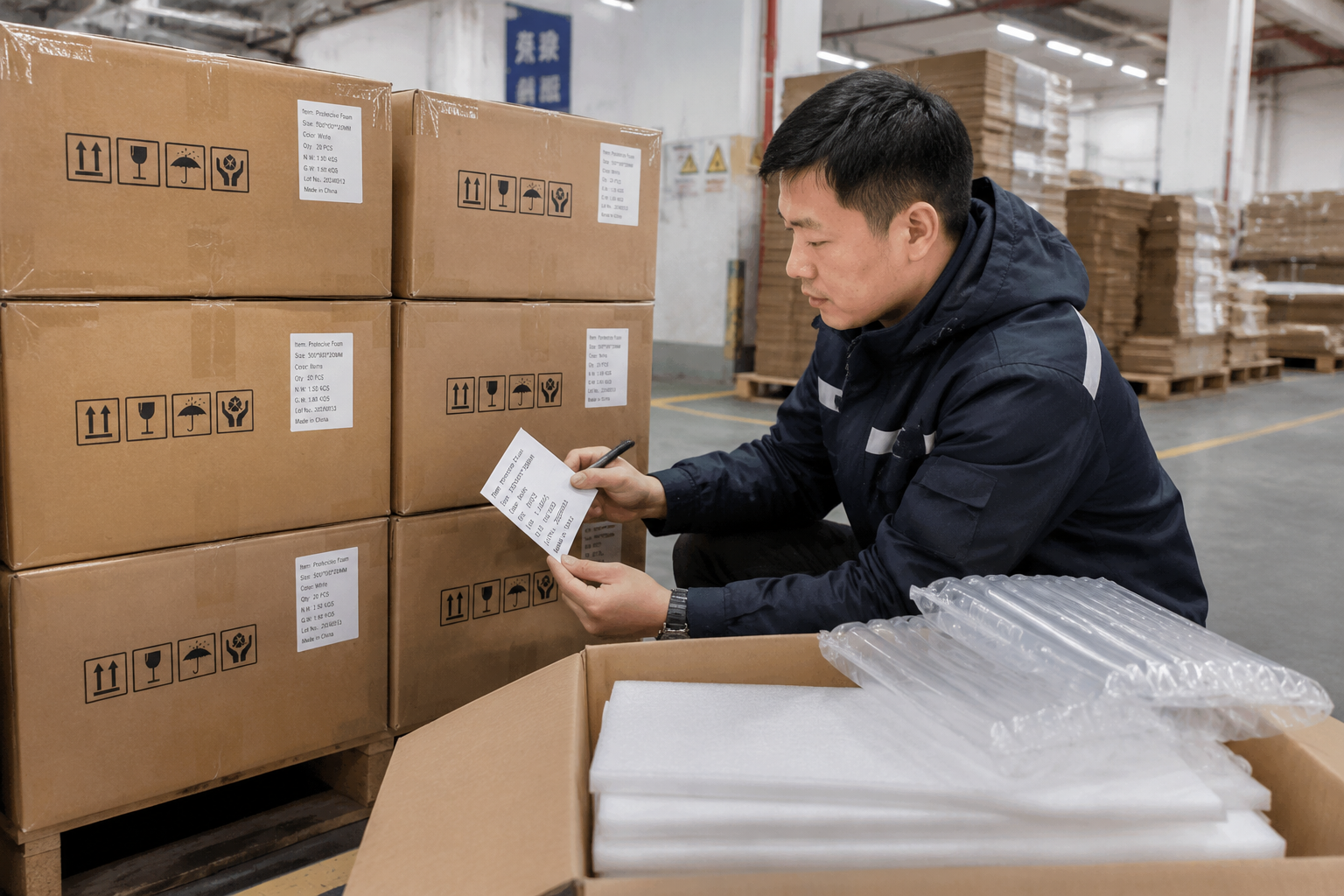
Batch control and traceability matter most when the buyer plans to reorder. If the supplier can link the approved sample, the production run, and the shipment file, the next order becomes easier to repeat with less confusion. If the factory cannot explain that chain clearly, the buyer may face new variation every time the order is repeated.
The goal is not to overcomplicate the supplier file. The goal is to make sure the paperwork reflects a real production system. A buyer who can talk to the factory, verify the line, and confirm the scope usually makes a safer decision than one who only collects documents without checking the process behind them.
How Certifications Affect Price, Lead Time, and Repeat-Order Reliability
Certification-related work can change the commercial side of a packaging order in more ways than one. It may affect the quoted price, the time needed to prepare the order, and how reliably the same item can be repeated later. That is why buyers should interpret the quote as more than a unit price. The real question is what the supplier had to do to support the document, the sample, and the production control behind the item.
A lower price can look attractive at first, but it may come with a hidden cost if the supplier has not controlled the spec well or if the product needs extra checking later. A higher quote may reflect testing, document preparation, or tighter production control. In many packaging programs, that extra effort can help the buyer reduce damage claims, rework, packing delays, or rejected shipments. The right comparison is not unit price alone. It is total landed value across purchase, packing performance, and repeat-use stability.
Total packaging cost also includes the way materials affect labor, storage, container loading, and damage handling. A thinner film may reduce the purchase price but increase tearing during packing. A smaller carton may save freight space but create pressure on the product or slow the line. A stronger carton may cost more per piece but reduce repacking work if the shipment is stacked, palletized, or handled through multiple warehouses. Buyers should compare the material price together with carton utilization, packing speed, reject risk, and the cost of replacing damaged goods.
Where certification-related work can add cost
Some of the added cost comes from the work needed to support the file itself. If a supplier must prepare documents, coordinate test records, or confirm the correct scope before production, that takes time and labor. The buyer may also see a higher quote if the factory has to hold tighter controls during production or adjust the line to meet a specific spec.
Another cost driver is the time spent on sample validation. If the buyer needs several rounds of sample confirmation, the supplier may need to remake samples, adjust sizes, or revise materials before bulk approval. That is not wasted work when the product is customized, but it does affect cost and schedule. For export packing or time-sensitive launches, that delay can matter more than the price difference itself.
There is also a practical cost tied to tighter quality control. Extra checks on thickness, density, sealing strength, or carton accuracy can reduce variation, but they take time on the factory floor. Buyers should expect that stricter control may not be the cheapest route up front. The key is to understand what risk that control is removing.
Ms. Tang usually keeps the order discussion focused on these points because small changes in spec or document work can affect production planning, packing arrangement, and shipment timing. That is the kind of cost that does not always show up clearly in a quote comparison, but it shows up later in execution if it is ignored.
When certification can protect the budget over time
Certification-related requirements can protect the budget when they help the buyer avoid repeat problems. If a supplier can control the spec, keep records aligned, and reproduce the same packaging item consistently, the buyer is less likely to face rejects, rework, or customer complaints on later orders. That consistency is especially valuable for packaging used in regular shipment cycles or recurring retail supply.
Repeat-order reliability is where the value becomes clear. A buyer who saves a little on the first order but loses time fixing size drift, bad sealing, or unclear packing marks on the second order may end up spending more overall. By contrast, a supplier that supports the approved sample, keeps the same document set, and repeats the same production path can reduce hidden cost across the full order cycle.
That is why buyers should think in terms of repeat-order support, not just one-time delivery. If the item will be reordered, the spec file, sample reference, and production notes become part of the financial picture. Fewer claims, fewer rejects, and less back-and-forth with the factory can justify a stricter requirement at the start.
In practical terms, the safest buying decision is often the one that balances price with control. A supplier that can prove the scope, hold the spec, and repeat the result may not always be the cheapest line item, but it is often the lower-risk packaging choice over time.
Go/No-Go Checklist Before You Release the Order
Before a purchase order is released, the buyer should be able to make a clear decision: approve, reject, or revise. A supplier approval checklist is useful because it brings the certificate, sample, specification, production scope, and quality-control evidence into one final buyer check. Without this step, a sourcing team may approve a low-price quote while leaving important details open, such as whether the document file matches the exact packaging item, whether the sample approved is the same as the quoted structure, or whether carton marks and packing requirements have been confirmed.
The decision should not depend on paperwork alone. A certificate may support confidence in the supplier, but order verification should also confirm the physical packaging. For corrugated boxes, that may mean board grade, size, printing, compression needs, and packing quantity. For EPE foam, bubble wrap, air cushion packaging, or plastic bags and film, it may mean thickness, density, sealing, cutting accuracy, fit, surface protection, and carton packing method. The final check should connect documents to the actual packaging function.
A practical go/no-go process works best when it is short and firm. If the document scope does not match the ordered item, revise or hold the order. If the sample has not been approved, do not treat the quotation as production-ready. If the spec is not locked, the supplier may interpret the order differently during material preparation, cutting, sealing, printing, packing, or shipment preparation.
Shipment preparation should be confirmed before production is released, not after goods are finished. Carton quantity, inner packing, labels, carton marks, pallet method, loading information, and destination requirements can affect how the factory packs the goods and how the buyer receives them. When these details are checked against the order file in advance, the supplier has a clearer basis for preparing the shipment and the buyer is less likely to face relabeling, repacking, or warehouse receiving problems.
Final boundary check before approval
Before release, buyers should ask whether any claim in the supplier file goes beyond what the documents and sample actually support. Statements about protection, strength, recycled content, compostability, food contact, moisture resistance, anti-static behavior, heavy-load use, or shipment performance should be tied to the exact material, construction, test basis, and use condition. If the statement cannot be connected to the order, it should be treated as a general comment rather than an approval basis.
No certificate or sample should be read as a guarantee that every shipment will arrive without damage. Packaging can help reduce risk when the material, design, carton fit, packing method, pallet plan, handling environment, and shipping route are reviewed together. The final approval should therefore focus on whether the packaging is reasonably matched to the expected use, whether the buyer’s required documents are available, and whether any remaining assumptions have been confirmed before production.
Go/no-go questions for the supplier file
The supplier file should answer a few direct questions before approval. These questions are not meant to create extra paperwork; they are meant to prevent unclear responsibility after production starts. The more customized or export-sensitive the packaging is, the more important this final check becomes.
| Final Check | Go | Revise or Hold |
|---|---|---|
| Document scope | The certificate, test report, or declaration clearly applies to the supplier, material, or packaging item being ordered. | The document is generic, expired, unrelated to the product family, or issued for a different company or factory. |
| Sample approval | The buyer has approved the actual sample, including size, material feel, structure, printing, sealing, and fit where relevant. | The sample is missing, only a photo was reviewed, or changes were discussed but not confirmed in writing. |
| Specification control | The packaging specification is locked, including dimensions, thickness, density, grammage, tolerance, color, printing, quantity per carton, and packing method as needed. | The quote uses vague terms such as “standard,” “similar,” or “as usual” without measurable details. |
| Factory scope match | The supplier can explain how the quoted packaging will be produced, checked, packed, and labeled. | The supplier cannot confirm the production line, process steps, inspection points, or responsibility for the item. |
| Shipment readiness | Carton marks, inner packing, pallet needs, export labels, and delivery requirements are confirmed before production release. | Shipping details are left until after production, creating risk of repacking, relabeling, or delivery delay. |
If all major answers fall into the “Go” column, the order is usually ready for release. If one or two points need adjustment, the better decision is often to revise before issuing the PO. If the supplier cannot connect the certificate, sample, and production method to the exact packaging order, the buyer should treat that as a no-go until the gap is closed.
For custom protective packaging, this final review should be shared with both sourcing and operations teams. Sourcing may focus on price, supplier documents, and payment terms, while operations may notice packing speed, carton fit, storage space, labeling, or line handling risks. A packaging order is safer when both sides approve the same confirmed specification rather than relying on separate email threads.
What to archive for repeat orders
Repeat-order reliability depends on what the buyer saves after approval. If the first order performs well but the supplier file is incomplete, the next purchase may drift. A new buyer, a new supplier contact, or a small change in material can lead to different packaging even when the item name stays the same. Archiving the right records helps make future orders faster and more consistent.
The buyer should keep the approved document file, including any relevant quality management certificate, product-specific report, material declaration, or supplier statement that supported the order. The file should show the document date, issuing source where applicable, supplier name, product scope, and the item it was used for. If the document was accepted only for a specific customer requirement or export route, that note should also be saved.
The approved sample reference is just as important. Buyers should archive photos of the approved sample, final drawings if available, dimensions, material thickness or density, weight, printing details, sealing or bonding requirements, color, surface finish, and any confirmed tolerance. For foam inserts, air column bags, bubble bags, plastic bags, or corrugated boxes, a small physical retained sample can also be useful when possible, especially for repeat custom orders.
The final packaging specification should include practical production and packing details, not only product dimensions. Save carton quantity, carton size, inner packing method, bundle or roll size, pallet requirement if used, carton marks, label content, and any special handling notes. These details affect packing labor, warehouse receiving, export preparation, and future quotation accuracy.
Feedback from the first shipment should also be added to the repeat-order file. If receiving staff report that carton labels were hard to read, pallets were too high, bags were difficult to open, foam pieces shifted inside the carton, or a certain mark helped warehouse sorting, that information can improve the next order. Repeat consistency is easier to control when the buyer and supplier treat real shipment feedback as part of the confirmed order history.
A good repeat-order file should include:
- Approved supplier documents: certificates, reports, declarations, or statements accepted for the order scope.
- Approved sample records: photos, sample date, version number if used, and any written approval notes.
- Locked specification: dimensions, material parameters, tolerance, printing, sealing, cutting, bonding, or structural details.
- Order execution details: packing quantity, carton marks, labels, pallet instructions, and shipment preparation notes.
- Quality feedback: inspection comments, receiving feedback, damage reports if any, and changes required for the next order.
This archive turns the first order into a controlled reference instead of a one-time transaction. For the next purchase cycle, the buyer can ask the supplier to quote against the same confirmed file, then review only the changes. That saves time, reduces misunderstanding, and makes repeat-order support more practical for both sides.
The final decision is simple: release the order only when the certificate is relevant, the scope match is clear, the sample is approved, the spec is locked, and the factory can explain how it will control production and packing. If those points are not confirmed before order release, the buyer is not only taking a documentation risk; the buyer is taking a packaging performance risk.
References
[1] ASTM International, “ASTM D642 Standard Test Method for Determining Compressive Resistance of Shipping Containers,” packaging test method reference for compression resistance discussions, available at ASTM D642 Compression Resistance.
[2] ASTM International, “ASTM D4169 Standard Practice for Performance Testing of Shipping Containers and Systems,” distribution-cycle performance testing reference for shipping container evaluation, available at ASTM D4169 Shipping Container Performance Testing.
[3] U.S. Food and Drug Administration, “Food Packaging and Other Substances that Come into Contact with Food,” consumer-facing reference explaining food packaging and food contact substance context, available at FDA Food Packaging and Food Contact Substances.
[4] European Commission, “Food Contact Materials,” regulatory overview for materials and articles intended to come into contact with food in the EU, available at EU Food Contact Materials.
[5] International Plant Protection Convention, “Regulation of Wood Packaging Material in International Trade,” international phytosanitary standard reference for wood packaging material used in trade, available at IPPC ISPM 15 Wood Packaging.
[6] USDA Animal and Plant Health Inspection Service, “Wood Packaging Material,” U.S. guidance reference for wood packaging material and related import/export requirements, available at USDA APHIS Wood Packaging Material.
[7] Federal Trade Commission, “Green Guides,” U.S. environmental marketing guidance relevant to recyclable, compostable, degradable, and similar packaging claims, available at FTC Green Guides.
[8] ASTM International, “ASTM D6400 Standard Specification for Labeling of Plastics Designed to be Aerobically Composted in Municipal or Industrial Facilities,” compostable plastics specification reference, available at ASTM D6400 Compostable Plastics.
[9] ASTM International, “ASTM D6868 Standard Specification for Labeling of End Items that Incorporate Plastics and Polymers as Coatings or Additives with Paper and Other Substrates Designed to be Aerobically Composted,” compostable coated packaging specification reference, available at ASTM D6868 Compostable Coated Packaging.
[10] International Safe Transit Association, “ISTA Procedure 3A Overview,” packaged-product test overview for parcel delivery systems and small package shipping contexts, available at ISTA Procedure 3A Overview.
[11] United Nations Economic Commission for Europe, “UN Model Regulations Rev. 24,” dangerous goods model regulations reference with packaging-related provisions for regulated shipments, available at UNECE UN Model Regulations Rev. 24.
[12] Pipeline and Hazardous Materials Safety Administration, “Hazardous Materials Regulations,” U.S. hazardous materials transport regulations reference relevant to packaging and shipping preparation, available at PHMSA Hazardous Materials Regulations.
Packaging Supplier Guides cornerstone library
Cornerstone guides for this topic
Keep these Packaging Supplier Guides guides close while you read. They are the standing references for the decisions covered on this page.
Wholesale Packaging Materials in China: Samples, MOQ, Quotation, and Bulk Order Process
Wholesale packaging materials from China can look simple at the inquiry stage, but the real decision depends on much more than naming a material...
Read cornerstone guide
Packaging Manufacturer vs Trading Company in China: What Overseas Buyers Should Check
When you are sourcing packaging from China, the main decision is not just who gives the quote. It is whether the supplier can handle...
Read cornerstone guide
China Packaging Materials Supplier Guide: How to Choose the Right Factory for Custom Packaging
Choosing a China packaging materials supplier is not only about finding a factory that can quote foam, bubble wrap, cartons, film, or plastic bags....
Read cornerstone guide