
For a mixed warehouse replenishment order, the risk is not only whether bubble bags, printed poly mailers, and corrugated boxes are made correctly. The receiving problem starts when similar-looking cartons arrive with unclear marks, hidden labels, mixed SKU positions, or records that do not match the packing layout, making a faster RFQ review method relevant when quote changes affect apparel poly mailer specifications. This article explains how Daipak reviewed carton marks and pallet packing for a North America order so the buyer’s warehouse could identify, count, and separate items without opening every carton.
The practical focus is on export packing details that affect receiving speed: SKU codes, product names, carton quantities, carton numbers, gross weights, label placement, pallet grouping, wrapping direction, and loading photos. Buyers can use the article to judge what information should be confirmed before packing, what photos should be checked before dispatch, and how clearer carton marking can reduce sorting work after arrival.
For mixed export shipments, carton marking and pallet preparation should be treated as part of the shipment control process, not as a cosmetic step. Carrier packaging guidance commonly emphasizes suitable cushioning, sealing, labeling, and shipment preparation, which supports the idea that the outer package must communicate clearly as well as protect the goods.[1]
Quick Packaging Decision Guide
| Buyer Question | Practical Reading | What to Check |
|---|---|---|
| Will the warehouse identify each SKU quickly? | Carton marks should match the packing list and remain visible after stacking. | SKU code, product name, carton number, quantity, and label position. |
| Are similar products easy to separate? | Mixed bubble bags, mailers, and box sizes need clear grouping before pallet wrapping. | Pallet layout, SKU separation, layer order, and section labels. |
| Can receiving staff count cartons without opening them? | Readable carton numbers and quantities reduce manual checks during put-away. | Total carton count, per-carton quantity, gross weight, and packing records. |
| Will labels still be readable after pallet packing? | Marks placed on blocked sides may slow unloading and warehouse sorting. | Label direction, wrapping coverage, pallet photos, and close-up mark photos. |
| Can mistakes be caught before dispatch? | Pre-dispatch photos give the buyer time to review carton condition and SKU arrangement. | Close-up labels, full pallet views, SKU group photos, and loading photos. |
Quick Questions Before You Read
Q: Why do carton marks matter for a replenishment order?
They help warehouse staff match cartons to records, count stock, and separate SKUs without opening every box.
Q: What should buyers send before packing starts?
Send the SKU list, product names, carton quantity requirements, preferred carton numbering, and any warehouse receiving instructions.
Q: Is pallet grouping important for mixed packaging materials?
Yes. Grouping by SKU, pallet, section, or layer helps reduce random sorting after arrival, especially for similar-looking cartons.
Q: What photos are useful before shipment?
Ask for close-up carton marks, full pallet views, SKU group photos, wrapping condition, and loading photos before dispatch.
On June 6, 2026, the Buyer Raised a Warehouse Receiving Concern Before Shipment
On June 6, 2026, a North America warehouse replenishment buyer confirmed a mixed order with Daipak that included bubble bags, printed poly mailers, and corrugated shipping boxes in three sizes. The discussion did not stop at whether each packaging item could be produced to specification. The buyer also wanted to know whether the receiving warehouse could identify cartons quickly after arrival, separate mixed SKUs, and avoid opening every carton just to confirm the contents.
For a China packaging materials supplier supporting overseas replenishment orders, this kind of question is part of practical export packing support. The goods may leave the factory in good condition, but the shipment still has to work inside the buyer’s warehouse. If carton marks are unclear or similar cartons are mixed without a visible system, warehouse staff may spend extra time checking, sorting, and matching cartons against receiving records.
The review started from the buyer’s practical order information rather than from a generic packaging name. Daipak needed the SKU list, product sizes, printed mailer artwork version, bubble bag dimensions, corrugated box sizes, carton quantity targets, packing method, and destination receiving preference before giving a useful packing recommendation. This information gave the supplier a clearer basis for deciding what should appear on each carton mark and how the cartons should be grouped before pallet wrapping.
The buyer was managing replenishment, not a one-time sample shipment
A sample shipment is usually small enough for the buyer to inspect manually. A replenishment order is different. It often includes repeated SKUs, multiple carton groups, and products that must move quickly from receiving to storage or fulfillment. In this project, the buyer was not only testing product quality; the order was intended to restock packaging materials for ongoing warehouse use.
That made carton mark clarity more important. Bubble bags, printed poly mailers, and three sizes of corrugated boxes may all be familiar to the warehouse team, but they still need to be received as separate inventory items. If the cartons do not clearly show SKU code, product description, quantity, or carton sequence, the receiving team may need to slow down and inspect carton contents manually. That extra handling can affect put-away speed and inventory entry, especially when the warehouse is processing other inbound shipments at the same time.
The main question was what happens after the goods arrive
The buyer’s main concern was the arrival process: unload the goods, identify each carton, count each SKU, separate the products, and move them to the right storage area. This is a different question from production quality. A printed poly mailer can be made correctly, and a corrugated box can meet the confirmed size, but if the outer carton does not help the warehouse identify what is inside, the receiving process still becomes harder than necessary.
Daipak treated the concern as a shipment clarity issue. Before dispatch, the review needed to consider whether carton information would be useful to the buyer’s warehouse staff, not only whether the cartons looked neat for export. For a mixed packaging materials order, the outer carton becomes part of the receiving system. It tells the warehouse what the carton contains, how it should be counted, and where it belongs after unloading.
Why Similar Outer Cartons Can Create Problems in a Multi-SKU Packaging Order
The order included bubble bags, printed poly mailers, and corrugated shipping boxes in three sizes. These products serve different packing jobs, but their export outer cartons can look very similar once they are sealed, stacked, stretch wrapped, and handled as a consolidated shipment. From the outside, a carton containing bubble bags may not look very different from a carton containing mailers or folded corrugated boxes unless the mark is clear enough to read and match to the buyer’s records.
This is the mixed-carton risk in a multi-SKU packaging order. The problem is not necessarily that the products are wrong. The practical risk is receiving confusion. If workers cannot tell which carton belongs to which packaging SKU, they may need to open cartons one by one, compare contents with the packing list, reseal cartons, and then sort the goods again. That creates extra labor and can delay put-away, especially in warehouses that need to move replenishment stock quickly into storage or picking areas.

Different products can still arrive in similar-looking cartons
Outer cartons are designed to protect and organize goods during transport, but they can also hide product differences from view. Bubble bags may be packed in cartons sized for volume rather than weight. Printed poly mailers may be packed tightly in boxes with a similar footprint. Corrugated boxes may be bundled or packed flat, then placed into cartons that look close to other export cartons after palletizing.
Once stretch film is applied, the visual difference becomes even smaller. Pallet stacking can cover side labels, and consolidated freight handling may place several carton groups close together. If the mark is only printed on one side, or if the marked side faces inward, warehouse staff may have to rotate cartons or cut wrap just to confirm what they are receiving. The carton may be physically sound, but it is not doing enough as an information carrier.
Simple marks may not be enough for warehouse staff
A basic product name can help, but it may not be enough for a replenishment buyer managing several packaging SKUs. For example, “poly mailer” does not tell the warehouse which printed design, size, or reseller SKU is inside. “Corrugated box” is also too broad if the same shipment includes three sizes. Even “bubble bag” may need a size description or buyer code if similar cushioning products are stored in the same warehouse zone.
Warehouse teams usually receive against a purchase order, packing list, or internal receiving sheet. If the carton mark does not match the terms used in those records, workers may need to interpret the label instead of simply checking it. That is where small wording differences can create avoidable sorting work. A clear mark should help the warehouse connect the carton to the right internal SKU without guessing.
Product shape and packing density can change the carton plan
For this order, the three product groups did not behave the same way inside export cartons. Bubble bags take up volume because of trapped air and cushioning structure, so carton fullness and compression need attention. Printed poly mailers can be packed more densely, but heavy stacks may create carton weight differences that should be easy to count and handle. Corrugated shipping boxes, especially when shipped flat or bundled, need carton support so corners and edges are not bent during stacking.
This is why a mixed packaging order should not use one carton marking or pallet plan only because the products are all “packaging materials.” Product size, weight, shape, and surface finish affect how cartons are filled, sealed, stacked, and identified. Printed mailers also have a surface appearance requirement; if cartons are opened repeatedly during receiving because labels are unclear, there is more chance of dust exposure, abrasion, or handling marks before the mailers reach the buyer’s own customers.
Corrugated shipping boxes should also be discussed by structure and performance need, not only by outside dimensions. Industry references for corrugated packaging distinguish box styles, rules, and tests, while compression testing is a recognized method for evaluating how fiberboard shipping containers resist stacking loads under defined conditions.[2]
Daipak Reviewed Carton Marks Around SKU Identification, Not Just Export Appearance
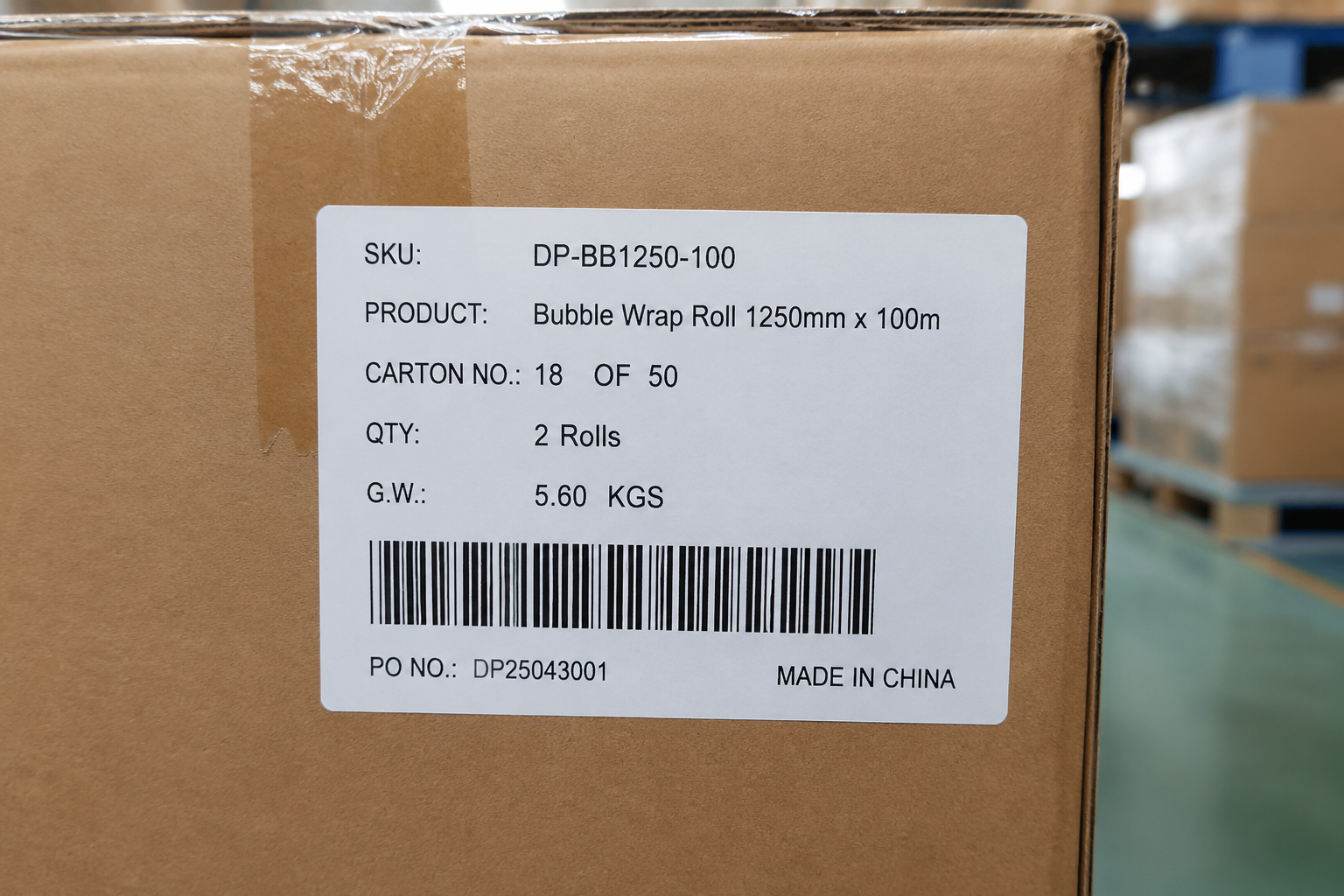
Daipak’s carton mark review for this shipment focused on whether each carton could be used for SKU identification at the receiving warehouse. The review considered SKU code, product name, carton quantity, gross weight, carton number, and outer carton label position. The goal was not to create a decorative export mark. It was to make each carton easy to identify, easy to count, and easier to match with the buyer’s receiving records.
A practical carton mark serves more than one party. The factory uses it to pack and group the correct goods. The freight forwarder uses it to confirm carton count and shipment handover. The destination warehouse uses it to separate SKUs and enter inventory. If the mark only works for one of those steps, the shipment may still create extra work later in the receiving process.
SKU code and product name helped separate similar cartons
For this type of replenishment order, the SKU code and product name need to work together. The SKU code gives the buyer’s warehouse a direct link to its internal receiving records. The product name gives staff a plain-language confirmation of what they are handling. Together, they reduce the chance that a carton is sorted only by visual guesswork or by a partial description.
This matters most when products have similar names or similar outer cartons. A reseller may carry several printed poly mailers with different artwork, several bubble bag sizes, and several corrugated shipping box sizes. If the carton mark shows only a broad product category, the warehouse may still need to open the carton. If it shows both the buyer’s SKU and a clear product description, the receiving team can usually separate cartons with more confidence.
For custom packaging, the carton mark is easier to control when the buyer’s SKU file is tied back to the confirmed product specification. A printed mailer should be linked to its size, color, artwork version, film thickness, sealing style, and carton quantity. A corrugated shipping box should be linked to its confirmed dimensions, board structure, packing count, and carton number sequence. This practical link between specification and outer mark helps the supplier check that the label follows the confirmed order detail instead of relying on memory or a short product nickname.
Carton quantity and carton number helped warehouse counting
Carton quantity supports the receiving count. If a carton contains a stated number of bags, mailers, or box units, the warehouse can compare the carton mark with the packing list before entering stock. This does not replace internal receiving checks, but it gives warehouse staff a faster way to confirm whether the carton belongs to the expected SKU group.
The carton number system is also useful when a shipment includes many cartons across several SKUs. Numbering helps the buyer check whether any carton group is missing, duplicated, or separated during receiving. It also makes communication easier if the buyer, forwarder, or supplier needs to discuss a specific carton after handover. Instead of saying “one carton of poly mailers,” the team can refer to the carton number and related SKU group.
Gross weight review added a practical cross-check
Gross weight is not only a shipping detail. In a mixed packaging order, it can act as a practical cross-check before shipment. If cartons within the same SKU group are expected to have similar contents, a large weight difference may signal that the packing quantity, product size, or carton grouping should be reviewed. This is especially useful before the goods leave the factory, when corrections are still easier to make.
The gross weight check should be understood as a support step, not a guarantee that every carton has been fully verified by weight alone. Lightweight packaging products can vary by carton size, packing method, or material thickness. Still, when gross weight is reviewed together with SKU code, product name, carton quantity, and carton number, it gives the supplier and buyer another way to detect abnormal cartons before shipment.
Specification wording should match the buyer’s real SKU file
Before carton marks are printed or labels are attached, the wording should be checked against the buyer’s actual SKU file, not only against the supplier’s internal product name. A buyer may describe the same item by size, color, print design, warehouse code, sales channel code, or replenishment line number. If the carton mark uses factory wording while the warehouse uses marketplace or reseller wording, receiving staff may have to stop and compare documents.
A useful pre-packing review can include product photos, confirmed drawings, size tables, print artwork references, carton quantity requirements, and the buyer’s preferred label wording. This is especially important for custom printed poly mailers and multiple corrugated box sizes, where a small difference in size or print version can create the wrong inventory entry. Confirming the wording early costs less time than correcting a full pallet after the marks are already applied.
Specification Confirmation Note: For mixed replenishment orders, Daipak asks buyers to confirm size, thickness, product structure, SKU wording, carton quantity, printing details, label format, and packing method before production or final packing so the carton mark can follow the buyer’s real receiving file.
The packing list should be checked against physical carton groups
For a multi-SKU shipment, the packing list is most useful when it matches the actual carton groups that the warehouse will see. If the document lists five product lines but the pallets are arranged by mixed layers or split carton groups, the receiving team needs enough detail to understand that structure. A practical review compares the carton marks, carton number sequence, and pallet grouping against the packing list before dispatch.
This check also helps the buyer and supplier use the same language when discussing a shipment question. If a carton group is identified by SKU, size, quantity, carton number range, and pallet position, the buyer can point to the exact area that needs review, much like a combined packaging solution that organizes multiple accessory-kit components under one clear packaging specification. That makes communication more efficient than relying on broad descriptions such as “the mailer cartons” or “the box pallet,” especially when the order contains similar packaging items.
What Daipak Did Not Assume From Carton Marks Alone
Carton marks can make a mixed shipment easier to identify, but they should not be treated as proof of every product attribute. A label that says “bubble bag,” “poly mailer,” or “corrugated box” identifies the item type; it does not by itself confirm special performance, destination-market suitability, or use in regulated applications. If a buyer needs a specific moisture barrier, anti-static handling, food-contact use, heavy stacking performance, or other special condition, that requirement should be discussed separately with material details and supporting documents before production.
For this replenishment order, the carton mark review was focused on practical warehouse receiving: SKU identification, quantity control, carton sequence, and pallet visibility. It was not presented as a transport damage guarantee or as a substitute for the buyer’s own receiving checks. The packaging should still be matched to the product, carton fit, carrier route, pallet plan, and warehouse handling condition, especially when the shipment includes several product families with different weights and shapes.
This distinction helps buyers use carton marks correctly. The mark should tell the warehouse what is inside and how the carton relates to the packing list. Any claim about special material performance, environmental positioning, or regulated use should be kept off the carton unless the buyer and supplier have checked the exact material, intended use, destination requirement, and available documentation.
Pallet Direction and SKU Separation Were Checked Before the Goods Left the Factory
Before the goods left the factory, Daipak treated pallet packing confirmation as part of the same review as carton marking. The cartons for bubble bags, printed poly mailers, and corrugated shipping boxes could carry the right information, but that information would lose value if the marked sides were hidden after stacking or stretch wrapping. For a North America replenishment order, the question was not only whether each carton had a label. The question was whether warehouse staff could see the label at the moment of unloading.
This matters more in an LCL shipment or consolidated shipment, where pallets and cartons may pass through more handling points before final delivery. Even if the shipment remains properly packed, a receiving team may face limited time, limited floor space, and several incoming orders at once. If different packaging SKUs are mixed without a visible pattern, the warehouse may need to stop, rotate cartons, or open cartons just to confirm what has arrived.
Daipak reviewed pallet direction, SKU separation, and pallet layout with that receiving situation in mind. The goal was practical: make the cartons easier to identify, easier to unload by SKU group, and easier to move into put-away areas after arrival. This does not mean every SKU must always occupy a separate pallet. Depending on order size and shipping limits, separation can also be handled by pallet section, pallet layer, clear side labeling, or grouped carton positions.
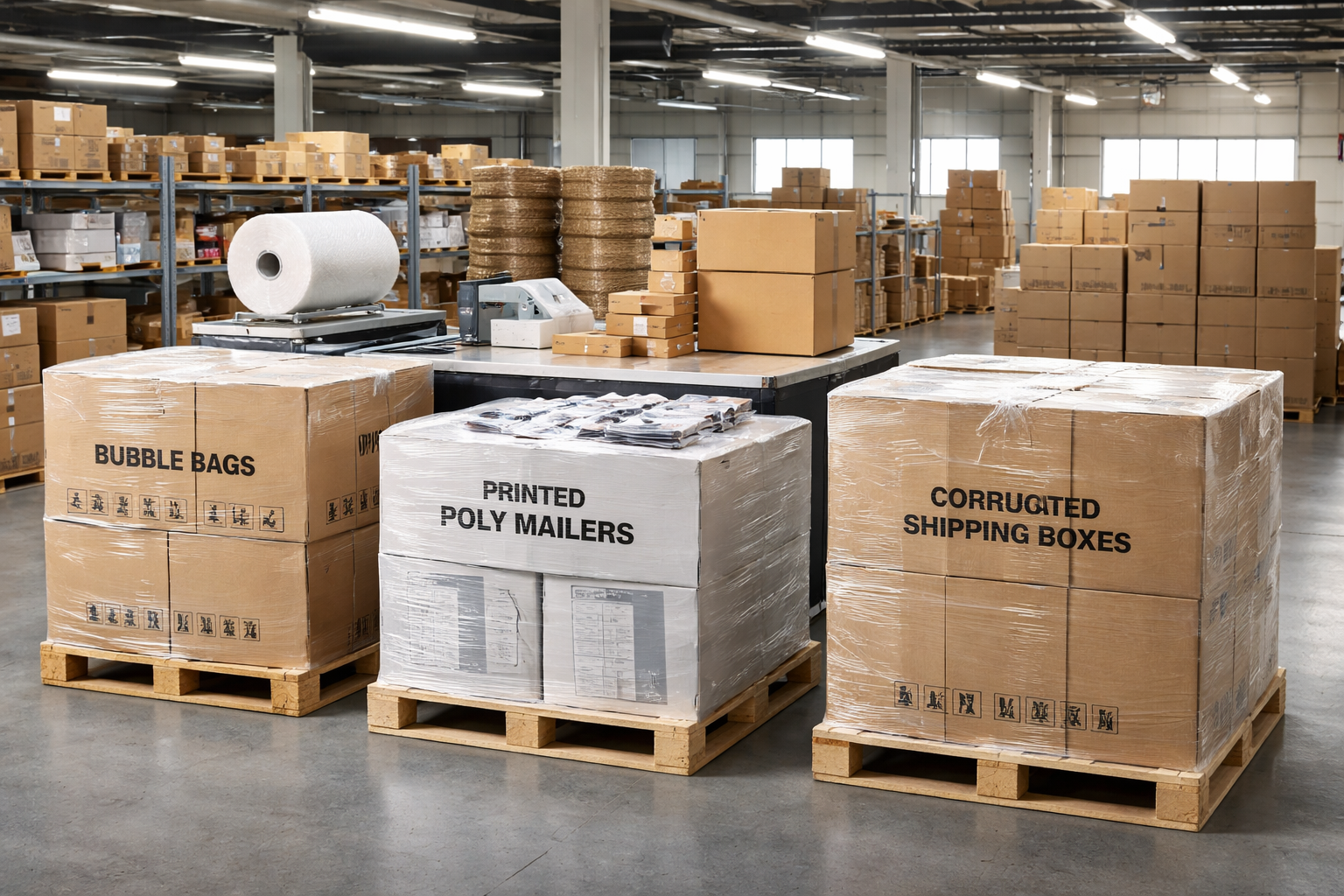
Label visibility matters after cartons are palletized
A carton mark that looks clear on a single carton can become difficult to use once the carton is stacked. If the label side faces inward, sits against another carton, or is covered by stretch film overlap, the receiving warehouse may not see the SKU code or carton number without moving the pallet apart. That creates extra labor before the warehouse even begins its normal receiving process.
For this reason, label position was reviewed as a pallet-level detail, not only as a printing or labeling detail. Outward-facing marks help warehouse staff compare cartons against the packing list, confirm product groups, and decide where the pallet should be placed. For cartons containing similar-looking packaging materials, visible labels can save time because the warehouse does not need to judge the contents by carton size alone.
The review also considered how cartons would look after wrapping. Stretch film can protect and stabilize a pallet, but it can also make small or low-contrast labels harder to read. A practical export packing review should check whether the main carton information remains visible after stacking and wrapping, especially for mixed SKUs that need to be separated quickly at destination.
SKU grouping reduced the chance of random sorting work
SKU grouping was another important part of the review. If bubble bags, printed poly mailers, and three sizes of corrugated shipping boxes are randomly mixed across pallets, the destination warehouse may need to sort carton by carton before inventory can be entered or stored. That sorting work can delay put-away and increase the chance that cartons are placed in the wrong location.
A more organized pallet layout gives the receiving team a clearer starting point. One SKU may be grouped on one side of a pallet, another may be grouped by layer, and larger corrugated box cartons may be positioned so their marks remain visible from the outside. The right method depends on carton size, carton strength, order quantity, and how the freight will be loaded. The key point is that the grouping should be understandable to the people who receive the goods, not only to the people who packed them.
For overseas replenishment orders, this small planning step can make the shipment feel more controlled after arrival. Warehouse staff can identify a visible carton group, count against the receiving record, and move that SKU to the correct storage or fulfillment area with less random checking. The result is not a guarantee that every handling step will stay unchanged, but it does reduce avoidable confusion before the shipment leaves the factory.
For this kind of mixed shipment, a simple pallet packing map can help connect the physical pallet to the packing list. The map does not need to be complicated; it can show which SKU is placed on each pallet, which side the labels face, which carton number range belongs to each group, and whether any SKU is split across more than one pallet. When this information is checked before wrapping, the buyer has a clearer basis for briefing the receiving warehouse before the container or truck arrives.
Pallet stability also depends on carton strength and product mix
Pallet grouping should not ignore physical support. Corrugated box cartons may be flatter and more edge-sensitive, while bubble bag cartons may be lighter and more compressible. Printed poly mailer cartons can become relatively heavy if packed densely. If the pallet is built only for visual grouping and not for load support, the marked cartons may be easy to identify but still face crushing, leaning, or corner damage during handling.
A practical pallet review looks at both information flow and physical packing. Heavier or stronger cartons are usually better placed where they support the stack, while lighter or more compressible cartons should not be forced to carry unsuitable pressure. Stretch wrapping direction, corner protection where required, pallet overhang, and carton alignment all affect how the shipment looks when it reaches the receiving dock. Clear marks help the warehouse work faster, but stable stacking helps the goods arrive in a condition that can be received without immediate repacking.
For large, heavy, or palletized shipments, buyers should also confirm whether the carrier or forwarder has special requirements for pallet quality, load containment, carton overhang, and securement. DHL’s large and palletized packing guidance, for example, addresses securing and palletizing heavy shipments, which makes pallet preparation a carrier-facing issue as well as a warehouse-facing issue.[3]
Factory Coordination Note: When one export order combines bubble bags, printed mailers, corrugated boxes, foam, film, or other protective packaging materials, the packing team should coordinate carton sequence, SKU grouping, pallet direction, and loading photos before dispatch instead of treating each product family as an isolated shipment.
Loading Photos Gave the Buyer a Final View Before Dispatch
Daipak prepared loading photos before shipment so the buyer could make a final check of the packed goods before dispatch. For this June 2026 replenishment order, the photos were not treated as a replacement for a packing list, invoice, or inspection. They were used as a practical communication step, giving the buyer a view of carton marks, pallet arrangement, carton condition, and mixed-SKU separation while corrections were still possible.
For overseas buyers managing warehouse replenishment from a packaging supplier in China, photos can answer questions that documents alone may not show clearly. A packing list can state the carton count and SKU quantity, but a photo can show whether labels are facing outward, whether carton marks are readable, whether different SKUs are visually separated, and whether there is any obvious carton crushing or loose pallet condition before loading.
The useful photo set usually includes several levels of detail: close-up carton mark photos, full pallet photos, SKU group photos, and loading photos. Each view serves a different purpose. Close-ups help confirm readability. Wider pallet photos show grouping and direction. Loading photos support the shipment handover record and help the buyer communicate with its warehouse or forwarder before the goods arrive.
Close-up photos confirmed carton mark readability
Close-up photos are useful because label problems are easiest to correct before the cartons are wrapped, stacked tightly, or moved into consolidated freight. A buyer can check whether the SKU code, product name, carton number, quantity, and gross weight are clear enough for warehouse use. If the mark is too small, incomplete, placed in the wrong position, or inconsistent with the receiving sheet, the supplier can review it before dispatch.
For this type of mixed packaging materials order, label clarity is especially important because the warehouse may handle several carton groups that look similar from the outside. A close-up view helps confirm that the carton mark is not only printed or attached, but also readable by someone who was not involved in the production process. That outside-reader perspective is often the difference between a label that looks acceptable at the factory and a label that works in a busy receiving area.
Pallet photos showed how SKUs were arranged
Pallet photos gave the buyer a wider view of how the goods were arranged. This is where SKU separation becomes visible. The buyer could see whether cartons for the same packaging SKU were grouped together, whether labels faced outward, and whether the pallet layout would help the warehouse unload and separate the order without unnecessary carton handling.
A wider photo is also useful for checking whether the carton condition appears suitable before loading. It can show whether outer cartons are aligned, whether the pallet looks stable, and whether stretch wrapping has covered key information. The photo does not prove every carton’s contents, but it gives the buyer a practical view of the shipment’s receiving readiness before it leaves the supplier’s control.
Loading photos supported shipment handover records
Loading photos provide a final record of how the goods were handed over for shipment. For a North America warehouse replenishment order, this can help the buyer brief its warehouse team or share a visual reference with the freight forwarder. If the receiving warehouse knows what the pallet groups and carton marks look like before arrival, it can prepare for faster unloading and put-away.
These photos also support internal communication on the buyer’s side. A procurement manager, warehouse coordinator, and inventory team may not all see the same documents at the same time. A clear loading photo can help them understand the shipment structure quickly: which SKUs were grouped, how the labels appeared, and what carton condition looked like at dispatch. That makes the handover more transparent without adding a complicated process.
Before the photos were shared, the review usually needed to compare the finished packing condition against the confirmed order details. For example, the close-up mark photo should match the approved SKU wording, the pallet view should match the intended SKU grouping, and the loading view should show the same carton number range that appears on the packing record. This practical comparison helps the buyer see how the confirmed specification moved from production detail to finished carton and then to shipment preparation.
Why the Review Focused on the Receiving Warehouse, Not Only the Freight Forwarder
The main lesson from this review is that warehouse receiving accuracy depends on more than moving the shipment from one point to another. A freight forwarder needs shipment documents, carton count, routing information, and handover details. The receiving warehouse needs something different: it must identify cartons, count them, separate SKUs, and store or allocate inventory correctly after arrival.
For an overseas distributor, packaging reseller, or third-party warehouse buyer, the shipment is not fully successful just because the goods leave the factory on time. The shipment also needs to arrive in a form that the warehouse can work with. If the cartons are hard to distinguish, the warehouse may spend extra time opening boxes, comparing contents, or correcting inventory entries. Those receiving errors and put-away delays can affect replenishment even when the products themselves were made correctly.
This is why Daipak’s export packing review looked beyond freight handover. Carton marks, pallet photos, label direction, and SKU grouping all support the warehouse’s receiving sequence. First, staff identify the carton. Then they count the carton group. After that, they separate SKUs and move inventory into storage or fulfillment areas. Clear shipment preparation helps each step run with fewer unnecessary stops.
Forwarders and warehouses need different information
Freight forwarders play an important role in the shipment, but their operating priorities are not the same as a destination warehouse. A forwarder may focus on whether the shipment documents match the cargo, whether the carton or pallet count is ready for handover, and whether the goods can move through the planned route. Those details matter for transportation and coordination.
A warehouse team, however, must work at the SKU level. It needs to know which cartons contain bubble bags, which contain printed poly mailers, and which contain each size of corrugated shipping box. It may also need to enter received quantities into an inventory system, place SKUs in different storage locations, or allocate goods to different customer or fulfillment areas. A carton mark that is sufficient for transport may still be too vague for receiving if it does not support those tasks.
For multi-SKU replenishment orders, the supplier should understand both sides of the handover. The freight side needs accurate shipment preparation. The warehouse side needs visible, practical identification. When both needs are considered before dispatch, the shipment is easier to manage after arrival.
A clear carton mark can reduce unnecessary carton opening
One of the simplest ways to reduce receiving work is to make the carton mark clear enough that warehouse staff do not need to open cartons just to identify the product type. Opening cartons during receiving takes time, creates loose packaging, and can make it harder to keep carton counts clean. It may be necessary in some checks, but it should not be the only way to tell one SKU from another.
A useful carton mark connects the physical carton to the buyer’s receiving record. The SKU code supports internal matching. The product name gives a plain-language confirmation. The carton number and quantity help the warehouse count and investigate missing or extra cartons. Gross weight gives another practical reference if one carton appears noticeably different from the expected group.
Clear marks do not solve every inventory issue, and they do not replace the buyer’s warehouse process. They do, however, reduce avoidable uncertainty at the first receiving touchpoint. For mixed packaging SKUs, that can make a meaningful difference in how quickly the warehouse can identify, count, separate, and store the replenishment order.
Daipak Added Multi-SKU Orders to Its Carton Mark Review Workflow
After reviewing the June 6 to June 20, 2026 replenishment order, Daipak gave multi-SKU export orders more attention in its carton mark review workflow. The order combined bubble bags, printed poly mailers, and three sizes of corrugated shipping boxes, which made the packing review different from a single-product bulk shipment. The product quality still mattered, but the next practical question was whether the receiving warehouse could identify each carton without extra sorting work.
For a protective packaging manufacturer handling several product families in one shipment, the review cannot stop at production completion. Bubble bags, poly mailers, corrugated boxes, foam items, film products, and other protective packaging materials may all move through different production and packing steps, while packaging news resources from an active packaging supplier can help buyers track relevant factory practices before export cartons are finalized. Once they are packed into export cartons, the buyer needs carton marks, carton numbers, quantities, gross weight, and pallet layout to work together so the shipment is easier to receive.
Multi-SKU orders need a different review rhythm
A single-SKU order is usually easier to check because most cartons carry the same product information. The warehouse can count cartons against one item line, and any label difference is easier to notice. A mixed order creates more chances for confusion because several packaging SKUs may share similar outer carton sizes, similar printed marks, or similar descriptions.
For this reason, Daipak treated the order review as a sequence of confirmations rather than one final label check. The team checked whether buyer SKU codes matched the product names, whether each size of corrugated shipping box was identified clearly, whether carton numbers followed a usable sequence, and whether quantity and gross weight information made sense for the packed goods. This type of review helps avoid confusion before shipping, when corrections are still practical.
The rhythm is also different because the buyer’s warehouse may use its own receiving sheet, reseller SKU code, or inventory label format. A product name such as “poly mailer” may not be enough if the buyer ordered several colors, printed versions, or sizes. SKU-based carton marks give warehouse staff a more direct way to match the goods to internal records.
The workflow connects production, packing, and shipment preparation
In a mixed packaging materials order, production coordination and shipment preparation are closely connected. A printed poly mailer may require print confirmation and sealing review. Bubble bags may need size, cushioning structure, and packing quantity confirmation. Corrugated shipping boxes may require size separation and carton count review. If these details are confirmed during production but not carried through to carton marking, the destination warehouse may still face unnecessary receiving work.
Daipak’s workflow for this type of order connects the later steps more carefully: production completion, carton packing, carton mark application, carton number review, gross weight check, pallet label direction, and loading photo preparation. This is not a formal certification or a guarantee that every warehouse process will be identical. It is a practical factory-side habit that helps the buyer see whether the shipment is organized before it leaves the factory.
For export orders, Ethan Lee usually pays close attention to whether carton marks and shipment preparation details can be understood by the overseas buyer, freight forwarder, and receiving warehouse. In this project, that meant reviewing the goods not only as finished products, but also as cartons and pallets that warehouse staff would need to identify and move quickly after arrival.
When Buyers Need More Than Photos, Packaging Tests Can Be Discussed Separately
For many replenishment shipments, a carton mark review, pallet photo review, and loading photo record are enough to support ordinary receiving preparation. When the order involves fragile goods, unusually heavy cartons, a new distribution route, or stricter marketplace requirements, buyers may want a separate discussion about packaging validation rather than relying only on visual checks.
Drop, vibration, compression, and distribution-cycle tests are formal ways to evaluate package performance under defined conditions. ASTM D4169 provides a standard practice for performance testing shipping containers and systems, while ISTA 3A is used for packaged products moving through parcel delivery systems.[4] These references do not guarantee that every shipment will arrive without damage, but they give buyers and suppliers a more structured language when transit risk must be tested rather than assumed.
When Regulated or Special-Use Products Are Involved, Confirm the Requirements Before Packing
This June 2026 replenishment order was discussed as a warehouse packaging materials shipment, but some buyers use similar packaging products for products that may have additional requirements. If the packaging will directly contact food, support medical or pharmaceutical goods, carry cosmetics, ship electronics, protect lithium batteries, or be used with hazardous goods, the buyer should identify that use before production and before carton marks are approved. The supplier should then review the material, structure, intended contact condition, shipping route, and documentation expectations for that specific use.
Special-use wording should be handled carefully on cartons and documents. A carton mark can identify the product and SKU, but it should not state or imply food-contact suitability, anti-static performance, moisture protection, hazardous goods suitability, or official approval unless the relevant product specification and documentation support that statement. Requirements may vary by destination market and by the buyer’s actual product, so unsupported broad phrases can create confusion for the receiving warehouse, reseller, or downstream customer.
For export packing, the safest practical approach is to separate normal receiving information from special-use claims. SKU code, product name, quantity, gross weight, carton number, and pallet position help the warehouse receive the goods. Any performance or regulated-use requirement should be confirmed through the quotation file, specification sheet, agreed material record, and buyer-side documentation review rather than added casually to a carton mark.
What Overseas Buyers Can Learn Before Their Next Replenishment Order
The June 2026 order shows that buyers can reduce receiving problems by preparing packing information early, not only by confirming product specifications. For distributors, resellers, warehouse buyers, and fulfillment suppliers, a bulk packaging order often includes several related items that need to be separated after arrival. The supplier can support that process better when the buyer explains how the warehouse receives, counts, and stores the goods.
Before placing the next replenishment order with a packaging materials supplier in China, buyers should think through the information that will appear on the outer cartons. Product size, SKU code, product name, carton quantity, carton numbering format, label position, and pallet separation needs are not small details for a receiving team. They can affect how quickly goods move from unloading to storage or allocation.
Share the SKU list before carton marks are printed
The SKU list should be sent before carton marks are printed or labels are prepared. If the buyer uses internal reseller codes, marketplace item codes, or warehouse item numbers, those codes should be checked against the product name and size description. This is especially useful when several items sound similar, such as different sizes of corrugated shipping boxes or different printed poly mailer versions.
A clear SKU list helps the supplier prepare custom carton marks that match the buyer’s receiving records. The list does not need to be complicated, but it should remove guesswork. A practical version may include buyer SKU code, product description, product size, color or print version where relevant, carton quantity, and any preferred carton mark wording. If the warehouse uses abbreviations or short item names, those should be confirmed before packing begins.
Confirm how the warehouse wants to receive the goods
Not every warehouse receives goods the same way. Some prefer SKU-separated pallets when order volume allows. Some prefer labels facing outward on at least one visible side. Others focus on carton numbering, carton count by SKU, or a specific label position that can be read during unloading. Buyers should share these preferences before the supplier starts final packing, because changing label direction or pallet grouping after wrapping can create extra work.
For packaging resellers, this step is often more important than it first appears. The supplier’s carton label should connect to the reseller’s internal inventory system or receiving sheet. If the carton mark uses one product name while the warehouse record uses another, staff may need to open cartons or pause receiving to confirm the contents. Aligning SKU labels early helps reduce receiving errors without adding complex procedures.
Ask for photos before dispatch, not after arrival
Photo confirmation is most useful before dispatch because the buyer still has time to request corrections. Close-up carton mark photos can show whether SKU labels are readable. Pallet photos can show whether cartons are grouped in a way that makes sense. Loading photos can support internal handover records and help the buyer communicate with the forwarder or receiving warehouse.
Photos should not replace packing lists, invoices, inspections, or warehouse receiving checks. Their value is practical visibility. If a label is blocked, a carton mark is unclear, or several SKUs appear mixed without separation, it is better to find that issue before the goods reach North America. Once the shipment arrives, correcting a labeling or sorting problem usually means extra warehouse labor.
Compare total receiving cost, not only material unit price
For repeat replenishment orders, a low packaging material unit price may not be the lowest practical cost if the shipment creates extra receiving labor. Unclear marks, mixed SKU pallets, weak cartons, or missing carton quantity information can make the warehouse spend time opening, sorting, relabeling, or recounting goods. Those steps may not appear on the supplier’s unit quotation, but they still affect the buyer’s total cost after arrival.
Buyers should compare the full packing arrangement: material specification, carton size, units per carton, gross weight, pallet count, loading method, label format, and photo confirmation. Sometimes a slightly clearer label, a better carton grouping plan, or a more suitable carton size can save more warehouse time than the small difference between two material quotations. The best choice depends on the buyer’s product mix, receiving process, storage space, and replenishment urgency.
Use receiving feedback to improve repeat orders
After the order arrives, the buyer’s receiving feedback can help make the next replenishment order easier to control. Useful feedback may include whether the SKU wording matched the warehouse record, whether carton marks were visible after unloading, whether any pallet grouping caused confusion, whether carton quantities were easy to count, and whether labels or carton marks need a different position. This feedback gives the supplier a practical basis for adjusting carton marks, packing quantity, pallet direction, or loading photo angles on repeat orders.
Be Careful With Sustainability and Compliance Language on Carton Marks
Carton marks and shipping labels should identify the goods clearly, but they should not add unsupported environmental or compliance claims. If a buyer wants phrases such as “recyclable,” “compostable,” “eco-friendly,” “food safe,” or “FDA compliant” on a carton, the claim should be reviewed against the actual material, product use, and destination market before printing.
In the U.S., environmental marketing claims are addressed by the FTC Green Guides, which cover topics such as recyclable, compostable, degradable, and broader environmental benefit claims.[5] For food-contact applications, U.S. and EU rules depend on the material and intended contact condition, so a general packaging shipment label should not imply food-contact suitability unless the buyer and supplier have confirmed the relevant material documentation.[6]
Environmental wording also needs to match the exact packaging material and the place where the claim will be used. A corrugated carton, a printed poly mailer, a bubble bag, and a protective film may each have different collection, sorting, and recovery conditions. If a buyer plans to make a recyclability, recycled-content, compostability, or reduced-material claim to its own customers, the claim should be checked against the actual structure, inks, adhesives, labels, local recovery options, and destination-market guidance before it is printed on packaging or sales material.
Export Support for Packaging Orders Should Continue Until the Shipment Is Easy to Receive
For overseas B2B buyers, a shipment is not truly complete just because production is finished or cartons have left the factory. The goods still need to arrive in a way that supports receiving, counting, separation, and storage. In the June 6 to June 20, 2026 project, Daipak’s export packaging support focused on that final buyer-side reality: the warehouse had to receive a mixed-SKU packaging order without unnecessary opening and sorting.
As a China protective packaging supplier, Daipak’s role in this type of replenishment order includes more than producing bubble bags, printed poly mailers, and corrugated shipping boxes. It also includes communication around carton marks, pallet packing confirmation, carton quantity review, gross weight checks, and loading photos when these details are relevant to the shipment. The goal is a clearer handover from factory to forwarder to receiving warehouse.
Production quality and receiving clarity should work together
Good production quality still needs clear shipment preparation. A well-made bubble bag or correctly printed poly mailer can still create receiving pressure if the carton mark is too vague. A corrugated box order can still slow warehouse work if three sizes arrive in similar cartons without visible size or SKU information. Product quality protects the buyer’s customer experience, while receiving clarity protects the buyer’s warehouse flow.
This is why carton marks should be reviewed as part of the order, not treated as a last-minute decoration. SKU code, product name, carton quantity, carton number, and gross weight each support a different check. Together, they help warehouse teams identify what arrived, count what arrived, separate the goods by item, and move inventory to the right storage or fulfillment area.
Multi-SKU replenishment orders benefit from early packing communication
Mixed replenishment orders work best when buyers discuss carton marks and pallet layout before packing is finalized. If the supplier knows that the warehouse wants visible labels, SKU grouping, or a certain carton numbering format, those details can be built into the packing review. If the buyer waits until after arrival, the same issue may become a receiving delay instead of a simple pre-shipment correction.
The practical takeaway is straightforward: overseas buyers should send SKU information early, confirm carton label requirements, explain warehouse receiving preferences, and ask for pallet or loading photos before dispatch when the order contains multiple packaging SKUs. This does not remove every possible receiving issue, but it gives the shipment a better structure for easier receiving, fewer sorting problems, and smoother repeat replenishment.
References
[1] FedEx, “FedEx General Packaging Guidelines,” carrier guidance covering package cushioning, sealing, labeling, and shipment preparation, available at FedEx General Packaging Guidelines.
[2] Fibre Box Association and ASTM International, “Fibre Box Handbook” and “ASTM D642 Standard Test Method for Determining Compressive Resistance of Shipping Containers,” industry and test references supporting corrugated box specification and compression-resistance discussion, available at Fibre Box Handbook and ASTM D642 Compression Resistance.
[3] DHL, “DHL Large and Palletized Packing Guide,” carrier guidance for packing, securing, and palletizing large or heavy shipments, available at DHL Large and Palletized Packing Guide.
[4] ASTM International and ISTA, “ASTM D4169 Shipping Container Performance Testing” and “ISTA Procedure 3A Overview,” package performance and parcel-delivery test references for structured transit validation discussions, available at ASTM D4169 Shipping Container Performance Testing and ISTA Procedure 3A Overview.
[5] Federal Trade Commission, “FTC Green Guides,” U.S. environmental marketing guidance for recyclable, compostable, degradable, and broader environmental claims, available at FTC Green Guides.
[6] U.S. Food and Drug Administration and European Commission, “FDA Food Packaging and Food Contact Substances” and “EU Food Contact Materials,” regulatory references for food packaging and food-contact material context, available at FDA Food Packaging and Food Contact Substances and EU Food Contact Materials.