
A poly mailer quote can change quickly when the first request is based only on rough size and order quantity. This article looks at a real apparel packaging inquiry where the buyer first needed a fast estimate, then added logo printing, multiple garment sizes, clear garment bags, carton packing, monthly usage, and warehouse delivery details, a process comparable to glass bottle export packaging planning when product protection, branding, and shipment timing all affect supplier decisions. Each new detail affected the price basis, because poly mailer cost depends on more than bag length and width.
The main decision is how to separate an early budget estimate from a final production quote. For apparel buyers, the first price can help with planning, but it should not be treated as a locked production price until the material, thickness, printing, packing method, delivery route, and end use are reviewed together.
Daipak Tests a Faster RFQ Review Method After an Apparel Poly Mailer Quote Changed Three Times in May 2026
On May 9, 2026, an apparel ecommerce buyer from the United States contacted Daipak Packaging for a poly mailer quote. The first message was simple: one approximate bag size and one estimated quantity. At that stage, Daipak could only provide a preliminary price range because the request did not yet confirm the film structure, thickness, printing requirement, carton packing, shipment plan, or whether the same bag would be used for all garment types.
During the following week, the buyer added more details. First, the poly mailer needed a printed logo. Then the buyer explained that the order would cover different garment sizes, including T-shirts, hoodies, and children’s apparel. Later, the buyer asked whether clear inner garment bags could be packed together with the outer mailers. After that, carton packing, monthly usage, and destination warehouse details were added. The quotation changed three times because the requirement changed three times.
This kind of change is common in apparel packaging procurement. A buyer may start with “10 x 13 inch poly mailer, 50,000 pieces” because that is the easiest way to ask for a price. However, a supplier still needs to know whether the bag is white, gray, co-extruded, recycled-content, self-seal, double-seal, printed on one side, printed on two sides, packed flat, packed in master cartons, or prepared for a specific warehouse receiving process. Without these details, the first number is useful only as a budget reference.
What Changed in the Quote
The first change came from logo printing. A plain poly mailer and a printed poly mailer do not have the same cost basis. Printing can affect plate setup, ink coverage, production arrangement, minimum economical run size, packing sequence, and lead-time planning. If the artwork uses large solid color areas, the price may also differ from a small one-color logo. Daipak treated the first printed quote as a revised estimate rather than a final production quote because the artwork file and print position were not yet confirmed.
The second change came from garment size mix. The buyer originally asked for one mailer size, but later explained that the same packaging program would serve several apparel categories. A mailer that fits a folded T-shirt may be too tight for a hoodie, while a mailer sized for bulky garments may waste material when used for small items. Daipak suggested reviewing the folded product dimensions, garment thickness, and packing style before selecting one universal size or a small group of mailer sizes.
The third change came from inner garment bags, carton packing, and warehouse delivery details. Clear inner bags add another material line to the quote, while carton packing changes the number of pieces per carton, carton dimensions, carton weight, and shipping calculation. Destination warehouse details may also affect labeling, carton marks, pallet preference, and receiving requirements. Carrier and warehouse packaging rules can differ, so shipment preparation should be checked against the actual route and receiving instructions before production.[1]
Why a Poly Mailer Price Is Not Only a Bag Price
A poly mailer quote usually combines several cost factors: material type, film thickness, bag size, flap and adhesive design, printing, order quantity, packing method, carton specification, shipping arrangement, and any special handling requirement. Changing one factor may not change the whole project, but it can change the unit price, the carton plan, or the production preparation work.
For example, two mailers with the same outer size may not have the same cost if one uses thicker film, one has a larger print area, or one needs a stronger closure for heavier garments. At the same time, a lower unit price may not be the better choice if the selected size causes poor fit, extra void space, or inefficient carton loading. A practical quote should compare the whole packing plan rather than the mailer price alone.
Damage reduction should also be discussed carefully. A poly mailer can help protect apparel from dust and handling abrasion in many ecommerce packing situations, but it should not be described as a guarantee against shipping damage. Protection depends on the garment type, bag thickness, seal quality, carton or parcel handling, route, weather exposure, and whether the product needs added cushioning or a different package format, while warehouse replenishment workflows may also require checks against carton marks and pallet packing requirements before shipment. Package performance can be reviewed through distribution testing when the shipping risk justifies it, but test selection should match the actual product and route.[2]
The Eight Fields Daipak Added Before Final Quotation
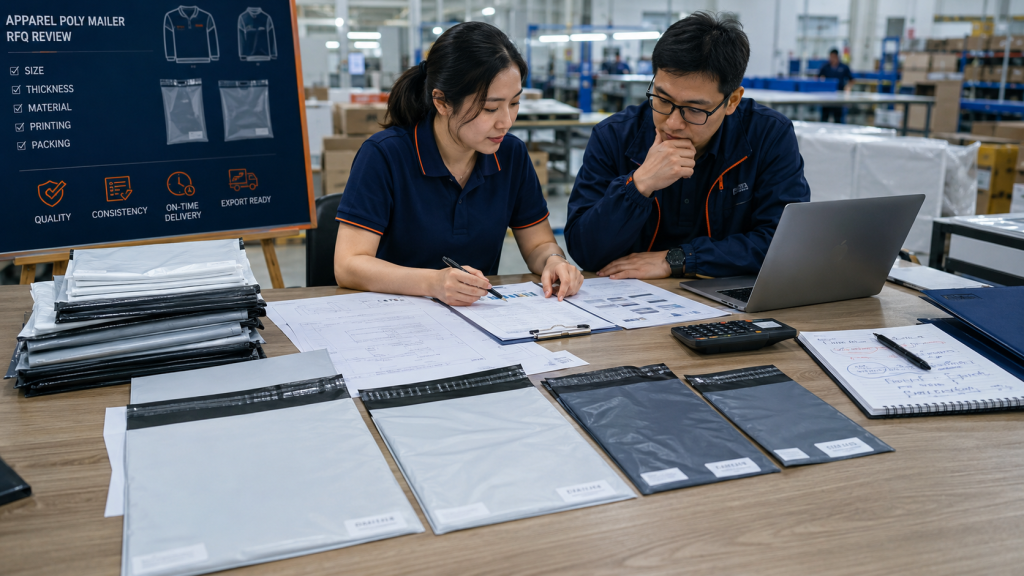
After reviewing this inquiry, Daipak tested a more structured RFQ review method for apparel poly mailers. The goal was not to slow the buyer down, but to separate a quick planning estimate from a production-ready quote. Before confirming a final quotation, the sales and production review needed eight fields:
- Bag size, including width, length, flap, and tolerance expectations.
- Material type and thickness, including whether any special structure is requested.
- Product type and folded garment dimensions for each main apparel category.
- Printing requirement, including artwork, color count, print area, and print position.
- Closure style, such as self-seal, resealable strip, or return-use design where applicable.
- Inner packaging requirement, including clear garment bags or other inserts.
- Carton packing plan, including pieces per carton, carton size limits, and label needs.
- Usage and delivery plan, including order quantity, monthly usage, destination, and warehouse receiving notes.
This eight-field method helped Daipak identify missing information earlier. It also helped the buyer understand why the quote changed: the supplier was not changing the basis randomly; the specification was becoming clearer. For repeat orders, the same checklist can reduce back-and-forth because the buyer can reuse confirmed bag sizes, artwork, carton packing, and warehouse information.
Compliance and Claim Boundaries for Apparel Mailers
Apparel poly mailers often appear simple, but some buyer requests need careful confirmation before production. If a buyer wants to describe a mailer as recyclable, recycled-content, biodegradable, compostable, or environmentally preferable, the claim should be checked against the actual material composition, local collection or processing conditions, label rules, and destination-market guidance. Environmental marketing claims should not be used only because a package “looks green” or uses a familiar material name; in the United States, environmental claims are addressed by the FTC Green Guides and should be properly qualified where needed.[3]
If the buyer asks for moisture resistance, the supplier should clarify the expected condition. A standard poly mailer may help reduce exposure to dust and light moisture during ordinary handling, but that is different from claiming waterproof or moisture-proof performance. If the garment is sensitive to humidity, long storage, sea freight conditions, or warehouse condensation, the packaging should be reviewed more specifically, and testing or additional barrier packaging may be needed before making performance claims. Water vapor transmission and conditioning methods are handled through defined test standards when formal evaluation is required.[4]
If the order involves children’s apparel, cosmetics, electronics, promotional items, or regulated products packed together with garments, the packaging discussion should not assume that a standard apparel mailer is automatically suitable for every use. Requirements may vary by product category and destination market. For electronics, anti-static or ESD performance should be confirmed separately before using that claim. For cosmetics or products with leakage risk, the inner package and closure system should be reviewed before relying on the outer mailer.
Food-contact, medical, pharmaceutical, hazardous goods, and lithium battery shipments require separate review and documentation where applicable. Daipak Packaging can supply packaging materials and discuss practical structure options, but it should not be treated as a regulator, testing laboratory, or certification body. If a package will be used for direct food contact, food-contact requirements should be confirmed before production because plastic food-contact materials are regulated differently from ordinary apparel shipping mailers in markets such as the European Union and the United States.[5]
How Buyers Can Avoid Three Quote Revisions
The easiest way to avoid repeated quote changes is to send a practical specification before asking for a final price. The specification does not need to be perfect at the first stage, but it should clearly separate confirmed details from open questions. For example, a buyer can say, “The bag size is estimated, artwork is not final, and carton packing needs supplier advice.” That tells the supplier to prepare a budget estimate rather than a production quote.
For apparel ecommerce orders, buyers can prepare a simple sample set before finalizing the mailer size. This may include the smallest garment, the bulkiest garment, the most common folded garment, and any garment with special packaging needs. If one bag size is expected to cover all items, the buyer should check whether the smallest items look overpacked and whether the largest items create seal stress. If several sizes are needed, the supplier can quote size groups instead of revising the entire project later.
Buyers should also confirm whether the outer mailer will ship directly as the courier package or be packed into cartons first. A direct-to-consumer mailer needs different review from a bulk carton shipment to a fulfillment warehouse. Parcel shipment may require attention to sealing, label placement, puncture risk, and handling conditions, while carton shipment may require carton strength, packing density, and pallet loading review. General carrier packaging guidance commonly emphasizes suitable cushioning, sealing, and preparation for the distribution method rather than relying on material name alone.[6]
A Practical RFQ Message Format
A clearer inquiry could look like this:
“We need printed apparel poly mailers for ecommerce orders. Estimated size is 10 x 13 inches plus flap, but we also ship hoodies and children’s clothing. Please advise whether one size is practical or whether two sizes are better. Material and thickness are open for review. Logo will print on one side, artwork to follow. We also need clear inner garment bags. Monthly usage is expected to be shared after our warehouse forecast is confirmed. Goods will ship to a U.S. fulfillment warehouse, and carton labels may be required.”
This message gives the supplier enough information to ask focused follow-up questions. It also protects the buyer from comparing quotes that are not based on the same assumptions, while current packaging industry news can help buyers recognize which specification details are commonly treated as standard in supplier discussions. One supplier may quote a thin plain bag, another may include printing, and another may include carton packing. Without a shared specification, the lowest number may simply reflect missing details.
What Daipak Learned From the May 2026 Case
The May 2026 inquiry showed that many quote revisions are not caused by negotiation alone. They are often caused by specification development. The buyer was not wrong to start with a simple request, and Daipak was not wrong to revise the quote after new details appeared. The problem was that the first conversation did not clearly label the price as preliminary.
Daipak’s updated approach is to tell buyers when a quote is an estimate and when it is ready for production confirmation. An estimate can be useful for budget planning, supplier comparison, and early project approval. A final quote should be based on confirmed drawings or dimensions, material, thickness, print file, packing method, quantity, shipping plan, and any documentation requirement that applies to the order.
For apparel buyers, this approach can make packaging decisions more predictable. The supplier can still respond quickly, but the buyer can see which missing details may affect price later. That is especially important when the packaging program includes printed mailers, inner garment bags, carton packing, and warehouse delivery requirements in the same order.
Buyer Checklist Before Approving Production
- Confirm the final mailer size with real folded garment samples.
- Approve material, thickness, color, closure, and printing artwork before mass production.
- Check whether one mailer size is enough or whether multiple sizes reduce waste and poor fit.
- Review inner garment bag needs separately from the outer shipping mailer.
- Confirm carton packing, carton labels, pallet needs, and warehouse receiving instructions.
- Use environmental, moisture, anti-static, or special performance claims only after the relevant material and documentation are confirmed.
A good poly mailer quote is not just a number. It is a record of assumptions. When the assumptions are clear, the buyer can compare suppliers more fairly, the supplier can prepare production more accurately, and both sides can reduce avoidable revisions before the order moves forward.
References
[1] FedEx, “FedEx General Packaging Guidelines,” carrier guidance covering package preparation, sealing, cushioning, and shipment handling considerations, available at FedEx General Packaging Guidelines.
[2] ASTM International, “ASTM D4169 Shipping Container Performance Testing,” standard practice reference for evaluating shipping containers and systems against distribution-cycle conditions, available at ASTM D4169 Shipping Container Performance Testing.
[3] Federal Trade Commission, “16 CFR Part 260 FTC Green Guides,” U.S. guidance for environmental marketing claims such as recyclable, compostable, degradable, and related packaging claims, available at 16 CFR Part 260 FTC Green Guides.
[4] ASTM International, “ASTM D4279 Water Vapor Transmission of Shipping Containers,” test method reference for water vapor transmission evaluation of shipping containers, available at ASTM D4279 Water Vapor Transmission of Shipping Containers.
[5] European Union, “EU Regulation 10/2011 Plastic Food Contact Materials,” regulatory reference for plastic materials and articles intended to come into contact with food in the EU market, available at EU Regulation 10/2011 Plastic Food Contact Materials.
[6] UPS, “UPS Packaging Guidelines,” carrier packaging guidance covering cushioning, sealing, labeling, and shipment preparation practices, available at UPS Packaging Guidelines.