
 By Chunjie Zheng, Technical Director, YK Door Industry · 17 years in fire door engineering · Technically reviewed by Yulin Zhang, General Manager
The short answer: A CNAS accredited test lab is a laboratory accredited by China’s national accreditation body to ISO/IEC 17025 for specific test methods. CNAS signs the ILAC mutual recognition arrangement, so its accreditation is recognized internationally. Check the certificate number, its validity and, above all, the scope schedule: the lab is accredited only for the methods listed there. Confirm the site and the method’s edition too.
Many door test reports come from laboratories in China, especially for acoustic, airtightness, water penetration and material tests. Reviewers outside China sometimes reject them on instinct, and sometimes accept them without a second look. Neither is a good habit. Accreditation gives a clear, checkable answer to the question that matters: was this laboratory independently assessed as competent to run this particular test? Three checks answer it. For how a test report fits into the wider question of what supplier documents prove, see our guide to verifying door test reports.
Three checks before you trust a report
The first check is recognition: is the accreditation body itself recognized internationally? The second is the certificate: is the laboratory’s accreditation real and current? The third, and the one most often skipped, is scope: is the laboratory accredited for the exact test method in the report? A report can come from a fully accredited laboratory and still fall outside its accreditation, because accreditation is granted method by method.
What a CNAS accredited test lab is
CNAS, the China National Accreditation Service for Conformity Assessment, is the national body that accredits testing and calibration laboratories in China against ISO/IEC 17025, the international standard for laboratory competence. CNAS is a signatory to the ILAC Mutual Recognition Arrangement for testing, which means its accreditations are recognized by the other signatory bodies, such as accreditation bodies in the United States and Europe; the ILAC signatory search lists CNAS’s testing accreditation under ISO/IEC 17025 with a signing date in November 2000 [1]. An example CNAS certificate states that the laboratory is accredited in accordance with ISO/IEC 17025:2017 and that the scope of accreditation is detailed in the attached schedule bearing the same registration number [2].
Recognition through ILAC does not make every Chinese report acceptable everywhere. It means the laboratory’s competence was assessed to the same international standard as a laboratory accredited in the reviewer’s own country. Whether a project accepts the report still depends on the specification and the authority having jurisdiction.
The certificate and its scope schedule
A CNAS certificate on its own tells you little. The schedule attached to it, under the same registration number, lists the tests the laboratory is accredited to perform, usually by standard and sometimes by product or parameter [2]. Laboratories are not accredited to test to any standard; each one is issued a scope of the standards it is authorized to test to [3].
To verify, ask the supplier for the laboratory’s legal name, site address and registration number, then check them against the CNAS online directory, confirm the expiry date, and open the schedule [3]. The certificate and schedule should match the laboratory named on the test report.
Matching the scope to the door test
This is where most problems hide. Find the test method in the report, for example EN 1634-1, ASTM E90 or EN 1026 (the air permeability test behind an EN 12207 class), including the edition, and look for it in the schedule. If it is not there, ask the laboratory how the test is covered, including any flexible scope or edition transition; a laboratory accredited for other tests is not automatically accredited for this one. Check the site address as well, because large laboratory groups may hold accreditation for a method at one site but run the test at another. Accreditation bodies make the same point in their own guidance: scope defines what a laboratory is accredited to do [4].
A report issued within scope usually carries the accreditation body’s mark. A report without the mark, or with a statement that some tests are outside the accreditation, deserves a closer look. Neither is automatically unacceptable, but the reviewer should know.
From the factory floor
With a test report we send the laboratory’s accreditation page, specimen photographs and the test curves. What the reviewer is really asking is whether the laboratory is qualified for that standard, and one accreditation page answers it.Chunjie Zheng, Technical Director
What accreditation does not prove
Accreditation proves the laboratory is competent to run the test. It does not prove the product is certified, and it does not extend the report beyond the specimen tested. A report from an accredited laboratory is still a test report, and the right wording for the product is “tested to” the standard [4].
We word our own evidence on this basis. Every performance claim we make lands on one of four evidence levels: designed, tested, certified or project-accepted. Third-party test reports are named by standard and model and worded as “tested to,” and each submittal includes a model-by-model evidence index that lists the report, the laboratory and the scope for each door type. Our current list of certifications and reports is on our page of door certifications and test reports.

CNAS and CMA: two marks on one report
Test reports from Chinese laboratories often carry two marks. CNAS is China’s national accreditation body for laboratories, and its accreditation to ISO/IEC 17025 is recognized internationally through the ILAC mutual recognition arrangement, which is why some reports also carry the combined ILAC-MRA mark [1]. CMA is the Chinese metrology certification that laboratories need before issuing test data to the public in China. The two answer different questions. CNAS accreditation, with its scope schedule, is the one that tells an overseas buyer the laboratory is competent for the specific test; CMA concerns the legal qualification to issue certain data in China.
A report that carries only a CMA mark may be perfectly valid for a domestic purpose, but an overseas reviewer will usually ask for the CNAS scope. Asking for it at the start saves a review round.
A worked example: accredited, but not for this test
A supplier sends a fire test report from a laboratory with a CNAS certificate. The certificate is genuine and in date. The scope schedule, however, lists building material tests such as reaction to fire and thermal conductivity, but not EN 1634-1 or GB/T 7633, the fire resistance tests for doors. The laboratory is accredited, but not for this test. Unless the report states that the test was carried out under accreditation and the scope covers it, the accreditation adds nothing to this report.
The same check applies to editions. A laboratory accredited for an older edition of a standard may not yet be accredited for the current one. The report should cite the edition, and the scope schedule should list it.
Reports from laboratories outside China
The same logic applies everywhere. UKAS accredits laboratories in the United Kingdom, and its schedules list the tests covered; IAS accredits testing laboratories in the United States and elsewhere and publishes their scopes [4]. A European notified body is a separate role, checked in the NANDO database for the product areas it is notified for. Each accreditation body is a signatory to the ILAC arrangement [1], which is what allows a reviewer in one country to accept a report from a laboratory accredited in another.
Mistakes when judging laboratory accreditation
The commonest mistake is checking the certificate and not the scope. The second is accepting a report without the accreditation mark when the laboratory holds accreditation but did not perform this test under it. The third is ignoring validity dates. The fourth is confusing a laboratory’s accreditation with product certification; a competent laboratory proves the test was done properly, not that production matches the specimen.
Frequently asked questions
Is CNAS recognized outside China?
Yes. CNAS is a signatory to the ILAC mutual recognition arrangement, so reports from CNAS-accredited laboratories within their accredited scope are recognized by other signatories’ systems [1]. Acceptance for a particular project still rests with the reviewer.
Where do I find a laboratory’s scope?
The accreditation body publishes it, usually as a schedule linked to the certificate number. The laboratory should also provide it on request.
Does a CMA mark prove competence for an export test?
CMA is a legal requirement for data issued in China. For overseas review, the CNAS scope is the more useful document.
Can a manufacturer’s own laboratory be accredited?
Yes, a factory laboratory can hold ISO/IEC 17025 accreditation for routine tests. For fire resistance tests used in certification, independent laboratories are normally required.
What if the laboratory’s accreditation has lapsed since the test?
The report remains a record of the test. Whether it is still accepted depends on the scheme and the reviewer, so check the status at the test date.
Our test laboratories
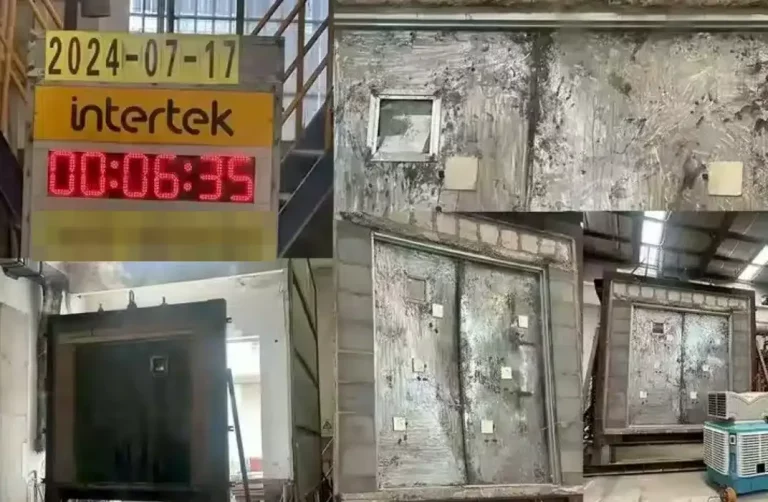
Our fire test evidence comes from laboratories accredited for the tests concerned: UKAS-accredited laboratories in the United Kingdom, a European notified body for extended application and CE work, and CNAS-accredited national testing centers in China for tests such as our blast door test. Each report is supplied with the laboratory’s accreditation page, specimen photographs and the test curves.
How to verify a CNAS certificate yourself
The quickest check is the directory. Take the laboratory’s accreditation number from the report, usually in the form CNAS L followed by digits, and search it in the CNAS online directory of accredited laboratories. The directory shows the laboratory’s name and address, the validity of the accreditation and the scope schedule, which lists each accredited test by standard number and edition. Compare three things with the report: the laboratory name and address, the test standard and edition, and the test date against the accreditation period. Guidance on verifying ISO/IEC 17025 accreditation for suppliers recommends exactly these checks, because a certificate on its own does not show the scope [3].
If the laboratory cannot be found, or the scope does not include the test, ask the supplier for an explanation before the report goes any further in your review. Sometimes the answer is innocent, such as a recent change of laboratory name; sometimes it is not.
Witnessed tests and laboratory visits
For high-value or critical orders, some buyers ask to witness the test, either in person or by video. Accredited laboratories usually allow witnesses under controlled conditions, and a witnessed test adds confidence that the specimen was built as described. A visit to the laboratory also lets the buyer see the furnace, the instrumentation and the specimen preparation area. These steps are not required for routine orders, but they are worth considering when a door type will be repeated across a large program.
A short checklist for the reviewer
Before accepting a test report from any laboratory, a reviewer can run through five questions in order. Is the laboratory named, with an address and an accreditation number? Is the accreditation body a signatory to the ILAC arrangement? Does the scope schedule list this test and edition? Was the test date inside the accreditation period? Does the report carry the accreditation mark, showing that the test was performed under accreditation? Five yes answers mean the report can be relied on for its content; any no goes to the issuer for confirmation before the report is accepted. Recording the answers in the evidence index keeps the check visible to everyone on the project.
Ask for three documents with every test report
When a supplier sends a test report, ask for three things with it: the laboratory’s accreditation certificate, the page of the scope schedule that lists the test method, and the full report rather than a summary. With those in hand, the checks above take a few minutes. For reading the report itself, see how to read a fire door test report, and for the difference between tested, listed and certified, see listed, tested to or certified.
Sources
- ILAC, MRA signatory search. https://ilac.org/signatory-search/?q=c
- Example CNAS laboratory accreditation certificate (English), with scope schedule reference. https://www.complifegroup.com/wp-content/uploads/2024/12/CNAS-LABORATORY-ACCREDITATION-CERTIFICATEENG-1.pdf
- CASRAI, ISO 17025 accreditation: how to verify a supplier. https://casrai.org/guides/iso-17025-accreditation-verify-supplier
- International Accreditation Service, Testing Laboratory Accreditation FAQs. https://www.iasonline.org/ias-testing-laboratory-accreditation-faqs/