 By Chunjie Zheng, Technical Director, YK Door Industry · 17 years in fire door engineering · Technically reviewed by Yulin Zhang, General Manager
The short answer: Fire door extended application (EXAP) is a documented assessment, under the EN 15269 series, that extends a fire test result to doors that differ from the tested specimen in size, hardware, glazing or other details. Without it, only the narrow field of direct application set by EN 1634-1 is covered. A larger door is not automatically included. Match the project configuration to the classification and assessment limits before manufacture.
“It passed 90 minutes at 1,000 mm wide, so it will be fine at 1,300.” This sentence, or a version of it, sits behind many rejected European door submittals. It sounds reasonable: the same leaf construction, the same core, the same hardware, just a little wider. But a wider leaf bows more in a fire, the gaps at the latch side open further, and the hardware sees different loads. Whether the larger door still performs is a technical question with a formal answer, and in Europe that answer comes from extended application.
Direct application comes first
Every fire test standard for doors sets a small zone of variations that are covered automatically. For doors tested to EN 1634-1, this field of direct application allows limited changes from the tested specimen, generally ones that are known to make little difference or to make the door safer. These rules are based on the results of a single test, which is why they are deliberately narrow [1]. A classification report under EN 13501-2 records the classification and its field of application, and the standard’s scope includes classification based on extended application [5].
Anything beyond direct application needs more evidence. The choices are an extended application assessment, an additional test, or a design change that brings the project door inside what has already been proven. Where this fits into the wider question of what a test report covers is explained in our guide to verifying what a door test report proves.
Fire door extended application under EN 15269
The EN 15269 series sets the rules for extending test results from fire-resisting and smoke-control doorsets to products that differ from the tested specimen. Part 1 gives general principles and covers pedestrian and industrial doors and openable windows tested under EN 1634-1 and EN 1634-3 [1] [2]. The permitted variations relate to common constructions where testing experience shows such changes are safely accepted, and the extent of variation is generally conservative [2].
Product-specific parts then apply those principles to particular door types. Published parts exist for steel hinged doorsets and timber hinged doorsets, covering how far results can be extended for features such as classifications, glazing, louvres, side and overpanels, hardware and seals [3]. Part 20 addresses smoke control. The part that matters is the one for your product type and your performance: a fire-resistance extension for a steel door comes from the steel doorset part, not from the smoke-control part.
Who issues an extended application, and what it looks like
An extended application assessment is prepared by a body competent to do it, typically the laboratory that ran the original tests or a notified body, using the rules in the relevant part of EN 15269. The output is an extended application report, followed by a classification report that cites both the test reports and the extended application report. An example from ift Rosenheim shows this structure: the classified product, the supporting test and extended application reports, and the classification and field of application [4].
For buyers, the practical point is that the classification report should list every document it relies on. If a supplier says a size is “covered by EXAP,” ask for the classification report that names the EXAP report, and check that the project door falls inside the stated field of application.
The hard part: several changes at once
Single variations are often straightforward. Projects rarely ask for just one. A typical request might combine a wider leaf, a taller leaf, a larger vision panel and a different exit device on a pair. Each change may be within its own extension rule, but together they can move the door outside what any one rule contemplates. Extended application rules are written to be conservative, so combinations are where assessments become restrictive.
In those cases, a new test can be quicker and cheaper than a long assessment, especially if several projects need the same configuration. The decision is best made early, when door sizes are still being set, because a design change of a few centimeters can sometimes keep the door within proven limits.
From the factory floor
The out-of-scope requests we see most are pairs wider than 2400 mm overall, added vision panels and non-listed hardware. Steel doorsets are assessed under EN 15269-2 and timber doorsets under EN 15269-3; anything beyond those boundaries goes back to the furnace.Chunjie Zheng, Technical Director
What we hold
Our evidence for European fire doors is set out model by model. Our FD90 door is tested to EN 1634-1 as YK-S90. Our YK-S60-CE door is CE marked under EN 16034 with the classification EI2 60-C5 + Sa, DoP issued under AVCP System 1. Steel doorsets are extended under EN 15269-2 and our timber doorsets under EN 15269-3; our EN 15269-20 assessment covers smoke control only, not fire-resistance size extension, and we describe it that way. For any project size outside our tested and classified limits, we say so at quotation and propose the route. The European testing route is described on our page about CE marked fire doors to EN 16034.
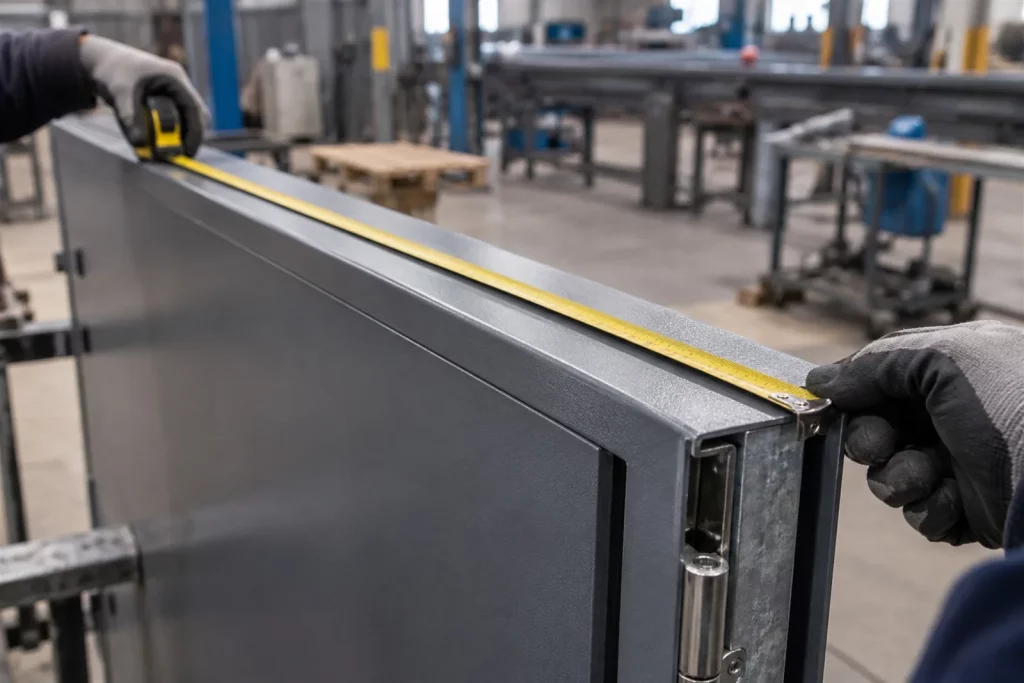
What an extended application can and cannot change
An extended application assessment works inside a stated boundary. Within it, the assessor may accept larger sizes, different hardware from an approved list, added glazing within limits, or alternative frames, each supported by the original test data and the rules of the relevant part [1]. Outside it, the answer is a new test. The draft of EN 15269-2 for steel hinged doorsets illustrates how detailed those rules are, covering dimensions, components and the effect of each change on integrity and insulation [3].
For changes to the core, leaf thickness or construction, ask the assessor whether the applicable part and supporting tests allow the variation; where they do not, the route is a redesign or a new test. Ask before the door schedule is frozen.
Steel, timber and smoke: three different parts
The EN 15269 series is split by door type and by property, and the parts are not interchangeable. EN 15269-2 covers fire resistance of hinged and pivoted steel doorsets, EN 15269-3 covers hinged and pivoted timber doorsets, and EN 15269-20 covers smoke control only. A smoke control assessment says nothing about how long a door resists fire, and a steel assessment says nothing about a timber door. When a supplier cites an EN 15269 assessment, check which part it is and which property it extends.
A worked example: from a tested leaf to a larger one
A steel leaf was tested at 1,000 × 2,200 mm and achieved EI2 90. The project needs 1,200 × 2,400 mm. If that increase falls outside the report’s direct application limits, the manufacturer asks the laboratory or notified body for an assessment under EN 15269-2. The assessor reviews the temperatures, deflections and gaps recorded in the test, applies the rules for increased size, and states in the report the maximum size, the hardware and glazing allowed, and any conditions. The classification report is then reissued to cite both the test and the assessment [4].
The buyer receives three documents that belong together: the test report, the extended application report and the classification report. The schedule line is covered only if the door falls inside every limit in the assessment.
Mistakes buyers make with extended application
The most common mistake is assuming that one assessment covers every variation the supplier offers. The second is accepting a smoke control assessment as evidence for a larger fire door. The third is combining several changes, such as a bigger size, a vision panel and different hardware, when each was assessed separately but not together. The fourth is forgetting that an assessment is tied to the tested product and the manufacturer named in it. Keep the assessment with the door’s records for future reference. File the assessment with the door’s approved drawings.
Frequently asked questions
Who can issue an extended application?
Typically the laboratory that ran the original tests or a notified body competent for the product. The report names the body and the rules applied.
Does extended application have an expiry date?
It is tied to the standards and the tested product. When a standard is revised or the product changes, the assessment should be reviewed.
Can extended application cover a pair when only a single leaf was tested?
Only if the relevant part and the test data allow it. Pairs add meeting stiles and coordinators, which often need their own test.
Is extended application recognized outside Europe?
It is a European mechanism. US listings handle size and variations through the listing agency’s own procedures.
What should I ask a supplier for?
Ask for the test report, the extended application report and the classification report, and check that your door sits inside the stated limits. If any of the three is missing, the chain of evidence is broken.
Our extended application evidence
Our steel fire door evidence is extended under EN 15269-2: the EN 1634-1 test of YK-S90 on a 1,000 × 2,200 mm specimen achieved EI2 90, with 93 minutes integrity and 91 minutes insulation, and the extended application assessment covers single leaves up to 1,200 × 2,400 mm (47 × 94 in.) and pairs up to 2,400 × 2,400 mm (94 × 94 in.) overall, within its stated glazing and hardware limits. Our timber fire doors, tested at FD30 and FD60, are extended under EN 15269-3 to single leaves of 1,200 × 2,400 mm. Our smoke control evidence is extended separately under EN 15269-20 and is quoted only for smoke leakage.
When a project size falls outside these limits, we say so at quotation and propose either a test or a project assessment. We do not describe a larger door as covered because it looks like the tested one.
How long an assessment takes
An extended application assessment is desk work by the assessor, based on existing test data, so it is usually quicker than a new furnace test. Allow weeks rather than days, because the assessor must review the full test data and apply the rules for each change, and may ask for supporting tests. Plan for it before the door schedule is frozen, not after the frames are ordered. Where the assessor concludes that the change is outside the rules, the routes left are a redesign or a new test, which adds the time to build, condition and test a specimen.
No direct equivalent in a US listing
US listings handle size differently. A UL or Intertek listing states the maximum sizes and configurations covered, and openings beyond those limits follow the agency’s own procedures for oversize doors, agreed with the authority having jurisdiction. There is no EN 15269-style assessment that a buyer can request separately. A door that is extended for a European project is not thereby covered for a US one, and the reverse is also true.
Check your largest door against the tested specimen before sizes are frozen
Before sizes are frozen, compare the largest and most complex door of each type on your schedule with the tested specimen. If it falls outside direct application, ask the supplier whether an existing extended application covers it, and for the classification report that proves it. How to compare a specimen with a project door is explained in how to read a fire door test report, and the notified body’s role in CE-marked doors is covered in notified bodies and AVCP System 1.
Sources
- Estonian Centre for Standardisation, EN 15269-1:2019, Extended application of test results for fire resistance and/or smoke control, Part 1: General requirements (scope). https://www.evs.ee/en/evs-en-15269-1-2019
- Swedish Institute for Standards, SS-EN 15269-1:2010 record (scope). https://www.sis.se/en/produkter/environment-health-protection-safety/protection-against-fire/fireresistance-of-building-materials-and-elements/ssen1526912010
- iTeh Standards, prEN 15269-2 (steel hinged doorsets) catalogue record. https://iteh.es/catalog/standards/cen/478aa070-4ab6-4e8d-9553-c7fa010e7658/pren-15269-2
- ift Rosenheim, example classification report on extended application, 23-002804-PR01 (published by AGC Pyrobel). https://agc-pyrobel.com/nl-nl/product-selector/dac672c6332502adf413135f56a8389b10461fc1/download/Ift_clas%20on%20EXAP_23-002804-PR01_EN.pdf
- Genorma, EN 13501-2:2023 standard record (scope). https://genorma.com/en/standards/en-13501-2-2023/amp