
When a wholesale packaging order is ready to ship, the main risk is usually not the product itself but the handoff between packing, freight, customs, and warehouse receiving. For buyers managing wholesale packaging negotiations with Chinese suppliers, this article focuses on the details buyers need to confirm before release: carton size, gross weight, CBM, labels, pallet use, moisture protection, and the documents that must match the actual shipment. Those choices affect freight cost, clearance speed, and whether the destination team can receive goods without repacking or delay.
It is especially useful for bulky but light materials such as bubble wrap, EPE foam, air cushion products, film, and flat-packed cartons, where volume matters as much as weight. The article also helps buyers compare shipping terms, understand what EXW, FOB, CIF, and DAP change in practice, and know what information to verify on invoices, packing lists, and loading records before the truck leaves.
Because export packaging touches freight, customs, receiving, and sometimes regulated end uses, buyers should separate practical packing decisions from unsupported product claims. A carton, pallet, liner, wrap, or protective material can help reduce handling risk when it is matched to the product and route, but it should not be treated as a guarantee against every carrier event, moisture condition, customs question, or warehouse mistake.
Quick Packaging Decision Guide
| Buyer Question | Practical Reading | What to Check |
|---|---|---|
| Is my shipment limited by weight or volume? | Light packaging often ships by CBM, not by kilos. | Carton size, compression limits, pallet plan, total loading space. |
| Do I need pallets or can I ship loose cartons? | Pallets improve handling, but they add space and cost. | Warehouse receiving needs, stackability, forklift access, pallet height. |
| What documents must match the cargo? | Paperwork errors can delay customs and receiving. | Invoice, packing list, HS code, carton count, weights, CBM, trade terms. |
| How does moisture affect export packing? | Humidity can weaken cartons, labels, straps, and pallets. | Storage condition, container condition, loading timing, protective wrap. |
| Which shipping term fits my team? | The right term depends on who controls freight and export handling. | Forwarder coordination, freight visibility, destination receiving responsibility. |
| How do I reduce receiving mistakes? | Clear marks and matching records make unloading smoother. | SKU labels, shipping marks, carton photos, seal number, loading count. |
Quick Answers Before You Read
Quick Questions Before You Read
Q: Why does export packaging need to be decided before final packing?
Because carton size, marks, pallets, and documents all affect freight, clearance, and receiving.
Q: Do lightweight packaging products still need careful shipping planning?
Yes. Bubble wrap, foam, and film can be costly to ship if the CBM is not controlled.
Q: What should I send to the supplier before shipment?
Share product details, packing method, destination needs, and any labeling or pallet rules.
Q: Why compare shipping terms instead of only comparing product price?
Because export responsibility, freight visibility, and destination costs can change the real landed cost.
Why Export Shipping Changes the Way Packaging Materials Must Be Prepared
Export shipping changes the job of packaging preparation because the shipment must survive more than production packing. A buyer may approve the correct bubble wrap roll, EPE foam sheet, air cushion film, poly mailer, garment bag, stretch film, or corrugated box, but the order can still arrive with crushed cartons, deformed rolls, wet outer boxes, or unclear shipping marks if export handling is not planned early. For wholesale packaging export documents and shipping terms for packaging materials, the physical packing and the paperwork need to describe the same shipment clearly.
This matters even more for bulk packaging materials imported from China because many packaging products are light but bulky. A carton of foam sheets may have low gross weight but occupy large space. Bubble wrap rolls may be difficult to stack neatly if the roll diameter and carton size are not controlled. Corrugated boxes shipped flat can look simple, yet the bundles may shift or bend during loading if they are not strapped or packed correctly. A low unit price can become less attractive if the freight volume is high, the cartons are hard to handle, or the destination warehouse spends extra time sorting mixed goods.
At Daipak, export packing discussions usually start before the final cartons are sealed. As a China packaging materials supplier, Daipak may need to confirm carton size, gross weight, roll diameter, pallet method, shipping marks, and document information with the buyer before shipment preparation. These details are not administrative extras. They affect container loading, LCL handling, warehouse receiving, and the chance of document mismatch during customs clearance.
For custom packaging, the export discussion should also include the product that the packaging will eventually protect. A foam insert for painted metal parts, a bubble bag for glossy electronics, and a poly mailer for apparel do not create the same packing risk. Size, weight, sharp corners, surface finish, scratch sensitivity, and dust tolerance all influence whether the material should be wrapped, separated, lined, bundled, or packed in a stronger outer carton before export.
Packaging materials are often damaged by handling, not product defects
Many arrival problems with packaging materials do not come from the product itself. They happen because the cargo passes through trucking, warehouse transfer, port handling, sea transit, unloading, and destination delivery. Loose cartons may be squeezed during consolidation. Tall stacks may lean. Soft foam products may compress under heavier cartons. Bubble wrap rolls may lose shape if the carton wall is weak or if the roll is loaded under pressure for a long trip.
Outer carton condition also affects how the goods are received. A plastic bag or stretch film product may not be ruined by brief moisture exposure, but a wet carton can tear, collapse, or lose its label. If carton marks are mixed, covered, or inconsistent with the packing list, the buyer’s warehouse may need extra time to identify SKUs, count cartons, and separate sizes or colors. The risk is not only product damage; it is also receiving confusion and shipment dispute.
Lightweight cargo can still create high freight cost
Packaging materials often create freight cost through space rather than weight. CBM, carton dimensions, pallet height, and container utilization can matter as much as gross weight. A shipment of air cushion film rolls, EPE foam, or bubble wrap may fill container space quickly while staying far below the container’s weight limit. In LCL shipping, bulky cartons can also increase cost because freight is often charged by volume when volume is the limiting factor.
Buyers should look at the landed cost per usable unit, not only the product price per roll, sheet, bag, or carton. If cartons are oversized, if roll diameters are not planned, or if pallet height creates unusable air space, the order may ship fewer units per container. For a distributor or e-commerce packaging wholesaler, that can affect margin, inventory planning, and warehouse storage after arrival.
Export readiness should be confirmed before final packing
Export readiness should not wait until the goods are already packed. Once cartons are sealed, it becomes harder to change carton size, reduce carton weight, add inner bundling, revise marks, or adjust pallet plans without extra handling. The better approach is to confirm the export packing method while production is still being arranged.
Before final packing, buyers should confirm the carton specification, expected gross weight, pallet requirement, moisture-control method, shipping marks, invoice and packing list information, and agreed trade term. If the freight forwarder needs carton dimensions or pallet details for booking, those details should be checked before the final quantity is locked. If the destination warehouse requires pallet labels, delivery references, or carton numbering, those requirements should reach the supplier before mass labeling starts.
For repeat orders, buyers should not assume the previous packing method is automatically correct. A small change in film thickness, foam density, roll length, bag size, printing coverage, or carton quantity can change gross weight, carton bulging, stackability, and CBM. The safer practice is to reconfirm the specification sheet, packed sample photos, carton marks, and loading data whenever the product size, material structure, or shipping method changes.
Keep one confirmed record from inquiry to loading
A practical shipment record starts with the buyer’s product details, then moves through the supplier’s confirmed material, thickness, density, structure, printing, labels, carton plan, and pallet requirement. When those details are kept in one agreed version, the sample review, production order, packing table, and shipping documents are easier to align.
That connection gives the supplier a clearer basis for production checks and finished product review. It also helps the buyer see whether the packed goods still match the approved sample or drawing before the shipment is released. If the carton size, mark format, or packing count changes after confirmation, the difference should be checked against the latest approved version rather than memory.
Specification Confirmation Note: Before production and export packing, buyers should confirm size, thickness, density, structure, quantity, printing, labels, carton method, and pallet requirements in writing so the packed goods, shipping marks, and documents are based on the same specification.
How Carton Strength and Packing Limits Protect Packaging Materials in Transit
Export carton strength is a practical protection decision, not just a box-buying detail. Wholesale packaging cartons may look similar from the outside, but their performance can differ during stacking, forklift movement, LCL consolidation, and long-distance transit. The carton has to hold the product, protect its shape, keep labels readable, and support the loading plan without creating unnecessary freight volume.
The right carton depends on the product form and shipping method. A normal carton may be enough for some compact plastic bags or small inner packing products. Stronger corrugated export cartons, reinforced sealing, reduced carton weight, or palletization may be worth considering for deformation-sensitive rolls, compressible foam, flat-packed corrugated products, or custom protective packaging that must arrive in a specific shape. Heavy-duty packing is not automatically better, but underbuilt cartons can turn a clean production order into an arrival damage problem.
Buyers should ask for practical packing details before shipment: carton dimensions, gross weight per carton, approximate quantity per carton, sealing method, stacking direction, and whether the cartons are intended for pallet loading or loose loading. If edge crush or burst strength information is available, it can help the buyer and supplier compare options, but the key decision is still whether the carton can handle the real route and handling method.
Carton strength should be treated as a condition-specific decision rather than a material-name guarantee. Compression resistance can be evaluated through standardized shipping-container compression testing, but the result is only meaningful when it is considered with the actual carton design, load direction, stacking time, humidity exposure, and handling route.[1]
When the order includes finished protective packaging for a buyer’s own products, the carton should be reviewed together with the inner protection. Void filling, wrapping, separation sheets, foam pads, bubble layers, or air cushion protection may be needed to stop movement inside the carton. A carton can be strong enough on paper but still fail in practice if the contents slide, rub, or concentrate pressure on one corner during truck vibration and container movement.
Match carton strength to product form and deformation risk
Different packaging products create different carton challenges. Bubble wrap rolls, stretch film rolls, and air cushion film rolls can deform if the carton is too weak or if pressure is applied unevenly. Plastic bags and poly mailers are more compact, but cartons can become heavy if too many pieces are packed together. EPE foam sheets and foam bags are light, yet they can compress when stacked under heavier cargo. Flat-packed corrugated boxes may need bundling or strapping to prevent shifting, edge damage, or uneven stacks.
Custom protective packaging needs special attention because the shape often matters. Foam inserts, air column structures, and die-cut protective parts may lose value if they are bent, crushed, or mixed inside the carton. In these cases, the carton should be selected as part of the protection system. Inner bundling, dividers, poly liners, or a stronger outer carton may be needed depending on product shape, surface finish, and how many times the cartons will be handled before arrival.
Set carton weight and size limits before production packing
A carton that is too heavy may fail during manual handling even if the board looks acceptable. Workers may drop it, lift it from one side, or stack it unevenly. A carton that is too tall may buckle under compression. A carton that is too large may contain empty space that allows the product to move inside, or it may be difficult to place tightly in a container. These are common reasons for crushed cartons and inconsistent arrival condition in bulk packaging orders.
Carton limits should be discussed before production packing starts. Buyers can ask the supplier to recommend a practical gross weight per carton and a carton size that supports both handling and freight planning. The answer may vary by product. Compact mailer bags may allow more pieces per carton than foam sheets. Bubble wrap rolls may need carton sizes based on roll diameter. Flat-packed corrugated boxes may need a balance between bundle weight, stack height, and loading efficiency.
For LCL shipments, carton strength and size become even more important because the goods may be loaded, unloaded, and reloaded with cargo from other suppliers. Loose cartons that are too weak, too tall, or poorly sealed face more risk during consolidation. If the order is valuable, deformation-sensitive, or difficult to sort after damage, palletizing or stronger cartons may cost less than dealing with arrival problems.
Use packing photos to confirm real carton condition
Packing photos are a simple way to check whether the agreed packing method has been followed. Buyers should request photos that show sealed cartons, carton labels, stack direction, packed quantity, and any pallet preparation if used. Photos should be clear enough to identify the product, carton mark, and packing condition, not only a distant view of stacked boxes.
Useful photos can show whether cartons are overfilled, underfilled, bulging, dented, poorly taped, or stacked in a way that may cause compression. They can also help confirm that the carton number, item code, product description, and quantity match the packing list. For repeat orders, these records make it easier to keep packing consistent from one shipment to the next.

Photo confirmation does not replace proper inspection or freight insurance where needed, but it reduces avoidable surprises. If the buyer sees weak sealing, unclear labels, or unstable stacking before shipment, the issue can often be corrected while the goods are still at the supplier’s warehouse. After loading or arrival, the same correction becomes slower, more expensive, and harder to prove.
Use the approved sample and drawing as the control record
When the packaging is custom, the approved sample, drawing, or specification sheet should be the basis for finished-product review and packing review. That means the supplier checks the production result against the confirmed version before mass packing, not against an informal memory of what was discussed earlier.
This matters for traceability because the order file then connects the buyer’s requirement, the confirmed material choice, the production result, and the packed shipment. If the film thickness, foam density, print position, label size, or carton count changes, the supplier and buyer can see exactly which part of the record needs to be updated before shipment.
When testing language belongs in the purchase discussion
For high-value, fragile, or claims-sensitive shipments, buyers can ask whether the packaging plan should be validated against a distribution test method rather than judged only by sample appearance. ASTM D4169 is a standard practice for performance testing shipping containers and systems, while ISTA Procedure 3A is used for packaged products moving through parcel delivery systems; these references can help buyers and suppliers discuss transit simulation without promising that one test result guarantees every route or carrier outcome.[2][3]
Testing language should be used carefully in purchase orders and inspection records. A supplier can confirm carton construction, packed photos, drop or compression observations, or test reports when available, but buyers should avoid wording such as “damage-proof” or “guaranteed safe arrival.” A more defensible requirement is to define the expected packing method, carton strength target if applicable, pallet condition, label format, and route-specific handling assumptions before shipment.
When Pallets, Stretch Wrap, and Strapping Are Worth the Extra Cost
Palletizing packaging materials is useful when handling protection and receiving efficiency are more important than maximizing every inch of container space. Pallets help keep cartons together, reduce repeated manual handling, and make forklift movement easier. They are especially helpful for LCL cargo, destination warehouses that require pallet receiving, and cartons that are easy to crush when handled loose.
At the same time, pallets are not always the best choice. They add cost, weight, and height. They may reduce loading quantity, especially for bulky packaging materials such as bubble wrap, foam, and flat-packed corrugated boxes. If a palletized load cannot be stacked safely, the empty space above it may become paid freight space. The practical judgment is simple: choose palletizing when the reduction in handling risk and receiving labor outweighs the lost loading space and extra packing cost.
Before approving pallets, buyers should confirm pallet size, material, maximum pallet height, whether destination rules require treated wood or non-wood pallets, and whether the warehouse can receive the chosen pallet format. Where wood packaging rules apply, the buyer and forwarder should confirm requirements before packing. Pallet marks, carton direction, stretch wrap method, and strapping should also be discussed before the goods are prepared.
For international shipments using solid wood pallets, crates, dunnage, or other wood packaging material, buyers should check whether ISPM 15 treatment and marking rules apply before loading. IPPC ISPM 15 sets the international phytosanitary framework for wood packaging material in trade, and USDA APHIS also provides wood packaging material guidance for U.S. import and export contexts.[4][5]
Pallets protect cartons during repeated handling
Pallets reduce the number of times individual cartons are touched. This matters during factory loading, trucking, port warehouse transfer, LCL consolidation, and destination unloading. A palletized shipment can be moved by forklift as a unit, which lowers the chance that single cartons are thrown, dragged, inverted, or stacked under unsuitable cargo.
For wholesale packaging materials, this can protect carton shape and label readability. Foam products, bubble wrap rolls, air cushion film, and lightweight corrugated cartons can be damaged by repeated compression even if the product is not fragile in the usual sense. Pallets can also help the buyer’s warehouse receive and count the shipment faster because cartons stay grouped by item, PO number, or SKU.
Pallet marks should be clear and consistent with carton marks. If a pallet contains mixed products, the label should not hide that fact. Buyers should ask whether each pallet contains one SKU, mixed SKUs, or a specific carton-number range. This avoids receiving errors when a warehouse team unloads the shipment quickly.
Pallets can reduce container utilization
The cost of pallet protection is often paid through space. Pallets raise the cargo height and may create air gaps if the carton stack does not match the container height. If the load is not stackable, the space above the pallet may be unusable. For light, bulky packaging products, this can affect freight cost more than the added pallet weight.
Buyers should compare loose carton loading and pallet loading before confirming the freight plan. Loose cartons may load more units into a full container, but they face more handling risk and can be slower to receive. Pallets may reduce damage and improve unloading, but they may increase CBM and lower total loading quantity. The best choice depends on product sensitivity, shipment mode, warehouse requirements, and whether the goods are going by FCL, LCL, air, or courier.
Pallet height deserves special attention. Very tall pallets may be unstable and difficult to wrap correctly. Very low pallets may waste vertical space. If the destination warehouse has rack height limits, forklift limits, or receiving rules, those details should be shared with the supplier before pallet packing begins.
Stretch wrap and strapping should stabilize, not crush, the load
Stretch wrapping export pallets should keep cartons together without deforming the products inside. Stretch film is useful for export packing because it helps protect the load from dust, light moisture exposure, and shifting during movement. But excessive wrap tension can crush soft cartons, dent roll products, or compress foam. The goal is stability, not maximum force.
Strapping also needs balance. Loose strapping does little, while overly tight strapping can cut into carton edges or deform flat-packed products. Corner protectors, edge boards, top boards, or protective sheets may be useful when cartons are soft, tall, or pressure-sensitive. For foam, bubble, and air cushion products, the supplier should check whether the load can handle strapping pressure before applying it as a standard method.
Cartons should not overhang the pallet if avoidable. Overhang exposes carton edges to impact and makes the pallet harder to wrap tightly. A clean pallet load usually has aligned cartons, readable labels, controlled wrap tension, and enough top protection to reduce dust and light splash exposure during handling. If the buyer needs pallet receiving, pallet labels should remain visible after wrapping or be added on the outside of the stretch film.
How Moisture Control Reduces Wet Cartons, Film Damage, and Arrival Claims
Moisture control for export packaging should be discussed before cartons are sealed, not after a wet carton appears at the destination warehouse. Ocean freight, port waiting time, humid storage areas, truck transfer, and rainy-season loading can all expose packaging materials to moisture. The risk is not always that the product itself becomes unusable. Often, the first visible problem is wet cartons during shipment, softened corrugated board, peeling labels, rusted staples or strapping, and cartons that cannot be handled safely by the receiving warehouse.
Different packaging materials react differently to moisture. Corrugated boxes, paper labels, and printed carton marks show damage quickly. Plastic bags, stretch film, PE film, bubble wrap, EPE foam, and many air cushion products may resist water better, but they still depend on dry outer cartons for stacking, counting, customs inspection, and warehouse receiving. If the outer carton collapses or the label becomes unreadable, a shipment can still create claims, delays, or repacking cost even when the inner goods are mostly intact.
Moisture risk starts before the container leaves the factory
Moisture exposure can begin at the supplier’s warehouse, loading area, or truck dock. Cartons stored directly on a damp floor, placed near an open doorway during rain, or loaded into a wet truck may already be weakened before they reach the port, which makes wholesale packaging MOQ planning more dependent on storage controls and supplier handling practices. For export orders, buyers should ask how finished cartons will be stored before loading, especially during rainy season or in regions with high humidity.
The container should also be checked before loading. A practical inspection looks for holes, water marks, unusual odor, damp flooring, damaged door seals, or visible rust flakes that may contaminate cartons. These checks do not make ocean freight moisture disappear, but they reduce avoidable problems. If the shipping route includes long port waiting time or humid destination conditions, buyers may also discuss container desiccants, pallet covers, inner poly bags, or water-resistant outer wrapping for selected cargo.
Loading timing matters as well. If loose cartons or pallets are moved between warehouse and container during heavy rain, even a short exposure can leave outer cartons damp. For bulk packaging materials, where many cartons may be light but large, the loading process can take longer than expected. A simple plan—keeping cartons under cover, staging cargo near the loading door, and closing the container promptly after loading—often prevents more problems than adding protection after cartons are already wet.
Plastic materials may survive while outer cartons fail
Buyers sometimes assume plastic film packaging is safe because the product itself is water-resistant. That assumption can be risky. Poly mailers, garment bags, stretch film, bubble wrap rolls, and EPE foam may not absorb water like paper, but the export carton still carries the product through stacking, customs checks, warehouse sorting, and final receiving. If the carton loses strength, the cargo can arrive deformed, mixed, or difficult to count.
For example, stretch film rolls packed in softened cartons may shift during unloading and damage the roll edges. Bubble wrap rolls can become flattened if the outer cartons collapse under stack pressure. Corrugated boxes shipped flat may arrive with warped bundles if moisture weakens the strapping or outer wrapping. Printed labels can smear or detach, which creates a receiving problem for mixed SKUs, private-label shipments, or distributor inventory.
The right moisture-control method depends on the product and route. Inner poly bags may help protect smaller items or printed bags from damp carton interiors. Pallet covers can reduce splash and condensation contact around palletized cargo. Water-resistant outer wrapping may help during truck transfer, but excessive tight wrapping may trap moisture if cartons are not dry before packing. Desiccants may be useful for some ocean shipments, but buyers should treat them as one part of a broader loading and storage plan, not a complete guarantee.

Photo records help separate packing issues from transit issues
Moisture claims are difficult to discuss if no one can show the condition of the cargo before departure. Useful photo records include sealed carton photos, pallet wrap photos, empty container inspection photos, loading-in-progress photos, and final loaded container photos. These records help show whether cartons were dry, labels were readable, pallets were wrapped, and the container appeared suitable at the time of loading.
Photos should show practical details, not only a closed container door. A buyer should be able to identify the item, carton mark, pallet condition, container floor, and loading arrangement. If a shipment arrives with damp cartons, these records help separate possible factory storage issues, loading exposure, port or vessel moisture, and destination handling problems. They do not replace insurance or carrier claim procedures, but they make the discussion more factual.
Receiving records also matter. Destination warehouse teams should note whether cartons arrived wet, soft, stained, or crushed, and they should take photos before repacking or discarding outer cartons. If only the damaged cartons are photographed after unloading, it may be harder to understand whether the issue affected the whole shipment, one pallet, or only cartons near the container door.
Set moisture expectations without overclaiming performance
Moisture-control wording should describe the method and the handling assumption, not promise a result that depends on the route. For example, a purchase record can say that cartons will be stored under cover before loading, pallets will be wrapped after cartons are dry, container condition will be photographed before loading, or inner liners will be used for selected items. That is more practical than calling a shipment moisture-proof without defining the material, exposure time, sealing method, and destination conditions.
If the buyer needs a specific moisture-barrier level for the final packaging application, that requirement should be confirmed separately before production. The supplier should review the material structure, sealing style, storage method, and any requested documentation before the buyer uses moisture-resistance language in sales materials or regulated product files.
Why CBM, Not Only Weight, Drives Freight Cost for Packaging Materials
Many packaging materials create freight cost because they occupy space, not because they are heavy. CBM for packaging materials is often a more important cost driver than gross weight, especially for bubble wrap, EPE foam rolls, air pillow film, garment bags, mailer bags, and flat-packed corrugated products. A shipment may look inexpensive by unit price but become costly after carton size, pallet height, and container loading are calculated.
Volume-based freight cost becomes more important when a product cannot be compressed, nested, folded, or stacked efficiently. A buyer should compare landed cost per usable unit, not only product price per roll, bag, sheet, or carton. If two packing options protect the product equally but one uses less carton space and loads more efficiently, the lower freight cost may be more valuable than a small material price difference.
Bulky lightweight cargo changes the freight calculation
Freight providers often look at space as well as weight. For sea freight, cargo volume affects container planning and LCL charges. For air freight and courier shipments, dimensional weight can make a light carton chargeable as if it were heavier. This is why bulky cargo such as bubble wrap rolls or thick EPE foam can cost more to ship than buyers expect from the gross weight alone.
Packaging products do not all behave the same. Air column bags before inflation may pack compactly, while inflated protective packaging takes much more space. PE bags and mailers may be dense in cartons, while foam sheets can be large and compressible but easily deformed if overpacked. Corrugated boxes shipped flat may stack efficiently when bundled well, but poorly sized bundles can waste container space or become unstable during loading.
Before confirming a bulk order, buyers should ask for estimated carton dimensions, gross weight, total carton count, and total CBM. For larger shipments, the loading quantity should be discussed before the final order quantity is locked. At Daipak, the packing and loading discussion for bulk orders usually starts with carton size, product form, and destination handling needs because those details affect freight as much as the product specification itself.
Carton size can change the landed cost per unit
A carton that is easy for production may not be efficient for freight. Excessive void space, uneven roll diameters, poor bundle sizes, and cartons that do not stack cleanly can leave air gaps in the container. The buyer still pays for that space. For packaging imports, wasted container space can raise the landed cost per usable unit even when the supplier’s unit price looks competitive.
Roll products are a common example. Bubble wrap, EPE foam, and stretch film need carton or roll dimensions that balance protection, handling, and loading efficiency. Oversized rolls may reduce packaging labor at the factory but become harder to palletize or load tightly. Smaller rolls may be easier to handle but may increase carton count, labeling work, and unloading time. There is no single best roll size; the better choice depends on the buyer’s warehouse handling method, resale unit, and freight plan.
Carton compression is another trade-off. Some foam and bubble products can be compressed to reduce volume, but too much compression may deform the material, affect appearance, or make rolls difficult to use after arrival. Buyers should confirm whether compression is acceptable for the product’s function and resale presentation. Saving CBM is useful only if the packaging material still performs as expected when unpacked.
Total packaging cost should include more than the material unit price. A cheaper carton that increases damage risk, a roll size that wastes container space, or unclear labels that add receiving labor can cost more after freight and warehouse handling are counted. Procurement teams should compare material cost, packing labor, carton count, freight CBM, pallet cost, unloading time, repacking risk, and possible claim handling before deciding that one quote is lower than another.
| Product Type | Freight Behavior | Loading Concern | Buyer Confirmation Point |
|---|---|---|---|
| Bubble wrap and EPE foam rolls | Light but bulky | Roll deformation and wasted air space | Roll diameter, carton size, compression limit |
| Poly mailers, garment bags, PE bags | Usually more compact | Carton weight and SKU mixing | Pieces per carton, gross weight, label format |
| Flat-packed corrugated boxes | Can stack efficiently if bundled well | Bundle bending, edge damage, pallet stability | Bundle size, strapping method, pallet plan |
| Air column bags before inflation | Compact before use | Carton identification and film protection | Roll or sheet format, carton marks, storage condition |
The main lesson is simple: carton design is part of freight planning. A buyer should not wait until the forwarder asks for final measurements to discover that the cargo volume is higher than expected.
FCL, LCL, air, and courier shipments have different volume risks
FCL shipments give the buyer more control over container loading, pallet layout, and cargo grouping. They can be efficient for bulky packaging materials if the order quantity is planned around container space. The risk is that weak cartons, unstable pallets, or poor loading sequence can still create crushing inside a full container.
LCL shipments are different because cartons or pallets may be handled several times during consolidation and deconsolidation. For light and bulky packaging products, this can increase both handling risk and cost. Palletizing may protect the cartons, but it can also increase CBM. Buyers need to decide whether the safer handling is worth the extra volume charge.
Air freight and courier shipments are useful when speed matters, samples are urgent, or the shipment is small. The cost basis, however, can be sensitive to dimensional weight. A large carton of lightweight foam or bubble wrap may be charged at a much higher weight than its scale weight. For urgent packaging materials, buyers should confirm carton dimensions before assuming air or courier freight is practical.
What Shipping Marks, Labels, and Carton Records Should Confirm
Shipping marks for export cartons are not decoration. They connect the physical shipment to the invoice, packing list, booking information, warehouse receiving plan, and sometimes the buyer’s internal inventory system. For wholesale packaging materials with multiple sizes, colors, roll lengths, printed versions, or custom SKUs, unclear marks can lead to mixed cartons, missing marks, wrong item codes, receiving errors, and delayed stock putaway.
Carton labels for packaging materials should be confirmed before mass packing, especially when one order includes several similar items. A roll of clear bubble wrap and a roll of antistatic bubble wrap may look similar after carton packing. Different mailer bag sizes may share the same outer carton style. Custom printed boxes may have small design differences that matter to the buyer’s sales channel. Clear carton records reduce the chance that the warehouse must open cartons one by one to identify the shipment.
If a label includes functional claims, the wording should be checked as carefully as the quantity. Terms such as antistatic, moisture barrier, food-contact, heavy-duty, recyclable, or compostable may require material confirmation or destination-market review before they are used on carton labels, retail labels, or resale documents. A practical label should identify the goods clearly without creating a claim the buyer has not verified.
Shipping marks should match the document set
The carton label, pallet label, packing list, commercial invoice, and booking details should tell the same story. The product description, SKU or model, carton quantity, gross weight, net weight, carton dimensions, destination, purchase order number, and total carton count should be consistent where they are used. If the packing list says 120 cartons but the pallet labels and loading record show a different number, the receiving team may treat the shipment as short or mixed even if the goods are physically present.
Buyers do not need to print every commercial detail on every carton. In some distributor shipments, neutral marks or private-label receiving marks may be preferred. The key is to agree on a label format that supports customs documents and warehouse receiving without exposing unnecessary sensitive information. If handling marks are needed, such as keep dry, do not crush, this side up, or pallet number, they should be applied consistently and in a place that remains visible after pallet wrapping.
For export shipments, label durability also matters. Labels should stay readable after normal handling, pallet wrapping, and possible humidity exposure. A label that looks clear at the packing table may fail if it peels from a dusty carton surface or is covered by stretch film in the wrong position. Buyers should confirm both the content and the placement.
SKU-level labels matter for mixed packaging orders
Mixed packaging orders create more label risk than single-item shipments. One container may include bubble wrap rolls, PE bags, stretch film, EPE foam sheets, and printed corrugated boxes. Even within one product family, there may be different thicknesses, widths, roll lengths, colors, printing versions, or packing quantities. SKU-level labels help the receiving warehouse separate goods quickly and reduce mistakes during resale, assembly, or internal distribution.
A practical label may include item name, SKU or model, specification, carton number, total cartons for that SKU, quantity per carton, gross and net weight, carton dimensions, purchase order number, and destination mark where needed. For palletized cargo, pallet labels should show which cartons or SKUs are on the pallet. This is especially useful when one pallet contains several smaller-volume items.
The risk is not only miscounting. If a warehouse receives mixed cartons with unclear marks, staff may open cartons for identification, damage the original packing, or place goods in the wrong inventory location. For printed bags, custom cartons, or packaging with customer-specific artwork, a wrong item code can create a sales or fulfillment problem long after customs clearance is complete.
Photo confirmation prevents surprises at arrival
Before loading, buyers should request clear photos of carton labels and pallet labels, especially for mixed orders or private-label shipments. The photos should show enough detail to read the label and understand how it is placed on the carton or pallet. A close-up label photo is useful, but it should be paired with wider photos showing cartons, pallet arrangement, and total packed condition.
Photo confirmation helps catch simple mistakes early: wrong SKU wording, missing purchase order number, incorrect carton sequence, unclear destination mark, or labels placed where stretch wrap will cover them. These issues are much easier to correct before the container leaves the factory than after the shipment reaches a destination warehouse.
Carton records should also align with the packing list. If the packing list separates items by SKU, the carton marks should support the same separation. If the buyer’s warehouse requires pallet-level receiving, the supplier should know that before packing is finished. Label planning is a small part of the order, but it can decide whether the shipment is received smoothly or becomes a manual sorting job at arrival.
Which Export Documents Packaging Buyers Should Check Before Shipment
Wholesale packaging export documents should match the physical shipment, not just the purchase order. For packaging materials, this matters because one order may include several product forms: bubble wrap rolls, EPE foam sheets, PE bags, stretch film, air cushion film, or corrugated boxes packed flat. If the document set says one thing and the cartons show another, the result can be customs clearance questions, incorrect duty calculation, payment delays, or receiving mismatches at the destination warehouse.
The main principle is simple: the shipping documents should tell the same story. They should agree on what was shipped, how many units and cartons were packed, the declared value, gross and net weight, CBM, buyer and seller details, shipment route, and trade term. A commercial invoice, packing list, bill of lading or airway bill, booking confirmation, HS code information, and certificate of origin where needed all support that same shipment record. If one document describes the goods as “plastic packaging” while another uses “PE mailer bags” and the cartons are marked with a different item code, the buyer may have to explain the difference during import review.
Commercial invoice and packing list must match the real shipment
The commercial invoice usually supports value, payment, and customs declaration. The packing list supports physical receiving and freight details. For export documents for packaging materials, these two documents should be reviewed together because packaging cargo is often bulky, mixed, and carton-count sensitive. A small error in carton quantity or CBM can affect warehouse receiving, freight billing, and customs paperwork.
Buyers should check that the product description is clear enough for import paperwork and internal receiving. “Bags” is often too vague if the shipment includes poly mailers, garment bags, inner liner bags, or printed PE bags. “Foam” may need to be clarified as EPE foam rolls, sheets, bags, or custom inserts. Corrugated boxes may need size, style, or printed/unprinted distinction. The wording does not need to be overloaded with technical detail, but it should be consistent and recognizable across documents and carton labels.
The packing list should also match the packed goods: carton count, pieces per carton, gross weight, net weight, carton dimensions, total CBM, and pallet count if pallets are used. If the buyer’s warehouse receives by SKU, the packing list should be arranged so the receiving team can identify mixed sizes, colors, roll lengths, or custom products without opening every carton unnecessarily. This is especially important for distributors and e-commerce packaging wholesalers that may split incoming goods into several inventory locations.
Before shipment, buyers can use a short review sequence:
- Product description: matches the order, carton labels, and intended import declaration.
- Quantity: matches the final packed quantity, not only the original order estimate.
- Carton count: matches the actual packed cartons or pallets ready for loading.
- Weight and CBM: align with the supplier’s packing data and freight booking.
- Trade term and shipment route: match the quotation, booking, and buyer payment process.
At Daipak, supplier-side documents are usually prepared from confirmed order and packing data, but buyers should still review drafts against their own import requirements. A supplier can provide commercial and packing information; the buyer or customs broker may need to confirm how that information should be used for local clearance.
HS codes should be checked before customs clearance
HS code information should be treated carefully because classification can depend on material, construction, use, and destination country interpretation. Packaging materials are not all classified the same way. PE bags, stretch film, bubble wrap, EPE foam, corrugated boxes, paper mailers, and composite packaging structures may fall under different classifications depending on how the goods are described and imported.
The supplier can often provide a commonly used export-side HS code or product description, but that does not automatically settle the import-side classification. The buyer’s customs broker should review the product material, product form, and destination rules when there is uncertainty. This is especially important when the shipment includes printed packaging, laminated material, adhesive products, coated paper, or custom protective packaging made from more than one material.
A document mismatch around HS code or product description can create several problems. Customs may request clarification, duty calculation may change, or the importer may need to amend paperwork after the goods arrive. If payment documents are involved, inconsistent product descriptions can also slow bank review or internal approval. The safest approach is to check classification questions before goods leave the factory or before the vessel departs, not after the cargo reaches the destination port.
Bill of lading details should match the booking and Incoterm
The bill of lading for sea freight, or airway bill for air freight, connects the physical shipment to the carrier record. For packaging imports, buyers should check that the consignee, notify party, port of loading, port of discharge, shipment mode, container number, seal number, and freight term match the booking and agreed trade term. A small error here can create larger problems when the buyer tries to release cargo at destination.
If the shipment is under FOB, CIF, or another agreed term, the freight wording and responsibility should be consistent with the commercial invoice and booking confirmation. If the buyer has appointed a freight forwarder, the forwarder’s booking details should also match the supplier’s loading information. For container shipments, container number and seal number should be checked against loading records. For LCL shipments, carton or pallet count should match the packing list and warehouse receipt information where available.
Buyers should also check whether the document description is too broad or inconsistent. A bill of lading may not list every SKU, but the general goods description should still align with the invoice and packing list. For example, if the invoice lists “EPE foam sheets and poly mailer bags,” a very different general description on the transport document can create unnecessary questions during clearance or cargo release.
Document review should happen before vessel departure when possible
Document corrections are easier before departure than after the shipment is already moving. Buyers should request draft documents early enough to review names, addresses, tax or registration details where applicable, product descriptions, quantities, carton count, weight, CBM, trade term, and destination details. This review does not need to be complicated, but it should be systematic.
For wholesale packaging shipments, final packing data may change slightly from the quotation stage because carton size, roll compression, pallet method, or mixed SKU packing can affect the final CBM and gross weight. The document set should be updated to reflect the final packed shipment. If the buyer uses the original estimated CBM while the forwarder books against final actual CBM, freight cost and receiving records may not match.
Early review also reduces amendment costs and communication pressure. Once the vessel departs or original documents are issued, changing consignee details, product descriptions, quantities, or freight terms may become slower and more expensive. A practical buyer should treat document review as part of shipment readiness, not as an afterthought after cargo loading.
Food-contact and regulated-use packaging needs separate confirmation
If the imported packaging will directly contact food, cosmetics, medical items, or other regulated products, buyers should not rely only on a general product name or export invoice description. Food-contact requirements depend on material composition, intended use, temperature, contact time, and destination market rules; the European Commission provides food contact material rules for the EU, and the FDA explains U.S. food packaging and food contact substance considerations for the United States.[6][7]
For these shipments, the document review should include the material specification, intended contact use, any declaration or test report requested by the buyer’s market, and whether the packaging is primary contact packaging or only secondary transport packaging. A poly bag used as an outer shipping sleeve is not the same compliance discussion as a liner that directly touches food, and a paperboard carton around a sealed product is not the same as paper packaging intended for direct food contact.
Special cargo should be reviewed before normal export packing is assumed
Some shipments need a separate logistics review before the supplier and buyer treat them as ordinary packaging cargo. If the packaging will be used with lithium batteries, electronics that require static-control handling, liquids, aerosols, chemicals, child-facing products, medical items, or other regulated goods, buyers should confirm the intended use and destination requirements before production and shipping documents are finalized. The packaging material alone does not decide whether the finished shipment is subject to special transport or market rules.
For hazardous goods or regulated transport, the buyer, forwarder, and qualified logistics parties should review the product classification, required packaging, marks, labels, declarations, and carrier acceptance rules before shipment. UN model regulations and U.S. hazardous materials transport rules provide transport compliance frameworks, but the correct shipment decision depends on the actual goods, route, and jurisdiction.[9][10]
How Incoterms Change Responsibility for Freight, Risk, and Export Coordination
Shipping terms for packaging materials affect more than the price line on a quotation. They decide who arranges pickup, who books freight, who handles export clearance, who receives carrier documents, who pays destination charges, and where risk transfers from seller to buyer. For bulky packaging cargo, these details matter because freight volume, loading records, and warehouse timing can influence both cost and arrival condition.
Incoterms for packaging imports should match the buyer’s logistics capability. A buyer with an experienced forwarder in China may prefer more control over freight, especially when planning a wholesale packaging process that involves samples, MOQ confirmation, quotation review, and bulk order coordination. A buyer without local pickup support may need the supplier to coordinate export-side delivery to port or provide more shipment-support information. No single term fits every order. The right choice depends on cargo type, shipment size, destination process, payment method, and how closely the buyer wants to manage freight cost and carrier communication.
EXW may shift more work to the buyer than expected
EXW can look simple because the supplier makes the goods available at the factory or warehouse. In practice, it shifts more coordination to the buyer and the buyer’s freight forwarder. The forwarder must arrange pickup time, local trucking, loading communication, export declaration support where required, and transfer from factory to port or consolidation warehouse. If the forwarder and supplier do not communicate clearly, cargo may wait, loading time may be missed, or documents may not be prepared in the format the forwarder needs.
For packaging materials, EXW can be especially demanding when the order is large, bulky, or packed on pallets. The forwarder needs accurate carton dimensions, pallet size, total CBM, gross weight, loading address, pickup contact, and loading conditions. If a truck arrives without knowing whether the goods are loose cartons, wrapped pallets, or oversized rolls, the pickup may take longer than expected. If the factory loading area has time restrictions or the cargo needs forklift handling, those details should be shared before pickup.
EXW can work well for buyers with strong freight control and a reliable China-side forwarder. It is less suitable when the buyer expects the supplier to handle port delivery, export coordination, or freight problem-solving without those responsibilities being included in the agreed term.
FOB can simplify export-side coordination
FOB is often practical for overseas buyers importing packaging materials because the supplier handles export-side delivery to the named port and supports export clearance under the agreed arrangement. The buyer still controls the main sea freight through a forwarder or carrier, but the factory-side movement from production site to port is more clearly coordinated by the seller.
For bulky cargo such as bubble wrap rolls, EPE foam, air cushion film, poly mailers, stretch film, and flat-packed cartons, FOB can help reduce confusion around local trucking and export documents. The supplier can coordinate factory loading, inland delivery, and export-side paperwork while the buyer’s forwarder manages the ocean shipment and destination process. This can create a cleaner communication flow, especially when the buyer wants visibility into container loading but does not want to manage every local pickup detail.
FOB still requires clear information exchange. The buyer or forwarder should confirm the booking, vessel schedule, cutoff time, shipping instructions, and document requirements. The supplier should confirm packed quantity, carton or pallet count, CBM, gross weight, loading time, and export document drafts. If either side treats FOB as automatic, errors can still happen.
CIF and DAP should be checked for hidden destination costs
CIF can be convenient because the seller arranges freight to the destination port and provides insurance under the agreed terms. However, buyers should not assume CIF includes every cost after arrival. Destination handling, port charges, customs clearance, duties, taxes, delivery from port, storage, demurrage, and local documentation fees may still belong to the buyer depending on the shipment and destination practice.
DAP can be even more convenient because the seller arranges delivery to a named destination address, but the buyer usually remains responsible for import clearance, duties, and taxes unless another arrangement is made. For packaging shipments, the destination address must be practical: warehouse access, unloading method, pallet acceptance, delivery appointment rules, and truck restrictions should be confirmed. A shipment of loose cartons may be handled differently from palletized cargo, and the delivery cost can change if the receiving site cannot unload efficiently.
Buyers should also check freight visibility. Under CIF or DAP, the buyer may have less direct control over carrier choice, routing, and freight cost structure. That may be acceptable for some shipments, but it should be understood before ordering. For volume-sensitive packaging materials, a small change in CBM, pallet height, or loading method can affect freight cost, so the buyer should ask how the shipment will be packed and quoted.
The trade term should match the forwarder’s role
The chosen trade term should match the real role of the freight forwarder. If the buyer’s forwarder is booking the vessel, issuing shipping instructions, and receiving loading data, FOB or a similar export-side arrangement may be more suitable than CIF. If the supplier is arranging the freight, the buyer should confirm what documents, tracking information, insurance details, and arrival notices will be provided.
Before confirming the shipment, buyers should ask direct questions: Who books the freight? Who pays local trucking? Who handles export clearance? Who receives the bill of lading draft? Who checks the container and seal number? Who manages amendments if the consignee or notify party is wrong? Who pays destination charges? These questions prevent assumptions that can lead to delayed cargo release or unexpected fees.
Daipak can coordinate with buyer-appointed forwarders or provide shipment-support information according to the agreed term, but the buyer should still align the forwarder, payment process, and document expectations early. The trade term is not only a pricing label; it is the operating plan for how the shipment moves from packed cartons to destination receiving.
How Container Loading Records Help Prevent Disputes and Arrival Damage
Container loading records give buyers a practical view of what was loaded, how the cargo was arranged, and whether the shipment data matches the documents. For packaging materials container loading, this is especially useful because many products are bulky, light, and sensitive to compression. A container may be full by volume long before it reaches its weight limit, so loading sequence and space use can affect both freight efficiency and arrival condition.
Good container loading records do not need to become excessive paperwork. They should provide enough evidence to support communication if there is arrival damage, missing cartons, container waste, or a shipment dispute. Useful records may include empty container inspection photos, loading-in-progress photos, final loaded container photos, container number, seal number, carton count, pallet count, and a loading list. These records support the shipment file, but they do not replace proper cargo insurance, carrier procedures, or destination receiving checks.
Useful loading photos show sequence and condition
Loading photos should show more than a closed container door. A buyer should be able to see the condition of the empty container, the first rows of cartons or pallets, mid-loading arrangement, final loaded position near the door, and the seal after closing. For palletized shipments, photos should show pallet wrapping, labels, pallet count, and whether cartons stay within the pallet footprint. For loose carton loading, photos should show stack direction and whether cartons are being pressed or distorted.
The empty container photo is useful because it can show whether the container appeared clean, dry, and free from obvious holes, water marks, strong odor, or floor damage before loading. It does not prove everything that happens later in transit, but it creates a starting record. Loading-in-progress photos help show sequence, product identity, and whether heavy or rigid cartons were placed in a way that could crush softer packaging materials.
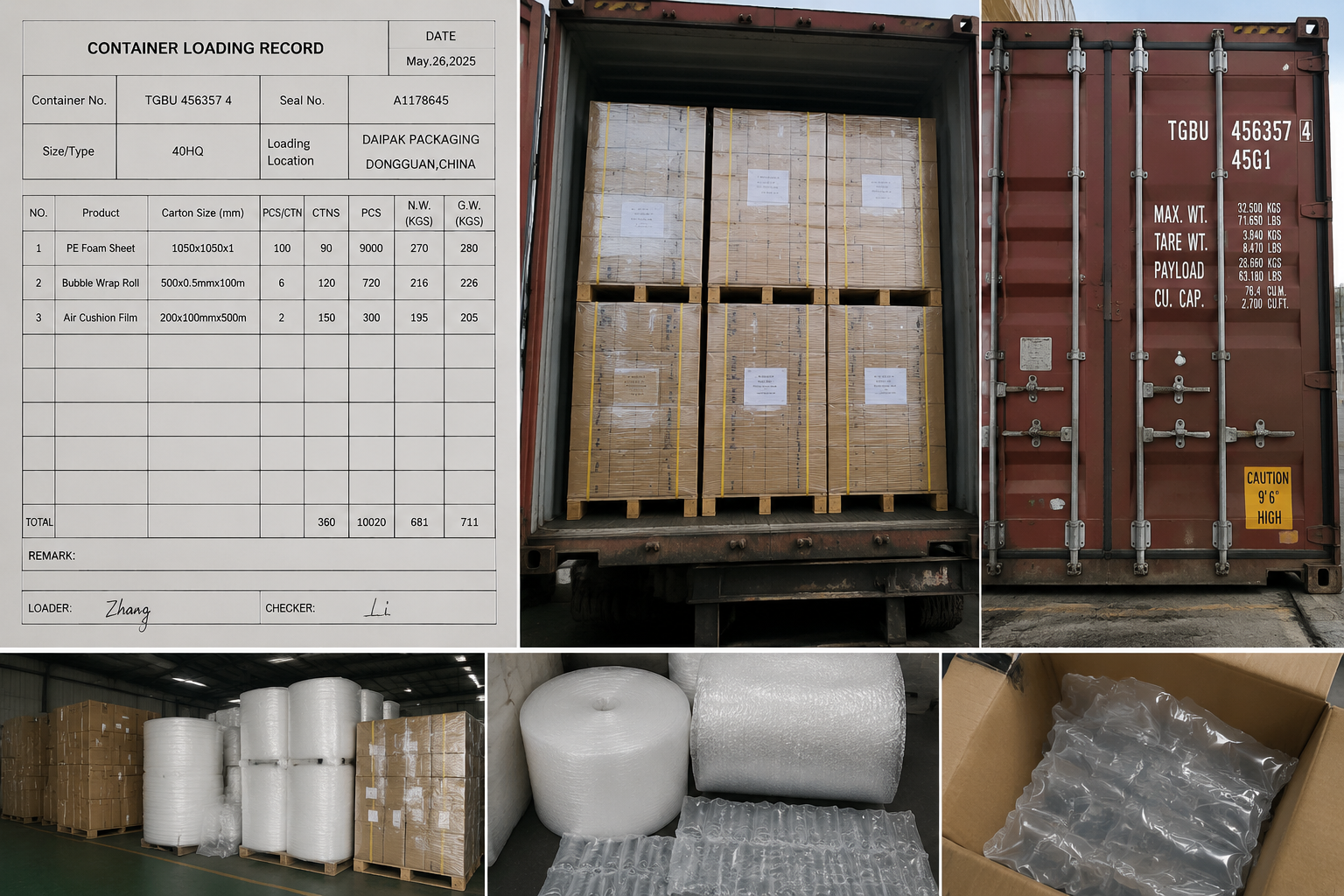
Final loaded photos should include enough visible product or carton marks to connect the image to the actual order. A photo of a full container with no readable labels may have limited value. Buyers importing mixed packaging materials should request photos that show SKU labels, carton marks, or pallet marks clearly enough to support receiving checks.
Loading plans should reduce crushing and wasted space
A loading plan should protect cartons and use container space efficiently. For packaging cargo, that balance can be difficult because product forms behave differently. Corrugated boxes packed flat may be rigid but can bend at exposed edges. Bubble wrap rolls and EPE foam products are light but compressible. Stretch film cartons may be compact and heavier. Poly mailers and garment bags may be dense in cartons but still need dry, clean handling.
Heavier cartons should usually sit lower in the load, while deformation-sensitive goods should be kept away from pressure points. If pallets are used, the pallet arrangement should avoid unstable gaps and unnecessary air space. If loose cartons are loaded, stack height and carton strength should be considered so bottom cartons are not crushed during inland trucking, port handling, or sea transit. For LCL cargo, the buyer should be aware that the shipment may be handled more than once before reaching the final container or destination warehouse.
Container waste is also a real cost issue. Bulky packaging materials can lose a large amount of usable space if carton dimensions do not work well with the container, if pallets are too high to stack, or if irregular rolls leave large voids. Loading records help buyers compare the planned CBM against actual loading. If the container has visible unused space, the buyer and supplier can review carton size, pallet height, roll diameter, or packing method before the next order.
Container and seal numbers should match documents
The container number and seal number should match the bill of lading, packing list records, forwarder information, and buyer receiving checks. This connection is important because it links the loaded cargo to the transport document. If the seal number on the loading photo does not match the final document, the buyer should ask for clarification before cargo release becomes urgent.
For full container shipments, the loading record should include the final container number, seal number, loaded carton or pallet count, and date of loading. For palletized cargo, the pallet count should match the packing list. For loose carton shipments, the total carton count should be clear enough for the buyer’s warehouse to check against arrival quantity. These details help separate packing questions from transit and receiving questions if a problem appears later.
Loading records are most useful when they are reviewed together with shipping marks and documents. The carton labels, packing list, invoice, bill of lading, and loading photos should all point to the same shipment. If the physical cargo, container record, and document set agree before departure, the buyer has a stronger basis for customs clearance, warehouse receiving, and shipment follow-up.
Export Packing Note: For export orders, carton space, pallet height, labels, marks, handling route, and destination receiving details should be reviewed together before loading so the packing method supports both transit handling and warehouse receipt.
Carry forward feedback into repeat orders
Repeat orders should start from the last shipment that was actually accepted, not only from the original quotation. The buyer should keep the confirmed specification, carton size, gross weight, shipping marks, pallet method, loading photos, and any packing feedback together so the next order can follow the same approved basis.
If the destination warehouse reported crushed corners, hidden labels, mixed cartons, or a pallet height problem, that feedback should be written into the next packing instruction before production starts. This is the simplest way to make the shipment record traceable from order to loading and from one shipment to the next without adding unnecessary paperwork.
What Buyers Should Confirm Before Releasing a Wholesale Packaging Shipment
A wholesale packaging shipment is ready to ship only when the physical packing, freight details, document set, and receiving plan all tell the same story. If the cartons are weak, the pallet plan is unclear, the freight volume has not been checked, or the invoice and packing list do not match the labels, the shipment is not fully ready even if production is finished.
A practical wholesale packaging shipment checklist should look beyond the product name and unit price. Packaging materials such as bubble wrap rolls, EPE foam sheets, plastic bags, stretch film, corrugated boxes, and custom protective packaging can create different export risks. Some are bulky and light. Some are compact but heavy. Some deform under pressure. Some arrive usable but inside crushed or wet outer cartons. The final pre-shipment review should reduce those risks before the goods leave the supplier’s warehouse.
At Daipak, packaging export shipment confirmation usually starts from confirmed order data: product specification, packed quantity, carton size, carton weight, shipping marks, pallet requirements, and destination details. As a China protective packaging supplier, Daipak can support packing photos, export carton details, loading coordination, and document preparation based on the agreed order information, while buyers should still confirm import rules and destination requirements with their own logistics partners where needed.
Confirm physical packing before confirming freight
Freight should not be finalized only from the product quantity. Buyers should first confirm how the goods will actually be packed. Carton dimensions, gross weight per carton, number of cartons, pallet size, pallet height, and whether the cargo is stackable can all change the freight quote. For bulky packaging materials, a small change in carton size or roll diameter may increase CBM enough to affect LCL cost, container utilization, or courier dimensional weight.
The carton should match the product form and export handling risk. Bubble wrap rolls and EPE foam rolls can deform if cartons are overstacked or strapped too tightly. Plastic bags and garment bags may be light, but cartons can still collapse if they are too large and loosely packed. Corrugated boxes shipped flat need bundling, strapping, or carton protection that prevents edge damage. Custom protective packaging may require separation inside the carton so shaped pieces do not press into each other during transit.
Before releasing the shipment, buyers should ask for the packed carton specification, not only the product specification. Useful confirmation points include carton length, width, height, gross weight, net weight, quantity per carton, sealing method, label position, pallet method, moisture protection, and total loading quantity. If the shipment includes several SKUs, the packing plan should show how each item is separated and identified.
The pallet decision should also be made before freight is booked. Pallets may reduce carton crushing and make receiving easier, especially for LCL cargo or warehouses that use forklifts. They can also add height and reduce container loading quantity. If the buyer’s priority is maximum loading volume, loose cartons may sometimes load better. If the buyer’s priority is handling safety and warehouse efficiency, palletizing may be worth the added cost and space.
Moisture protection belongs in the same physical packing review. Buyers should confirm whether cartons will be stored dry before loading, whether pallet covers or water-resistant outer wrapping are needed, and whether desiccants should be discussed for long ocean freight or humid routes. These measures do not remove every moisture risk, but they help reduce wet cartons, weakened labels, and receiving disputes.
For custom-size or custom-thickness packaging, the buyer should confirm drawings, product photos, samples, material thickness, foam density, bag opening direction, sealing position, cutting tolerance, bonding method, printing content, and label format before mass production and export packing. Many shipment problems begin as small specification misunderstandings, so written confirmation and clear photos usually save more time than trying to correct mixed cartons after loading.
Confirm document consistency before vessel or flight departure
The commercial invoice, packing list, shipping marks, booking details, and transport document should match before departure whenever possible. Once a vessel sails or an air shipment moves, corrections can become slower, more expensive, or more difficult to coordinate with banks, brokers, carriers, and destination warehouses.
A packing list review should verify the real shipment: item description, SKU or model, quantity, carton count, gross weight, net weight, CBM, pallet count if applicable, and package type. The invoice should use product descriptions that are clear enough for customs review and consistent with the packing list. For packaging materials, descriptions such as plastic bags, PE film, EPE foam, bubble wrap, stretch film, or corrugated boxes should not be mixed casually if the shipment includes different materials.
HS code information should be checked before customs clearance, especially when material, construction, coating, printing, or destination rules may affect classification. The supplier can provide product and material information from the order side, but the buyer or customs broker should confirm the final import classification when there is uncertainty. This is especially important for mixed packaging orders, where several product types may travel under one shipment.
Shipping marks and carton labels should match the document set. If the carton says one item code and the packing list says another, the destination warehouse may miscount cartons or delay receiving. If the total carton count on the packing list differs from the loading record, the buyer may have difficulty checking shortages. If consignee, notify party, destination port, Incoterm, or freight term details are wrong, customs clearance and document release can be delayed.
The Incoterm should also be understood before release. Under some terms, the buyer’s forwarder controls booking and pickup. Under others, the supplier coordinates export-side delivery or freight booking. The document flow, freight responsibility, insurance discussion, and destination charges can change depending on the term. A shipment is not ready if the buyer, supplier, and forwarder do not agree on who books freight, who receives draft documents, who checks the bill of lading details, and who handles amendments.
Confirm environmental and recycling claims before using them commercially
If packaging materials will be resold or described with environmental language, buyers should separate the physical shipment discussion from marketing claims. Terms such as recyclable, compostable, biodegradable, eco-friendly, or reduced impact should be checked against the material structure, destination-market rules, collection access, and any label or certification requirement before they appear on invoices, product pages, or retail packaging. The FTC Green Guides are a U.S. reference point for environmental marketing claims, including claims related to recyclability, degradability, and compostability.[8]
This is especially important for mixed-material packaging, coated paper, laminated mailers, printed films, and packaging that may be recyclable in one market but not accepted in another local recovery system. A supplier can provide material information, but buyers should confirm whether the claim is suitable for their sales market, disposal instructions, and customer-facing label before treating it as a commercial advantage.
Confirm receiving requirements at the destination warehouse
Export preparation should include the destination warehouse, not only the departure port. A shipment that is packed correctly for ocean transit can still create problems if the receiving site cannot unload it efficiently. Buyers should confirm whether the warehouse requires pallets, maximum pallet height, specific carton labels, delivery appointments, advance shipping notices, or separate SKU identification.
For wholesale packaging materials, receiving teams often deal with high carton counts and similar-looking products. Bubble wrap rolls of different widths, foam sheets of different thicknesses, printed poly mailers in different sizes, and corrugated boxes with similar dimensions can be easy to mix if labels are unclear. SKU-level carton labels and pallet labels help the warehouse separate stock correctly and reduce receiving errors.
Warehouse unloading limits matter as well. If cartons are too large for manual handling, too heavy for a small receiving team, or packed as unstable pallets, the destination team may spend extra time unloading, sorting, or repacking. If the warehouse has limited dock space, delivery appointments and pallet counts should be shared in advance. If floor loading is used to maximize container space, the buyer should make sure the warehouse has enough labor and time to unload loose cartons safely.
Photo evidence at arrival should be part of the receiving routine. The warehouse should record container or truck condition, pallet condition, carton damage, wet areas, broken stretch wrap, missing marks, and visible shortages before moving the goods too far into stock. These photos do not replace carrier claim procedures or insurance requirements, but they help separate packing issues, transit handling issues, and receiving-side damage.
The final release decision should be practical: if physical packing can withstand the handling route, if freight volume is understood, if shipping marks match the documents, if the HS code information has been reviewed, if the Incoterm is clear, and if the destination warehouse knows how to receive the cargo, the shipment is much closer to being ready. If any of those points remain unclear, it is better to pause and confirm than to solve the problem after arrival.
References
[1] ASTM International, “ASTM D642 Standard Test Method for Determining Compressive Resistance of Shipping Containers,” packaging test method reference for compression resistance discussions, available at ASTM D642 Compression Resistance.
[2] ASTM International, “ASTM D4169 Standard Practice for Performance Testing of Shipping Containers and Systems,” distribution-cycle performance testing reference for shipping container validation language, available at ASTM D4169 Shipping Container Performance Testing.
[3] International Safe Transit Association, “ISTA Procedure 3A Overview,” packaged-product test overview for parcel delivery systems and small package shipping contexts, available at ISTA Procedure 3A Overview.
[4] International Plant Protection Convention, “ISPM 15 Regulation of Wood Packaging Material in International Trade,” international phytosanitary standard for wood packaging material used in international trade, available at IPPC ISPM 15 Wood Packaging.
[5] USDA APHIS, “Wood Packaging Material,” U.S. guidance for wood packaging material and ISPM 15 import/export compliance context, available at USDA APHIS Wood Packaging Material.
[6] European Commission, “Food Contact Materials,” EU food contact materials rules and safety context for packaging articles, available at EU Food Contact Materials.
[7] U.S. Food and Drug Administration, “Food Packaging and Other Substances That Come into Contact with Food,” FDA consumer-facing reference for food packaging and food contact substances, available at FDA Food Packaging and Food Contact Substances.
[8] Federal Trade Commission, “Green Guides,” U.S. environmental marketing guidance for recyclable, degradable, compostable, and other green claims, available at FTC Green Guides.
[9] United Nations Economic Commission for Europe, “UN Model Regulations Rev. 24,” dangerous goods model regulations with packaging-related provisions for regulated shipments, available at UNECE UN Model Regulations Rev. 24.
[10] Pipeline and Hazardous Materials Safety Administration, “Hazardous Materials Regulations,” U.S. hazardous materials transport regulations relevant to regulated packaging and shipping preparation, available at PHMSA Hazardous Materials Regulations.
Packaging Supplier Guides cornerstone library
Cornerstone guides for this topic
Keep these Packaging Supplier Guides guides close while you read. They are the standing references for the decisions covered on this page.
Wholesale Packaging Materials in China: Samples, MOQ, Quotation, and Bulk Order Process
Wholesale packaging materials from China can look simple at the inquiry stage, but the real decision depends on much more than naming a material...
Read cornerstone guide
Packaging Manufacturer vs Trading Company in China: What Overseas Buyers Should Check
When you are sourcing packaging from China, the main decision is not just who gives the quote. It is whether the supplier can handle...
Read cornerstone guide
China Packaging Materials Supplier Guide: How to Choose the Right Factory for Custom Packaging
Choosing a China packaging materials supplier is not only about finding a factory that can quote foam, bubble wrap, cartons, film, or plastic bags....
Read cornerstone guide