
Small changes in packaging layers can create larger problems when a cosmetic gift box is assembled for real production. This article looks at Daipak’s April 2026 review of a three-piece skincare gift set, where the poly bags, EPE foam insert, printed corrugated box, and export cartons each appeared acceptable on their own, similar to the coordination logic used in a combined packaging solution for multi-component accessory kits. The issue only became clear after the bottles were bagged and placed into the foam: added thickness, wrinkles, and surface friction changed the seating height.
For buyers approving custom cosmetic packaging, the main decision is not whether each component looks correct separately, but whether the complete packed system works under the same conditions used in bulk packing. The article explains why sample approval should include bagged product dimensions, foam fit, box closure, packing sequence photos, carton review, and written version confirmation before production begins.
Quick Packaging Decision Guide
| Buyer Question | Practical Reading | What to Check |
|---|---|---|
| Do the approved parts still fit after assembly? | Individual approval is not enough for multi-component packaging. | Test the product with bags, labels, sleeves, foam, box, and carton together. |
| Can a thin poly bag affect foam fit? | Yes, added thickness and friction can change seating height. | Measure the product after all inner packaging layers are added. |
| Will the retail box close cleanly? | Foam height and product position affect presentation and closure. | Check lid closure, alignment, visible pressure, and packing speed. |
| Is the sample record clear enough for production? | Photos and version records reduce confusion between teams. | Confirm artwork, bag type, foam version, carton setup, and approval date. |
| When should export cartons be reviewed? | Carton packing should be checked before final sign-off. | Review final packed quantity, carton space, stacking condition, and handling route. |
Quick Questions Before You Read
Q: Why did the foam insert need adjustment if the sample looked acceptable?
Because the bottle was checked again after being placed in a clear poly bag, which slightly changed its fit inside the foam cavity.
Q: Should buyers approve foam, bags, boxes, and cartons separately?
They can review each part separately, but final approval should be based on the complete packed condition used in real production.
Q: What information should be confirmed before bulk production?
Confirm the actual product, bag, label or sleeve, foam insert, printed box, export carton, packing sequence, and approved sample version.
Q: Does this matter for repeat orders?
Yes. If the product, bag, foam, artwork, or carton changes later, the packed system should be rechecked before repeating production.
What Happened During the April 2026 Cosmetic Gift Set Sample Review
On April 18, 2026, Daipak reviewed a cosmetic gift set packaging project for an Oceania beauty brand that had already provided approved artwork and was waiting for final sample confirmation before bulk production. This was not a simple approval of one bag, one box, or one insert. The order involved a three-piece skincare gift set packaging structure where several materials had to work together in the same packing sequence.
The custom packaging sample included clear poly bags for the individual bottles, a custom EPE foam insert to hold the products in position, a printed corrugated presentation box for retail display, and export outer cartons for shipment preparation. Each item had its own function, but the sample review needed to confirm the complete packed condition, not only the appearance of each component on the table.
At first, the separate parts looked acceptable. The clear poly bags were clean and suitable for inner protection, the foam insert matched the general cavity layout, the printed corrugated presentation box reflected the approved artwork, and the outer cartons were prepared for export packing review. The practical question was whether these parts still worked correctly after the bottles were bagged, placed into the foam, closed inside the retail box, and arranged for carton packing.
For this type of project, Daipak’s recommendation depends on more than the product category. The buyer’s product size, filled weight, bottle photos, drawings, surface finish, intended bagging method, order quantity, carton quantity preference, and shipping destination all give the supplier a clearer basis for checking whether the material choice and packing sequence are realistic. When these details are confirmed before sample approval, the foam allowance, bag thickness, box height, carton marks, and export packing method are easier to connect to the same approved requirement.
The Packaging Parts Involved in the Project
The clear poly bags were used as the first layer around each bottle. For cosmetic bottles, this type of inner bag can help reduce surface contact, dust exposure, and handling marks during packing. Even though a poly bag looks thin, it becomes part of the product’s final packed size once it wraps around the bottle, cap, label, and any curved surface.
The custom EPE foam insert was designed to separate and support the three bottles inside the gift box. In this project, the foam was not just a cushioning material. It also controlled product position, spacing, height, and presentation. If one bottle sat too high or leaned slightly, the visual arrangement inside the printed box could change.
The printed corrugated presentation box carried the retail-facing role. It needed to close properly, show the artwork cleanly, and hold the foam insert without unnecessary shifting. The export outer cartons then added another layer of responsibility: they had to contain the finished retail boxes in a practical packing quantity and remain suitable for shipment handling.
Surface finish was also part of the judgment. Cosmetic bottles may have glossy labels, metallic caps, soft-touch coatings, transparent walls, or printed decoration that can show scuffs more easily than plain industrial parts. A clear poly bag can help reduce direct rubbing, but if the bag is too loose it may wrinkle heavily inside the foam; if it is too tight it may pull against the label or cap during insertion. For this type of packaging set, the supplier should check not only whether the product fits, but also whether the finished surface remains clean after normal handling.
For a multi-component packaging order like this, none of the materials could be judged in isolation. The bag affected the foam fit, the foam height affected the presentation box closure, and the retail box dimensions affected outer carton packing. That connection is why the sample review had to follow the real packing flow.
Why Final Sample Confirmation Was Important
Final sample confirmation mattered because cosmetic gift set packaging has to do more than prevent obvious damage. It must protect the bottles, keep the set visually aligned, support the brand’s retail presentation, and remain practical for workers to pack repeatedly before shipment. A sample that looks fine in parts can still create problems if the final packed set is too tight, uneven, or slow to assemble.
For cosmetic and skincare packaging, small differences are easy for customers to notice. A slightly raised bottle may affect lid clearance, box closure, or the way products appear when the box is opened. A foam insert that feels acceptable with a bare bottle may feel too tight after the bottle is placed in a clear poly bag. These details are easier to correct at the sample stage than after materials have moved into bulk production.
The April review showed why Daipak treats sample approval as a packing check, not only a material check. The buyer needed confidence that the approved artwork, foam structure, inner bags, and cartons could move forward together as one finished packaging set.
Why Separate Component Approval Was Not Enough
Multi-material packaging samples can be misleading when each part is inspected separately. A poly bag may look correct by itself. An EPE foam insert may appear properly cut. A printed corrugated box may match the artwork and close normally when empty. But the real test begins when the product is packed in the same condition that workers will use during production.
In this project, the clear poly bag was the small layer that changed the result. It did not create a major redesign issue, but it did affect the final fit. Once the bottle was inside the bag, the surface became slightly thicker and less direct against the foam. The bag also changed the friction during insertion, which affected how the bottle entered the cavity and how fully it seated at the bottom.
This is the difference between table inspection and real packing. On a table, a buyer or supplier may check size, material, print, color, and general workmanship. In actual packing, the product is bagged, handled, angled into the foam, pressed into position, and closed inside a box. That sequence can reveal tightness, pressure points, uneven height, or box closing resistance that separate component approval may miss.
Material Selection Note: For a multi-material cosmetic set, the packaging choice should follow the product’s actual risk and packing sequence. A thin bag, foam cavity, printed box, and export carton should be reviewed together instead of selected only by material habit or lowest unit price.
How the Clear Poly Bag Changed the Foam Fit
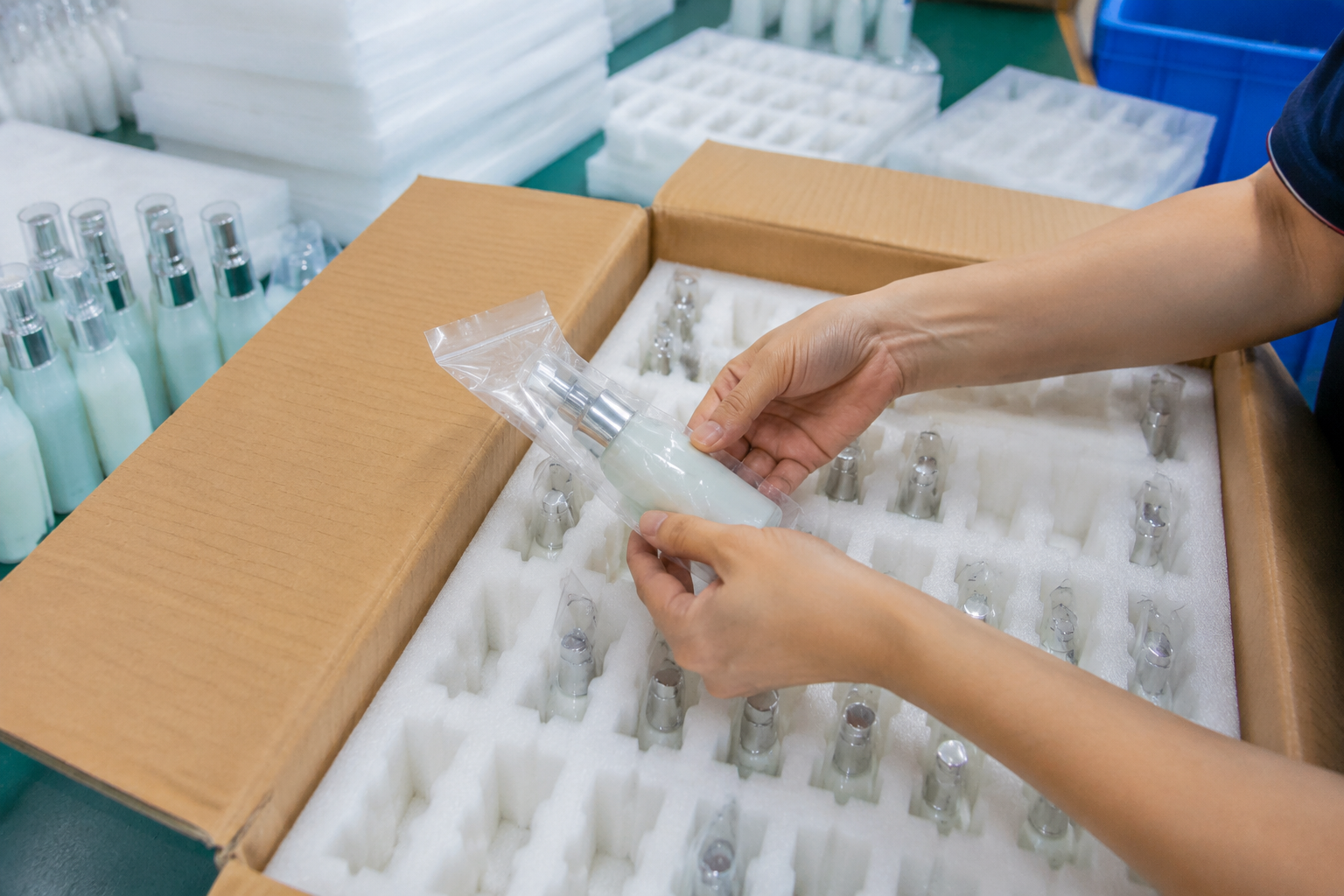
The bare bottle fit the foam cavity as expected. When the same bottle was placed into the clear poly bag, it sat slightly higher inside the cavity. The difference was small, but it was visible enough during final sample confirmation to require attention before production.
The reason was practical. A clear poly bag does not add only measurable thickness. It can bunch slightly near the bottom, create light wrinkles near corners or curves, and increase surface friction as the bottle slides into the foam. If the cavity allowance is already snug, those small changes can stop the bottle from seating as deeply as it did without the bag.
This did not mean the poly bag was wrong or the foam insert was unusable. It meant the sample needed to be judged as a complete packed item. For custom protective packaging, the accepted product condition should match the actual production condition. If the product will be packed with a bag, sleeve, label, or cap cover, the insert should be checked with that layer included.
Why Cosmetic Packaging Is Sensitive to Small Fit Changes
Cosmetic packaging is especially sensitive to small fit changes because the package is part of the product experience. Buyers usually care about bottle alignment, visible spacing, lid clearance, box closure, and how the set looks when opened. A bottle that sits slightly higher may not be damaged, but it can make the set look less controlled or create pressure against the lid or inner surface of the box.
There is also a packing efficiency issue. If workers have to push each bagged bottle into the foam cavity with extra force, packing slows down and consistency becomes harder to maintain. A tight fit can wrinkle the poly bag, rub against labels, or make it difficult to keep each bottle seated at the same height. In a retail gift box, those small differences can become visible across a batch.
The risk is not only breakage. It can be poor presentation, slower packing, uneven product height, or a box that feels slightly stressed when closed. That is why a sample-stage adjustment can be valuable even when each separate component appears acceptable.
How Daipak Rechecked the Sample as a Full Packing System
After identifying the seating difference, Daipak rechecked the sample as a full packing system rather than treating the bag, foam, box, and carton as separate approvals. The review followed the practical sequence of the order: actual product, clear poly bag, foam cavity, printed presentation box, export outer carton, and final packed condition.
This approach is important for a custom protective packaging factory because the final package is built through repeated handling steps. The bottle is bagged, inserted, seated, covered by the box structure, grouped into cartons, and prepared for shipment. If one step requires forcing the product or changes the height inside the insert, the issue should be found while the sample can still be adjusted.
As a packaging materials supplier in China working with overseas buyers, Daipak also needed the sample approval process to be clear from a communication standpoint. Photos, product condition, box closure, and carton packing all had to match what the buyer would approve before bulk production. A sample is most useful when both sides understand exactly which packed condition is being confirmed.
Daipak’s recheck followed a simple order trail: buyer information first, confirmed sample condition second, production requirement third, and packing review last. The product photos and dimensions helped define the foam cavity target, the confirmed bag thickness and sealing position became part of the insertion check, and the approved box and carton arrangement became the reference for final review. This kind of practical trace from information to finished packing can help prevent a sample decision from being separated from the production details that workers must actually follow.
From Product Bagging to Foam Insertion
The first recheck focused on the moment the product condition changed. The bottle without the bag was compared with the bottle after bagging. Then the bagged bottle was inserted into the foam cavity in the same way workers would handle it during production. The review looked at whether the bottle could slide into place smoothly, whether the bag wrinkled heavily, and whether the product reached the intended seating depth without extra pressure.
This step mattered because the foam insert had to balance support with packability. A snug cavity helps hold cosmetic bottles in position, but a cavity that becomes too tight after the poly bag is added can slow packing and create inconsistent presentation. The sample review therefore checked not only size, but also the feel of insertion and the final seated height.
From the factory side, this kind of check is also a production reference. If a sample can only be packed correctly by one careful person using extra adjustment, it may not be practical for repeated packing. The approved method should be clear enough for workers to follow consistently during the bulk order.
From Presentation Box to Export Carton
After the bagged bottles were placed into the foam, the next check was the printed corrugated presentation box. Daipak reviewed whether the foam sat correctly inside the box, using glass bottle packaging rebuild requirements to confirm whether the bottles stayed aligned, and whether the lid closed without pressing down too tightly on the products. A good foam fit is not complete if the retail box becomes hard to close or shows stress after assembly.
The review then moved to the export outer carton. The finished gift boxes had to be placed into the carton in the planned arrangement so the team could check packing quantity, carton closure, and shipment preparation. For export orders, the outer carton is not just a shipping container; it also affects stacking, handling, carton marks, and how consistently the retail boxes are protected during transport.
Carton review should include the carton’s internal space, board strength suitability, flap closure, tape area, gross weight, and whether the carton marks match the buyer’s receiving requirements. If the retail boxes are packed too tightly, the outer carton may bulge or transfer pressure to the presentation boxes; if there is too much empty space, the sets may shift during warehouse handling. In many export orders, the carton plan also needs to consider pallet stacking direction, container loading condition, and whether workers can handle the carton safely without crushing corners.
By checking from inner bag to outer carton, Daipak could confirm the full set rather than approving attractive parts that might not work together. The main lesson from this project was simple: for multi-material cosmetic packaging, the approved sample should represent the real packed product, not a collection of separate acceptable components.
Export Packing Note: For export cosmetic gift sets, carton packing should be reviewed against the destination, carton space, handling method, labels, carton marks, and shipment details before production sign-off. This keeps the outer packing decision connected to the actual retail box and inner protection structure.
Evidence-Based Checks Added to the Approval Thinking
Daipak’s checklist update also separates ordinary visual approval from packaging performance questions. A finished gift box may look correct in photos, but shipment performance depends on the packed product, cushioning, carton structure, sealing method, handling route, and stacking condition. Standardized transport-package testing is normally performed on complete packed units, which supports Daipak’s decision to review the bag, foam, presentation box, and outer carton as one system rather than as unrelated parts.[1]
For export cartons, compression and stacking should not be assumed from the word “corrugated” alone. Carton strength depends on the board grade, box style, dimensions, closure, contents, humidity exposure, and stacking pattern. When stacking risk is important, compression resistance should be evaluated against the actual shipping container and loading condition instead of relying only on the appearance of the carton sample.[2]
For parcel or courier routes, drop and vibration risks should be discussed before final approval when the product is fragile, high-value, liquid-filled, or presentation-sensitive. A foam insert that looks attractive can still need validation if the package will face repeated handling, sorting, or impact during distribution. Drop-test references are useful because they focus attention on the loaded package, not just the empty box or the insert material by itself.[3]
Buyer teams should also avoid broad environmental or recyclability claims unless the material, label, destination market, and local recovery route have been confirmed. A corrugated box, plastic bag, foam insert, and printed coating may each follow different recovery or disposal paths, so any public-facing claim should be checked carefully rather than treated as a general “eco-friendly” statement.[4]
What Changed in Daipak’s Sample Approval Checklist
After the sample-stage finding, Daipak refined its sample approval checklist for packaging sets that use more than one material. The update was not about adding paperwork for its own sake. It was about making sure the approved sample reflects the product in the same condition that workers will handle during real packing.
For this cosmetic gift set, the separate parts looked acceptable: the clear poly bag, the foam insert, the printed corrugated presentation box, and the export outer carton each met its own visible requirement. The issue appeared only when those parts were used together. That is why the updated checklist puts more attention on measurement points, version photos, packing sequence confirmation, and carton packing review before final sample sign-off.
For overseas buyers, this matters because a custom packaging supplier may receive several revisions during sampling. One version may show the bare bottle in the foam. Another may show the bagged bottle. A third may include the printed box and export carton arrangement. If the approved version is not clearly identified, the factory team and buyer can both believe they are working from the correct sample while looking at different reference points.
Measurement Points Added for Bagged Products
The main measurement update is simple but important: the product should be measured in its actual packed condition, not only as a bare item. For the cosmetic bottle, the bare bottle fit the foam cavity, but the clear poly bag changed the practical fit. The bag added a small layer around the bottle, changed the surface friction, and affected how the bottle seated in the foam.
In future multi-material sample reviews, Daipak gives more attention to the dimensions and seating height of the product after the inner bag, label, sleeve, cap cover, or other surface layer is added. The measurement does not stop at length, width, or diameter. It also includes whether the product sits level, whether the top height leaves enough clearance, and whether workers can insert the item without pushing it down by force.
For foam and bag specifications, the checklist now encourages buyers to confirm more than the material name. EPE foam thickness, density, cavity tolerance, cut depth, bonding method, and whether the insert uses one piece or layered construction can all change the final support. For the inner bag, thickness, sealing position, opening direction, loose allowance, and any printed warning or product label should be reviewed before production. These details help the quotation and sample record describe the real packaging structure rather than a simplified material list.
Daipak also separates “drawing dimensions” from “packing dimensions” in this type of review. Drawing dimensions help start the quotation and tooling discussion, but packing dimensions show how the bottle behaves after the bag, label, cap, and foam contact are included. For buyers, this difference is useful because it prevents a measurement from looking correct on paper while the assembled set still feels tight or uneven during trial packing.
This helps prevent a common approval gap. A buyer may approve a foam insert based on a neat photo of the bare product, while the bulk packing team later handles products already wrapped in clear bags. That small difference can lead to tight insertion, wrinkled bags, raised bottles, or a presentation box that does not close as cleanly as expected.
Sample Version Notes and Photo Records
The updated checklist also places more weight on sample version control. For a multi-component packaging order, version notes are more than an internal reference. They help the buyer, sales contact, sampling team, production team, and packing team confirm which sample condition has been approved.
Useful version photos should show the packaging set in stages: the product alone, the product inside the clear bag, the bagged product inside the foam insert, the foam inside the printed box, and the packed set prepared for the export carton. These photos make it easier to identify whether the approved sample was based on the bare product or the final packed product.
Photo records are especially helpful for overseas buyers because the approval discussion often happens through email, messaging, or shared files rather than an in-person review. A clear photo set reduces the risk of unclear approval status. It also gives the factory a more reliable production reference when the order moves from sampling to material preparation, cutting, printing, box assembly, and final packing.
Daipak’s internal handover for this type of order usually needs the same details that the buyer approved: foam material and density, cavity allowance, bag size and thickness, sealing direction, printed box artwork version, carton dimensions, packing quantity, labels, carton marks, and shipment destination. When these items are kept together with the sample photos, production checks can compare the finished parts against the confirmed requirement rather than relying only on a short product name or an earlier quotation description.
Packing Sequence Confirmation Before Production
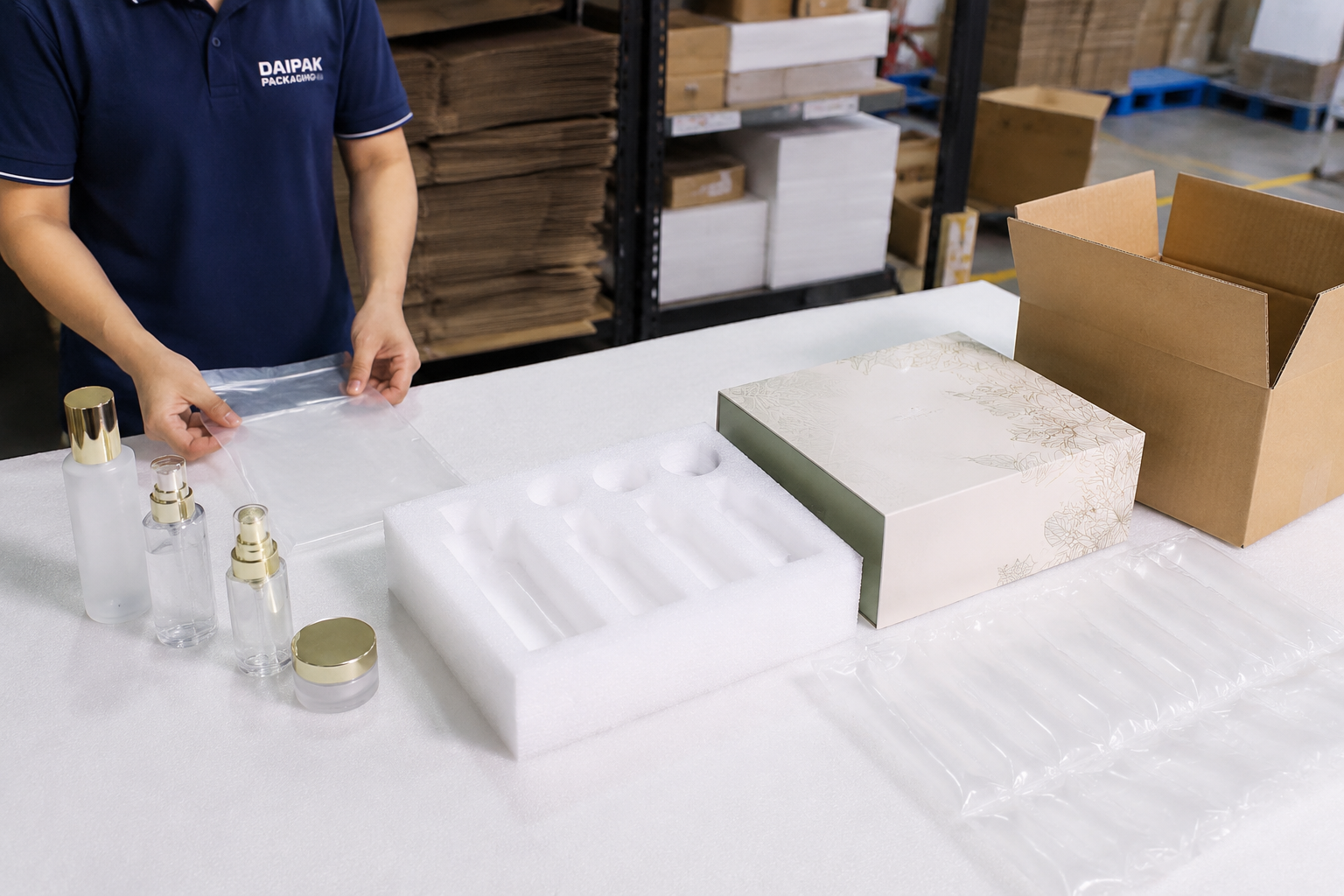
The checklist now emphasizes that the approval should follow the same sequence used in real packing: product, inner bag, insert, retail box, and outer carton. This sounds basic, but it is often where hidden fit changes appear. A sample that looks correct on a table may behave differently when workers repeat the full packing method.
For the cosmetic gift set, the packing sequence confirmed that the bagged bottle needed a slightly different foam allowance. In another project, the same type of review might reveal that a sleeve changes the product width, a label edge catches on the insert, a tray height affects box closure, or the printed box arrangement changes the number of sets that fit safely into the export carton.
Carton packing review is part of the same logic. A presentation box can look acceptable by itself, but the outer carton still needs to close properly, hold the planned packing quantity, and remain practical for export handling. The final sample sign-off should therefore confirm not only how the product looks in the gift box, but also how the finished retail packs sit inside the shipping carton.
Why the Foam Insert Needed a Small Adjustment
The custom EPE foam insert did not need to be redesigned from the beginning. The bare cosmetic bottle fit the cavity, and the insert provided the intended product position inside the presentation box. The practical issue was that the bottle became slightly larger and less smooth to insert after the clear poly bag was added.
This is a common point in cosmetic bottle packaging. A foam cavity that feels correct for a bare bottle can become too tight after a bag, label, sleeve, cap seal, or decorative surface is included. In this project, the bagged bottle sat slightly higher in the insert, which could affect presentation alignment and box closure if repeated during bulk packing.
The adjustment was therefore a small cavity allowance change, not a shift toward loose packaging. The goal was to let the bagged bottle seat correctly without forcing, while still keeping the product supported and visually aligned in the gift box. From a protective packaging manufacturer’s perspective, that balance matters more than simply making the cavity bigger.
Snug Support Versus Over-Tight Insertion
A snug foam fit helps keep bottles aligned, reduces movement inside the gift box, and supports a clean retail presentation. For skincare and cosmetic sets, alignment is part of the product experience. If one bottle leans, sits high, or presses against the lid, the package can look less controlled even if the product itself is not damaged.
Over-tight insertion creates a different set of risks. Workers may need to press the product into the foam, which can slow packing and create inconsistent results from one set to another. The clear bag may wrinkle or bunch at the bottom of the cavity. A label, coating, printed surface, or cap detail may receive unnecessary pressure. The product may also sit higher than planned, reducing lid clearance in the printed corrugated box.
Too loose is not the answer either. If the cavity has too much allowance, the bottle may shift during handling or look unstable when the consumer opens the box. The better correction is usually a controlled adjustment based on the real packed product, the foam density, the product shape, and the desired retail presentation.
Why Bare Product Fit Can Be Misleading
Bare product fit is useful during early sample development, but it is not enough for final approval when the product will not be packed bare. Cosmetic bottles often include labels, caps, pumps, sleeves, seals, or clear protective bags. Each part may look minor, but together they can affect how the product enters and sits inside foam packaging.
Surface finish also changes the fit. A smooth glass bottle, a soft-touch coated bottle, a labeled plastic bottle, and a bagged bottle can all slide differently into the same foam cavity. The dimensions may be close, but the packing behavior is not always the same. This is why Daipak’s review focused on the actual product condition rather than only the drawing or bare sample.
For buyers, the lesson is to send or confirm the product in the same condition expected during packing. If the final product will be bagged, sleeved, labeled, or fitted with a cap protector, those details should be included before the foam insert is approved for production. Small sample-stage changes are much easier to manage than a repeated fit problem after foam has already been cut in bulk.
How Multi-Component Packaging Orders Create Hidden Approval Risks
A multi-component packaging order creates approval risks because each layer depends on the next one. The inner bag affects the product size. The foam insert affects the retail box height and product alignment. The printed box affects the export carton layout. The export carton affects loading, carton closure, labeling, and shipment preparation.
This is why cosmetic gift set packaging should be reviewed as a connected system rather than a collection of separate items. A clear poly bag, EPE foam insert, printed corrugated box, and export carton may all meet their individual requirements, yet still need adjustment when assembled in the real packing order.
The same principle applies beyond skincare gift sets. Fragrance kits, small electronics sets, promotional kits, and retail gift box packaging often combine plastic bags, foam, molded inserts, printed boxes, labels, and shipping cartons. The hidden fit issue is usually not caused by one obviously wrong part. It appears because one acceptable layer changes the working space for the next layer.
When One Packaging Layer Changes the Next Layer
Packaging layers are not neutral. A bag can change the outside thickness of a bottle. A sleeve can change the product edge. A label can increase friction against foam. A foam insert can raise the product height. A raised product can press against the lid of a printed box. A slightly larger printed box can then change how many units fit into the export carton.
These small changes matter because production packing is repetitive. If one worker needs to adjust the product by hand, press down one corner, or reclose a box several times, the issue may become a packing delay across the whole order. The cost is not only material waste. It can include slower packing speed, inconsistent presentation, unclear inspection judgment, and avoidable communication during shipment preparation.
For buyers, the practical question is not only whether each material looks correct. It is whether the complete set can be packed smoothly, closed properly, and prepared for shipment using the same method that will be used in bulk production.
Where Problems Usually Appear Too Late
Many approval risks appear late because early sample checks are often done on a desk, not on a packing line. The first sample may confirm color, print, foam shape, bag clarity, or carton style, and related packaging news updates often highlight why these checks should be evaluated against real production handling. Those checks are necessary, but they may not show what happens when the product is packed repeatedly in the final order sequence.
Problems often appear during trial packing, line packing, carton loading, or shipment preparation. A bottle may be difficult to insert after bagging. A gift box lid may need extra pressure to close. The export carton may not hold the expected packing quantity cleanly. Carton flaps may bulge if the retail boxes sit slightly higher than planned. These are not always visible when components are approved separately.
A good sample approval process should therefore include the practical packing moment before bulk production begins. For a cosmetic packaging supplier or any factory handling protective packaging materials, this step helps connect the approved sample with real production behavior. For the buyer, it reduces the chance that a small hidden fit issue becomes a larger bulk production risk.
What Overseas Buyers Should Confirm Before Approving Samples
For overseas B2B buyers, custom packaging sample approval should confirm more than the appearance of each individual part. A clear bag, foam insert, printed box, and export carton may all look acceptable on a table, but the real question is whether they work together around the actual product. This is especially important for cosmetic gift sets, where bottle alignment, surface finish, retail presentation, and packing speed all affect the final result.
Before approving a sample, buyers should send the actual product whenever possible, not only drawings or estimated dimensions. Exact bottle height, shoulder shape, cap diameter, pump height, label position, and surface finish can all change how the product sits inside foam. If the product will be packed inside a clear poly bag, sleeve, dust bag, or protective film, that layer should be included in the sample review. A China packaging materials supplier can make a better recommendation when the sample reflects the real packed condition instead of a simplified version.
The buyer and factory should also align on the commercial details that affect the packaging structure. Printed box artwork, carton packing quantity, export carton size limits, label requirements, and the expected bulk packaging order method can influence the sample decision. A good sample is not only attractive; it should be practical to pack, close, stack, label, and prepare for shipment.
Approve the Product in Its Real Packed Condition
The safest approval method is to check the product exactly as it will enter the packaging line. If a skincare bottle will be placed in a clear poly bag before foam insertion, the foam fit should be reviewed with the bagged bottle, not only the bare bottle. Even a thin bag can add surface thickness, create wrinkles near the base, change the insertion angle, or increase friction between the bottle and the foam cavity.
Labels, caps, sleeves, pumps, and decorative finishes also matter. A label edge may catch slightly during insertion. A glossy cap may show scratches if the cavity is too tight. A soft bag may fold under the bottle and lift it higher than expected. These are not always major design failures, but they can become repeated packing problems if they are missed before production.
For custom packaging sample approval, buyers should tell the supplier what kind of fit they expect. Some cosmetic products need a firm retail display position, while others need easier removal for end users. If the foam is too loose, the bottle may shift and look poorly presented. If it is too tight, workers may need to force the product into place, which can slow packing and increase surface pressure. The right approval balances protection, presentation, and workable packing.
Ask for Photos That Show the Full Sequence
Photo approval is most useful when it shows the full packing sequence, not just a finished beauty shot of the gift box. For a multi-part cosmetic set, the buyer should be able to see the bare product, the product inside the inner bag, the bagged product placed into the EPE foam insert, the foam inside the printed presentation box, and the final box inside the export carton. Each view answers a different question.
A bare product photo confirms the starting item. A bagged product photo shows whether the inner bag has extra folds, tight corners, or loose material. Foam insertion photos help the buyer judge seating height and alignment. Box closure photos show whether the lid closes naturally without pressure. Carton packing photos help confirm quantity per carton, internal space, and whether the retail boxes are arranged in a stable way for export handling.
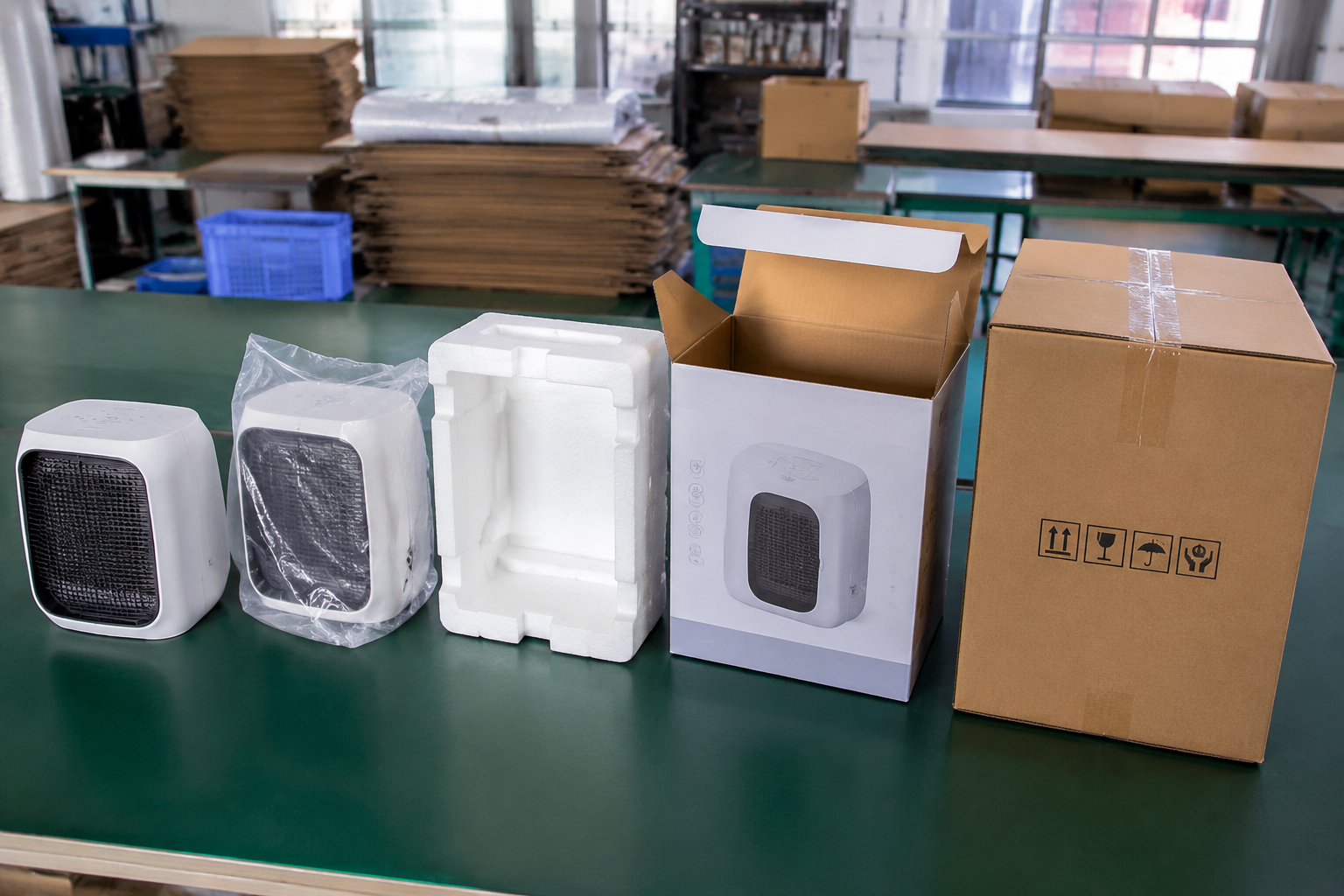
These photos also help when procurement, branding, and warehouse teams are in different locations. One person may focus on artwork, another on carton quantity, and another on packing workability. Clear sample photos reduce back-and-forth because everyone is looking at the same approved condition.
Confirm Which Sample Version Goes to Production
Sample revisions are common in custom cosmetic packaging. A buyer may approve the artwork in one message, request a small foam adjustment in another, and later confirm carton packing details in a separate discussion. If the final approved version is not clearly identified, the factory team may have to interpret which sample is the true production reference.
Before production starts, overseas buyers should confirm the approved sample version in writing and keep the related photos together. The confirmation should make clear which product condition was checked, which inner bag was used, which foam version was accepted, which printed box artwork was approved, and how the export carton was packed. This does not need to be complicated, but it should remove uncertainty.
At Daipak, sample version control is treated as part of order coordination rather than a separate paperwork step. Ms. Tang often keeps sampling details, specification confirmation, and production preparation connected so the factory side and overseas buyer are working from the same reference. That is especially useful when a packaging quotation turns into a bulk order after several small sample changes.
Keep a Buyer-Side Confirmation File
Overseas buyers can make sample approval more reliable by keeping one confirmation file for the final packaging set. This file can include the approved artwork, foam drawing or photo, bag specification, product condition, packing sequence photos, carton quantity, carton marks, and the approval date. The purpose is not to create extra administration, but to prevent the purchasing team, brand team, warehouse team, and supplier from using different reference versions.
When the order moves into production, this confirmation file gives both sides a practical checklist for first-piece review and final packing review. If the factory sends updated photos, the buyer can compare them with the approved packed condition instead of relying on memory. If a later reorder changes the product or carton arrangement, the same file helps identify which part of the packaging system needs to be checked again.
The same confirmation file should also connect to shipment preparation. Carton quantity, inner packing method, carton labels, carton marks, pallet requirements, and loading information should be checked against the buyer’s receiving plan before shipment. If the destination warehouse needs specific marks or the forwarder requires a certain pallet arrangement, those details are easier to control when they are confirmed with the finished packing setup rather than added after cartons are already packed.
Claim Boundaries Buyers Should Keep Clear
A sample approval checklist should not be treated as a promise that every package will avoid damage in every shipping condition. It is a practical control step that can help reduce avoidable fit, closure, presentation, and packing-sequence problems when the product, materials, carton setup, and handling route are reviewed together. Buyers should still match the packaging structure to the actual product value, fragility, filled weight, destination, and distribution method before production.
Buyers should also be careful with public-facing wording about environmental features. A package that includes corrugated board, plastic bags, foam inserts, printed surfaces, coatings, tapes, or labels may need separate review before recyclability or other environmental claims are used. If these claims matter for retail packaging, the buyer should confirm material composition, local recovery routes, and destination-market expectations before printing or publishing the claim.[4]
For cosmetics packaging, the packaging supplier can help review fit, materials, cushioning, presentation, carton packing, and production workability, but product-category requirements remain buyer-specific. If a project later changes from cosmetic presentation packaging to direct food-contact, medical, pharmaceutical, child-related, hazardous-goods, battery, or regulated product packaging, the buyer should flag that use before sampling. Documentation, material review, or specialized testing may be required depending on the market and end use.
Moisture, anti-static, heavy-load, and long-distance transit performance should also be described carefully. A film, bag, foam, or carton may be useful in a specific structure, but it should not be described as moisture-proof, anti-static, or load-bearing unless the exact material, design, test condition, and required documentation support that claim. For export orders, this keeps the discussion focused on the real packaging risk instead of relying on broad material names.
How This Checklist Supports Repeat Orders and Bulk Production
A sample approval checklist is not only useful for the first order. Once a cosmetic gift set packaging structure has been confirmed, the same notes, photos, and measurement points become a production reference for future batches. This helps the factory team understand what was approved and helps the buyer reorder with fewer repeated explanations.
For bulk packaging production, small details can create large differences when repeated across many sets. A slightly different foam cavity allowance, a changed bag thickness, a revised carton packing direction, or an updated printed box structure can affect packing speed and final presentation. The checklist helps both sides see whether a future order is truly the same as the approved sample or whether a change needs review before production.
This is where quality control begins earlier than final inspection. The approved sample record gives production, packing, and export preparation teams a shared reference. It does not remove the need for normal production checks, but it reduces avoidable misunderstandings about what should be made, packed, photographed, and shipped.
Keeping the Approved Sample Clear for the Factory Team
Factory teams work best when the approved sample is specific. “Use the same packaging as last time” can be too vague if there were several sample versions, artwork changes, or foam adjustments. A clearer production reference includes measurement points, approved photos, material notes, packing sequence details, and carton packing requirements.
For the cosmetic gift set project, the useful reference was not only the foam insert drawing or the printed box artwork. It was the complete packed condition: bottle inside clear poly bag, bagged bottle seated in the adjusted foam cavity, foam placed into the presentation box, and retail boxes packed into export cartons. This type of record helps a packaging materials manufacturer repeat the structure more consistently because the team can compare production against the final approved condition rather than against memory or incomplete notes.
Production consistency also depends on checking the first pieces against the approved sample before the order moves too far. For this kind of packaging set, useful checks may include foam cavity size, cut cleanliness, bag sealing position, box assembly accuracy, print alignment, carton dimensions, and the packed height after closure. A small deviation in one part may still be acceptable, but it should be reviewed in the complete packing system rather than judged only as a loose component.
From the factory side, Mr. Wang usually checks whether the structure can be repeated during batch production, including cutting accuracy, insertion fit, box closure, and carton packing. For buyers, that factory-side review matters because a sample that looks good once still needs to be practical for repeated packing.
Helping Overseas Buyers Reorder With Fewer Changes
Repeat orders are easier when the buyer can refer to the same approved sample instead of rebuilding the discussion from the beginning. If the product bottle, label, inner bag, foam insert, printed box, and export carton remain unchanged, the previous approval record can guide the reorder. If one part changes, the record helps both sides quickly identify which related parts may need rechecking.
For example, a new cap height may require another foam fit review. A different poly bag thickness may affect seating height. A revised printed box size may change carton quantity or carton closure. These are manageable updates when the original packing sequence is documented. Without that record, a small change can create uncertainty across the full packaging set.
Repeat-order feedback should also be tied back to the same approved details. If the buyer reports that cartons arrived with corner pressure, workers found the bottle difficult to insert, labels rubbed against the foam, or the warehouse preferred a different carton mark position, that feedback can guide the next production review. It is easier to improve consistency when the feedback points to a specific material, thickness, packing step, carton quantity, or shipment preparation detail instead of a general comment that the packaging should be “better next time.”
For international custom packaging orders, the practical value of the checklist is clearer communication. Buyers get a more reliable reference for purchasing and internal approval, while the factory gets a clearer guide for production preparation and export packaging support. The result is not a promise that every future order will be identical in every condition, but a stronger process for keeping the approved packaging structure clear from sample review through repeat production.
Why Total Packaging Cost Is More Than the Unit Price
For multi-component cosmetic packaging, a lower material unit price does not always produce a lower total cost. If a foam cavity is too tight, workers may spend more time inserting each bottle. If a bag wrinkles badly, the packer may need to smooth or replace it. If the retail box is difficult to close, the line may slow down and inspection may become less consistent. These labor and coordination costs are easy to miss when comparing only the price of a bag, foam insert, or carton.
Buyers should also consider the cost of rework, urgent sample revisions, carton repacking, additional photos, and shipment delay risk. A slightly better-confirmed packaging structure can be more economical than a cheaper structure that creates repeated packing friction. The practical goal is not to overbuild the package, but to choose the right combination of poly bag, EPE foam, printed box, and export carton for the product’s size, weight, surface finish, fragility, retail presentation, and shipping route.
References
[1] ASTM International, “ASTM D4169 Shipping Container Performance Testing,” standard practice reference for performance testing shipping containers and systems through distribution cycles, available at ASTM D4169 Shipping Container Performance Testing.
[2] ASTM International, “ASTM D642 Compression Resistance,” standard test method reference for determining compressive resistance of shipping containers, available at ASTM D642 Compression Resistance.
[3] ASTM International, “ASTM D5276 Free-Fall Drop Test,” standard drop-test method reference for loaded shipping containers, bags, and transport packages, available at ASTM D5276 Free-Fall Drop Test.
[4] Federal Trade Commission, “16 CFR Part 260 FTC Green Guides,” U.S. environmental marketing guidance relevant to recyclable, compostable, degradable, and other green packaging claims, available at 16 CFR Part 260 FTC Green Guides.