
An overseas packaging supplier audit should not start with a generic checklist. The real issue is whether the supplier can reliably produce, inspect, pack, label, and ship the exact packaging your order requires, while aligning production capacity, sample approval, and packaging MOQ terms with the buyer’s delivery plan and payment controls through a clear supplier verification process before purchase commitment. For custom foam, bubble wrap, plastic bags, corrugated boxes, air cushions, or export packing, small gaps in material control, sample version management, sealing, cutting, printing, carton labeling, or warehouse separation can become shipment delays, shortages, mixed goods, or product damage risk.
This article helps buyers judge audit evidence by order risk, not by factory presentation alone. It explains how to check what the supplier controls in-house, what is outsourced, how raw materials and samples are managed, whether production checks are recorded, and when weak evidence should lead to conditional approval, corrective action, or holding the order before production.
A packaging supplier audit should help the buyer decide whether the factory can control the exact order, not simply whether it looks capable in a catalogue or video call. The practical risk depends on the packaging material, product size and weight, fragility, surface protection needs, carton space, export route, quantity, and how tightly the buyer’s packing method must be followed.
Use the article as an evidence checklist for supplier approval. It shows where packaging failures often begin: unclear sample versions, uncontrolled raw materials, weak first-piece checks, poor sealing or cutting control, mixed warehouse lots, wrong carton labels, and incomplete export loading records. The goal is to separate fixable gaps from risks that should delay approval before production starts.
Quick Packaging Decision Guide
| Buyer Question | Practical Reading | What to Check |
|---|---|---|
| Is the audit depth suitable for this order? | Higher-risk products need more proof than simple stock packaging. | Fragility, product weight, surface sensitivity, export distance, and custom fit requirements. |
| Does the supplier control the critical process? | Factory ownership matters less than control over the result shipped to the buyer. | In-house work, outsourced steps, production instructions, line setup, and subcontractor checks. |
| Can the approved sample be repeated? | A good sample is weak evidence if versions, drawings, and production records are not linked. | Sample labels, revision status, quotation match, first-piece approval, and retained references. |
| Will defects be found before the full batch is finished? | Final inspection alone may miss batch-wide mistakes in thickness, sealing, cutting, or printing. | Incoming checks, in-process records, measured values, defect isolation, and rework approval. |
| Is the shipment ready for overseas receiving? | Correct packaging can still fail through mixed cartons, weak labels, poor pallets, or unclear loading records. | Carton marks, SKU separation, packing list accuracy, pallet condition, moisture protection, and loading photos. |
Quick Answers Before You Read
Does every packaging supplier need the same audit depth?
No. A simple stock poly bag may need lighter checks, while custom foam inserts, air column bags, printed cartons, or fragile-product export packing need stronger evidence.
What evidence is more useful than a factory overview photo?
Close-up proof is stronger: raw material labels, approved samples, production sheets, measurement records, inspection photos, finished-goods labels, and packing list checks.
When should a buyer delay supplier approval?
Delay approval when the supplier cannot connect samples, materials, production records, QC checks, and warehouse labels to the actual order or a very similar order.
Is a lower packaging price always cheaper overall?
Not necessarily. If weak controls cause rework, shipment delay, mixed goods, product damage risk, or receiving confusion, the total cost can be higher than the unit price suggests.
Start the Audit by Defining the Packaging Risk and Supplier Approval Standard
A packaging supplier audit checklist is only useful when it is tied to a real approval decision. Before asking for factory photos, QC records, or a video walkthrough, overseas buyers should define what the supplier must prove for the specific order. The audit standard for a simple clear poly bag should not be the same as the standard for a custom EPE foam insert protecting a fragile instrument, an air column bag for export transit, or a printed corrugated carton used for retail and shipping.
The first question is not only, “Does this packaging materials supplier have a factory?” A stronger question is, “Can this supplier repeatedly produce, check, pack, and ship the same specification without creating unacceptable risk?” That risk may be product damage, inconsistent dimensions, weak sealing, poor carton control, contamination, late production, wrong labels, or export packing mistakes. The audit should help the buyer decide whether to pass the supplier, request more evidence, require corrective action, or reject the supplier before placing a larger order.
For procurement and quality teams, this early standard prevents the audit from becoming a general document collection exercise. If the product is lightweight and low-risk, the supplier may only need to prove stable material thickness, clean packing, and correct quantity control. If the product is heavy, fragile, scratch-sensitive, or moving through long-distance export handling, the packaging factory audit needs to examine cushioning structure, carton strength, packing sequence, pallet preparation, and shipment labeling in more detail.
A stronger audit also defines the traceability level expected before evidence is reviewed. For low-risk stock packaging, a basic link between material label, production date, and finished-goods carton may be enough. For custom protective packaging or export orders, buyers should expect a clearer chain from approved sample to material lot, production run, inspection record, warehouse label, packing list, and loading evidence. If the supplier cannot show that chain, the audit finding should be treated as a control gap rather than a missing document only.
Define claim boundaries before accepting supplier statements
Supplier claims should be separated into ordinary capability statements, test-backed claims, compliance claims, and commercial promises. A statement such as “we can make EPE foam inserts” can be checked through equipment, samples, drawings, and production records. A statement such as “this carton is suitable for heavy export stacking” needs stronger evidence, such as board specification, packing method, compression-related review, or comparable shipment history. A statement such as “food grade,” “recyclable,” “compostable,” “water resistant,” or “export compliant” should be treated as claim-sensitive and verified against the exact material, destination market, and intended use.
Buyers should avoid approving a supplier based on broad labels such as “premium quality,” “factory direct,” “eco-friendly,” “export safe,” or “standard grade” unless the supplier can explain what those phrases mean in measurable order terms. In a practical audit, useful evidence includes specifications, test reports, material declarations, inspection criteria, label requirements, and shipment records. Unsupported promotional language may be acceptable in a catalogue, but it should not be used as the basis for supplier approval.
This boundary is especially important for overseas sourcing because the same phrase can mean different things across markets, buyers, and product categories. A recyclable claim may depend on material design and local recovery systems. A food-contact claim may depend on formulation, migration assumptions, and intended contact conditions. A moisture-protection claim may depend on actual packaging construction and storage environment. The audit should therefore ask the supplier to tie every important claim to documents, samples, test evidence, or clear process controls.
If evidence is not available, the finding does not always require rejection. The buyer can classify it as “needs verification” and restrict approval to lower-risk use until supporting documents are provided. For example, a supplier may be approved for non-food inner packaging but not for direct food-contact packaging, or approved for domestic carton use but not for high-stacking export shipments, until the missing evidence is reviewed.
Match the audit depth to the packaging material and product risk
Different packaging materials create different audit priorities. For EPE foam, the buyer should pay attention to density, thickness, cutting accuracy, bonding quality, and whether custom inserts fit the product without compression or loose movement. For bubble wrap, the audit should check film consistency, bubble integrity, roll width, perforation if required, and whether the material gives enough cushioning for the product weight. For air cushion packaging, sealing quality and air retention matter more than visual appearance alone.
Film bags and poly mailers require a different focus. Thickness, sealing strength, size tolerance, printing position, and packing quantity are usually the key control points. Corrugated boxes bring another set of risks: board grade, folding accuracy, printing, slotting, carton marks, compression resistance, moisture exposure, and pallet loading condition. If the order combines several materials, such as foam inserts inside printed cartons with stretch-wrapped pallets, the audit should examine how the supplier coordinates the full packaging system rather than checking each material in isolation.
Product risk should guide the depth of questioning. A fragile glass component, a painted metal part, and a garment packed for e-commerce delivery may all need protective packaging, but the failure modes are not the same. One buyer may be most concerned about breakage during export handling. Another may be concerned about scratches, dust, moisture, label errors, or slow packing at the warehouse. The audit should reflect those risks before the supplier is scored.
Use external test references only when they match the shipment risk
For high-risk export shipments, buyers can ask whether the supplier has packaging test evidence or can arrange testing against a recognized distribution or shipping-container method. ASTM D4169 is a standard practice for performance testing shipping containers and systems, while ISTA Procedure 3A is a packaged-product test overview used for parcel delivery systems; these references can support a test request, but they do not prove that a supplier’s current packaging has passed unless the supplier provides the actual report for the same or comparable pack design.[1][2]
Compression evidence should be treated with the same restraint. ASTM D642 covers a compression resistance test method for shipping containers, so it can be a useful reference when stacked cartons, pallet loads, or heavy export handling are part of the risk review.[3] However, a visual photo of a carton or a supplier statement that the carton is “strong enough” should not be treated as equivalent to a dated compression test record, board specification, or order-specific packing validation.
Set a simple decision rule before reviewing evidence
Buyers should decide how findings will be classified before the audit begins. A simple decision rule keeps the review practical and prevents minor issues from being treated the same as serious supplier risks. Each audit point can be marked as pass, needs more evidence, corrective action required, or rejection risk.
A pass should mean the supplier provides clear, consistent evidence that the process is controlled. For example, the factory can show current production records, labeled materials, approved samples, inspection photos, and packing instructions that match the buyer’s order. “Needs more evidence” means the supplier’s answer sounds reasonable, but the proof is not complete enough for approval. This may apply when the supplier describes incoming inspection but cannot yet show records for similar materials.
Corrective action is appropriate when the gap is real but fixable. Examples include missing sample labels, unclear separation of finished goods, incomplete inspection records, or packing instructions that need to be updated before production. Rejection should be considered when the supplier cannot prove control over key processes, hides outsourced work, refuses to show relevant evidence, or gives inconsistent answers about material, production, quality, or shipment preparation.
Confirm whether the audit is remote, on site, or hybrid
The audit method affects what can be verified. A remote audit can be effective when it is structured around live video, timestamped photos, document samples, and close-up evidence. Buyers can review production areas, raw material labels, sample storage, inspection records, finished goods, carton marks, and warehouse condition without visiting the factory. However, remote evidence should be tied to the buyer’s actual product type, not only to general factory images.
An on-site audit gives the buyer or inspection team a better chance to observe production behavior in real time. They can see whether machines are running, whether operators follow work instructions, whether materials are separated, and whether nonconforming products are controlled. It is also easier to notice disorder, mixed batches, unlabeled goods, or differences between what is shown in documents and what happens on the production floor.
A hybrid audit often works well for overseas buyers. The buyer may first use remote evidence to screen the supplier, then arrange an on-site visit, third-party check, or pre-shipment inspection for higher-risk orders. This approach is especially useful for custom protective packaging, large export orders, or products where a packaging failure would create expensive damage, returns, or receiving delays.
Verify Factory Scope Before Judging Production Capability
A broad product catalog does not prove production capability. Before approving a China packaging materials supplier, buyers should confirm which processes the factory actually controls and which processes are coordinated through outside partners. This matters because the process that creates the most risk may not be the most visible one. A supplier may display bubble wrap, EPE foam, plastic bags, air cushion packaging, and corrugated boxes, but the audit should identify who controls the dimensions, thickness, sealing, cutting, printing, packing, and final inspection for the specific order.
Outsourcing is not automatically a problem. Many packaging supply chains use outside support for printing, special lamination, corrugated board production, or certain finishing steps. The risk appears when outsourcing is not disclosed, specifications are not transferred clearly, or the supplier cannot show how subcontracted work is checked before shipment. A capable protective packaging manufacturer or custom packaging supplier should be able to explain the full production route and provide evidence for the steps that affect quality.
For overseas buyers, the practical goal is to separate real factory control from general sourcing ability. The audit should ask: Which processes are done in-house? Which are outsourced? Who approves the material and specification? Can the supplier show active production lines for similar products? Can they show previous order records or production documents with confidential customer details removed? These answers help buyers judge whether the supplier can manage repeat orders, not just quote a wide range of packaging products.
Supplier names, catalogue categories, and quoted capability lists should be treated as starting points, not proof of order control. A packaging supplier may be strong in one product family and weaker in another because foam cutting, bag sealing, film printing, corrugated converting, and export pallet preparation require different equipment, operators, records, and subcontractor controls. The safer audit judgment is version-specific and order-specific: check the exact material, size, structure, process route, inspection points, and warehouse handling needed for the order being approved.
Check whether the supplier controls the key production steps
Start by identifying the steps that directly affect the performance of the packaging. For EPE foam inserts, this may include material selection, foam thickness, cutting accuracy, slot position, bonding, and fit testing. For bubble wrap rolls or sheets, the key points may be roll width, bubble size, film consistency, perforation, and packing. For plastic bags, buyers should look at film converting, sealing, punching, printing, and size control. For air column packaging, sealing and inflation performance are central audit points.
Corrugated packaging often requires coordination between board supply, printing, die cutting, folding, gluing, bundling, and carton packing. If the supplier does not make the corrugated board in-house, the buyer should still expect control over specifications, approval samples, carton marks, and incoming checks. The key question is not whether every machine is owned by the supplier. The key question is whether the supplier controls the result that the buyer will receive.
During the audit, ask the supplier to walk through the order from quotation to shipment. A reliable answer should connect the buyer’s specification to the production order, machine setup, operator instructions, QC checks, packing method, and warehouse identification. If the supplier can only describe products in general terms, but cannot explain how a specific size, material, density, thickness, seal, or carton mark is controlled, the capability evidence is weak.
Ask what is outsourced and how it is controlled
Buyers should ask directly which processes are outsourced. Common examples may include printed film, special surface treatment, corrugated carton production, mold preparation, complex die cutting, or certain assembly steps. The supplier should be able to explain why the process is outsourced, who checks the work, and what records are kept before the product moves to the next stage.
The audit should look for control points rather than a simple yes-or-no answer. If printing is outsourced, does the supplier provide approved artwork, color references, size requirements, and print position instructions? If corrugated production is outsourced, does the supplier confirm board material, carton dimensions, compression risk, printing, and carton marks before accepting the goods? If a special foam structure is prepared outside the main workshop, who checks the first pieces and how are changes recorded?
Undisclosed outsourcing creates avoidable risk. It can lead to specification drift, delayed correction, inconsistent batches, and confusion when defects appear. A buyer does not need every process to be in-house, but they do need visibility. If the supplier cannot explain outsourced process control, the order may require more evidence, a smaller trial batch, or corrective action before approval.
Look for real production signals during a video or site audit
Real production capability shows up in practical details. During a video or site audit, buyers should look for active production lines, production order sheets near the machines, work instructions, measuring tools, material labels, semi-finished goods, and operators following a defined process. A clean showroom or product display is useful, but it does not replace evidence from the production floor.
Ask the supplier to show machines producing similar materials, not only idle equipment. For example, if the buyer needs foam inserts, the walkthrough should include foam cutting or forming activity where possible. If the order involves bags or film, the audit should show sealing, cutting, roll handling, or packing steps. If the order involves cartons, the buyer should see how carton samples, marks, bundling, and finished goods are controlled.
Useful signals include labeled raw materials near the line, operators checking dimensions, supervisors reviewing output, defect products separated from good products, and semi-finished goods that match the type of orders the supplier claims to handle. Weak signals include unlabeled rolls, mixed materials, no visible specifications, operators relying only on verbal instructions, or a factory walkthrough that avoids close-up views of current production.
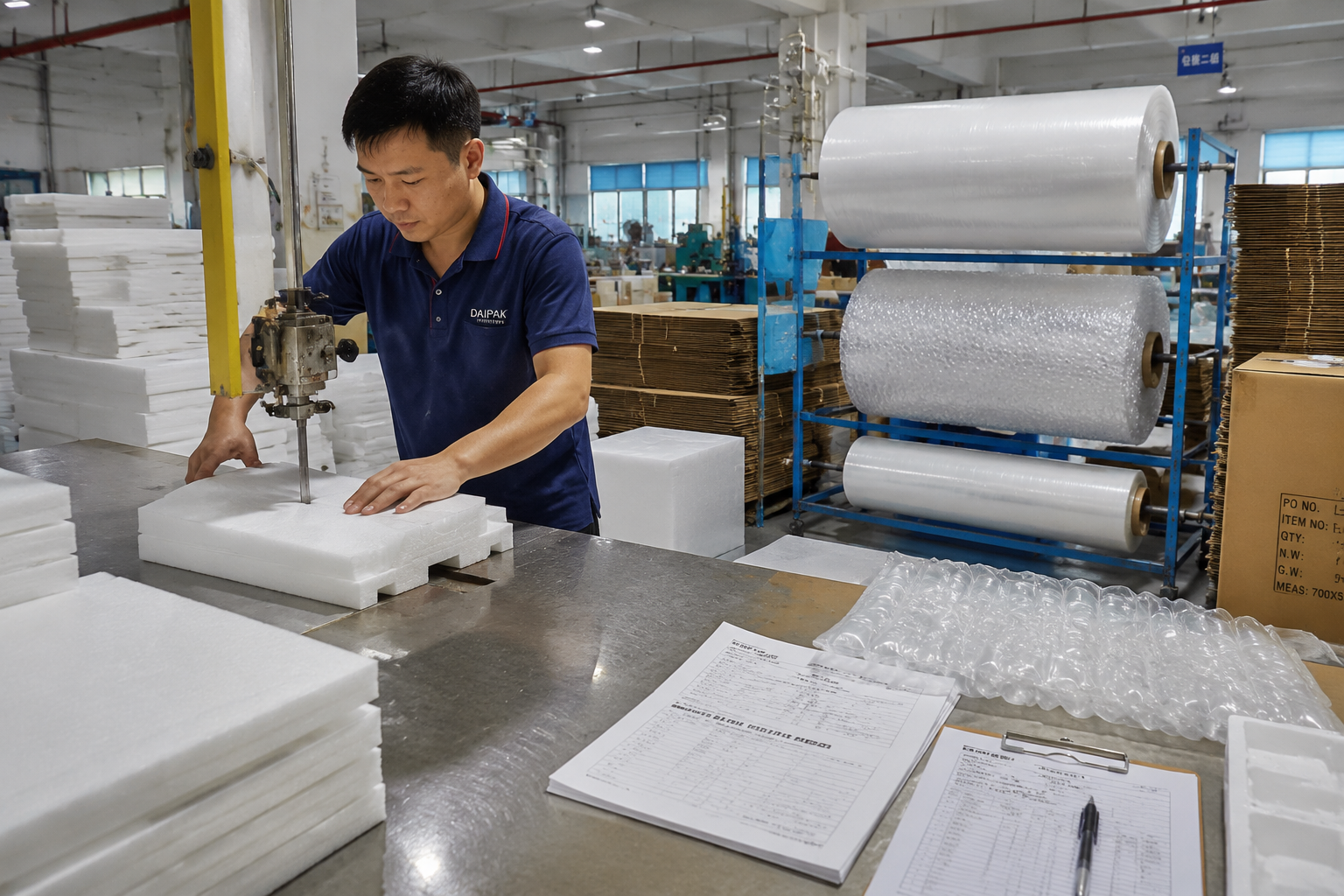
Audit Raw Material Storage and Traceability Before Production Begins
Many packaging failures begin before production starts. If raw materials are mixed, unidentified, poorly stored, or used without inspection, the finished packaging may look acceptable at first but fail during packing, storage, or transit. A packaging supplier audit checklist should therefore include raw material control as a core audit area, especially for products where thickness, density, strength, sealing, or carton condition directly affects protection.
For protective packaging, raw materials may include EPE foam rolls or sheets, bubble film, PE film, air cushion film, kraft paper, corrugated paper, adhesive, ink, labels, cartons, cores, bags, and packing accessories. Each material has a practical risk. Wrong foam density can reduce cushioning. Thin or inconsistent film can weaken bags or bubble wrap. Poor adhesive or sealing material can cause open seams. Moisture-damaged corrugated board can reduce carton strength. Dust or contamination can affect products with sensitive surfaces.
The audit should confirm whether the supplier can trace finished goods back to the material used when needed. This does not require a complicated system for every low-risk order, but the factory should have a clear way to identify material type, size, thickness, batch number, storage condition, and usage record. If a quality issue appears after shipment, traceability helps the buyer and supplier identify whether the problem came from one batch, one production run, one storage area, or a wider process gap.
Check food-contact and claim-sensitive material boundaries
If the packaging will touch food, cosmetics, medical-adjacent items, or other sensitive products, the audit should not rely on general material names alone. In the United States, FDA information distinguishes food packaging and other food contact substances as a safety and regulatory topic, while federal rules also address indirect food additives involving polymers and paper or paperboard components.[4][5][6] For supplier approval, this means buyers should request material declarations, food-contact statements where applicable, and document control that matches the exact material and intended use.
Environmental claims also need evidence. If a supplier describes a bag, tray, carton, or cushioning material as recyclable, compostable, biodegradable, or sustainable, buyers should ask what standard, label program, or design guidance supports that claim for the specific market. The FTC Green Guides are relevant to environmental marketing claims in the United States, so unsupported broad language such as “eco-friendly” should be treated as a claim requiring clarification rather than as proof of material performance.[7]
Compostable and biodegradable claims should be reviewed with particular care because they are not the same as ordinary recyclability claims. ASTM D6400 addresses compostable plastics, ASTM D6868 addresses compostable coated packaging, and BPI maintains a certification program for compostable products and packaging; these references can help buyers frame document requests, but they do not verify a supplier’s material unless the exact product, formulation, certificate scope, and market use match the order being audited.[10][11][12]
For recyclable packaging, buyers should ask whether the structure, coating, adhesive, ink, label, and multi-material components support the claim in the destination market. How2Recycle provides consumer-facing recyclability label guidance, while APR and RecyClass publish design-for-recycling guidance for plastic packaging; these resources can support audit questions, but supplier approval should still depend on product-specific material data and the buyer’s market requirements.[13][14][15]
Build a material-to-finished-goods traceability map
For higher-risk orders, buyers should ask the supplier to show one complete traceability example from material receipt to finished carton. The example can use a previous order with customer details removed, but it should show how the material batch, incoming inspection result, production order, machine run, first-piece approval, in-process record, final inspection, warehouse label, and packing list connect. This is more useful than seeing isolated forms that cannot be linked to the same batch.
The traceability map should also show where the chain can break. Common weak points include materials issued to production without batch recording, operators changing rolls without updating the line sheet, rejected material returned to storage without status labels, finished cartons labeled only after warehouse mixing, or packing lists prepared from planned quantities rather than verified physical counts. These gaps do not always cause defects, but they make later problem investigation slow and uncertain.
A practical buyer request is simple: ask the supplier to pick one finished carton or pallet and trace it backward. The supplier should be able to identify what item it contains, when it was produced, which material lot was used, which inspection records apply, and whether any rework or hold decision occurred. If the team can only answer from memory, traceability should be marked as weak until records and labels support the explanation.
Check whether raw materials are labeled and separated
Raw material labels should be easy to understand and physically attached to the relevant rolls, sheets, bundles, cartons, or pallets. For foam, the label should help identify material type, thickness, density or grade where applicable, size, batch information, and receipt date. For film materials, buyers should look for width, thickness, roll identification, material type, and batch number. For corrugated or paper-based materials, the audit should confirm board type, size, supplier batch, and storage condition.
Separation is just as important as labeling. Materials for different buyers, specifications, thicknesses, or production lots should not be casually mixed. Storage zones should make it clear what is approved for use, what is waiting for inspection, what is reserved for a specific order, and what should not be used. For bulky materials such as foam rolls, bubble wrap rolls, or corrugated cartons, poor separation can create picking mistakes even when labels exist.
Buyers should also pay attention to the physical environment. Foam and film should be protected from unnecessary dust, crushing, and disorder. Corrugated paper and cartons should be protected from moisture and floor contact where relevant. In a crowded warehouse, the audit question is not whether the area looks perfect. The question is whether the supplier can prevent the wrong or damaged material from entering production.
Review incoming inspection records
Incoming inspection records show whether the supplier checks materials before using them. A useful record normally includes the date received, material name, supplier or batch reference, checked items, inspection result, inspector, and disposition. For packaging material inspection, the checked items may include thickness, width, length, density, appearance, weight, roll condition, carton condition, print base material, or other order-specific requirements.
The records do not need to be complicated, but they should be consistent and connected to actual materials in storage. If the supplier shows a roll of PE film or EPE foam sheet, the buyer should be able to ask how it was received, what was checked, and whether it was released for production. If the supplier cannot connect records to physical materials, the paperwork has limited audit value.
For remote audits, buyers can request close-up photos or live video of incoming material labels and sample inspection records. The goal is to verify that raw material control is part of the normal workflow, not a document prepared only for the audit. Records with dates, measured values, inspection notes, and clear disposition are stronger than general statements such as “materials are checked before production.”
Look for rejected or uncertain material control
A strong supplier should have a clear method for controlling rejected or uncertain materials, and a packaging supplier verification checklist can help confirm that MOQ, lead time, and payment terms are reviewed alongside factory inspection controls, while a marked quarantine area, separated pallets, red tags, hold labels, or another visible system prevents questionable material from being used by mistake. The specific format can vary, but the principle is the same: material that has failed inspection or is waiting for a decision should not sit beside approved material without identification.
Unclear rejected-material control creates practical production risk. A roll with weak film strength may be used for bags. A foam sheet with the wrong thickness may be cut into inserts. Moisture-affected cartons may be packed for export. Mixed batches may cause inconsistent color, stiffness, cushioning, or sealing performance within the same order. These problems are difficult to correct once the goods are packed and shipped.
Buyers should ask what happens after material is rejected. Does the supplier return it, rework it, downgrade it for another use, scrap it, or wait for supplier confirmation? Who approves the decision? Is the final disposition recorded? If the answer is vague, raw material control should be marked as needing more evidence or corrective action before the supplier is approved for higher-risk orders.
Inspect Production Lines for Process Control, Not Just Machine Availability
A useful packaging factory audit does not stop at confirming that machines exist. Machines only show possible capability. Process control shows whether the factory can repeat the same size, thickness, sealing quality, cutting accuracy, print position, cushioning structure, and packing method across a full order. For overseas buyers, this difference matters because a small setup mistake can become thousands of wrong bags, inserts, rolls, or cartons before anyone notices.
During production-line review, buyers should ask how an approved specification moves from quotation or engineering into daily operation. A line making EPE foam inserts may need drawings, cavity dimensions, thickness requirements, bonding instructions, and fit samples. A bubble wrap line may need roll width, bubble size, roll length, perforation requirements, and packing quantity. A film bag line may need thickness, opening direction, seal width, hole position, printing reference, and carton packing method. A corrugated box order may need flute type, board requirement, folding structure, printing position, and carton mark control.
The audit point is not whether the supplier can describe these requirements in a meeting. The stronger question is whether the same requirements appear at the production line where operators are actually working. Look for production order sheets, size drawings, approved samples, measuring tools, line check records, and separated nonconforming pieces. If operators rely only on memory or verbal instruction, the risk of specification drift is higher, especially for repeat orders or custom packaging production.
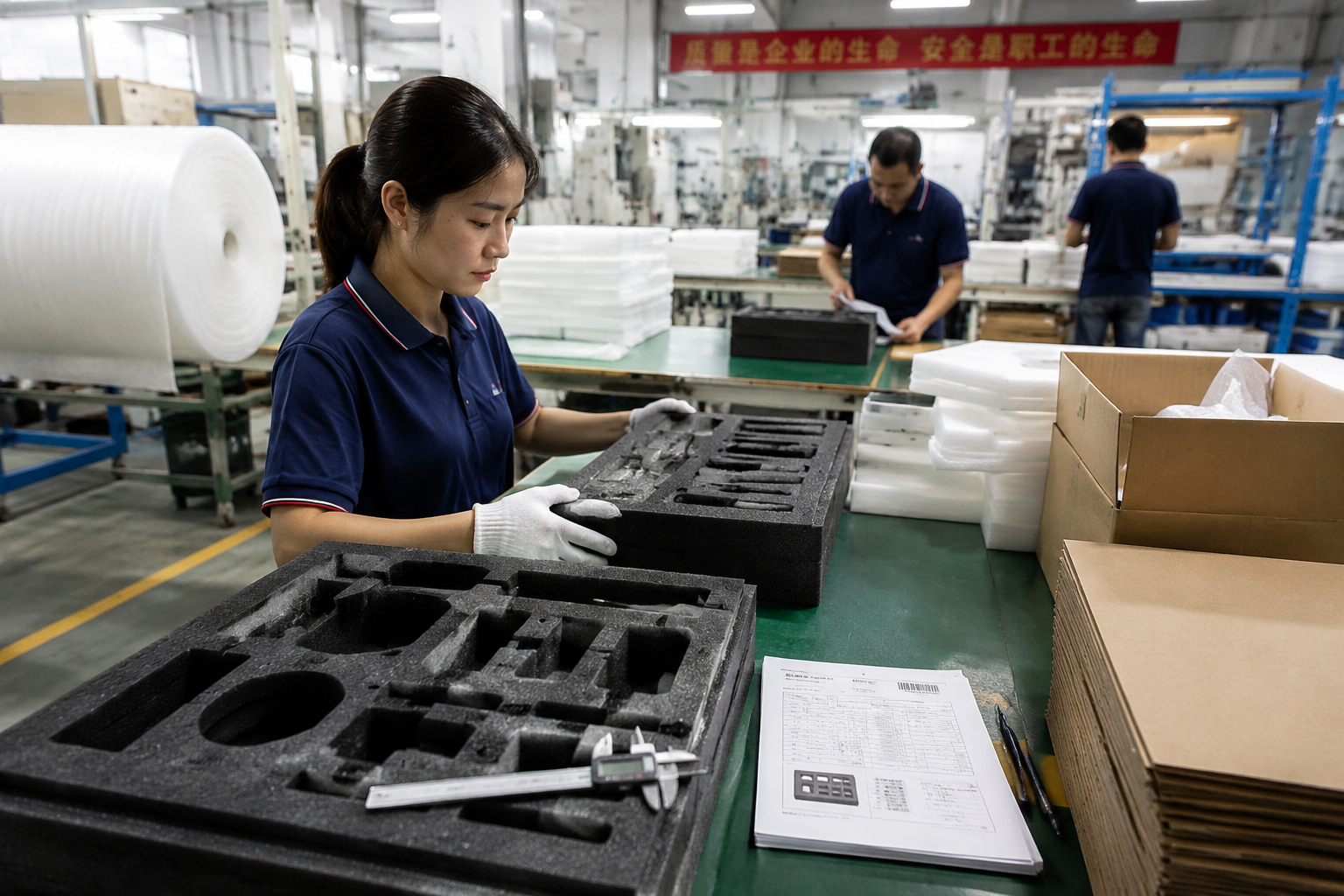
Confirm how order specifications reach the production line
Order specifications should reach the line in a form operators can use. A buyer should ask to see the production record or work instruction connected to the audited order or a similar product. It should show the item number, material type, thickness or density where relevant, product size, cutting or sealing requirements, printing or label details, packing quantity, and any special handling notes. For custom protective packaging, drawings and approved reference samples should be available near the line or controlled by the production supervisor.
This step often exposes weak coordination between sales, sampling, and production. If the quotation says one foam thickness, the sample label shows another, and the line sheet has a third value, the supplier has a control problem even if the factory looks busy. The same applies to printed bags, air column packaging, bubble rolls, and corrugated boxes. The production team must work from the latest confirmed information, not from an old drawing, a past order, or an informal message.
At Daipak, the practical review before bulk production usually starts with matching product requirements against the production instruction. This is especially important when one order combines several materials, such as EPE foam pads inside a corrugated box with a plastic liner or stretch-wrapped pallet. If the inner and outer packaging instructions are not aligned, the finished shipment may be difficult to pack, count, label, or load correctly.
Review first-piece approval before mass production
First-piece approval is one of the most important controls in protective packaging production. Before the factory runs the full batch, someone should check the first acceptable piece against the confirmed specification. This check may include foam insert length, width, slot position, thickness, and fit; bag size, film thickness, seal strength, and opening direction; air column sealing and inflation performance; bubble roll width and roll length; or carton folding, printing position, and assembly fit.
Buyers should ask who approves the first piece, what is checked, how the result is recorded, and where the approved first piece is kept during production. A good line setup should not depend only on the machine operator’s experience. The supervisor or QC staff should compare the first output with the order documents, approved sample, or drawing before allowing mass production to continue.
This control prevents full-batch errors. Without first-piece approval, a slightly wrong cutting knife, seal temperature, roll width setting, printing plate position, or folding setup can produce a large quantity of unusable packaging. The cost is not only the material loss. It can delay packing at the buyer’s warehouse, create repacking labor, or cause poor product protection during shipment.
Observe in-process checks during active production
In-process checks show whether the supplier controls the line after mass production starts. Packaging materials can drift during a run. Foam cutting may shift, bag sealing temperature may change, film rolls may vary in tension, printed marks may move, and carton folding may become inconsistent. For this reason, the audit should look for routine operator checks and supervisor review, not only a final inspection after the order is complete.
Useful signals include measuring tools at the line, operators recording dimensions at defined intervals, supervisors checking output, approved sample pieces placed nearby for comparison, and rejected pieces clearly separated from good products. The buyer can ask the supplier to show a recent in-process inspection record and explain what action was taken if a measurement was out of tolerance. A blank form is not enough; the record should connect to a real production batch.
For remote audits, a live video walkthrough can still reveal a lot. Ask the supplier to move from the production order sheet to the running machine, then to the operator check point, then to the separated defect area if any. Close-up views of calipers, rulers, weighing scales, seal samples, line records, and semi-finished goods are more useful than a wide shot of equipment. The goal is to judge whether the line is controlled in real time.
Evaluate the Sample Room as the Bridge Between Quote, Approval, and Bulk Production
For a custom packaging supplier audit, the sample room is not just a display area. It is evidence of whether the supplier can control the path from quotation to sample confirmation to bulk production. This matters because many packaging disputes begin with sample confusion: the buyer approved one size, the quotation used another detail, and production followed an older version of the sample or drawing.
Sample control is especially important for custom EPE foam inserts, air column bags, printed poly bags, corrugated boxes, and combined protective packaging. A foam insert sample may look acceptable in a photo but fail if the cavity is too tight, the edge protection is too thin, or the foam density does not match the product weight. A printed bag may be correct in size but wrong in logo position or opening direction. A corrugated box may fold properly in the sample stage but create packing trouble if the latest board or structure is not reflected in the production order.
Buyers should treat the sample room as a version-control checkpoint. Ask whether approved samples are retained, how they are labeled, how revised samples are distinguished from old samples, and how the supplier confirms that bulk production follows the latest approved version. Strong suppliers do not rely only on verbal approval. They connect the approved sample to written specifications, quotation details, production documents, and communication records.
Check whether approved samples are labeled and retained
An approved sample should be easy to identify. At minimum, the label should include a buyer name or buyer code, item number, material description, size, date, version or revision number, and approval status. For custom protective packaging, the label should also connect to a drawing number, product model, or packing method if those details affect the structure. A signed sample or clearly marked reference sample gives production and QC teams a fixed point for comparison.
The storage condition also matters. Samples should not be mixed loosely in cartons without identification. Foam samples can be compressed or deformed if stored poorly. Film and bags can be confused when several transparent materials look similar. Printed samples can fade, rub, or become outdated if not marked properly. Corrugated samples may absorb moisture or lose shape in a messy storage area. These problems make it harder for the supplier to prove what was actually approved.
For remote review, buyers can request photos or live video of the approved sample label, the sample itself, and the storage area. The supplier should be able to find the sample quickly and explain which version is valid. If the team needs a long time to locate it, or if several similar samples are stored without clear status, the audit should mark sample control as needing more evidence or corrective action.
Compare sample records with quotation and production documents
The approved sample should match the latest quotation and the production document. This comparison is where buyers often find hidden risk. The sample may show 30 mm foam thickness, while the quote lists 25 mm. The sample may use a stronger outer carton, while production instructions refer to a lighter carton. A printed bag sample may include a color reference that is not shown on the final order sheet. These mismatches can lead to wrong cost, wrong material preparation, and a poor bulk order match.
During the audit, ask the supplier to connect one sample to its related quotation, drawing, material specification, and production order. The details do not need to expose confidential information from other buyers, but the system should show how information is linked. For repeat orders, ask how the supplier confirms that the new order follows the same approved sample or a confirmed revision. This is important when the buyer has changed product size, carton quantity, label requirements, or shipping destination.
A supplier that manages this well can explain the document chain clearly. A supplier that cannot may still make good samples, but bulk production becomes more dependent on individual memory. That is a weak control point for overseas buyers because problems may not be visible until the goods arrive at the buyer’s warehouse or the product packing line.
Review how sample revisions are controlled
Sample revisions must be controlled carefully. Custom packaging often changes during development: a foam insert cavity is widened, a bag thickness is adjusted, an air column structure is modified, a printed position is corrected, or a corrugated box size is changed to reduce carton space. Each change should create a clear revision record, not a chain of unclear messages and similar-looking samples.
Buyers should ask how revised drawings, updated photos, email confirmations, and old samples are handled. Old samples should be removed, marked as obsolete, or separated from approved samples. If both old and new samples remain in the same area without status labels, production may follow the wrong version. This is a common cause of repeated dimensional errors and packing mismatches.
Good revision control should show what changed, who approved it, when it was approved, and which document or sample is now valid for production. The buyer does not need a complicated system, but the supplier should have a practical method that prevents old specifications from returning during bulk production or repeat orders.
Review QC Workflow From Incoming Check to Final Inspection
A packaging quality control audit should follow the full order cycle, not just the final inspection table. A supplier may catch some visible defects at the end, but many packaging problems are created earlier: wrong raw material thickness, weak film strength, poor foam density control, incorrect line setup, unstable sealing, printing offset, carton moisture damage, or mixed packing quantities. A reliable QC workflow checks the order before, during, and after production.
For packaging products, QC should be tied to the actual function of the material. EPE foam used for cushioning should be checked for size, thickness, density where specified, cutting accuracy, bonding quality, and fit. Bubble wrap should be checked for width, roll length, bubble integrity, and packing quantity. Air cushion packaging should be checked for sealing and air retention. Plastic bags and film products may require checks for thickness, size, seal strength, print position, opening direction, and roll weight. Corrugated boxes need review of dimensions, folding, printing, board condition, quantity, and carton marks.
Buyers should ask who performs each inspection, what tools are used, how often checks are made, where records are kept, and how nonconforming products are handled. A verbal statement such as “we inspect before shipment” is not enough for supplier approval. The factory should be able to show inspection checklists, measurement records, defect samples where appropriate, inspection photos, and disposition notes for products that failed checks.
Quality Control Note: For packaging supplier audits, buyer confidence should come from visible control evidence such as material labels, sample version records, first-piece approval, measured in-process checks, defect isolation, carton mark review, packing list verification, and loading photos. These details should be judged order by order rather than assumed from a factory profile, catalogue, or general supplier claim.
Confirm the inspection points for each packaging type
Inspection points should change according to the packaging type and the buyer’s product risk. A foam pad for simple separation does not need the same inspection depth as a custom foam insert holding a fragile glass, electronics, or painted component. For a foam insert, the audit should confirm whether the supplier checks length, width, height, slot position, thickness, bonding, and product fit. For foam bags or self-adhesive foam pouches, sealing, adhesion, opening size, and surface cleanliness may matter more.
For bubble wrap and air cushion products, the inspection should focus on whether the cushioning structure is consistent. Bubble integrity, roll width, roll length, perforation, air column sealing, inflation condition, and leakage risk are more useful audit points than a general visual check. For plastic bags, liners, garment bags, courier bags, or stretch film, the buyer should confirm thickness, size, sealing, printing, film surface, roll weight, and packing quantity. For corrugated boxes, the supplier should check dimensions, folding line accuracy, printing position, board condition, carton strength requirements where agreed, and outer packing condition.
Custom assemblies require extra attention because several materials must work together. A product may need a plastic liner for dust protection, EPE foam for cushioning, bubble wrap for wrapping, and a corrugated carton for outer handling. In that case, QC should not inspect each material in isolation only. It should also confirm that the assembled packing method matches the approved specification and can be repeated by warehouse or packing staff.
Ask for inspection records, not only inspection promises
Inspection records turn a quality claim into audit evidence. A useful record should show the date, order or item reference, checked items, measured values where applicable, inspector name or code, result, and final disposition. Photos are especially helpful for remote audits because they can show actual measurements, packing labels, carton marks, finished goods condition, and defect handling before shipment.
Buyers should ask for records from different stages: incoming inspection, in-process inspection, and final inspection. Incoming inspection may show material thickness, roll width, foam sheet size, paper condition, or purchased carton status. In-process inspection should show line-level checks such as cutting dimensions, sealing condition, print position, or roll length. Final inspection should connect to finished goods quantity, carton packing, labels, carton marks, and shipment preparation.
The strongest records are consistent with the production order and the approved sample. If the inspection checklist uses generic terms only, with no measured values or order-specific criteria, it may not control the real risk. If the supplier cannot explain where records are stored or how they are reviewed, the audit should treat the QC workflow as incomplete.
Check how defective packaging is isolated and corrected
Defective packaging should not remain mixed with good products. Buyers should ask to see the supplier’s quarantine area, defect labels, rework process, scrap handling, and approval method for corrected goods. Clear separation is important because many packaging defects look minor but can cause real problems: weak bag seals, short rolls, undersized foam inserts, misprinted cartons, air leakage, mixed labels, or incorrect packing quantity.
The supplier should be able to explain what happens after a defect is found. Some products may be reworked, such as repacking, trimming, relabeling, or correcting carton marks. Others should be scrapped because rework cannot restore function, such as weak air column sealing or badly cut foam inserts. Supervisor approval should be required before reworked goods return to accepted stock.
Defect trend tracking is also useful. A single issue may be a line setup mistake. Repeated sealing failures, dimension deviations, printing errors, or packing shortages suggest a deeper process problem. For supplier approval, buyers should look at whether the factory only removes bad pieces or also corrects the cause. A mature QC workflow should reduce repeat defects, not simply sort them at the end.
Audit Warehouse Control, Packing Accuracy, and Shipment Readiness
Warehouse control is part of supplier capability, not a separate logistics detail. A factory can produce acceptable bubble wrap, EPE foam inserts, plastic bags, air column bags, or corrugated boxes, but still create problems if finished goods are mixed, counted incorrectly, labeled poorly, or packed in weak outer cartons. For overseas buyers, these mistakes often appear late: at the receiving warehouse, during customs handling, or when the shipment is unpacked for production use.
An export packaging supplier audit should therefore include the finished-goods area, not only the production floor. Buyers should check how the supplier identifies completed orders, separates lots, follows packing instructions, verifies carton labels, prepares pallets, and records loading evidence. The practical question is simple: can the supplier prove that the right items, in the right quantity, with the right carton marks, are ready for shipment?
Check finished goods identification and lot separation
Finished packaging materials should be clearly identified after production and before shipment. Each batch should show the order number, item number or buyer code, SKU description, production date, quantity, and packing status. This is especially important when the supplier produces similar-looking items, such as clear poly bags in different thicknesses, bubble bags in close sizes, foam sheets with different densities, or printed corrugated cartons for multiple SKUs.
Weak lot separation increases the risk of mixed cartons, wrong quantity, and short shipment. A buyer should ask for warehouse photos showing how completed goods are separated by order or buyer, not stacked in a general area without visible identification. If the factory uses temporary labels, handwritten tags, or pallet cards, those labels should still be readable and tied to the packing list. The format matters less than whether warehouse staff can quickly identify what each carton or pallet contains.
Quantity control should also be visible. For rolls, sheets, bags, foam inserts, and cartons, the supplier should have a counting or packing method that matches the product type. Small plastic bags may be counted by bundle and carton quantity; bubble wrap rolls may be checked by roll count, width, and length; foam inserts may need piece count and carton quantity confirmation. Bulky protective packaging also needs enough storage space to avoid compression, deformation, or carton damage before loading.
Review carton marks, labels, and packing list consistency
Carton labeling is a practical receiving issue. Missing labels, wrong carton marks, unclear SKU codes, or inconsistent packing quantities can slow down warehouse scanning, cause receiving disputes, or delay import handling. For a buyer with multiple destination warehouses or retail channels, label errors may be as costly as a production defect because the goods cannot be identified quickly after arrival.
The audit should compare carton mark samples, finished-goods labels, and the packing list before shipment. The buyer should confirm whether the supplier uses the correct buyer name or code, item number, SKU, carton number, quantity per carton, gross weight or net weight where required, carton dimensions, and any handling marks requested for the shipment. If the buyer has a required label format, barcode, pallet label, or destination mark, the supplier should show evidence that the latest version is being used.
Packing list accuracy depends on more than office paperwork. The warehouse team needs a final cross-check between physical cartons and the shipment document. Buyers can ask how the supplier verifies carton count, mixed SKU cartons, partial cartons, and pallet quantity before loading. A strong answer includes photos of labeled cartons, a packing list draft for review, and a final confirmation process rather than a verbal statement that “the warehouse will check it.”
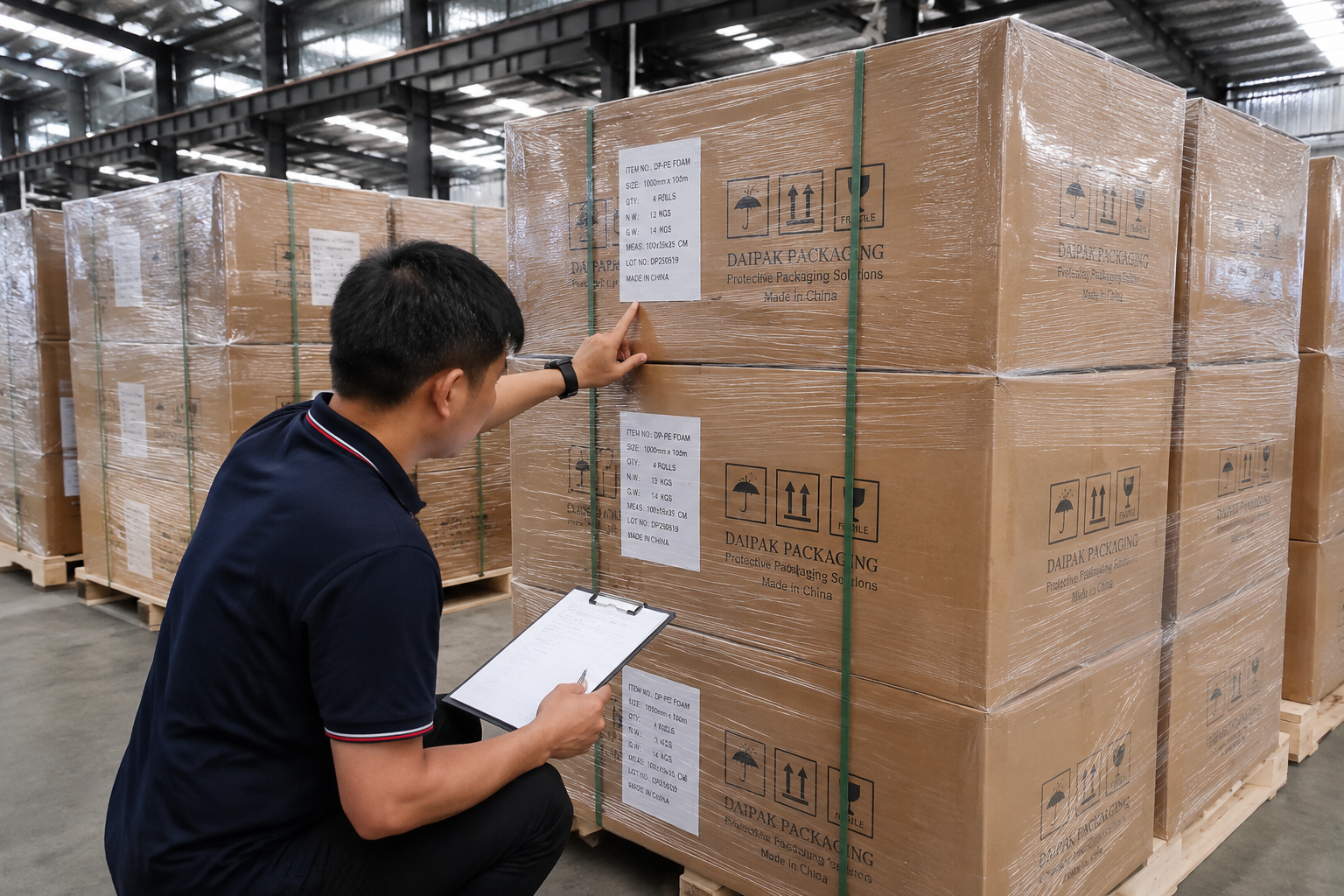
Assess export packing condition before loading
Export packing condition should be reviewed before the shipment leaves the supplier. Outer cartons should be suitable for the product’s weight and handling risk. For lightweight but bulky products such as bubble wrap rolls, air pillow film, foam sheets, and EPE inserts, the main risk may be carton crushing, moisture exposure, or deformation during storage and loading. For heavier packaging materials, the concern may be carton strength, pallet stability, and safe handling during transport.
Buyers should ask for evidence of outer carton condition, pallet arrangement, stretch film wrapping, moisture protection where appropriate, and loading preparation. Pallets should be stable, not overhanging, and not packed in a way that crushes lower cartons. If goods are floor-loaded without pallets, the supplier should still show how cartons are protected from rough stacking and how mixed items are separated during loading.
Loading photos are useful because they show the final handoff point between the supplier and the shipment process. They do not guarantee that nothing will happen in transit, but they help confirm that the supplier prepared the goods according to the agreed packing method. For export orders, Mr. Li often pays close attention to carton marks, packing quantity, destination details, and shipment preparation because small warehouse errors can become large receiving problems for overseas buyers.
Confirm wood pallet and export-material compliance when used
If the supplier uses wood pallets, wood crates, dunnage, or other wood packaging material for international shipments, buyers should verify the required treatment marks and import documentation before loading. USDA APHIS explains wood packaging material requirements for plant import contexts, and IPPC ISPM 15 is the international phytosanitary standard for wood packaging material used in international trade.[8][9] These sources do not prove that a particular pallet is compliant; the audit evidence should come from the visible marks, supplier records, and shipment documents for the actual goods.
This check is especially important when a packaging supplier prepares export packing for multiple buyers and destinations. A pallet that looks clean may still create receiving or inspection issues if the mark is missing, unclear, damaged, or not matched to the export requirement. Buyers should ask for close-up pallet-mark photos, packing list notes where relevant, and confirmation that warehouse staff know when treated wood packaging is required.
Use Corrective-Action Records to Judge Supplier Maturity
A supplier that claims it has never had a quality issue may not be more reliable than one that can explain past problems clearly. Packaging production involves materials, cutting, sealing, printing, packing, and shipment preparation. Defects can happen. The audit value lies in whether the supplier can identify the root cause, contain affected goods, correct the problem, and prevent the same issue from happening again.
Supplier corrective action packaging records help buyers judge maturity. A useful record does not need to expose customer names or confidential order details, but it should show the issue type, date, affected item, investigation result, action taken, responsible person, deadline, and verification result. If a factory has no corrective-action records at all, buyers should not automatically read that as perfect performance. It may mean problems are handled informally and lessons are not captured.
Corrective-action evidence should be traceable to the affected order, not just written as a general improvement statement. Buyers should look for the link between complaint or defect, affected material lot or production batch, containment quantity, inspection method, rework or scrap decision, revised instruction, and follow-up verification. When this link is missing, the supplier may correct the visible problem but fail to prevent the same issue from returning on a repeat order.
Ask for a closed corrective-action example
A closed corrective-action example should tell a complete story. For packaging, that story might involve wrong bag size, weak sealing, foam thickness deviation, carton printing error, air leakage in an air column bag, quantity shortage, or damaged outer cartons. The buyer, applying custom packaging supplier guide criteria during supplier evaluation, should ask what happened, how the supplier found it, which products were affected, and what immediate containment action was taken.
Containment matters because it prevents defective or uncertain goods from moving further into packing or shipment. For example, if a batch of plastic bags has weak side sealing, the supplier should separate the suspect cartons, inspect related production, and decide whether goods can be reworked or must be scrapped. If foam insert dimensions are outside tolerance, the supplier should check whether the issue came from cutting setup, drawing interpretation, material compression, or operator error.
A strong corrective-action record should also show final verification. This may include revised work instructions, new first-piece approval records, additional in-process checks, inspection photos, retraining notes, or supervisor approval before production restarts. Without verification, the action is only a response, not a confirmed prevention step.
Look for repeat-defect tracking
Repeated defects are more serious than isolated mistakes. If the same supplier repeatedly has weak sealing, dimension variation, label errors, carton mark mistakes, or packing quantity disputes, the issue may not be one operator’s mistake. It may point to unclear specifications, poor line setup, weak inspection frequency, rushed packing, or a communication gap between sales, production, QC, and warehouse teams.
Buyers should ask whether the supplier tracks complaints and internal nonconforming products by defect type. The record can be simple, but it should make repeated patterns visible. For example, several air leakage complaints should trigger a deeper review of sealing temperature, film quality, operator checks, and finished product testing. Several wrong carton label issues should trigger a review of label approval, warehouse instruction, and final packing list cross-checks.
Repeat-defect tracking also helps separate a fixable issue from a supplier-disqualifying risk. A one-time carton printing error with clear containment and prevention may be acceptable after correction. Repeated printing or labeling errors without a clear prevention action suggest the supplier may not control document versions and warehouse instructions well enough for overseas orders.
Judge whether the supplier answers with evidence or excuses
The quality of the supplier’s response is often as important as the defect itself. Evidence-based answers include photos, inspection records, revised drawings, updated production instructions, retraining records, defect samples, re-inspection results, and follow-up checks on later orders. Excuse-based answers usually stay vague: “the worker made a mistake,” “it will not happen again,” or “the shipment was rushed.”
Buyers should not expect every issue to be solved with a long technical report. The response should match the risk. A small label formatting issue may need a revised label file and final approval step. A foam thickness deviation or weak sealing issue needs deeper review because it can affect product protection, packing speed, and buyer complaints after arrival. The supplier should be able to show what changed in the process, not only offer a replacement or discount.
For supplier approval, corrective-action maturity gives procurement and quality teams a more realistic view of cooperation risk. A supplier that admits a problem, isolates affected goods, explains root cause, updates the process, and verifies the result is usually easier to manage than a supplier that denies issues until the buyer provides repeated evidence.
Build a Remote Audit Evidence Package When You Cannot Visit the Factory
A remote packaging supplier audit should be structured like a planned factory review, not treated as a casual video call. Overseas buyers may not be able to visit the factory before supplier approval, but they can still request a clear evidence package covering production areas, raw materials, sample control, QC workflow, warehouse control, export packing, and corrective-action records. The goal is to reduce uncertainty before placing a larger or repeat order.
Remote evidence should be tied to the buyer’s actual packaging type. Generic factory photos are not enough. A buyer sourcing custom EPE foam inserts needs to see foam materials, cutting or forming control, sample labels, measurement tools, and finished insert packing. A buyer sourcing poly mailers needs to see film material, sealing quality, print position control if applicable, carton packing, and label accuracy. Random images of a clean warehouse do not prove that the supplier can control the order under review.
Request a live walkthrough around the actual audit checklist
A useful video audit follows a planned sequence. The buyer should send the supplier a short agenda before the call and ask one responsible contact to walk through specific areas: raw material storage, relevant production lines, in-process inspection points, sample room, finished-goods warehouse, packing area, and loading preparation area if available. The video should not jump only to the best-looking corner of the factory.
During the live walkthrough, buyers should ask the supplier to show active production where possible, not only idle machines. The camera should pause at production order sheets, material labels, measuring tools, semi-finished goods, sample references, inspection records, and separated defective or uncertain goods. If the supplier cannot show the buyer’s exact product because production has not started, it should show a similar product type and explain the differences honestly.
Remote walkthroughs also test communication quality. The supplier’s contact should understand the order, the material, the production steps, and the buyer’s main risk points. If every question must be passed to another person and no one can connect documents with factory practice, the buyer may need more evidence before approval.
Ask for close-up evidence, not only factory overview photos
Factory audit photos should include close-up details. Overview photos can show general layout, but they rarely prove control. Buyers should request timestamped photos of material labels, production records, approved samples, inspection reports, carton marks, finished-goods labels, packing quantities, pallet condition, and loading preparation. The supplier should be able to connect each photo to an order number, item code, or sample reference.
Close-up evidence is especially important for packaging because many defects are small but costly. A one-centimeter size error in a foam insert can affect product fit. A weak seal on a plastic bag can fail during packing. A wrong carton mark can send goods to the wrong warehouse location. A missing production date or batch label can make traceability difficult when a buyer later reports a defect.
Document samples should be reviewed together with photos. A production record without a matching product photo is weak evidence. A carton mark photo without a packing list cross-check is incomplete. A QC report without measured values, inspector information, or disposition notes may not prove that inspection actually happened. The strongest remote evidence package connects documents, photos, and live video into one consistent order story.
Verification Note: When possible, buyers should review real order evidence before approval, including live video, close-up material labels, approved sample photos, inspection sheets, measured values, finished-goods labels, carton marks, pallet condition, and loading records. Promotional images and general factory descriptions can help with screening, but they should not replace evidence connected to the exact packaging type, version, and shipment risk.
Test evidence consistency across documents, photos, and video
Remote evidence is stronger when the same order details appear consistently across different proof types. The buyer can compare the item code on the quotation, the revision number on the approved sample, the material description on the warehouse label, the size on the production sheet, the measured value on the inspection record, and the carton mark on finished goods. If these details do not align, the supplier may still be capable, but the approval decision should wait until the mismatch is explained and corrected.
Buyers should also be cautious with evidence that is too generic to audit. A photo of a measuring tool does not prove measurement control unless it shows the actual product being checked and the result recorded. A warehouse video does not prove shipment readiness unless labels, carton counts, SKU separation, and packing list details can be seen. Remote audit confidence comes from connected evidence, not from the quantity of images sent.
Know when remote evidence is not enough
Remote audits have limits. They can show many useful signals, but they cannot always verify machine condition, operator behavior over time, full warehouse discipline, or every subcontracted process. Buyers should be cautious when the order involves high-risk custom packaging, large quantities, tight tolerances, expensive products, repeated defects, or unclear supplier responses.
For custom protective packaging, remote evidence may be enough for early screening but not for final approval of a critical shipment. A complex foam structure, custom air column design, printed corrugated box, or combined packaging system may require sample testing, pre-shipment inspection, or an on-site review before bulk production or before release of the first major shipment. The higher the product damage risk, the stronger the evidence should be.
A practical decision rule is to use remote audit results to classify the supplier: acceptable evidence, more evidence needed, corrective action required, or not ready for approval. If the supplier responds with organized records, clear video, close-up photos, and practical explanations, the buyer can move forward with better confidence. If the supplier avoids specific questions, sends only polished promotional photos, or cannot connect records to real production, remote approval should be delayed until the gaps are closed.
Score the Supplier and Decide: Approve, Request Evidence, or Require Corrective Action
A packaging supplier audit checklist only becomes useful when it leads to a clear supplier approval decision. After reviewing production capability, material control, sample management, QC workflow, warehouse handling, export readiness, communication quality, and corrective-action maturity, the buyer should not leave the result as a general impression. The audit should end with one of four practical outcomes: approved, conditional approval, hold order pending more evidence, or corrective action required before approval.
The scoring does not need to be complicated. What matters is whether the supplier can prove that the same packaging specification can be produced, checked, packed, labeled, and shipped repeatedly. A supplier that gives complete, consistent evidence and can explain its process clearly should score higher than one that only provides broad statements or polished photos. For packaging materials, the risk is often in small details: foam thickness, bag sealing, bubble roll width, carton marks, quantity per carton, pallet condition, or whether the approved sample matches the production order.
As a China packaging materials supplier, Daipak often sees overseas buyers use audit results to decide not only whether to place an order, but also how much control the first order needs. A lower-risk standard item may be approved with normal pre-shipment photos and packing records. A custom EPE foam insert, printed poly mailer, air column structure, or export corrugated carton may need sample confirmation, in-process photos, final inspection records, and carton mark checks before bulk shipment.
Use scoring dimensions that match packaging order risk
The audit score should reflect the buyer’s actual packaging risk, not a generic factory profile. A supplier making simple inner poly bags may not need the same review depth as a supplier making custom foam inserts for fragile export products. The more the packaging affects product protection, receiving accuracy, or export handling, the more weight should be placed on process control and evidence quality.
A practical scoring model can divide each audit area into three questions: Is the process defined? Is there evidence that the process is followed? Does the supplier respond clearly when asked for details? This prevents the audit from becoming a document collection exercise. For example, a QC checklist has limited value if the supplier cannot show dated inspection records, measured values, defect handling, or photos connected to the buyer’s product type.
| Audit Dimension | What to Score | Higher-Risk Warning Sign |
|---|---|---|
| Production capability | Relevant in-house or controlled processes, line setup, first-piece approval, operator checks | Supplier cannot show how the ordered packaging will actually be produced |
| Material control | Material labels, batch separation, incoming checks, storage condition, rejected material control | Wrong thickness, density, film grade, or paper material could enter production unnoticed |
| Sample management | Approved sample retention, revision control, match between sample, quote, and production order | Old samples and revised drawings are mixed without clear status |
| QC workflow | Incoming, in-process, and final inspection records with measurable checks | Inspection is only a final visual check before shipment |
| Warehouse and export readiness | Finished goods labels, SKU separation, carton marks, packing list accuracy, pallet condition | Mixed cartons, unclear labels, or no loading evidence for export orders |
| Corrective-action response | Root cause, containment, prevention action, responsible person, verification evidence | Repeated issues are explained away without process changes |
Buyers should adjust the weighting based on product sensitivity. For fragile goods, cushioning design, foam fit, bubble integrity, carton compression risk, and pallet preparation may carry more weight. For apparel or e-commerce shipping supplies, bag size, sealing quality, printing position, carton count, and labeling accuracy may matter more. For distributors buying mixed packaging materials, warehouse control and lot separation become especially important because receiving mistakes can spread across many downstream orders.
Separate minor gaps from supplier-disqualifying risks
Not every audit finding should block supplier approval. Some gaps are fixable if the supplier understands the issue, assigns responsibility, and provides evidence before production or shipment. A missing sample label, incomplete packing photo, unclear carton mark template, or outdated work instruction may be acceptable under conditional approval if the supplier corrects it quickly and shows proof.
Other findings should carry much more weight. Hidden outsourcing of key production steps, no incoming material records, no first-piece approval for custom packaging, no final inspection records, uncontrolled rejected materials, or inconsistent answers during a factory walkthrough can indicate a deeper control problem. These issues do not only create one-time defects; they make repeat orders unpredictable.
A useful way to classify findings is to ask whether the gap affects product protection, order identity, shipment accuracy, or the buyer’s ability to trace a problem later. If the answer is yes, the finding should not be treated as a minor paperwork issue. For example, weak sealing on plastic bags, foam thickness deviation, air leakage in air column bags, wrong carton printing, or mixed SKU cartons can lead directly to damage, receiving delays, customer complaints, or rework costs.
The supplier’s response also matters. A factory that openly explains a gap and proposes a practical correction may still be a workable partner. A supplier that avoids direct answers, refuses to show production evidence, changes explanations, or cannot identify who controls the process should be treated as higher risk. In a packaging factory evaluation, transparency is part of capability.
Convert audit findings into a corrective-action request
When the supplier has real but fixable gaps, the buyer should convert the audit result into a written corrective-action request. The request should be specific enough that both procurement and quality teams can verify completion. “Improve QC” is too vague. “Add first-piece approval records for custom EPE foam inserts, including length, width, thickness, cavity fit, inspector name, and approval photo before mass production” is much more useful.
A strong corrective-action request should define the issue, the required action, the responsible person, the deadline, the evidence needed, and the verification method. For packaging orders, evidence may include revised work instructions, updated sample labels, incoming material inspection records, production-line photos, defect isolation photos, final inspection sheets, packing list cross-checks, carton mark samples, pallet photos, or loading photos.
- Approve when the supplier provides complete and consistent evidence, the process fits the order risk, and no major control gaps remain.
- Conditional approval when the supplier appears capable, but minor documentation, labeling, sample, or packing controls must be corrected before or during the first order.
- Hold order when the supplier’s answers are plausible but not proven, especially for custom protective packaging, export packing, or large-volume orders.
- Require corrective action when gaps are real but can be fixed with clear responsibility, deadline, and verification evidence.
- Reject supplier when the supplier cannot prove key capability, hides important processes, lacks basic QC records, or fails to control materials, samples, defects, or shipment accuracy.
The final decision should be shared in clear business language. If the supplier is approved, define any ongoing controls for the first order, such as sample sign-off, pre-production confirmation, inspection photos, or loading records. If approval is conditional, state what evidence must be submitted before production starts. If corrective action is required, do not release the order until the supplier provides proof and the buyer confirms that the gap is closed.
This approach keeps the audit practical. The goal is not to find a perfect supplier with no past issues. The goal is to approve a packaging materials supplier that can control specifications, communicate clearly, handle corrections responsibly, and support the buyer’s product risk from quotation through shipment preparation.
Compliance Boundary for Supplier Approval Decisions
Supplier audit results should not be treated as guarantees of future performance. They are evidence-based approval decisions made from the documents, samples, records, photos, videos, and observations available at the time of review. A supplier may pass an audit for one packaging type and still need a separate review for another material, structure, claim, destination market, or export route.
Buyers should be careful with unsupported policy or service promises during supplier evaluation. Unless the supplier provides written and order-specific terms, statements about warranty, replacement, refunds, customs clearance, guaranteed delivery dates, waterproof performance, pressure testing, or after-sales support should be recorded as items to confirm rather than accepted as audit evidence. The safer procurement approach is to separate manufacturing capability from commercial terms and verify both before order release.
The same boundary applies to price and value comparisons. A lower quoted price may be attractive, but it should be compared against material specification, production controls, inspection scope, packing method, export preparation, communication quality, and corrective-action behavior. Without that context, a price comparison can hide quality, delay, rework, or receiving risk.
When the audit includes environmental, food-contact, transport, or export-material claims, the approval decision should state the exact scope. For example, a supplier may be conditionally approved for non-food protective foam but not for direct food-contact packaging, or approved for cartons without wood pallets but not for export shipments using wood packaging material. This keeps the approval practical, specific, and easier to enforce on repeat orders.
References
[1] ASTM International, “ASTM D4169 Standard Practice for Performance Testing of Shipping Containers and Systems,” shipping container performance testing standard, available at ASTM D4169 Shipping Container Performance Testing.
[2] International Safe Transit Association, “ISTA Procedure 3A Overview,” packaged-product test overview for parcel delivery systems, available at ISTA Procedure 3A Overview.
[3] ASTM International, “ASTM D642 Standard Test Method for Determining Compressive Resistance of Shipping Containers,” compression resistance test method reference, available at ASTM D642 Compression Resistance.
[4] U.S. Food and Drug Administration, “Food Packaging and Food Contact Substances,” consumer-facing reference on food packaging and substances that come into contact with food, available at FDA Food Packaging and Food Contact Substances.
[5] Electronic Code of Federal Regulations, “21 CFR Part 177 — Indirect Food Additives: Polymers,” U.S. federal regulations for polymer materials in food-contact contexts, available at 21 CFR Part 177 Polymers.
[6] Electronic Code of Federal Regulations, “21 CFR Part 176 — Indirect Food Additives: Paper and Paperboard Components,” U.S. federal regulations for paper and paperboard components in food-contact contexts, available at 21 CFR Part 176 Paper and Paperboard.
[7] Federal Trade Commission, “Green Guides,” U.S. guidance for environmental marketing claims including recyclable, degradable, and compostable claims, available at FTC Green Guides.
[8] USDA Animal and Plant Health Inspection Service, “Wood Packaging Material,” official guidance for wood packaging material and import/export compliance context, available at USDA APHIS Wood Packaging Material.
[9] International Plant Protection Convention, “ISPM 15 Regulation of Wood Packaging Material in International Trade,” international phytosanitary standard for wood packaging material, available at IPPC ISPM 15 Wood Packaging.
[10] ASTM International, “ASTM D6400 Standard Specification for Labeling of Plastics Designed to be Aerobically Composted in Municipal or Industrial Facilities,” compostable plastics reference, available at ASTM D6400 Compostable Plastics.
[11] ASTM International, “ASTM D6868 Standard Specification for Labeling of End Items that Incorporate Plastics and Polymers as Coatings or Additives with Paper and Other Substrates Designed to be Aerobically Composted,” compostable coated packaging reference, available at ASTM D6868 Compostable Coated Packaging.
[12] Biodegradable Products Institute, “BPI Certified Compostable Products and Packaging,” certification reference for compostable products and packaging, available at BPI Certified Compostable Products and Packaging.
[13] How2Recycle, “How2Recycle Label Guidance,” recyclability labeling resource for consumer-facing recycling instructions, available at How2Recycle Label Guidance.
[14] Association of Plastic Recyclers, “APR Design Guide Overview,” design guidance reference for plastic packaging recyclability, available at APR Design Guide Overview.
[15] RecyClass, “Design for Recycling Guidelines,” European design-for-recycling guidelines and protocol context for plastic packaging, available at RecyClass Design for Recycling Guidelines.
Disclosure: This article is for general supplier-audit, procurement, and quality-control education. Packaging performance, compliance status, environmental claims, food-contact suitability, export requirements, test results, prices, availability, shipping terms, and after-sales support can vary by material, order specification, destination market, supplier process, and documented policy. Buyers should verify important claims, reports, certificates, specifications, and commercial terms directly with the supplier before approval or purchase.
Packaging Supplier Guides cornerstone library
Cornerstone guides for this topic
Keep these Packaging Supplier Guides guides close while you read. They are the standing references for the decisions covered on this page.
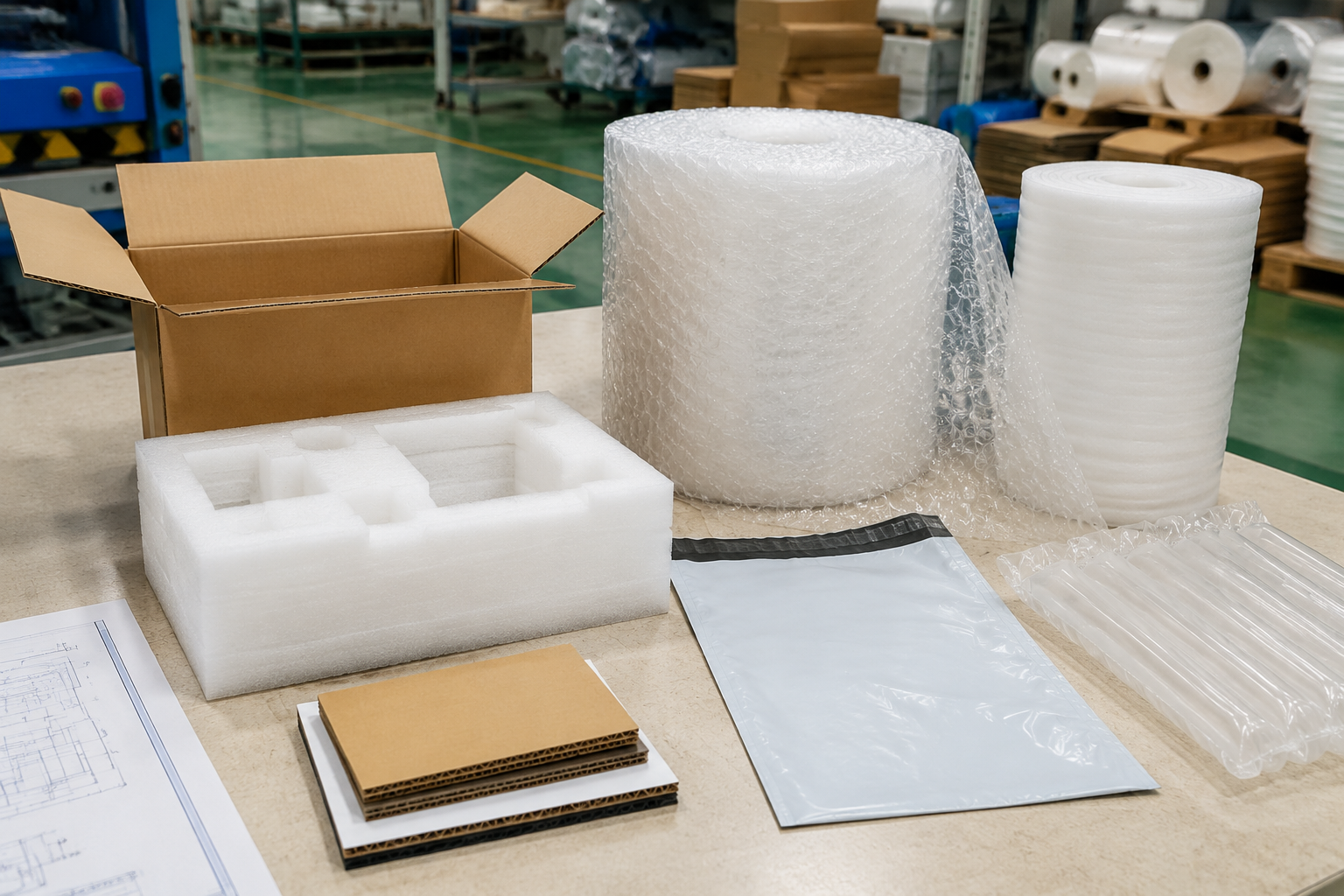
Wholesale Packaging Materials in China: Samples, MOQ, Quotation, and Bulk Order Process
Wholesale packaging materials from China can look simple at the inquiry stage, but the real decision depends on much more than naming a material...
Read cornerstone guide
Packaging Manufacturer vs Trading Company in China: What Overseas Buyers Should Check
When you are sourcing packaging from China, the main decision is not just who gives the quote. It is whether the supplier can handle...
Read cornerstone guide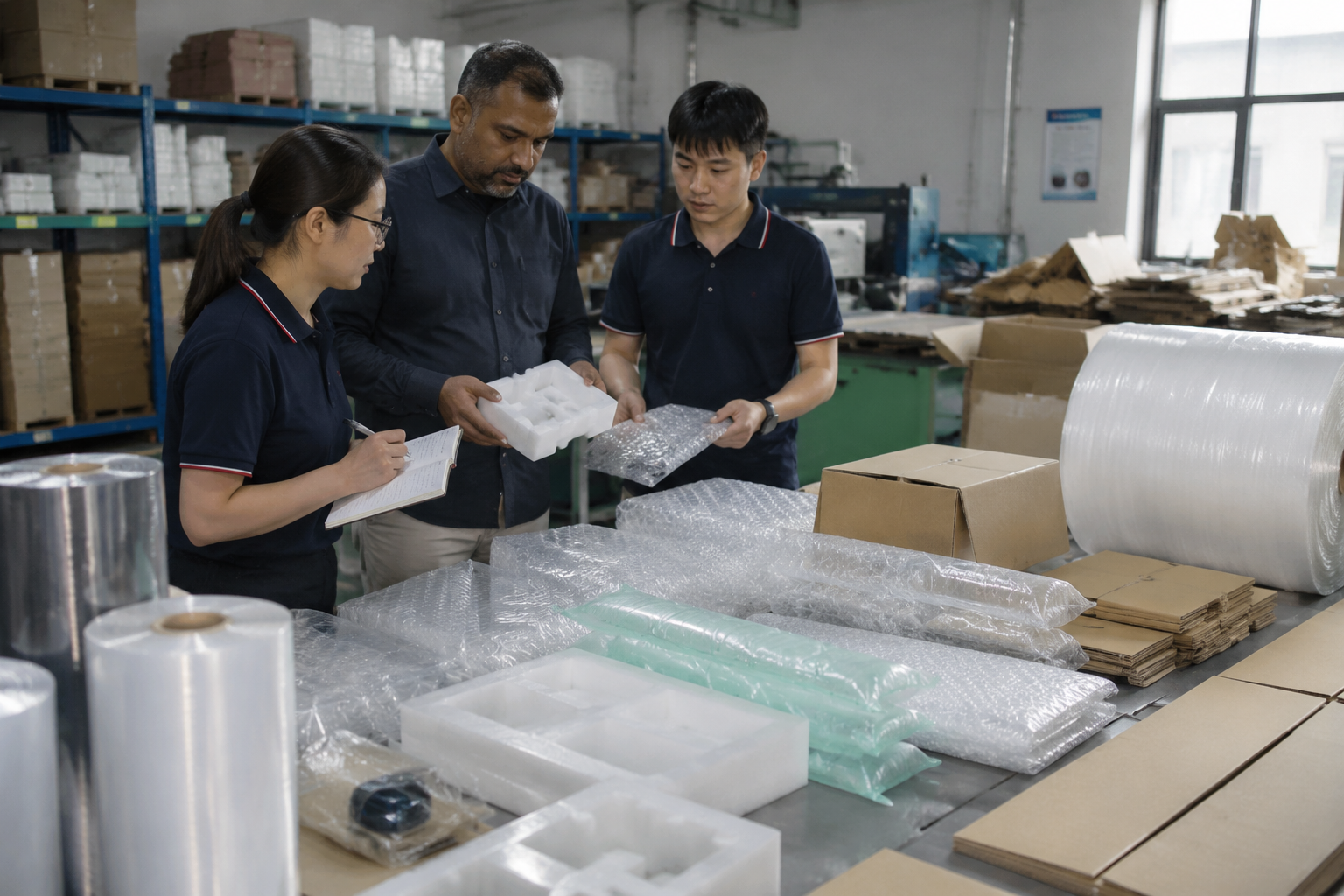
China Packaging Materials Supplier Guide: How to Choose the Right Factory for Custom Packaging
Choosing a China packaging materials supplier is not only about finding a factory that can quote foam, bubble wrap, cartons, film, or plastic bags....
Read cornerstone guide