
When exporting bulk goods, the wrong corrugated box specification can lead to crushed loads, rejected shipments, and unexpected costs that spiral higher than expected. Many buyers focus on outer dimensions or price per box, but effective corrugated box cost reduction depends on how the box is built—its flute type, board grade, ECT rating, and whether the internal fit was calculated correctly. This article walks through the structural and measurement choices that determine whether a packaging buyer must get right before placing an export carton order.
The focus here is practical: how to choose between flute types, match ECT vs burst strength to your shipping mode, avoid the common mistake of ordering using outer instead of internal dimensions, and confirm specifications with your supplier before production. Whether you are shipping FCL containers, LCL pallets, or courier parcels, the decision criteria are different. The article helps you match the carton to the actual load and the route, not just to a price point.
Quick Packaging Decision Guide
| Buyer Question | Practical Reading | What to Check |
|---|---|---|
| How do I choose between single-wall and double-wall board? | Compare flute types (B, BC, B) against product weight and stack height. | Double-wall BC-flute is standard for heavy palletized FCL loads. |
| Should I specify ECT or burst strength for my order? | ECT for containerized stacking loads; burst for rough handling routes. | Confirm which test your carrier or destination market expects. |
| What happens if I give the supplier outer dimensions instead of internal? | The box may be too small to fit the product plus cushioning. | Always specify internal dimensions from product size + tolerance + padding. |
| How does pallet size affect box strength? | Overhang reduces compression strength by up to 30%. | Match box footprint to pallet dimensions exactly. |
| What is the best box style for export containers? | RSC (regular slotted container) offers best stacking strength and cost. | Confirm whether interlocking or column stacking is planned. |
Quick Questions Before You Read
Q: Is a higher ECT rating always better for my export cartons?
Not always. A very high ECT board can be stiffer but more brittle. For LCL or multi-stop shipments that will be handled roughly, a board with good burst strength may be more important than maximum stacking compression.
Q: Do I need to specify internal dimensions when ordering bulk boxes?
Yes. The most common mistake is to specify outer dimensions, which leads to boxes that cannot hold the product. Always give the supplier internal length, width, and depth based on your product plus cushioning and tolerance.
Q: What flute type should I use for heavy export loads on pallets?
BC-flute double-wall is the most practical choice for heavy palletized stacks in containers. It offers good compression strength without excessive board weight. Single-wall B-flute is better for lighter courier shipments.
Q: How do I confirm my box specification is correct before bulk production?
Provide your product details (dimensions, weight, fragility), cushioning plan, and shipping mode to your supplier. They should confirm internal dimensions, board grade, flute type, and ECT target before you approve a sample. The sample approval is the final verification point.
Why Box Structure Matters More Than Box Size in Export Shipping
A buyer sources export cartons for bulk packaging. The product fits. The outer dimensions match the pallet. The price looks right. Then the containers are loaded, and the bottom-tier cartons collapse under the weight of the stack. The damage is not caused by the wrong size. It is caused by the wrong structure.
This scenario is more common than it should be. Many buyers focus on external dimensions first and treat flute type, board grade, and box style as secondary details. In export shipping, those structural decisions determine whether the carton survives the journey or crushes under load. Size tells you whether the product fits. Structure tells you whether the carton holds.
Three structural elements should be decided before the final dimensions are confirmed: flute type, board grade, and box style. Each one affects how the carton handles stacking pressure, cushioning, and handling during transit. A buyer who starts with these three decisions will end up with a box that fits both the product and the shipping route.
Beyond these three elements, the buyer should also consider the surface finish of the product and the risk of abrasion during transit. A product with a painted or polished surface, for example, may be damaged by the inner corrugated liner if the box shifts during shipping. In such cases, an internal liner with a smooth finish or a separate inner wrap may be needed. This is one of those details that a material-only specification misses, but a careful packaging buyer will raise early in the discussion.
Industry standards provide a useful framework for evaluating corrugated box performance. The Fibre Box Handbook, published by the Fibre Box Association, is the authoritative reference for box construction rules, flute profiles, and test methods used across the corrugated industry.[1] Buyers who reference this handbook when discussing specifications with their supplier can ensure they are using consistent terminology and realistic performance expectations.
Traceability in box structure starts with the information the buyer provides before any recommendation is made. A supplier cannot recommend the correct flute type or board grade without knowing the product weight, the number of cartons per pallet, the stacking height inside the container, and the shipping route. When a buyer sends these details to the supplier, the recommendation becomes traceable to a specific set of conditions rather than a general guess. At Daipak, the team reviews these product and shipping details before quoting, so the box structure is linked to the actual load it must carry.

Flute Type: Which One Supports Stacking and Cushioning?
Not every flute type is useful for export bulk orders. For export cartons, the relevant choices narrow down to B-flute, C-flute, BC-flute, and EB-flute. Each serves a different stacking and cushioning role.
BC-flute is the most practical choice for heavy stacking. The combination of B and C flutes gives double the thickness and significantly higher compression strength. For export cartons that will be palletized and stacked several tiers high inside a container, BC-flute is the reliable starting point.
B-flute works well for lighter retail-ready boxes that do not carry heavy stacking loads. It is thinner, takes up less space, and provides adequate protection for low-weight products shipped on short courier routes. It is not a good choice for dense or heavy loads.
EB-flute offers a smoother surface for printing while still providing reasonable stacking strength. It is a good fit when the carton needs to carry printed graphics for retail display and still hold up in moderate stacking conditions. For pure shipping strength, BC-flute outperforms it.
The right flute choice depends on product weight, stacking height, and shipping mode. A heavy part stacked six pallets high inside an FCL container needs BC-flute. A lightweight accessory shipped by courier may be fine with B-flute. The buyer should match the flute to the load, not pick one by habit.
When selecting a flute type, it also helps to consider the product shape. A product with sharp corners or protruding edges may press into the flutes and cause localized crushing. In such cases, a thicker flute like BC-flute provides more cushioning depth between the product and the outer liner, reducing the chance of puncture. A buyer shipping automotive parts or metal brackets, for example, should confirm that the flute depth is sufficient to keep the product from contacting the outer surface under compression.
The flute type recommendation becomes traceable when the supplier documents the product weight, the stacking height, and the shipping mode that led to the flute choice. If the buyer later changes the product weight or the pallet configuration, the flute type may need to be re-evaluated. This is easier to manage when the original basis for the recommendation is written down and shared with the buyer.
Board Grade: What Single-Wall, Double-Wall, and Triple-Wall Actually Mean for Export
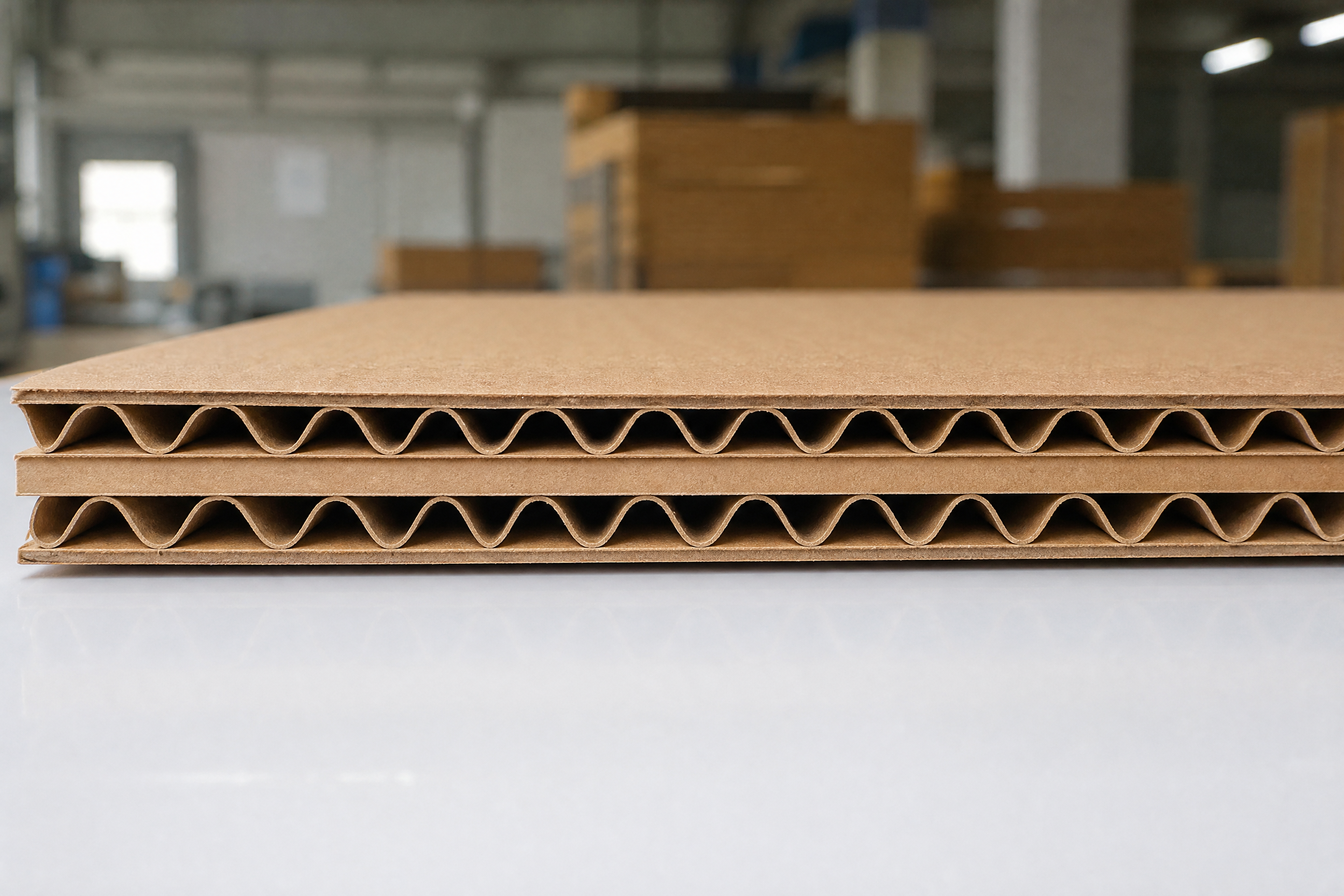
Board grade refers to the number of corrugated layers. Single-wall has one fluted layer between two liners. Double-wall has two fluted layers between three liners. Triple-wall has three fluted layers between four liners. The difference is not just in thickness. It is in how much compression the board can withstand before the flutes buckle.
For most export bulk orders, double-wall is the practical starting point. It provides enough stacking strength for standard pallet loads inside a container and handles the vibration and pressure of long-distance shipping. A double-wall BC-flute carton is the most common specification for export-grade packaging across many industries.
Single-wall is acceptable only for lightweight products on short shipping routes. If the carton will be stacked more than two pallets high or travel through multiple handling points, single-wall carries a real risk of collapse. It should not be the default choice for export.
Triple-wall is for very heavy industrial parts. It adds significant weight and cost, and it is harder to fold and tape during packing. Most export cartons do not need triple-wall. But for dense metal components or parts that require extreme stacking height, it is the right call.
The buyer should think about board grade in terms of layers and load, not just names. Double-wall is the workhorse. Single-wall is the exception. Triple-wall is the specialty case.
A practical note on packing speed: triple-wall cartons are noticeably more difficult to fold and tape by hand. If your packing line relies on manual labor, switching from double-wall to triple-wall may reduce packing throughput. The buyer should check whether the packing team can handle the heavier board before committing to triple-wall for the full order. Mr. Wang, who reviews production feasibility at Daipak, often flags this point when a buyer requests triple-wall without confirming their packing setup.
Board grade selection is easier to control when the supplier knows the exact product weight per carton, the number of layers per pallet, and the expected stacking height in the container. These three inputs give the supplier a clear basis for recommending double-wall over single-wall or triple-wall. Without them, the board grade recommendation is not traceable to the actual load.
How to Match Burst Strength and ECT for Your Shipping Route
Many buyers ask for “strong boxes” without specifying how strength should be measured. That is understandable, but it creates a gap. A carton that survives a drop test in a warehouse may still collapse under the weight of a tall pallet stack inside a container. The two situations test different kinds of strength.
The two standard measures are burst strength, measured by the Mullen test, and edge crush test (ECT). Burst strength measures how much pressure the board can take before it ruptures. ECT measures how much force the board can withstand along its edge before the flutes crush. They are not interchangeable.
Burst strength matters more for rough handling. If the carton will be tossed, dropped, or impact-loaded during loading and unloading, a high burst rating helps prevent punctures and ruptures. ECT matters more for stacking. If the carton will sit under other cartons for days or weeks during shipping, ECT determines whether the bottom tier holds.
For most export container shipping, ECT is the better primary metric. Containerized freight places the highest stress on the bottom cartons in a stack. ECT directly measures the board’s resistance to that compression. That does not mean burst strength is irrelevant. But for a buyer shipping FCL loads with stable pallet stacking, ECT should be the first number to specify.
| Strength Metric | What It Measures | Best For | Typical Export Value |
|---|---|---|---|
| Burst (Mullen) | Resistance to puncture and rupture | LCL, break-bulk, rough handling | 200 psi or higher |
| ECT | Resistance to edge crush and stacking | FCL, high pallet stacking | 32 ECT or higher |
Specifying both is ideal, but not always necessary. If the supplier knows the shipping mode and stacking height, they can recommend the right balance. The buyer just needs to provide that information clearly.
Standardized test methods exist for both measurements. For ECT, the industry reference is TAPPI T 804, which specifies the compression test procedure for fiberboard shipping containers.[2] For burst strength, TAPPI T 810 provides the test method for corrugated board bursting strength.[3] A buyer who asks the supplier whether their board has been tested to these standards can verify that the quoted ECT or burst value is based on a reproducible method rather than a rough estimate.
When Burst Strength Is the Better Choice
Burst strength becomes the priority when the shipping route involves multiple handling points, transshipment between carriers, or break-bulk loading. LCL shipments are a good example. The carton is loaded and unloaded several times, mixed with other cargo, and handled by different teams at each stop. A high burst rating helps the board survive those impacts without tearing.
Warehouse transfers and last-mile delivery also favor burst strength. Cartons that move through distribution centers, get sorted on conveyor belts, and are dropped onto delivery trucks face repeated impact stress. In those conditions, a carton with high ECT but low burst strength may hold its stack but rupture on impact.
For buyers who cannot control how their cartons are handled after they leave the factory, burst strength provides a safety margin against rough handling that ECT alone does not cover.
When ECT Should Be Your Primary Specification
ECT is the better choice for containerized shipping where pallet stacking is the dominant stress. In an FCL container, the bottom cartons carry the full weight of the stack above them for the entire transit. That compression load is constant and sustained. ECT directly measures the board’s ability to resist that load.
The relationship between ECT value and stacking height is practical. A higher ECT rating means the board can support a taller stack without the flutes crushing. For typical export pallet stacking of four to six tiers, ECT 32 or higher is a reasonable starting point. For taller stacks or heavier products, ECT 44 or higher may be needed.
When the buyer specifies ECT, the supplier can design the board structure to meet that target. The result is a carton that holds its shape under sustained compression, which is exactly what container shipping demands.
One point that is often overlooked is how the board’s moisture content affects ECT performance. Corrugated board naturally absorbs moisture from the air, and higher moisture content reduces edge crush resistance. A carton that tests well in a dry factory environment may perform differently after weeks at sea in a humid container. Buyers shipping to tropical or high-humidity destinations should discuss this with the supplier. A moisture-resistant coating or a higher initial ECT target can help compensate for the expected drop in strength during transit.
For buyers who need to validate their packaging before bulk shipment, ASTM D4169 provides a standard practice for performance testing of shipping containers and systems.[4] This test method simulates the distribution environment, including stacking, vibration, and impact, and can help identify whether the chosen ECT or burst specification is adequate for the intended shipping route.
When the buyer provides the shipping route details and the expected stacking height, the supplier can select an ECT or burst target that is traceable to those conditions. If the buyer later changes the shipping mode from FCL to LCL, the strength specification should be reviewed. A clear record of the original shipping conditions helps both sides know when a re-evaluation is needed.
Internal Dimensions: The Most Common Specification Mistake in Bulk Box Orders
A buyer needs export cartons for a product line. The product measures roughly 40 x 30 x 20 cm. The buyer orders boxes with outer dimensions of 42 x 32 x 22 cm, assuming that gives enough room. When the boxes arrive, the product does not fit. The internal space, after accounting for the corrugated board thickness, is several centimeters smaller than expected. The order has to be reworked, and the shipping deadline is missed.
This scenario happens more often than it should. The mistake is simple: the buyer specified outer dimensions instead of internal dimensions. For bulk packaging, internal length, width, and depth determine whether the product fits. Outer dimensions are useful only for freight volume calculation. They tell you nothing about usable space inside the box.
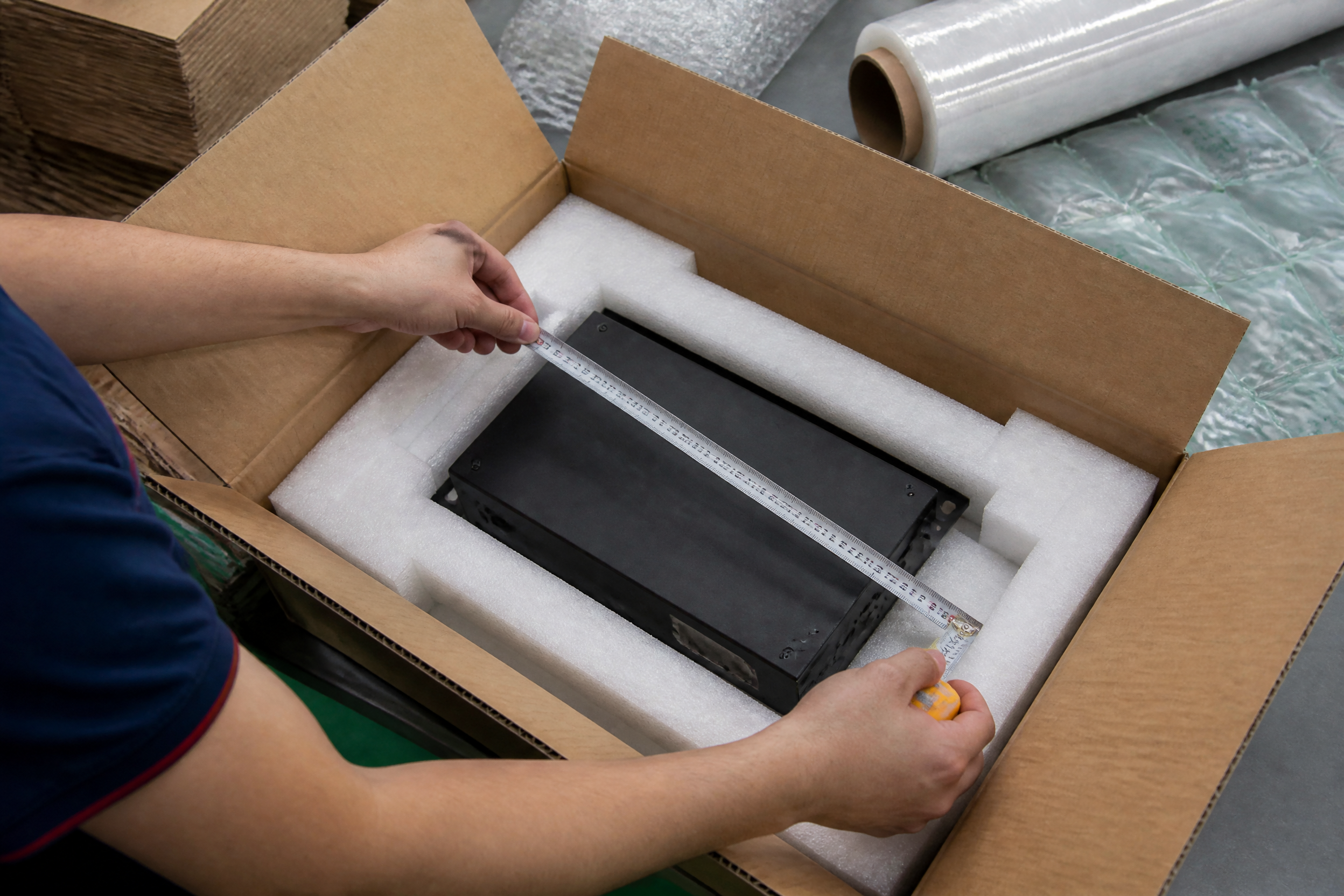
The correct approach is to start with the product. Measure the product at its widest points. Add the thickness of any cushioning material on each side. Add a small tolerance for packing ease. That gives you the internal dimensions. A basic formula looks like this:
Internal dimension = product size + cushioning thickness on each side, with folding cartons vs corrugated boxes considered when selecting board structure, plus packing tolerance of 2–3 mm per side for consistent fit.
For a product that is 40 cm long with 2 cm of foam on each end and a 3 mm tolerance, the internal length should be about 44.6 cm. If you order a box with that internal length, the outer dimension will be larger once the corrugated board thickness is added. That is fine. The outer size matters for the freight quote. The inner size matters for product fit.
When communicating with a supplier, always state internal dimensions first. Confirm that the quote is based on internal measurements. This prevents the most common specification error in bulk box orders.
Dimensional planning also benefits from considering pallet utilization standards. ISO 3394 specifies dimensions for rigid rectangular transport packages to optimize pallet and container space.[5] By aligning box dimensions with this standard, buyers can reduce wasted freight volume and improve load stability. A box that fits the pallet footprint without overhang not only uses container space more efficiently but also maintains the compression strength that the board grade was designed to provide.
How to Confirm Internal Dimensions with Your Supplier
The confirmation process is straightforward but requires clear information. Send the supplier the following details before they quote:
- Product dimensions (length, width, height at the widest points)
- Product weight per unit
- Cushioning material type and thickness on each side (foam, bubble wrap, air cushions, etc.)
- Quantity of products per box
- Packing method (single layer, multiple layers, orientation inside the box)
The supplier uses this information to calculate internal dimensions and recommend board grade and flute type. At Daipak, the team usually treats this step as part of the quotation process rather than waiting until after the order is placed. If the product has an irregular shape, sending a photo or a simple drawing helps avoid guesswork.
For critical orders, request a sample box before bulk production. A sample carton allows you to test the fit with the actual product and cushioning. It takes a few days, but it eliminates the risk of a full batch of boxes that do not work. Ms. Tang, who coordinates operations at Daipak, often recommends that buyers confirm the sample fit before moving to production. A small time investment at this stage prevents costly rework later.
Traceability in dimension confirmation works best when the buyer provides the product details in writing and the supplier confirms the calculated internal dimensions back to the buyer. This creates a clear chain from the product size to the box size. If the product dimensions change later, the buyer can refer back to the original calculation and update the internal dimensions accordingly. Without this written record, the basis for the box size may be forgotten by the next order.
Specification Confirmation Note: Before production begins, confirm internal dimensions, board grade, flute type, ECT or burst target, printing details, and packing method in writing. A clear specification at this stage reduces the risk of cartons that do not fit the product or fail during transit. The supplier should review the product size, weight, cushioning plan, and shipping mode before quoting.
Why Tolerance Matters for Automated Packing Lines
Automated packing equipment relies on consistent box dimensions to function properly. If the internal width of a box varies by even 3–4 mm from one carton to the next, the machine may misfeed, fail to close flaps, or damage the product during insertion.
Corrugated board has natural thickness variation depending on flute type and board grade. A BC-flute double-wall board is thicker than a B-flute single-wall board, and the thickness can vary slightly across production runs. If the box specification does not include a tolerance limit, the supplier may produce boxes that are within standard manufacturing variation but outside the range your machine can handle.
When ordering for automated packing, specify the acceptable tolerance for internal dimensions. A typical tolerance for corrugated boxes is ±2 mm for smaller cartons and ±3 mm for larger ones. Confirm this with the supplier before production. From the factory side, Mr. Wang usually checks whether the cutting and slotting setup can hold the required tolerance consistently across the full order quantity. If the tolerance is tighter than standard, the supplier may need to adjust production parameters or use a different board source.
Do not assume that standard manufacturing variation will work for your equipment. Confirm the tolerance in writing as part of the specification.
Tolerance confirmation becomes traceable when the supplier records the board thickness and the cutting setup used for the order. If a later batch of boxes has a different thickness, the supplier can check whether the board source or the flute profile changed. This level of detail is especially useful for repeat orders where the buyer expects the same fit from one production run to the next.
Box Style and Printing: What Export Buyers Should Know
Box style and printing may seem like secondary decisions compared to board grade and dimensions, but they affect cost, stacking strength, packing speed, and how the carton performs during shipping. For export cartons for bulk packaging, the most practical choice is often the simplest one.
The box style determines how the carton is cut, folded, and closed. It affects how evenly weight is distributed across the stacked layers. It also affects how easily the box can be palletized, strapped, and handled during loading. Printing, meanwhile, adds cost and lead time. For bulk export, the printing decision should be driven by logistics needs, not by what looks good on a screen.
RSC: The Workhorse of Bulk Export Packaging
The regular slotted container (RSC) is the most widely used box style for export shipping, and for good reason. All flaps are the same length, and the two outer flaps meet at the center of the box. This design provides even top-to-bottom compression strength, which is critical for pallet stacking.
RSC boxes are cost-effective to manufacture, easy to set up, and compatible with most palletizing and strapping equipment. The flat top surface distributes weight evenly, reducing the risk of bottom-tier collapse. For most bulk export orders, RSC is the right starting point.
If the buyer needs a box that opens like a lid, a half-slotted container (HSC) with a separate cover may work better. But for general export packing, RSC offers the best balance of strength, cost, and packing speed.
When to Choose HSC or Die-Cut Boxes
Half-slotted containers (HSC) have flaps on the bottom only. The top is open, and a separate cover is used to close the box. This style is useful when the product needs to be loaded from the top after the box is placed on the pallet, or when the buyer wants a lid-and-tray setup for easy access during packing or inspection. HSC boxes are also common for products that are heavy or difficult to lower into a standard RSC.
Die-cut boxes are custom-shaped cartons made from a single piece of board. They are used when the box needs a specific structural feature, such as a handle, a display window, or a locking tab. Die-cut boxes add cost because the cutting die is custom-made, and the setup time is longer. For bulk export shipping, die-cut boxes are rarely the best choice unless the carton also serves as retail display packaging. If the box is going into a shipping container and then to a warehouse, RSC is more practical and more cost-effective.
| Box Style | Relative Cost | Stacking Strength | Best Use Case |
|---|---|---|---|
| RSC | Lowest | High (even top surface) | General bulk export and pallet stacking |
| HSC with cover | Moderate | Moderate (gap at cover seam) | Lid-and-tray setups, heavy or awkward products |
| Die-cut | Highest | Variable (depends on design) | Retail-ready display, specialty structural needs |
Printing on Corrugated: What Works and What Does Not
Flexographic printing is the standard method for corrugated boxes. It uses flexible rubber or photopolymer plates and fast-drying ink. It is cost-effective for medium to large runs and works well for simple designs with solid colors and bold text. Fine details, small fonts, or thin lines may not print sharply on corrugated board, especially on B-flute or C-flute surfaces. The board surface is not smooth, and the printing process has natural limitations.
If the box needs high-quality graphics, such as a full-color logo or a photographic image, pre-print or litho-lamination is an option. Pre-print involves printing the design on a paper liner before it is laminated to the corrugated medium. Litho-lamination uses a printed sheet glued to the finished board. Both methods produce better print quality, but they add material cost, lead time, and minimum order quantity.
Digital printing is available for short runs and variable data, such as different barcodes or text on each box. It is flexible but more expensive per box for large orders.
For export cartons that will be packed into a container and shipped to a warehouse, simple one-color or two-color flexographic printing is usually sufficient. The box needs to show the product name, handling marks, barcode, and supplier information. It does not need a glossy logo. If the same box is also used for retail display, higher-quality printing may be justified. Otherwise, keep the printing simple and focus the budget on board grade and structure.
For export shipments, handling marks and carton symbols should follow recognized standards to ensure they are understood across different languages and handling teams. ISO 780 specifies graphical symbols for handling and storage of distribution packages.[6] Using standardized symbols such as “fragile,” “keep dry,” or “this way up” helps reduce the risk of mishandling when the carton passes through multiple countries and carrier networks.
Printing and labeling choices become traceable when the buyer provides the artwork file, the required carton marks, and the barcode content before production. The supplier should confirm that the printing plate setup matches the approved artwork and that the carton marks are positioned on the correct panels. For repeat orders, the supplier can reference the previous artwork approval to ensure consistency. Ms. Tang usually keeps a record of the approved printing specification for each buyer, so the same marks and label placement can be reproduced without re-approval for every order.
Stacking Strength and Pallet Configuration: How to Prevent Bottom-Tier Collapse
A buyer orders double-wall BC-flute cartons with a high ECT rating. The board grade seems correct for the product weight. When the pallets arrive at the destination warehouse, the bottom-tier boxes are crushed. The board did not fail. The stacking configuration did.
Stacking strength is not only about the box material. It is also about how the boxes are arranged on the pallet, how the pallets are stacked, and how the load is supported during shipping. Ignoring pallet configuration can undo the benefit of a well-chosen board grade.
Two factors have the largest effect on bottom-tier collapse: stacking pattern and pallet fit.
Column Stacking vs. Interlocking: Which One for Export?
Column stacking means each box sits directly on top of the box below it, with the side walls aligned. The weight of the upper boxes transfers straight down through the vertical walls of the lower boxes. This pattern makes the most efficient use of box compression strength. For export containers where pallets are stacked two or three high, column stacking is the safer choice.
Interlocking, or brick stacking, means each layer of boxes is offset so that the boxes in the upper layer straddle the seams of the layer below. This pattern creates a more stable block that resists shifting during transport. However, it does not transfer weight directly downward. The upper boxes place load on the center panels of the boxes below, which are weaker than the vertical edges and corners. Interlocking can reduce effective stacking strength by 20–30 percent compared to column stacking.
For export pallets that will be stacked inside a shipping container, column stacking is usually preferred. The container walls provide lateral support, so shifting is less of a concern. For mixed loads or less stable pallets that need to resist sideways movement, interlocking may be necessary despite the strength trade-off.
| Stacking Pattern | Compression Efficiency | Load Stability | Best Use Case |
|---|---|---|---|
| Column stacking | High (weight transfers through corners) | Moderate (needs lateral support) | FCL containers, stable pallet loads |
| Interlocking (brick pattern) | Lower (weight on panel centers) | Higher (resists shifting) | Mixed loads, less stable pallets, LCL |
How Pallet Overhang and Underhang Affect Box Strength
When a box extends beyond the edge of the pallet, the bottom flaps and side walls are not fully supported. This overhang can reduce the effective compression strength of the box by up to 30 percent. The unsupported portion of the box bears the weight of the boxes above without the pallet surface to distribute the load. The result is premature collapse at the bottom tier.
Underhang, where the pallet is larger than the box footprint, wastes cargo space and can cause the load to shift during handling. The boxes may slide off the pallet edge during forklift movement or container loading.
The solution is to match the pallet size to the box footprint. If the standard pallet size is 1200 x 1000 mm, the box dimensions should be arranged so that the combined footprint covers the pallet surface without significant overhang. A small gap of 10–15 mm between the boxes and the pallet edge is acceptable. Anything more than 20 mm of overhang should be corrected by adjusting the box size or the pallet size.
When ordering export cartons for bulk packaging, confirm the pallet size with the supplier before finalizing box dimensions. Ethan Lee, who handles export orders at Daipak, usually reviews the pallet layout as part of the specification discussion. The goal is to avoid a situation where the box is strong enough on paper but fails in practice because the pallet does not support it properly.
Another factor that affects bottom-tier collapse is the condition of the pallet itself. A warped or damaged pallet can create uneven support under the boxes, concentrating stress on a few points rather than distributing it evenly. Buyers should inspect pallets before loading and replace any that are visibly warped or have broken deck boards. This is a simple step that is often skipped, but it directly affects how well the box specification performs in practice.
Carrier-specific packing guidelines also influence how boxes should be configured on pallets. The FedEx General Packaging Guidelines, for example, advise that packages should be placed on pallets with no overhang and that the load should be secured with strapping or stretch wrap to prevent shifting during transit.[7] Following carrier guidelines helps ensure that the box specification is not undermined by poor pallet preparation.
Pallet configuration and stacking pattern should be documented as part of the order specification. When the buyer tells the supplier the pallet size, the number of boxes per layer, the number of layers, and the stacking pattern, the supplier can verify that the box dimensions and ECT rating are appropriate for that configuration. This traceability helps both sides identify the cause if a stacking failure occurs later. Was the board grade too low for the number of layers, or was the stacking pattern changed during loading?
How to Confirm Specifications Before Bulk Production
Once the flute, board grade, dimensions, box style, and strength metrics are understood, the next question is how to communicate all of that to the supplier. A buyer who sends only “I need 10,000 shipping cartons” will get a quotation, but it may not match the actual product or shipping route. The goal is to reduce specification errors before production starts.
A step-by-step confirmation process helps both sides stay aligned. At Daipak, the discussion usually follows a logical sequence: start with the product, then move to the box structure, then confirm the details that affect cost and performance. The process below covers the key points for a bulk export order.
Step 1: Product Details and Cushioning Plan
The first thing to provide is the product itself. The supplier needs to know the product dimensions, weight, and fragility level. A lightweight electronic accessory and a heavy cast metal part will not use the same box structure, even if the outer carton size looks similar.
The cushioning plan matters just as much. If the product is wrapped in bubble wrap, foam inserts, or air cushions, the internal box dimensions must account for that thickness. The supplier uses this information to recommend the right board grade and internal space. Without it, the box may be too tight for the product plus padding, or too loose, creating movement and void-filling waste.
Step 2: Box Dimensions and Tolerance
Internal dimensions must be confirmed, not outer dimensions. The buyer should specify the internal length, width, and depth that match the product plus cushioning allowance. A common mistake is to give outer dimensions and assume the supplier will work backward. That can lead to a box that is too small inside.
Tolerance should also be stated. For most corrugated boxes, a 2–3 mm variation is normal. If the order is for an automated packing line, the tolerance range should be tighter, and the supplier should confirm that the board thickness stays consistent across the run.
Step 3: Flute Type, Board Grade, and Box Style
By this point, the buyer and supplier have enough information to agree on the flute type and board grade. For a 15 kg product stacked four pallets high in a container, double-wall BC-flute is a reasonable starting point. For a 2 kg e-commerce item shipped by courier, single-wall B-flute or EB-flute may be sufficient.
The box style should also be decided here. RSC is the default for most bulk export orders. If the buyer needs a lid-and-tray setup or a retail-ready display box, HSC or die-cut styles should be discussed now. Changing the box style after production starts is costly.
Step 4: Printing Method and Artwork
Printing on export cartons should serve a practical purpose: brand identification, handling instructions, carton marks, or barcode placement, with specifications often aligned to custom printed shipping boxes used for retail and logistics applications. For most bulk shipments, one-color or two-color flexographic printing is sufficient. It is cost-effective and works well on corrugated board.
If the carton also functions as retail packaging, the buyer may need pre-print or litho-lamination for higher print quality. That adds lead time and cost, so it should be confirmed early. The buyer should provide the artwork in the correct format and check whether fine details or small text will be readable on the corrugated surface.
Step 5: Strength Test and Pallet Configuration
The buyer should specify whether the box will be tested to ECT or burst strength. For containerized shipping with high stacking, ECT 32 or higher is a practical target. For LCL or break-bulk routes where rough handling is likely, burst strength may be the better specification.
Pallet configuration should also be confirmed. The supplier needs to know the pallet size, stacking pattern, and stacking height to calculate the required box compression strength. A mismatch between the box footprint and the pallet size can reduce effective stacking strength by a significant margin. Column stacking for FCL loads and interlocking for mixed loads should be discussed here.
Step 6: Sample Approval Before Bulk Production
Sample approval is the final confirmation step. The buyer should request a physical sample and check three things: internal fit of the product plus cushioning, printing quality and position, and overall box construction. If the sample is for a stacking test, the buyer can simulate the expected pallet load to confirm the box holds.
At Daipak, sample production is part of the specification flow. Ms. Tang usually coordinates the sample order alongside the dimension and structure details, so the buyer can confirm fit before the full production run begins. Once the sample is approved, the bulk order moves forward with less risk of rework or rejection.
For buyers who want to validate their packaging design under realistic conditions, the ISTA (International Safe Transit Association) testing procedures provide a standardized framework. ISTA Procedure 1A is an integrity test for individually packaged products weighing 150 lb or less, and it simulates the handling and transport conditions typical of parcel delivery.[8] For heavier palletized loads, ISTA Procedure 3B simulates less-than-truckload (LTL) delivery systems.[9] Requesting ISTA testing from the supplier or an independent lab adds a layer of verification that goes beyond board-grade specifications alone.
The entire specification confirmation process becomes traceable when each step is documented in writing. The buyer’s product details, the supplier’s board grade recommendation, the agreed internal dimensions, the approved sample, and the final production order should all reference the same specification sheet. If a problem arises during production or at the destination, the buyer and supplier can review the specification sheet to find where the deviation occurred. Ethan Lee, who manages export documentation at Daipak, usually keeps a copy of the confirmed specification with the order file so that any future changes can be tracked against the original agreement.
How Shipping Mode Changes Box Specification Requirements
The same product may need a different box depending on how it ships. A carton that works well for courier delivery may collapse under the weight of container stacking. A box designed for FCL shipping may be unnecessarily heavy and expensive for a domestic parcel. The shipping mode is not a secondary detail. It should be part of the specification from the beginning.
The buyer should tell the supplier the shipping mode before quoting. Without that information, the supplier can still recommend a general-purpose box, but it may not match the actual handling and stacking conditions. Below is a summary of how each shipping mode affects the box specification.
| Shipping Mode | Primary Risk | Recommended Flute / Board | Strength Focus | Stacking Pattern |
|---|---|---|---|---|
| FCL (Full Container Load) | Bottom-tier collapse under high stacking | Double-wall BC-flute | ECT 32 or higher | Column stacking |
| LCL (Less than Container Load) | Rough handling, multiple transfers | Double-wall, high burst strength | Burst strength | Column or interlocking |
| Courier / Parcel | Single-box drops, light stacking | Single-wall B-flute or EB-flute | High ECT in lightweight board | Not typically palletized |
| Break-Bulk | Heavy loading, long handling chain | Triple-wall or reinforced cartons | Burst strength + strapping | Column stacking with corner protection |
FCL Shipping: High ECT and Column Stacking
In an FCL container, the cartons are loaded by the buyer or their freight forwarder, and the container goes directly to the destination without transfers. The main risk is stacking pressure. Cartons at the bottom of a pallet may bear the weight of several layers above them, especially if the pallets are double-stacked inside the container.
For FCL shipping, double-wall BC-flute with an ECT rating of 32 or higher is a practical starting point. Column stacking should be used so the weight transfers straight down through the box walls. The pallet should match the box footprint to avoid overhang, which reduces effective stacking strength.
LCL Shipping: Burst Strength for Rough Handling
LCL shipments are consolidated with other cargo and go through multiple handling points. Cartons may be moved, sorted, and reloaded several times before reaching the destination. The risk is not just stacking but impact and dropping.
For LCL, burst strength is often the more relevant metric. A double-wall box with high burst resistance can better withstand the rough handling that comes with shared container space. The pallet should still be configured for stability, but the box itself needs to absorb more impact than it would in an FCL load.
Courier Shipping: Light but Strong Single-Wall
Courier shipping typically involves single boxes or small cartons moving through parcel networks. The stacking height is low, and the handling is mostly automated. The priority is light weight to keep shipping costs down, combined with enough strength to survive sorting equipment and last-mile delivery.
Single-wall B-flute or EB-flute is common for courier cartons. The ECT value should still be reasonable, but the board does not need to be as heavy as container-grade material. EB-flute offers a smooth surface for printing, which is useful if the carton doubles as retail packaging.
Carrier-specific guidelines also apply to courier shipments. The UPS Packaging Guidelines, for example, recommend that boxes used in parcel delivery should have at least 2 inches of cushioning on all sides of the product and that the box should be strong enough to withstand a drop from at least 30 inches without damage.[10] Buyers shipping via courier networks should review carrier requirements and ensure their box specification meets those minimums.
Break-Bulk Shipping: Heavy Triple-Wall or Reinforced Cartons
Break-bulk shipping involves loose cargo loaded individually into the ship’s hold. The handling chain is long, and the cartons may be stacked under heavy weight from other cargo. Standard double-wall cartons may not be enough.
For break-bulk, triple-wall corrugated or reinforced cartons with strapping and corner protectors are more appropriate. The pallet configuration should use column stacking, and the cartons should be secured with edge protection to distribute strapping pressure. The buyer should confirm the stacking load with the supplier before production.
Another consideration for break-bulk is the need for carton marks and handling labels that are visible from multiple angles. Because break-bulk cargo is handled manually and may be stacked in various orientations, the buyer should ensure that carton marks are printed on at least two adjacent sides. This helps the handling team identify the carton without having to rotate or move it. Ethan Lee, who manages export documentation at Daipak, usually advises buyers to include side marks for any shipment that will not travel in a sealed container.
For export shipments involving wood pallets or wooden crates, buyers should also be aware of ISPM 15, the international phytosanitary standard for wood packaging material used in international trade.[11] This standard requires that wood packaging be heat-treated or fumigated and marked with an approved IPPC stamp. Non-compliance can result in shipment rejection or costly delays at the destination port. Buyers exporting to regions that enforce ISPM 15 should confirm that their pallets and any wood blocking or dunnage meet the treatment and marking requirements before the cargo is loaded.
Traceability at the shipping mode level means that the supplier’s recommendation is linked to the buyer’s stated shipping route. If the buyer ships FCL for the first order but switches to LCL for the second, the supplier should re-evaluate the box specification. A record of the shipping mode used for each order helps both sides understand why a particular board grade or strength metric was chosen and whether it still applies to the new shipment.
Export Packing Note: For export orders, review the carton specification against the destination, shipping mode, and handling chain. Confirm that carton marks are printed on at least two adjacent sides, that pallet size matches the box footprint, and that any wood packaging meets ISPM 15 treatment and marking requirements. A clear export packing review before loading reduces the chance of shipment rejection or transit damage.
Environmental Claims and Regulatory Boundaries for Export Cartons
As sustainability expectations grow across global markets, buyers of export cartons may encounter requests or requirements related to recyclability, recycled content, compostability, or other environmental attributes. These claims are subject to regulatory oversight in many destination markets, and using them without proper substantiation can create legal and commercial risk.
In the United States, the Federal Trade Commission’s Green Guides provide detailed oversight criteria for environmental marketing claims, including those related to recyclability, compostability, and recycled content.[12] A claim that a corrugated box is “recyclable” may be acceptable in many U.S. contexts because corrugated fiberboard is widely collected and processed in municipal recycling systems.[13] However, if the box contains coatings, laminations, or adhesives that interfere with the recycling process, the claim may need to be qualified. The buyer should confirm with the supplier whether any additives or treatments could affect the recyclability of the board under local recycling conditions.
In the European Union, the Packaging and Packaging Waste Regulation sets compliance mandates for packaging placed on the EU market, including requirements for recyclability, heavy metal content, and producer responsibility.[14] Buyers exporting cartons to EU member states should confirm with their supplier that the corrugated board meets the applicable requirements, and that any environmental claims made on the packaging or in marketing materials are supported by appropriate documentation. The supplier should review the material composition and any coatings or inks used in printing against the destination market’s rules before the claim is used.
For corrugated packaging, the How2Recycle label program provides operational guidance on how to communicate recyclability to consumers in a standardized way.[15] If a buyer intends to use such a label, the packaging design should be reviewed against the program’s criteria for material type, size, and any barriers to recycling. The supplier can help confirm whether the board grade and any applied coatings are compatible with the label’s requirements.
Claims about recycled content should also be handled carefully. A buyer who wants to state that a carton contains “X% post-consumer recycled fiber” should request a material specification sheet from the supplier that documents the recycled fiber content of the linerboard and medium. Without this documentation, the claim cannot be substantiated. The supplier should provide the recycled content data in writing, and the buyer should verify that the data matches the actual board used in production.
Compostability claims are subject to even stricter requirements. In the United States, compostable claims for packaging must be supported by evidence that the item will compost in a timely manner in a municipal or industrial composting facility. ASTM D6400 provides the standard specification for labeling plastics designed to be aerobically composted in such facilities.[16] Standard corrugated board is not typically certified as compostable under this standard unless it is specifically designed and tested for that purpose. Buyers should not claim compostability for standard export cartons without third-party certification and supplier confirmation that the board meets the applicable standard.
For buyers who want to optimize packaging for environmental performance, ISO 18601 provides a framework standard for packaging and the environment, covering requirements across the packaging system.[17] ISO 18602 addresses packaging optimization, which includes source reduction and fit-for-purpose design.[18] These standards can help a buyer structure their sustainability approach without making unsupported claims. The key is to match the environmental statement to the actual material and market conditions, and to have the supplier’s documentation ready to support any claim that is made.
The safest approach for any environmental claim is to confirm the material composition, the destination market’s regulatory requirements, and the availability of recycling or composting infrastructure before using the claim. The supplier should review the board grade, coatings, inks, and adhesives against the relevant criteria. If the claim cannot be supported, it should not be used. A buyer who follows this approach reduces the risk of regulatory action, customer complaints, or reputational damage related to greenwashing.
References
[1] Fibre Box Association, “Fibre Box Handbook,” industry handbook covering corrugated box styles, rules, tests, and usage, available at Fibre Box Handbook.
[2] TAPPI, “TAPPI T 804 Fiberboard Box Compression Test,” compression test method for fiberboard shipping containers, available at TAPPI T 804 Fiberboard Box Compression Test.
[3] TAPPI, “TAPPI T 810 Corrugated Board Burst Strength,” burst strength test method for single-wall and double-wall corrugated board, available at TAPPI T 810 Corrugated Board Burst Strength.
[4] ASTM International, “ASTM D4169 Shipping Container Performance Testing,” standard practice for performance testing of shipping containers and systems, available at ASTM D4169 Shipping Container Performance Testing.
[5] International Organization for Standardization, “ISO 3394 Dimensions for Rigid Transport Packages,” dimensional standard for rigid rectangular transport packages and unit loads, available at ISO 3394 Dimensions for Rigid Transport Packages.
[6] International Organization for Standardization, “ISO 780 Packaging Handling Symbols,” graphical symbols for handling and storage of distribution packages, available at ISO 780 Packaging Handling Symbols.
[7] FedEx, “FedEx General Packaging Guidelines,” guidance on single-box, double-box, sealing, and special-item packaging, available at FedEx General Packaging Guidelines.
[8] International Safe Transit Association, “ISTA Procedure 1A Overview,” integrity testing for individually packaged products weighing 150 lb or less, available at ISTA Procedure 1A Overview.
[9] International Safe Transit Association, “ISTA Procedure 3B Overview,” general simulation test for packaged products shipped through LTL delivery systems, available at ISTA Procedure 3B Overview.
[10] UPS, “UPS Packaging Guidelines,” guidance on package cushioning, sealing, labeling, and shipment preparation, available at UPS Packaging Guidelines.
[11] International Plant Protection Convention, “IPPC ISPM 15 Wood Packaging,” international phytosanitary standard for wood packaging material used in international trade, available at IPPC ISPM 15 Wood Packaging.
[12] Federal Trade Commission, “16 CFR Part 260 FTC Green Guides,” oversight criteria for environmental marketing claims, available at 16 CFR Part 260 FTC Green Guides.
[13] Fibre Box Association, “Corrugated is Recyclable,” industry resource on corrugated recovery and recyclability, available at Fibre Box Association Corrugated is Recyclable.
[14] European Commission, “EU Packaging and Packaging Waste Regulation,” compliance mandate for packaging placed on the EU market, available at EU Packaging and Packaging Waste Regulation.
[15] How2Recycle, “How2Recycle Label Guidance,” operational guidance for standardized recyclability communication, available at How2Recycle Label Guidance.
[16] ASTM International, “ASTM D6400 Compostable Plastics,” standard specification for labeling plastics designed to be aerobically composted in municipal or industrial facilities, available at ASTM D6400 Compostable Plastics.
[17] International Organization for Standardization, “ISO 18601 Packaging and the Environment,” framework standard for packaging and environmental requirements, available at ISO 18601 Packaging and the Environment.
[18] International Organization for Standardization, “ISO 18602 Packaging Optimization,” standard for packaging optimization and source reduction, available at ISO 18602 Packaging Optimization.
Material Guides cornerstone library
Cornerstone guides for this topic
Keep these Material Guides guides close while you read. They are the standing references for the decisions covered on this page.
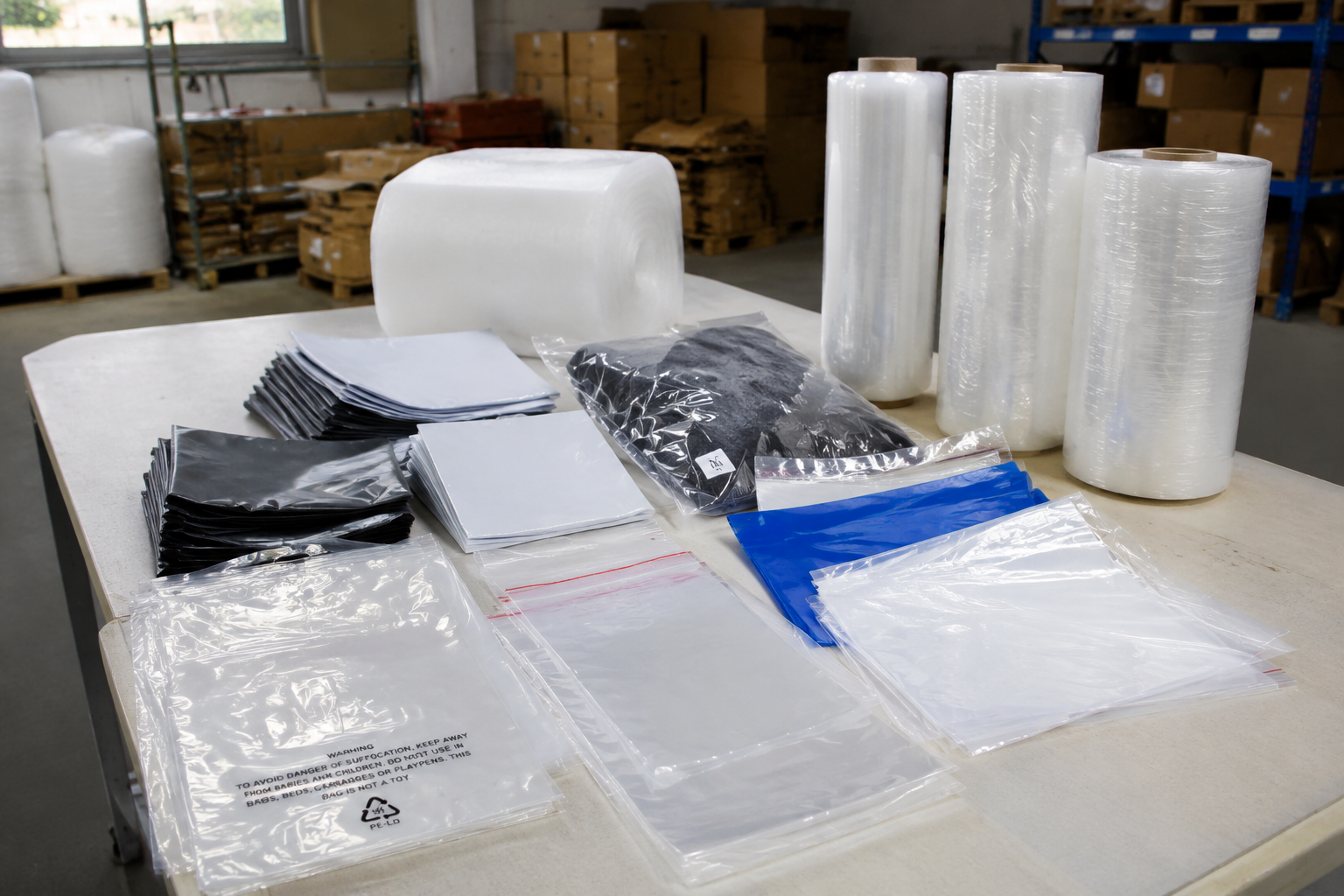
Plastic bags and film packaging are useful only when the specification matches the job: inner protection, product organization, parcel shipping, carton lining, or pallet...
Read cornerstone guide
EPE Foam Packaging Guide: Rolls, Sheets, Bags, Inserts, and Custom Cushioning Solutions
EPE foam packaging is often chosen when products need more than simple void fill. The real decision is how much cushioning, surface protection, spacing,...
Read cornerstone guide
Bubble Wrap and Air Cushion Packaging Guide: Rolls, Sheets, Bags, Air Columns, and Air Pillow Film
If you are deciding between bubble wrap and air cushion packaging, the real question is not which material is better in general, but which...
Read cornerstone guide
Corrugated Boxes Guide: Custom, Postal, Zipper, Moving, and Printed Shipping Boxes
Choosing corrugated boxes is not only a question of carton size or unit price. The right box depends on what is being packed, how...
Read cornerstone guide