 By Chunjie Zheng, Technical Director, YK Door Industry · 17 years in fire door engineering · Technically reviewed by Yulin Zhang, General Manager
The short answer: To read a fire door test report, start with what was tested, not the result. Check the specimen description (size, leaf, frame, hardware, glass, seals), the test standard and the exposed side, then the result in minutes. Finally read the field of direct application: only doors inside those limits are covered without a separate classification or extended application. A difference needs documented coverage.
Picture a consultant who receives a 40-page PDF from a supplier with a cover sheet that says “EI2 90.” The project needs 90-minute doors, so the box is ticked. Months later, at shop drawing review, it turns out the report covered a single leaf 1,000 mm wide with a mortise lock, while the project has pairs 1,800 mm wide with exit devices and vision panels. The report was genuine; it simply described a different door. Reading a fire test report well means reading it in the order of risk, starting with the specimen, because the result only means something for the door that was in the furnace.
Test report or classification report?
Two documents often arrive together and are easily confused. A test report records what happened in the laboratory: the specimen, the conditions, the observations and the times at which criteria were met or failed. It contains raw data. A classification report expresses those results in a standard form under EN 13501-2, which covers classification from fire resistance and smoke control test data and includes classification based on extended application of test results [3]. One fire classification guide describes the classification report as the document that uses a uniform and standardized structure to express fire performance in a way non-experts can understand [2].
The classification report is what specifiers usually quote, but it is not a certificate. An ift Rosenheim classification report states that it does not represent type approval or certification of the product [1]. In Europe, certification comes from the notified body under the construction products regulation, a separate step. To see where each of these documents sits in the wider question of what door paperwork proves, see our guide on how to verify a door test report.
How to read a fire door test report, page by page
Most fire door test reports follow the same structure, so it helps to read them in a fixed order. The front pages identify the laboratory, the sponsor and the date, and the test standard and edition. The specimen description follows, usually with drawings: leaf construction, core, frame profile and fixing, hinges, locks, closers, glazing, seals and gaps, and the supporting wall. Next come the test conditions, including which face was exposed to the fire. The observations record events minute by minute, and the results give the times reached for integrity (E), insulation (I) and, where measured, radiation (W) [1].
The final section matters as much as the result. Under the EN system, the test standard sets a field of direct application, a short list of variations that are covered without further assessment. Anything beyond it requires a classification based on extended application under the EN 15269 series, which sets general principles for extending results from fire-resisting and smoke-control doorsets [5].
The specimen description is the contract
The specimen description is the part of the report that the project door must match. Width and height of the leaf, single or pair, swing direction relative to the fire, hardware types and positions, glass size and type, frame material and fixing, and the wall the door was installed in all affect the result. A test result on its own applies only to the sample that was tested [4], so each difference between the specimen and the project door is a question to answer with direct application rules, an extended application or a new test.
Two details catch buyers most often. The first is the exposed side. The classification and its field of application state which exposure direction is covered; a door that must resist fire from either side needs evidence for both, through the applicable rules or a further test. The second is the supporting construction. A door tested in a masonry wall is not automatically covered in a lightweight partition, so the wall type on the project should be compared with the test.
From the factory floor
Buyers most often overlook three specimen details: the specimen size, the leaf thickness and the hardware list. We add a one-page scope sheet in front of each report that states the specimen size, the permitted substitutions and how anything outside them is handled.Chunjie Zheng, Technical Director
Red flags
Some features of a report deserve a second look. An old edition of the test standard may not be accepted on current projects. Missing drawings make the specimen impossible to compare. A sponsor that is not the supplier means the supplier must show it has the right to use the report and builds the same product. Summaries, translations or extracts without the full original should be followed by a request for the complete report. Scope statements that seem to stretch far beyond the specimen should be traced back to an extended application report.
How we present our reports
We send reports with the information needed to compare them with the project. Our FD90 door is tested to EN 1634-1 as YK-S90, reaching EI2 90 with 93 minutes of integrity and 91 minutes of insulation. Our YK-S60-CE door is CE marked under EN 16034 with the classification EI2 60-C5 + Sa, DoP issued under AVCP System 1. Each submittal includes a model-by-model evidence index that lists, for each door type, the report, the specimen it covers and how the project door relates to it, using our four evidence levels of designed, tested, certified and project-accepted. More on the European testing route is on our page about EN 1634-1 fire door testing.
Direct application: what the report already allows
A fire test report applies first of all to the specimen tested. European test standards add a short list of variations that are allowed without further assessment, known as the field of direct application, such as limited reductions in size or minor changes stated in the test standard. Anything beyond that list needs an extended application assessment under the EN 15269 series, which sets out the rules for extending results for fire resistance and smoke control [5]. When you read a report, look for the section on direct application; it tells you how far the result can travel without another document.
A worked example: a single leaf report, a pair on the schedule
A supplier sends a report for a single steel leaf, 1,000 × 2,200 mm, tested to EN 1634-1 and classified EI2 60. Your schedule calls for a pair, 2,000 × 2,200 mm, with a vision panel. Read the specimen description: one leaf, no glass, a named lock and three hinges. Nothing in that report covers a pair, a meeting stile, an astragal or a vision panel. Direct application will not add a second leaf.
The supplier now needs one of three things: a separate report for a pair of the same construction, an extended application report that covers pairs and glazing, or a new test. If the supplier answers that “it is the same door,” the answer is not evidence. A classification report built on an extended application will state the extended field in its own text [1].
Test reports in the US system
In the United States, test reports for fire doors are rarely reviewed directly by inspectors. The building code and NFPA 80 rely on the listing and the label, and the test report sits behind the listing at the certification agency. Industry bodies stress that a door is a fire door because it has been tested and its production is controlled, not because a single report exists [4]. Where labels are missing or doors need evaluation in the field, specialist agencies carry out field evaluations against the listing, as described in industry white papers on fire door field evaluation [6]. A US buyer should therefore ask for the listing first and treat the report as background.
Mistakes when reading reports
The commonest mistake is reading the result on the first page and skipping the specimen description. The second is overlooking the exposed side: a door tested from one side only may need evidence for the other side if the fire can come from either. The third is ignoring the test date and standard edition, which matter when standards are revised. The fourth is accepting a summary letter or certificate of test instead of the full report. Keep the report’s scope pages together with the result.
Frequently asked questions
How long is a fire door test report?
A full EN 1634-1 report often runs to dozens of pages, with drawings, photographs and temperature data. A two-page summary is not a substitute.
Can I use a report from another manufacturer?
Only where the rights to use it, the manufacturing arrangement and the supplied configuration are documented and accepted under the relevant scheme. A report describes a specimen made by a named sponsor with stated components.
What is the exposed side?
It is the face of the door that faced the furnace. Many classifications are stated for one or both sides; check that the classification covers the direction of fire your plan assumes.
Does a report cover hardware changes?
Only the hardware described in the specimen, plus any variations allowed by direct or extended application. A different closer or lock needs evidence.
Is a classification report enough on its own?
It states the class and refers to the test and any extended application. For CE-marked doors, the Declaration of Performance and the notified body certificate add the production control.
Thermocouples, deflection and the numbers inside the report
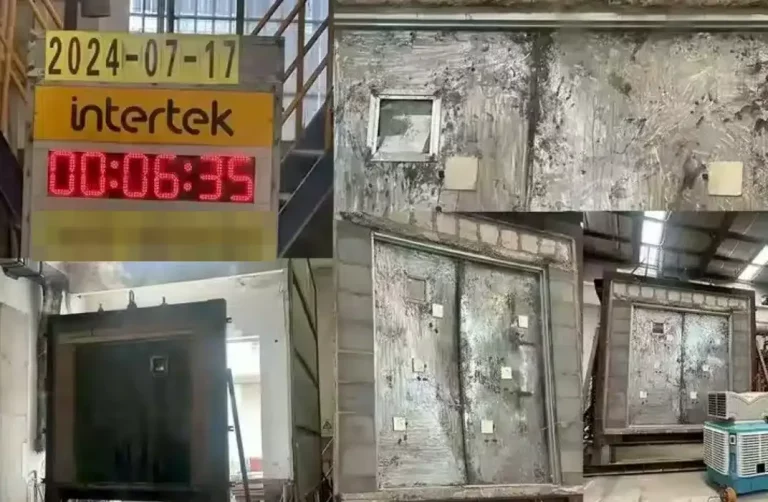
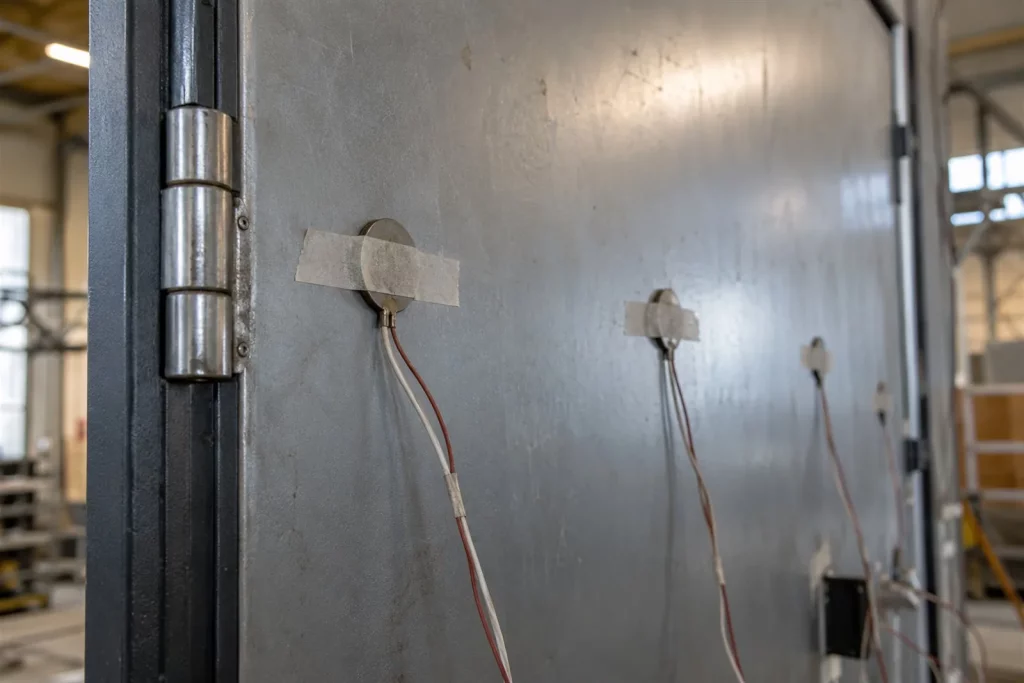
Behind the classification are measured data. The report records furnace temperatures, unexposed-face temperatures from thermocouples on the leaf and frame, deflection of the leaf during the test, gap measurements and observations such as flaming or cotton pad ignition. Integrity is judged by gaps, flaming and the cotton pad; insulation is judged by temperature rise on the unexposed face [3]. A door that achieved integrity for 93 minutes and insulation for 91 minutes, for example, is classified EI2 90, the class being the lower of the two rounded down to the class periods.
These numbers matter when the door changes. Deflection data show how much margin the leaf had at the latch and hinge edges, which is one of the inputs an assessor uses when judging a larger size. Temperatures near the frame show whether a different wall type might change the result. Judge changes through the formal field of application or an authorized assessment rather than from the plotted margin; a document that omits this data is a summary rather than the full report.
What to ask for with every report
When a supplier sends a fire test report, ask for four things with it, adjusted for the route (a listed product starts from its listing): the full report including drawings and photographs, the classification report that cites it, any extended application report that the classification relies on, and a short statement mapping each door on your schedule to the specimen or to the extended field. The last item is the one most suppliers do not offer unprompted, and it is the one that saves the most review time. It turns a pile of documents into an answer to the only question that matters: is this door covered?
Compare the specimen with one door of each type on your schedule
Before accepting a report, compare the specimen with one representative door of each type on your schedule, and list every difference. For each difference, ask whether it falls within direct application, needs an extended application, or needs a new test; fire door extended application explains the second option. If the report comes from a laboratory you do not know, check its accreditation using test lab accreditation, and if the supplier’s documents use words such as “certified” loosely, see listed, tested to or certified.
Sources
- ift Rosenheim, example classification report on extended application, 23-002804-PR01 (published by AGC Pyrobel). https://agc-pyrobel.com/nl-nl/product-selector/dac672c6332502adf413135f56a8389b10461fc1/download/Ift_clas%20on%20EXAP_23-002804-PR01_EN.pdf
- Siniat, What is Fire Classification? https://siniat.helpjuice.com/fire/1767362-what-is-fire-classification
- Genorma, EN 13501-2:2023 standard record (scope). https://genorma.com/en/standards/en-13501-2-2023/amp
- British Woodworking Federation Fire Door Alliance, Question of the week: Do I have to have doors tested to call them fire doors? https://firedoors.bwf.org.uk/uncategorised/question-of-the-week-do-i-have-to-have-doors-tested-to-call-them-fire-doors-and-what-affects-their-certification/
- Estonian Centre for Standardisation, EN 15269-1:2019, Extended application of test results for fire resistance and/or smoke control, Part 1: General requirements (scope). https://www.evs.ee/en/evs-en-15269-1-2019
- QAI Laboratories, Fire door field evaluation white paper (November 2021). https://qai.org/wp-content/uploads/2021/12/FD-FEB-White-Paper-111621.pdf